Burgstall Saufelsen: A Medieval Castle Site in Germany
Site at a Glance
- Rating
- 4
- Popularity
- Very Low
- Country
- Germany
- Primary era
- Medieval
- Eras represented
- Medieval
- Civilizations
- Holy Roman Empire
- Site type
- Military
- Remains
- Castle
On this page8 sections
History
Burgstall Saufelsen is a former high-medieval noble castle site in Germany, above Unteremmendorf in the municipality of Kinding, Bavaria. Probably established during the twelfth century, it was a small single-part hilltop castle held by ministeriales, a medieval service nobility whose members performed administrative or military duties for lords.
The Emmendorfer family
The builder and precise date of construction are unknown. The castle was probably founded by the Emmendorfer ministerial family, which was first recorded in 1119 as serving the Prince-Bishopric of Eichstätt. This was an ecclesiastical principality in which the bishop exercised both religious and territorial authority.
Burgstall Saufelsen formed part of a group of castle sites associated with the family. Burgstall Torfelsen and Burgstall Hubertusfelsen, located nearby, were probably also held by the Emmendorfers. Since the family used several coats of arms, the three castles may have belonged to different branches of the family.
Abandonment and protection
The castles were probably abandoned after the Emmendorfer family died out after 1506. Burgstall Saufelsen is now recorded by the Bavarian State Office for Monument Protection as a medieval castle site and is protected as an archaeological monument under designation number D-1-7034-0153.
Remains
Hilltop setting and defenses
Castle plateau
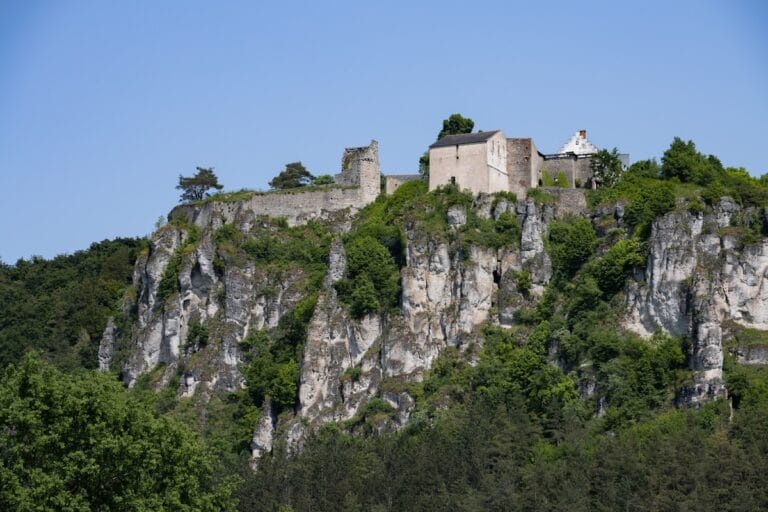
The castle stood at 492.4 metres above sea level on a rocky plateau projecting north from the southern edge of the middle Altmühl Valley. The spur forms part of the Kühberg and lies about 100 metres above the valley, a few metres below the surrounding upland. The plateau falls several metres vertically to the north and east before continuing as a steep slope toward the valley floor.
The castle proper occupied a slightly raised rocky head measuring about 22 metres from north to south and 17 metres from east to west. A ring ditch in a U-shaped form protected the southern side. At the eastern end, a transverse bank indicates that a wall closed the ditch there. Foundation remains along the eastern edge of the plateau probably belonged to the castle’s curtain wall.
Outer and ring ditches
The gentle rise toward the Kühberg made a broad, deep ditch necessary on the southern side. About 60 metres in front of the main ditch, an additional ditch followed a slightly curved line from the western slope edge toward the east. It ended at a small dry spring basin and probably also helped secure this water source. An outer bank accompanied the ditch.
Surviving fabric
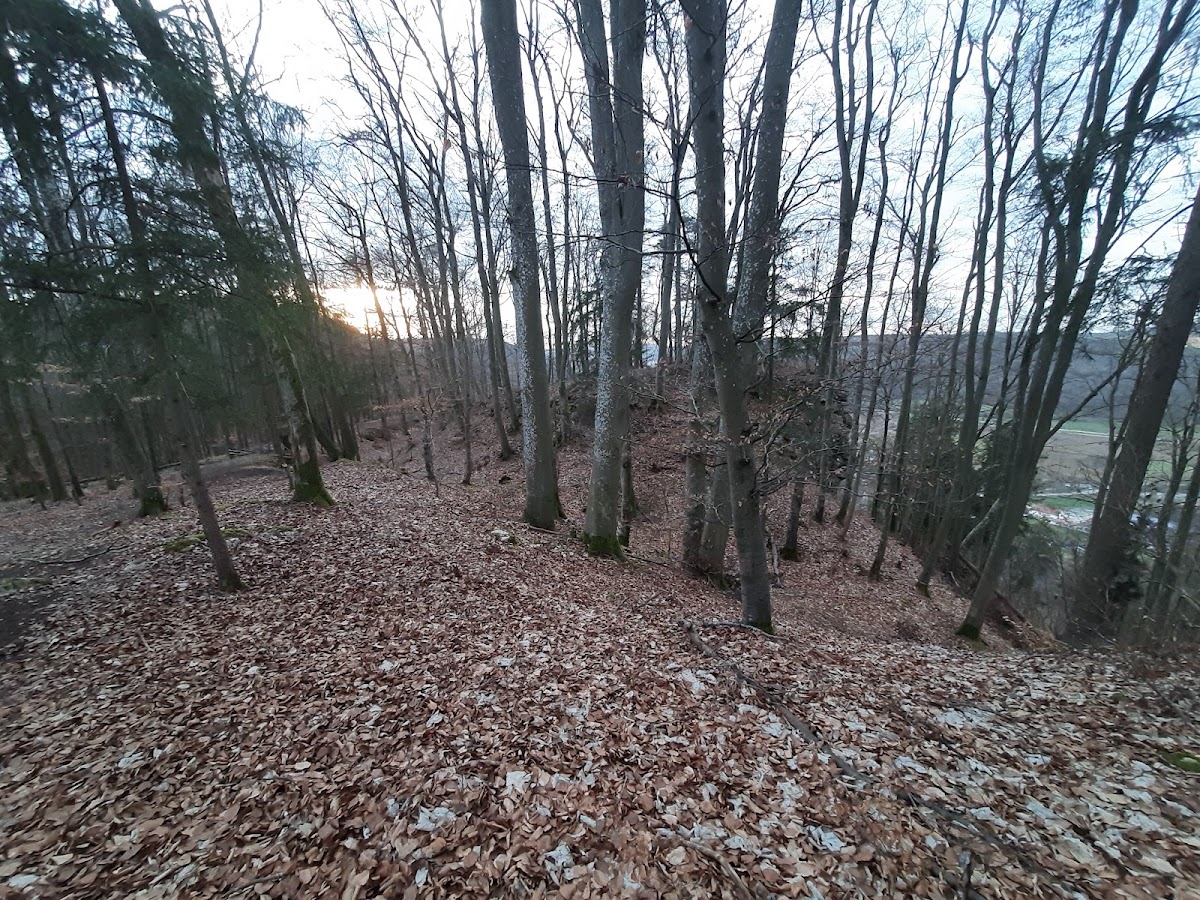
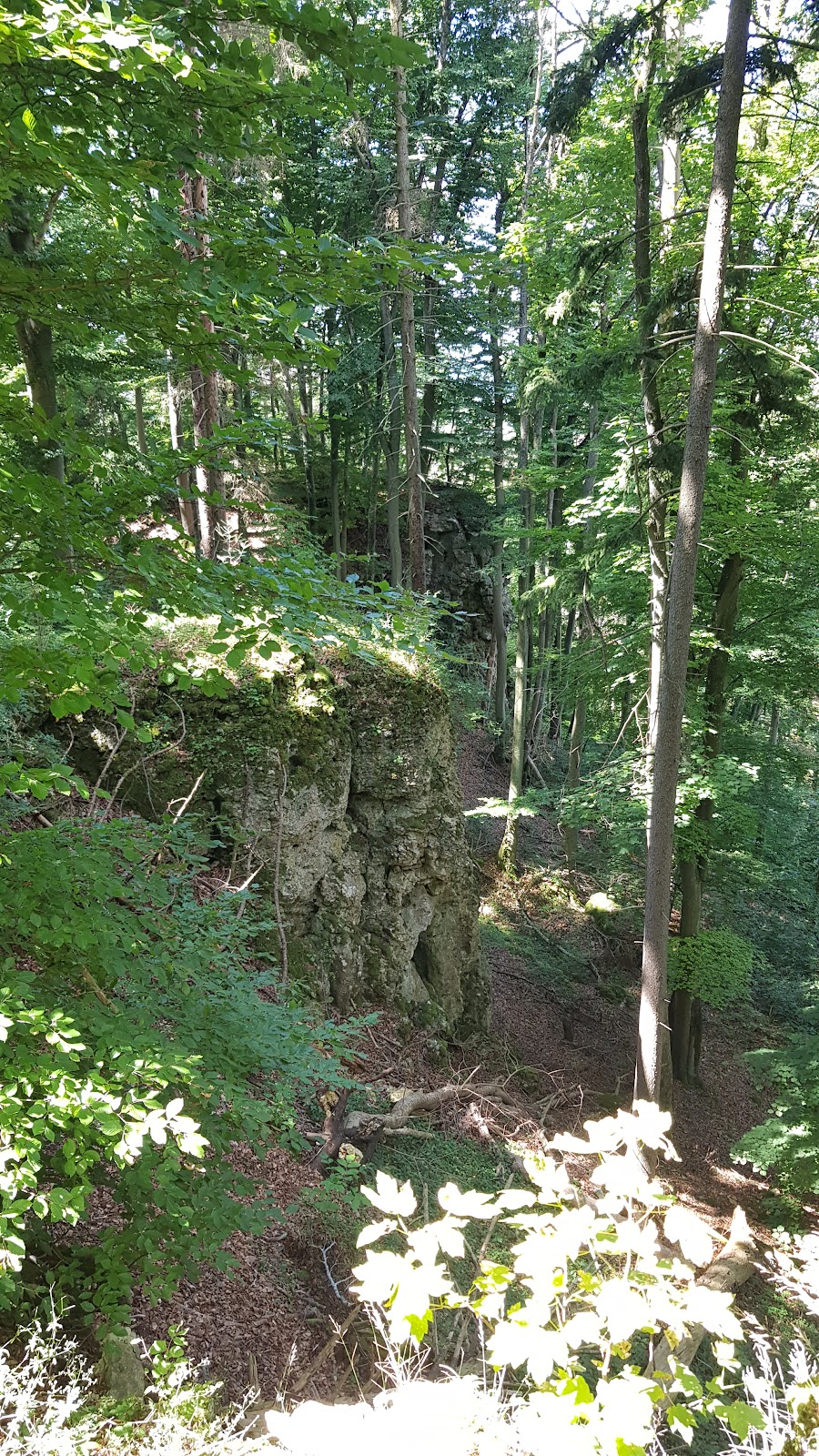
Dense woodland covers the site. The surviving physical evidence consists mainly of the U-shaped ring ditch, the additional ditch, the outer bank, and slight masonry remains above ground. Former building traces are only faintly visible, while the foundation remains at the eastern plateau edge preserve evidence of the castle’s enclosing wall. As a Burgstall, Burgstall Saufelsen is a former castle site where little substantial structure remains above ground.
Nearby sites