Eschenbach Castle: A Medieval Water Castle in Germany
Site at a Glance
- Rating
- 3.8
- Popularity
- Very Low
- Country
- Germany
- Primary era
- Early Modern
- Eras represented
- Medieval, Early Modern, Modern
- Civilizations
- Holy Roman Empire
- Site type
- Military
- Remains
- Castle
On this page12 sections
History
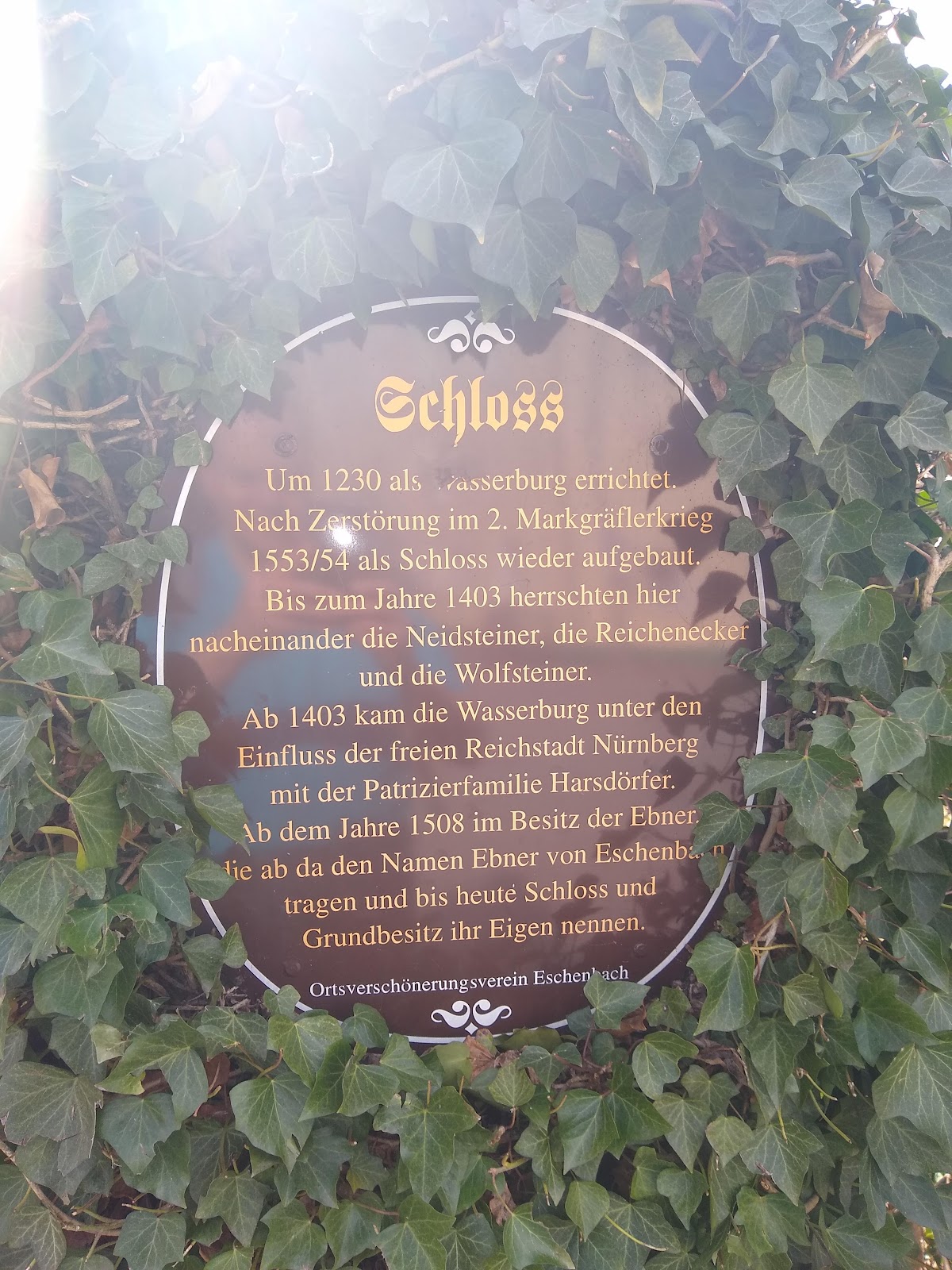
Eschenbach Castle is a Gothic water castle in Germany, built in 1230 at Eschenbach in the municipality of Pommelsbrunn. In the thirteenth century, the surrounding territory belonged to the Reichsministerial families of Hartenstein and Neidstein. Reichsministerials were medieval officials who served secular or ecclesiastical lords in administrative and military roles. The area remained subject to the feudal rights of the Bamberg bishopric, an ecclesiastical principality ruled by the prince-bishop of Bamberg, until the end of the Holy Roman Empire in 1802.
Ministerial possession and feudal change
The castle was occupied by ministerials, initially the Lords of Eschenbach, also known as Eschenbecken, from 1230 or 1238. After the Hartenstein and Neidstein families died out, Eschenbach came under the suzerainty of the Schenk family of Reicheneck in 1324. After 1330, the castle was held by the ministerial family Türriegel of Riegelstein.
In 1367, Dietrich Türriegel sold the house of Eschenbach, together with its other fiefs, to Hermann Erlbeck. Erlbeck then surrendered the holding to his feudal lord, Walter III Schenk of Reicheneck. Ulrich of Reicheneck lived at Eschenbach with his brother-in-law Stephan of Wolfstein in 1382, apparently after the Reicheneck family had taken over the right of use from the Erlbecks. After Ulrich died before 1389, the castle passed to his widow, Margarethe of Wolfstein.
Transfer to Nuremberg authority
In 1403, Hans, Wolf, and Wygleis of Wolfstein sold their residence at Eschenbach, together with its goods and rights, to the Nuremberg mining entrepreneur Heinrich Harsdörffer and his wife, Margarethe. The water castle thereby came under the authority of the Free Imperial City of Nuremberg. Such a city was directly subordinate to the Holy Roman Emperor rather than to a territorial prince.
Harsdörffer rule ended with the death of Hans Harsdorffer in 1511. He had divided the castle and its associated estates among his daughters Katharina, Ursula, and Anna. Through his marriage to Ursula on 17 January 1508, Hanns III Ebner, who lived from 1482 to 1552, acquired a share in the property. In 1528, he purchased a second third from Ursula’s elder sister Katharina, while Anna’s share passed to the Volckamer family.
Destruction and rebuilding
During the Second Margrave War, a conflict in the 1550s in which Albrecht Alcibiades of Brandenburg-Kulmbach attacked territories and cities in Franconia, mercenaries serving the margrave destroyed Eschenbach Castle on 4 July 1552. The attack followed Hans III Ebner’s refusal to pay the punitive levy demanded by Albrecht Alcibiades. Hans IV Ebner rebuilt the castle in its present form in 1554.
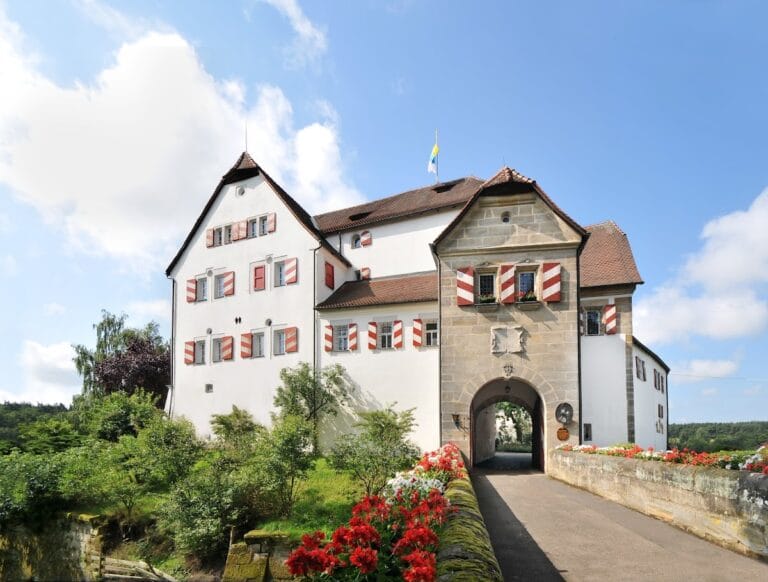
The rebuilding established much of the form that survives today. A new three-storey wing was added at the northeastern corner in 1554 and 1555, and the service buildings in the outer bailey, the part of a castle complex outside the principal residential stronghold, were completed in 1559.
Ebner ownership and later changes
Except for an interruption between 1667 and 1676, Eschenbach Castle has belonged to the Ebner family since 1508. Maria Helena Ebner, née Fürer, and Margarete Ebner sold the property to Johann Friedrich von Wimpffen. He later overextended himself financially and embezzled municipal funds while serving as a city revenue official. He was imprisoned in 1668 and died there that year. The Council of Nuremberg placed the castle under compulsory administration, and the Ebner family bought it back in 1676 for 12,000 gulden.
The moat was filled between 1736 and 1740. Around 1830, the outer defensive enclosure was removed except for its western round tower, which was restored in 1863. The pointed-helmet tower dates from 1885. An engraving from 1725 depicts Eschenbach Castle as it was originally built and includes the alliance arms of the Ebner and Harsdörffer families. An alliance coat of arms combines the arms of two families, often to mark a marriage or dynastic connection. The castle is protected as both an architectural monument and an archaeological monument, with the latter designation identifying the site as a medieval water castle and an early-modern moated castle.
Remains
Setting and castle buildings
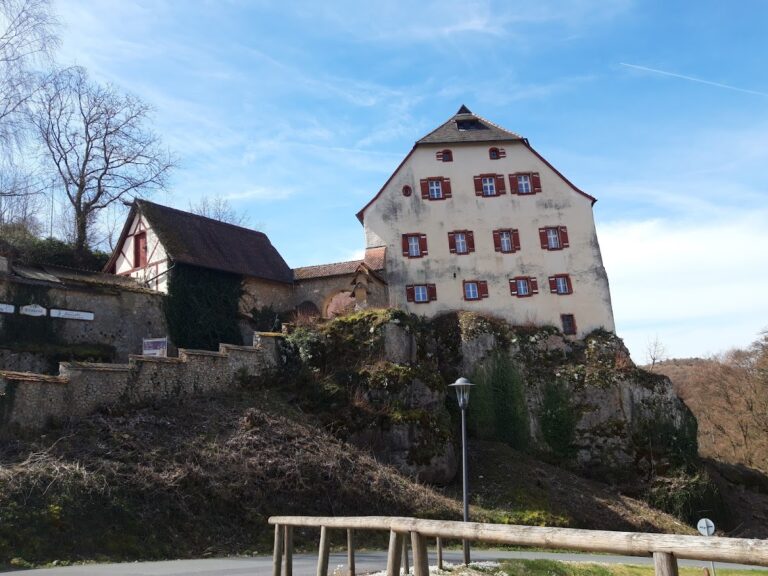
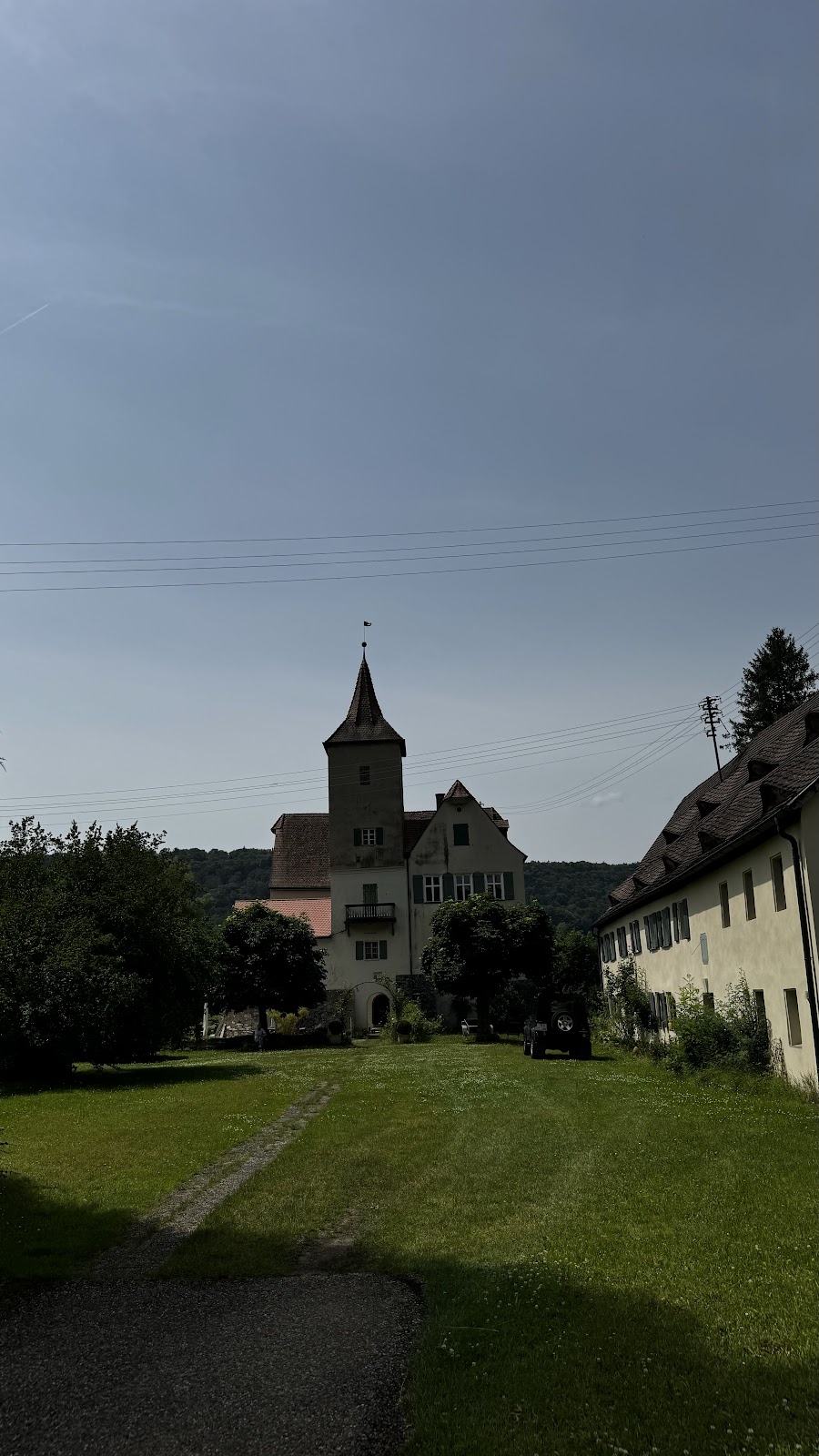
The former water castle is bounded by the Hirschbach on its southeastern side and the Pegnitz on its southwestern side. Its surviving arrangement largely reflects the rebuilding carried out after the destruction of 1552, combining the principal residential building, a later northeastern wing, service buildings, and parts of the defensive enclosure.
Principal building
The principal building is a three-storey palas, the main residential and representative building of a medieval castle. Masonry on the ground floor of its main range may date to the thirteenth century, linking the surviving structure with the castle founded in 1230. A wall walk, a passage along the top of a defensive wall, runs along the southern side of the inner courtyard.
Northeastern wing and service buildings
A three-storey wing occupies the northeastern corner of the castle complex. It was constructed in 1554 and 1555 during the rebuilding after the Margrave War. The service buildings in the outer bailey were completed in 1559, adding the working and supporting structures outside the principal residential range.
Defensive remains and interiors
Outer enclosure and western tower
The outer defensive enclosure was largely removed around 1830. One of its four round towers survives on the western side. Known as the Fuchsen Tower, it was restored in 1863 and had previously served as a prison. The pointed-helmet tower now associated with the castle dates from 1885. The former moat, which surrounded the water castle, was filled between 1736 and 1740.
Ancestral hall
An ancestral hall created around 1730 contains a collection of oil portraits of members of the Ebner family. The room preserves a later phase of the castle’s interior history and reflects the family’s long association with the property.