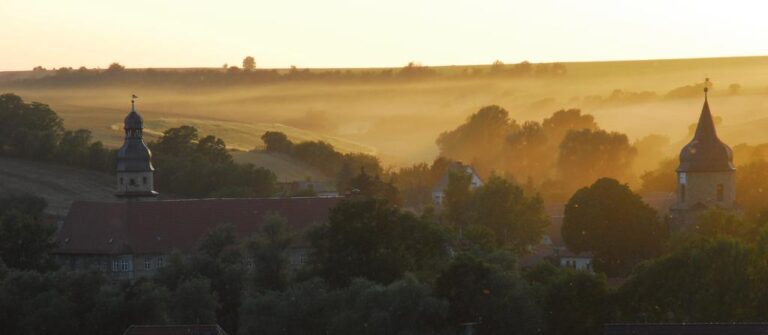
Schraplau Castle (Burg Schraplau): A Medieval Castle Ruin in Germany
Site at a Glance
- Rating
- 3
- Popularity
- Very Low
- Country
- Germany
- Primary era
- Medieval
- Eras represented
- Medieval, Early Modern
- Civilizations
- Holy Roman Empire
- Site type
- Military
- Remains
- Castle
On this page9 sections
History
Schraplau Castle is a medieval castle ruin in Schraplau, Germany, whose Romanesque castle was established around 1200 within an earlier fortified settlement. The settlement appears in the Hersfeld Tithe Register, a medieval record of communities and their obligations to the imperial abbey of Hersfeld, at approximately 845 as “Scrabanloh,” a name interpreted as meaning roughly “scrub forest.” A castle list from approximately 881 names “Scrabenlebaburg,” indicating that a fortified site existed by that time.
Early fortified settlement
The first fortification was probably created between 845 and 881 as a ring-wall and ditch complex on the initiative of King Louis the German or his sons. It was held by the crown and was recorded by 979 as a fortified settlement called “Scroppenlevaburch.” The Altenburg, the earlier fortified area, was laid out and expanded during the ninth and tenth centuries. Finds associated with Slavic settlement have been recovered there, and Sorbian settlers west of the Saale were connected with Frankish settlement policy.
The early stronghold was a large fortified settlement rather than simply a residence-sized aristocratic castle. It occupied a substantial area protected by an earth rampart, dry-stone walls, and ditches. Excavations identified two dry-stone walls built at different times, showing that the defenses were destroyed and rebuilt during the settlement’s period of use. Their construction represents a change from defenses based primarily on earthworks to the use of stone.
The lords of Schraplau and Magdeburg
During the tenth and eleventh centuries, the castle was held by the nobles of Schraplau, who possessed immediate imperial status, meaning that they stood directly under the authority of the emperor. They were probably related to the noble lords of Querfurt. Thimo von Schraplau is regarded as the family ancestor, while Egeloff von Schraplau appears in written records. Egeloff’s death in 1196 brought the family line to an end.
The castle of the lords of Schraplau probably occupied only a relatively small part of the earlier fortified settlement. It may already have stood where the later archbishopric castle was built. Around 1200, the Archbishopric of Magdeburg, a major ecclesiastical territory governed by an archbishop, became the feudal lord and established a Romanesque castle in the western part of the Altenburg. A fief was land or an office granted by a higher lord in return for allegiance and service. The fief was granted to the burgraves of Magdeburg from the Querfurt family, who appointed stewards to administer the lordship.
Rudolf von Schrapelo appears in 1242 as a knight and vassal of the burgrave. From 1267, Burchard I von Schraplau, a member of a collateral branch of the Querfurt nobles, lived in the castle. Burchard II von Schraplau, known as “the Lapp,” also used the title burgrave of Schraplau. During the thirteenth century, the family’s close relationships with the Querfurt nobles and the archbishopric helped their lordship expand. Their possessions came to include the lordship of Nebra, estates near Röblingen am See, valley estates at Halle, and part of the lordship of Querfurt.
Burchard III von Schraplau became Archbishop of Magdeburg in 1307. He sought to strengthen the archbishopric and recover rights that had been lost, but in 1325 he was captured and killed during a feud against the allied cities of Halle and Magdeburg. The conflicts left him heavily indebted. His heirs sold the lordship of Schraplau to the counts of Mansfeld in 1335, and the lords of Schraplau withdrew to their fief at Wettin.
Mansfeld rule and destruction
Schraplau Castle belonged to different branches of the counts of Mansfeld during the fourteenth and fifteenth centuries. Ernst and Albrecht von Mansfeld repaired the medieval castle in 1484. Following an inheritance division in 1501, the lordship was divided into two offices, and Count Gebhard von Mansfeld-Mittelort received the upper office, including the castle.
Imperial troops captured and devastated the castle in 1547 during the Schmalkaldic War, the conflict of 1546–1547 between the Protestant Schmalkaldic League and the forces of Emperor Charles V. Under Count Christoph I von Mansfeld-Mittelort, a palace-like new building was erected at the residence between 1574 and 1591. The castle was still described in 1571 as “very desolate in itself,” indicating the poor condition of the medieval complex before this later rebuilding.
After the Schraplau branch of the Mansfeld family died out, the lordship passed to the counts of Mansfeld-Hinterort. In 1637, Count Johann Georg von Mansfeld-Vorderort moved his residence to the castle. Countess Barbara Magdalene sold the upper office of Schraplau to the lords of Hake in 1683 and became the last member of the Mansfeld family to leave the castle.
The castle’s decline accelerated during the eighteenth century. In 1713, the official Sylvester Brachvogel removed the cap from the keep, the principal fortified tower of a castle. A Prussian garrison of 22 men is recorded in 1730, although the complex was already in poor structural condition. Its use as an archive and courtroom was last recorded in 1732. By 1736, the ruins were being used as a quarry, and the complex subsequently deteriorated further.
Remains
Fortified settlement and castle
The Altenburg defenses
The surviving archaeological picture begins with the Altenburg, a large fortified area on the hill within the settlement. Its defenses consisted of a high earth rampart, a dry-stone wall built without mortar, and a forward ditch. Later expansion added further forward ditches. Excavations revealed two dry-stone walls from different construction phases, with their sequence indicating destruction and rebuilding while the stronghold remained in use.
The Romanesque castle
The Romanesque castle established around 1200 occupied the western part of the earlier fortified area. Its remains survive in ruinous form and represent the later medieval castle that served the archbishopric of Magdeburg and its feudal holders. The castle’s position within the larger Altenburg reflects the development of a residence-sized noble and administrative stronghold inside an earlier fortified settlement.
Surviving structures
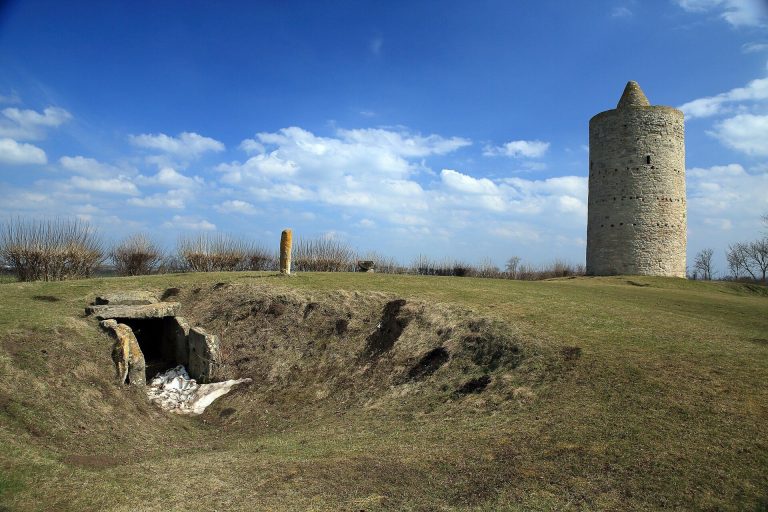
Schraplau Castle now consists of limited wall remains and a cellar passage distributed across several privately owned properties. A surviving section of the inner ring wall includes a flanking tower. The visible exterior walls form a small part of the former complex, while the division of the ruins among private properties limits the extent of the castle that can be seen today.