Caergwrle Castle: A Welsh Border Fortress


Site at a Glance
- Rating
- 4.4
- Popularity
- Low
- Country
- United Kingdom
- Primary era
- Medieval
- External website
- Open
- Eras represented
- Medieval
- Civilizations
- English, Welsh
- Site type
- Military
- Remains
- Castle
On this page9 sections
History
Caergwrle Castle is a late thirteenth-century Welsh castle in the United Kingdom, built by the prince Dafydd ap Gruffydd after Edward I of England granted him the lordship of Hope in 1277. It was the last castle built by a Welsh ruler before Wales lost its independence, and its history reflects the struggle between Welsh princes and the English Crown along the border.
Foundation under Dafydd ap Gruffydd
Dafydd had previously fought against his brother Llywelyn the Great, who had imprisoned him over inherited land rights. Edward I intervened, placing territories formerly controlled by Llywelyn under English authority and granting Dafydd the lordship of Hope as a reward for service to the Crown during the wars against Welsh forces. Construction at Caergwrle began in 1277, although another chronology places the building work between 1278 and 1282. The castle appears to have remained unfinished when Dafydd rebelled against Edward.
The first recorded reference to Caergwrle occurs in the Royal Wardrobe rolls, which state that Edward sent Dafydd 100 marks on 12 November 1278. The payment may have supported the beginning of construction, or it may have been intended for the maintenance of a building that already existed. This uncertainty reflects the difficulty of distinguishing the castle’s earliest building phase from its later development.
Rebellion and English repair
Caergwrle probably served as Dafydd’s base for an attack on the English garrison at Hawarden Castle, an action associated with the opening of Edward’s second campaign in Wales. In June 1282, Edward sent Reginald de Grey, 1st Baron Grey de Wilton, to seize the castle. When Grey’s forces arrived on 16 June, Dafydd had already withdrawn. The Welsh had damaged the defenses and blocked the well before abandoning the site.
Reginald de Grey then directed repairs over the following fourteen weeks. Between June and November, the work employed more than 340 carpenters, over 600 diggers, and between 30 and 35 stonemasons each week. The project cost £1,466 4 shillings 5½ pence. Edward I may have visited before 6 July to give instructions to the architect James of Saint George.
Royal ownership, destruction, and decline
In February 1283, Edward granted Caergwrle to his wife, Eleanor of Castile, queen consort of Edward I. A settlement for English settlers was planned at the foot of the castle, and Eleanor received permission for a weekly market there on 25 June 1283. The plan ended after an accidental fire broke out at the castle on 27 August while Edward and Eleanor were present.
After the fire, the damaged castle passed to Edward of Caernarfon, later Edward II, who did not repair it. It was subsequently granted to John of Cromwell for life on the condition that he restore the building, although the extent of this work is uncertain. One chronology places Cromwell’s acquisition in 1308 and records another destructive fire, followed by abandonment in 1335.
The castle later passed to Edward, the Black Prince, eldest son and heir of Edward III. He described its walls and towers as ruined and noted that no housing remained. Even in this condition, Caergwrle was still regarded as strategically important for protecting the Welsh-English border during the rebellion led by Owain Glyndwr in 1405.
Excavation and care
The ruins were excavated in three phases between 1988 and 1990, with the work concentrating on the interior and the three surviving towers. Cadw, the Welsh Government’s historic-environment service, now cares for the site. Caergwrle Castle is a Grade I listed structure, a designation for buildings and monuments of exceptional architectural or historic interest. Since 2024, Cadw has used the Welsh name Castell Caergwrle in English as part of a bilingual naming standardization effort.
Remains
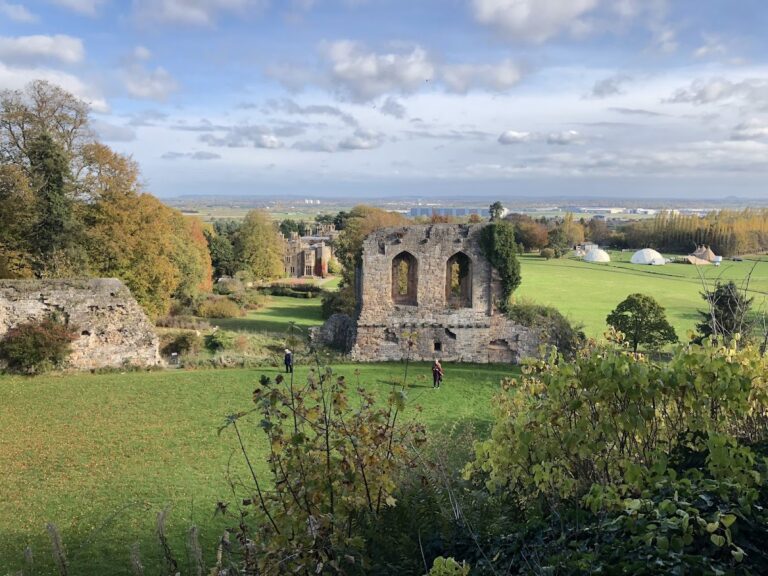
Caergwrle Castle occupies the south-west corner and highest point of a steep hill near the Anglo-Welsh border, with views extending far into Cheshire. Its foundations use gritstone quarried locally from Caergwrle Hill to the north-west. The surviving layout includes an inner curtain wall, a defensive wall enclosing the fortified area, together with the remains of towers positioned around the hilltop defenses.
Defensive layout
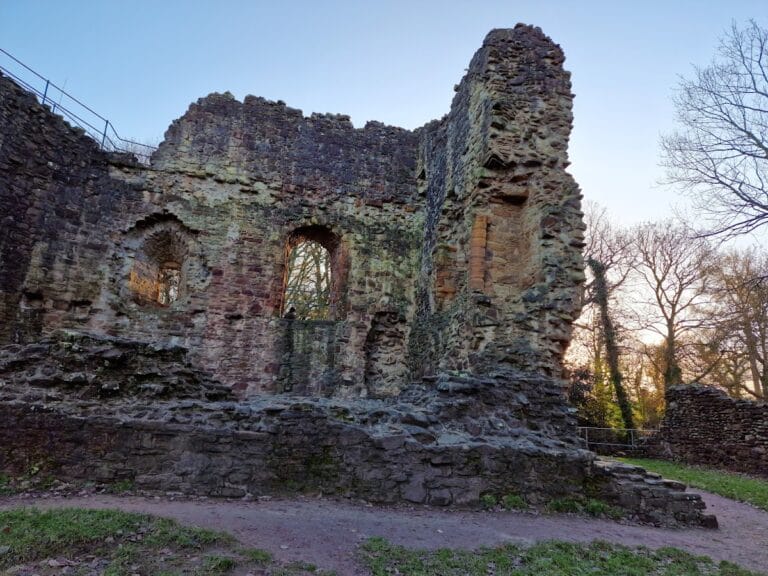
The principal medieval defenses included two D-shaped towers and a great circular keep overlooking the south-eastern approach. A D-shaped tower has a straight inner wall facing the enclosure and a curved outer face projecting toward the exterior. The remains of two such towers survive on the northern and south-eastern sides, while the inner curtain wall preserves part of the castle’s defensive enclosure. The west curtain wall is missing, and only part of the south tower remains.
Building materials and surviving fabric
The masonry displays two distinct styles. The most elaborate work was concentrated around the residential areas and on exterior portions of the castle. Interior walls were originally plastered, concealing the masonry and reducing the need for finely finished internal stonework. Wooden buildings added during the repairs of 1282 included a chapel, a bakehouse, and several offices for clerks.
The crag beneath the south tower has also disappeared, possibly because of quarrying close to the castle. The hilltop was quarried for millstones during the seventeenth century. Stone robbing after the castle’s destruction removed large blocks from individual walls and eliminated wider sections of the structure, probably including the west wall and most of the south tower. Their position on the steep hillside made these sections comparatively easy to dismantle and roll downhill.
Earlier remains and archaeological find
A possible hillfort, dating from either the late Roman or post-Roman period, may have preceded the medieval castle. The site is also associated with the Caergwrle Bowl, a unique Bronze Age vessel discovered in 1823 by a workman digging a drain in fields below the castle. Made from shale, tin, and gold in an unusual combination, the vessel belongs to the prehistoric period when bronze became a major material for tools, weapons, and prestige objects in Britain.