Tokmar Castle: A Cilician Armenian Hilltop Fortress in Türkiye



Site at a Glance
- Rating
- 4.5
- Popularity
- Low
- Country
- Turkey
- Primary era
- Medieval
- Eras represented
- Medieval
- Civilizations
- Kingdom of Cilicia
- Site type
- Military
- Remains
- Castle
On this page7 sections
History
Tokmar Castle is a medieval fortress ruin in Türkiye, built within the tradition of the Armenian Kingdom of Cilicia at the end of the twelfth century in the Crusading period. It stands near Akdere in the Silifke district of Mersin Province and is identified with the names Castellum Novum and, probably, Norpert, meaning “New Castle.” The fortress belongs to a group of Cilician Armenian castles modeled on Yilankale and is the westernmost known example of this type.
The Castle of Norpert
Norpert was probably the castle recorded in 1199 and 1210 as the possession of Sevasdios Heri. In 1210, the Armenian king Leon II transferred the fortress, under the name Castellum Novum, together with the city and citadel of Silifke, to the Knights Hospitaller, also known as the Order of Saint John. This religious-military order maintained fortified establishments and supplied troops during the Crusading period. In return, Leon II received military assistance from 400 knights against the Seljuks and an annual payment.
Silifke Castle was returned to the Armenians in 1226, while the later history of Tokmar Castle remains unknown. The size of Tokmar’s enclosure and the remains of its internal buildings led Hansgerd Hellenkemper and Friedrich Hild to interpret it as an aristocratic castle. In this interpretation, it controlled the territory west of Seleukeia on the Calycadnus, now Silifke, toward the Gulf of Ovacik, now Yeşilovacik.
Later Names and Historical Setting
The castle served as a landmark in the 1490 Rizo portolan, a navigational chart, under the name lo chastel chamandrachi, probably meaning “castle by the harbor.” Richard Kiepert’s map of Asia Minor later marked it as Castle Palaea, suggesting an association with the ancient harbor of Palaiai, about four kilometers east of the fortress. Tokmar thus remained connected in historical geography with the coastal routes and harbor visible from its elevated position.
Remains
Hilltop Setting and Enclosure
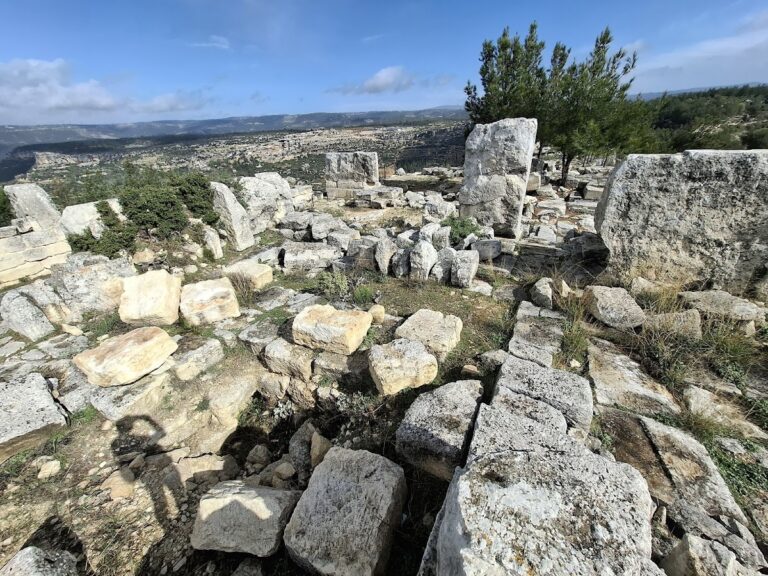
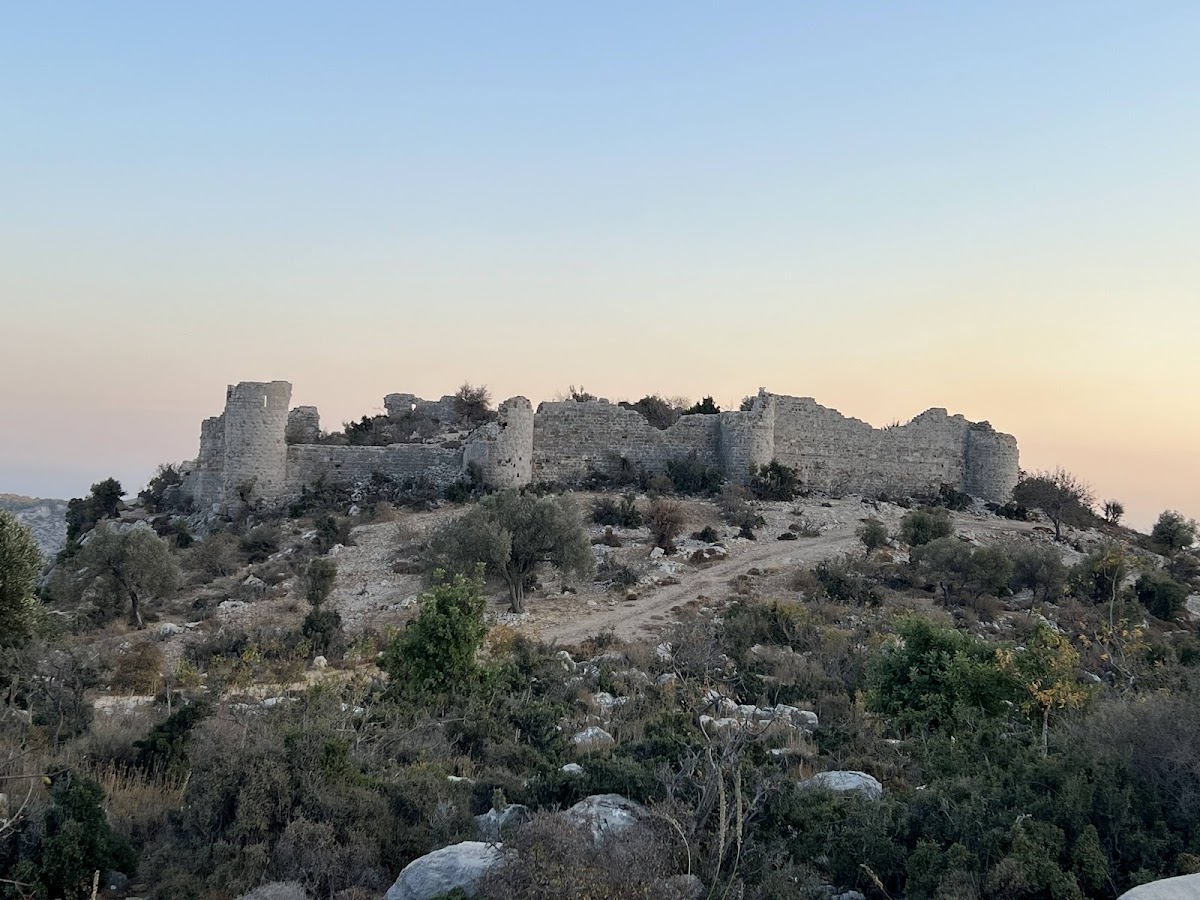
Tokmar Castle occupies a roughly 50-by-70-meter area on a plateau and rocky spur about 380 to 400 meters above sea level, on the southern slopes of the Taurus Mountains. The spur falls steeply toward the southeast, while especially sharp cliffs protect the southern side. The fortress lies approximately three kilometers from the shoreline in a straight line and overlooks the Mediterranean. The ancient harbor of Palaiai was visible from the castle.
A polygonal perimeter wall follows the contours of the terrain. The enclosure’s scale supports its interpretation as a substantial aristocratic stronghold rather than a small isolated watchpoint. The castle survives as a ruin, with extensive losses to both its outer defenses and internal buildings.
Northern Defenses
Four semicircular bastions survive along the northern side, where the ground provided less natural protection. The bastions and the connecting curtain walls were built with two faces of limestone bossage masonry, in which the outer faces of the stone blocks project roughly from the wall surface. The curtain walls are about 1.5 meters thick. Large sections have collapsed or were reused elsewhere.
Simple arrow slits remain in the upper stories of the bastions. Only slight traces of the wall walks survive, while the battlements and parapets have fallen. These remains show how the northern side combined projecting towers with a continuous defensive wall to strengthen the more vulnerable approach.
Eastern Enclosure and Interior
On the eastern side, the foundations of a ramp-like outer defensive enclosure remain. Its former main-gate front and gateway have disappeared, leaving the surviving foundations as the principal evidence of this addition to the defenses.
The southeastern part of the interior contains visible remains of a residential building. Other structures that once occupied the enclosure have been destroyed, and the internal buildings are otherwise largely demolished. The surviving residential remains, together with the broad enclosure and fortified perimeter, contribute to the interpretation of Tokmar as a castle with an aristocratic and territorial role.