Olba: An Ancient City and Episcopal Seat in Türkiye


Site at a Glance
- Rating
- 4.5
- Popularity
- Low
- Country
- Turkey
- Primary era
- Classical
- Eras represented
- Classical
- Civilizations
- Byzantine, Roman
- Site type
- City
On this page13 sections
History
Olba is an ancient city in Türkiye, located in and around the modern settlement of Uzuncaburc north of Silifke in Mersin Province. It stood on a high plateau at the foot of the Taurus Mountains, near a tributary of the Calycadnus, in the mountainous region known in antiquity as Cilicia Aspera. The city was later incorporated into the Roman province of Isauria and became known for its religious and administrative importance.
Origins and Hellenistic rule
Olba, also called Olbe, was known in Turkish as Oura or Ura. Ancient writers used several related forms, including Olbe, Olbasa, and Olbia, while earlier versions may have included Ourba or Orba. A later account used the name Ourbanopolis. Greek mythology attributed the foundation of Olbe to Ajax, a Greek hero and half-brother of Teucer, the famed archer of Trojan War tradition.
The city’s territory included Canytellis, about 30 kilometres to the southwest. In the first century BC, Olba was ruled by the local tyrant Zenophanes and his daughter Aba. A descendant of Aba later supported Mark Antony, the Roman politician and military commander, and Cleopatra VII, the last active ruler of Ptolemaic Egypt. Augustus, the first Roman emperor, consequently overthrew him, although Aba’s family retained control of Olba for a time. The city later became a Roman colony.
Olba’s principal religious institution was the temple of Zeus, whose priest was traditionally believed to rule over all Cilicia Aspera. Zeus Olbios was the local form of the Greek god Zeus associated with the city. The proposed identification of Olba with the Bronze Age settlement of Ura was advanced by William Mitchell Ramsay, a historian and archaeologist of Asia Minor, but later research rejected the connection because Ura was understood to have been a port city.
Christian and Byzantine Olba
Christianity reached Olba during the late Roman period. During the suppression of pagan cults, the temple of Zeus was probably closed and converted into a church or cathedral in the fourth or fifth century. At this time Olba still had a substantial Christian population.
In the Christian period, Olba belonged to Isauria and became the seat of a bishop. Its bishopric was a suffragan see, meaning a diocese subordinate to a metropolitan archbishop at Seleucia, the metropolitan centre of Isauria. The see weakened along with many other bishoprics in Asia Minor, although ecclesiastical lists continued to mention it until the thirteenth century. A Latin titular see, a bishopric retained as a title without ordinary jurisdiction over an active diocese, was restored in 1927, suppressed that same year, and restored again in 1933. The title is now vacant.
Rediscovery and archaeological study
The ruins were identified in March 1890 by the archaeologist Theodore Bent and his wife during a survey of Cilicia Tracheia. Later archaeological work was associated with Detlev Wannagat, Kai Trampedach, and Ulrich Gotter. The remains now extend through Uzuncaburc and its surroundings, where the ancient city survives in a ruined condition.
Remains
Olba’s physical remains occupy the modern settlement of Uzuncaburc and the surrounding plateau. The archaeological area includes urban streets and monuments, the temple of Zeus Olbios, Roman water infrastructure, defensive features, and burial grounds beyond the city. The surviving buildings combine Hellenistic, Roman, Christian, and Byzantine phases, with later construction sometimes inserted into earlier structures.
Urban monuments
Monumental entrances and the colonnaded street
A monumental gate formed one entrance to the city, and five of its columns remain standing. From this gate, a colonnaded street ran past the temple of Zeus Olbios and continued toward the temple of Tyche. A separate three-arched Roman gate stood to the northwest and served as an exit from the city.
Temple of Tyche
The Temple of Tyche retains five granite columns topped by Corinthian capitals. Massive architraves, the lowest horizontal members of the entablature carried directly by the columns, connect the columns and bear votive inscriptions. The surviving elements preserve part of the temple’s architectural arrangement along the ancient colonnaded street.
Observation tower and city wall
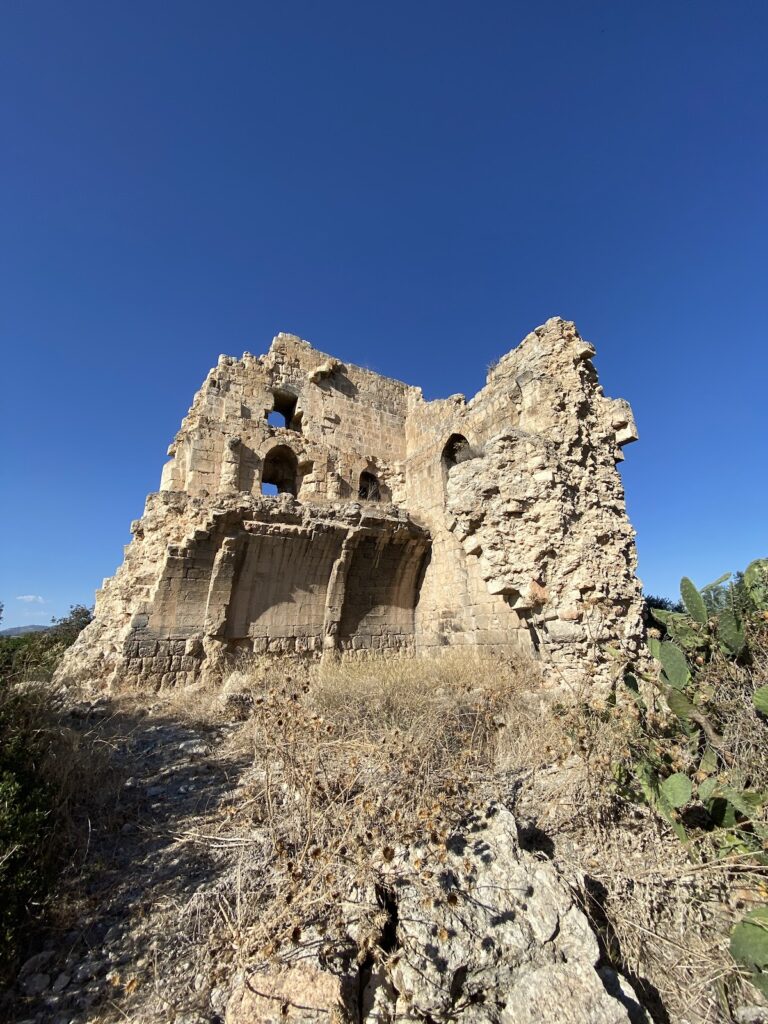
A five-storey observation tower rises within a section of the city wall north of the urban centre. Approximately 20 metres high, it gave the modern settlement its name, Uzuncaburc, meaning “long tower” in Turkish. The tower also appears on ancient coins of Olba.
Theatre, nymphaeum, and civic area
The remains include a theatre, a nymphaeum connected with water supply and fountain architecture, a victory arch, and an agora. Together these structures formed part of the city’s public and civic environment. Rock-cut tombs and several necropoleis, including burial areas of considerable size, extend beyond the urban centre.
Temple of Zeus Olbios
The Temple of Zeus Olbios stands approximately 4 kilometres from the city. It followed a peripteral plan, meaning that a single external colonnade surrounded the building. Six by twelve columns stood on a stylobate, the upper platform supporting the columns, which measured about 21 by 39 metres.
The columns rested on Attic bases without plinths. Their shafts had 24 flutes, whose lower thirds changed into plain surfaces. The edges of the flutes continued as narrow convex bands over slightly concave surfaces, although the treatment did not reach the same height on every column. The Corinthian capitals were assembled from three separate pieces, a construction method associated with Ptolemaic culture, the Hellenistic culture of the dynasty that ruled Egypt after Alexander the Great. A similar arrangement appears at the Temple of Augustus in the Philae temple complex.
Fragments of a Doric entablature survive among the temple’s other architectural elements. The date of construction remains disputed, with proposed dates ranging from the early third century BC to the middle of the second century BC.
Christian cathedral
During the Christian period, a cathedral was inserted between the temple columns. Its floor preserves traces of a cross-shaped baptismal pool, linking the earlier sanctuary’s colonnade with the later Christian use of the site.
Roman aqueduct
The Olba Aqueduct is a ruined Roman structure built of granite. It crossed a valley beside the city as a double-tier construction approximately 25 metres high and 150 metres long. Observation towers stood around it, while part of the aqueduct remains visible west of the agora ruins.
The watercourse began near Kızılgeçit at the Limonlu River, also called the Lamas River, approximately 8 kilometres to the northeast. The aqueduct was commissioned in AD 199 under Septimius Severus, the Roman emperor who ruled from AD 193 to 211. Its inscription refers to “the city of the Olbans.” Repairs probably began under the Byzantine emperor Justinian I and were completed in AD 566 under Justin II.