Hammam al-Sarah: An Umayyad Bathhouse in Jordan


Site at a Glance
- Rating
- 3.9
- Popularity
- Low
- Country
- Jordan
- Primary era
- Medieval
- Eras represented
- Medieval
- Civilizations
- Umayyad
- Site type
- Sanitation
- Remains
- Baths
On this page10 sections
History
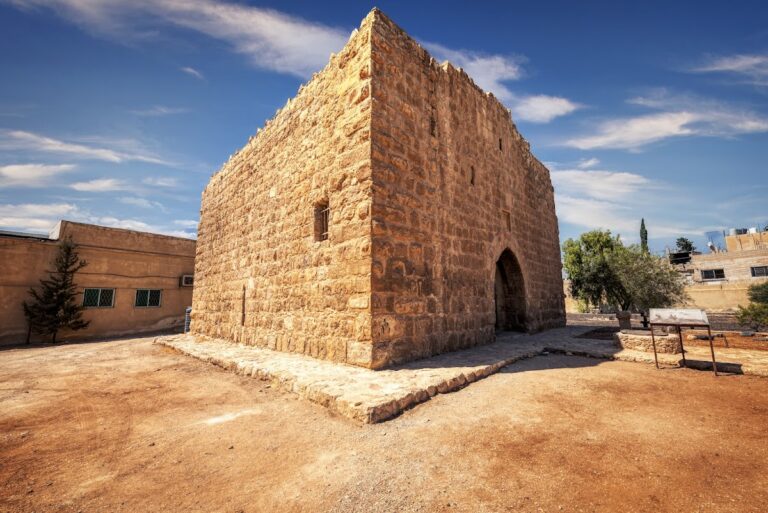
Hammam al-Sarah is an early eighth-century Umayyad bathhouse in Jordan, built as part of the Qasr al-Hallabat complex near Zarqa. Located about 2 kilometers west of Qasr al-Hallabat, it is among the oldest surviving remains of a Muslim bathhouse in Jordan. The Umayyads, the ruling dynasty of the early Islamic caliphate from 661 to 750, developed rural estates, palaces, bathhouses, and fortified complexes across Jordan that are commonly called desert castles.
Umayyad construction and later addition
The bathhouse belongs broadly to the early eighth century and is associated with the Umayyad Caliphate, particularly the reign of Caliph Hisham ibn Abd al-Malik, who ruled from 724 to 743. Its design has been compared with Qusayr ‘Amra, another Umayyad desert-castle complex. The building served the wider Qasr al-Hallabat estate as its bathing facility.
After the Umayyad period, a small mosque was added at the northern corner of the service rooms. Its precise date remains uncertain because no material evidence securely dates the addition.
Discovery, damage, and conservation
H.C. Butler discovered Hammam al-Sarah in 1905. K.A.C. Creswell surveyed and photographed it in 1926, when the structure was considered well preserved. Extensive stone robbing during the 1950s brought the building close to complete destruction.
The Jordanian Department of Antiquities excavated the site in 1974–75 and undertook emergency restoration. Most of the bath complex was undergoing conservation by 2007 or earlier. Later excavation and restoration formed part of the work of the Spanish Archaeological Mission to Jordan at Qasr al-Hallabat, directed by Ignacio Arce. Arce published a study of the ruins in 2015 and sought to replace the 1974 emergency reconstructions with more balanced methods of preservation and strengthening. Rebuilding and restoration in 2017 included reconstruction of the caldarium’s circular white dome. Hammam al-Sarah is now a restored ruin within the Qasr al-Hallabat archaeological complex.
Remains
Building and water system
Audience hall and bathing suite
The complex consists of a rectangular audience hall attached to a bathing suite. The audience hall had vaulted roofs, and its entrance was probably in the southwestern part of the building. The bathing section lay to the north. Its rooms followed a sequence comprising an apodyterium, or changing room, a tepidarium, or warm room, and a caldarium, or hot room. The plan did not include a frigidarium, the cold room characteristic of Roman bathhouses.
Service installations
The service area contained a furnace, a water well, a sāqiyah, or water-lifting device, and a raised water tank. A hydraulic water-supply system lay east of the bathhouse. Together, these installations provided the infrastructure needed to heat the bathing rooms and raise and distribute water.
Construction and decoration
Stonework and architectural details
The walls were built from finely dressed stone masonry, limestone blocks, and brick. Carved mouldings decorated the wall surfaces. The door jambs carried fluted mouldings also found at the Hallabat mosque and at the bath porch of Khirbat al-Mafjar, although the examples at Hammam al-Sarah were more complex. Limited stucco survived, chiefly in frames around doors and windows.
Interior decoration
Marble, frescoes, and mosaics formed part of the interior decoration. A mosaic depicting gazelles is associated with the bathhouse. Fragments of flat, coloured glass suggest that the windows were probably glazed and may have helped regulate the interior temperature. The caldarium had a dome, reconstructed during modern restoration, while the later mosque at the northernmost corner of the service rooms has been described as roofless.