Ballyheigue Castle: A Tudor Gothic Revival Mansion in County Kerry
Site at a Glance
- Rating
- 4.5
- Popularity
- Low
- Country
- Ireland
- Primary era
- Modern
- External website
- Open
- Eras represented
- Early Modern, Modern
- Civilizations
- British, Irish
- Site type
- Domestic
- Remains
- Castle
On this page7 sections
History
Ballyheigue Castle is a ruined mansion in Ballyheigue, Ireland, enlarged in 1809 in the Tudor Gothic Revival style from a house built in 1758. The property was associated with the Crosbie family, whose members included a bishop of Ardfert and Aghadoe, several High Sheriffs of Kerry, and representatives in the United Kingdom Parliament.
The Crosbie family estate
The family’s connection with the bishopric was traced to John Crosbie, a bishop of Ardfert and Aghadoe. Before his association with the Crosbies, he was identified as Sean Mac an Chrosain, from a family described as a Leinster bardic lineage. The property came into Thomas Crosbie’s possession in 1709. He represented Kerry in Parliament in 1709 and 1710, represented Dingle from 1713 to 1731, and served as High Sheriff of Kerry in 1712 and 1714. A High Sheriff was the Crown’s senior ceremonial and administrative representative in an Irish county.
Ownership passed through James Crosbie in 1731, Pierce Crosbie in 1761, James Crosbie in 1797, and Pierce Crosbie in 1836. James Crosbie, who held the office of High Sheriff in 1862, was also a colonel of the Kerry Militia. James Dayrolles Crosbie, who lived from 1865 to 1947, served as High Sheriff in 1894, Deputy Lieutenant of County Kerry in 1900, chairman of the Tralee and Fenit Railway Company, Brigadier-General in 1916 and 1917, and a justice of the peace. A Deputy Lieutenant assisted the Lord Lieutenant in county affairs, while a justice of the peace held local judicial and administrative responsibilities.
The earlier house was enlarged in 1809 to designs by Richard Morrison, an Irish architect known for country houses and institutional buildings in the late eighteenth and early nineteenth centuries. The enlarged mansion incorporated part of the 1758 building.
The Cantillon tradition
A separate tradition connects an earlier castle on the site with the Cantillon family. It attributes the construction to Tadhg Cantillon and places the family’s settlement at Ballyheigue in the period of the Anglo-Norman conquest of Ireland in 1171. According to this tradition, Queen Elizabeth I confiscated the castle and its lands in the sixteenth century after the family supported Irish rebels, then granted the property to the Crosbies.
The Cantillons were also associated with a legend concerning Muhan-na-Marb, where the dead were said to be left on the cliffs. Spirits were believed to carry the bodies at night to the family burial place at Teampall-fo-toinn.
Occupation and destruction
Parts of the property were used as a Royal Irish Constabulary station from 1890. The Royal Irish Constabulary was the police force that operated throughout Ireland under British administration before the establishment of the Irish Free State. On 1 December 1912, a hay shed was burned, and two more were destroyed the next day. The fires consumed 200 tons of hay, and James Crosbie claimed £1,000 in damages.
Between 1916 and 1920, James Crosbie sold the estate’s demesne lands to local residents and sold the castle to Jeremiah Leen, ending the family’s connection with Ballyheigue. A demesne was the principal landed estate surrounding a country house, including its grounds, agricultural land, and associated buildings.
The building was vacant in early 1921. R. Palmer and Mrs Erskine then lived there for several weeks. Palmer, a proprietor of local creameries, planned to move to England and told Michael Pierce, captain of the Ballyheigue Company of the Irish Volunteers, that the British military was to occupy the building. Pierce passed the information to his battalion commanding officer.
In March 1921, elements of the Royal Irish Constabulary occupied the building. During a sweep across north Kerry for Irish Republican Army members, hundreds of men were detained in the outbuildings. The Irish Volunteers were an Irish nationalist military organization, while the Irish Republican Army was a separate republican organization active during the War of Independence.
The contents of the buildings were auctioned on 25 May 1921. Two days later, local Irish Volunteers attacked and burned the castle. Thomas Clifford, a draper’s assistant and Irish Republican Army officer, later admitted that he started the fire with petrol on the floorboards after receiving orders to destroy the building. An earlier fire at the castle had taken place in 1840.
Palmer received £127 from a Tralee court in October 1921 for furniture lost in the fire. On 14 June 1923, Jeremiah Leen won an insurance case against Lloyd’s of London underwriters in the King’s Bench Division, a major division of the superior courts handling civil and criminal cases. He received £9,500 plus costs. The underwriters had argued that he failed to disclose the occupation of the property by Crown forces and the internment of Sinn Fein members there.
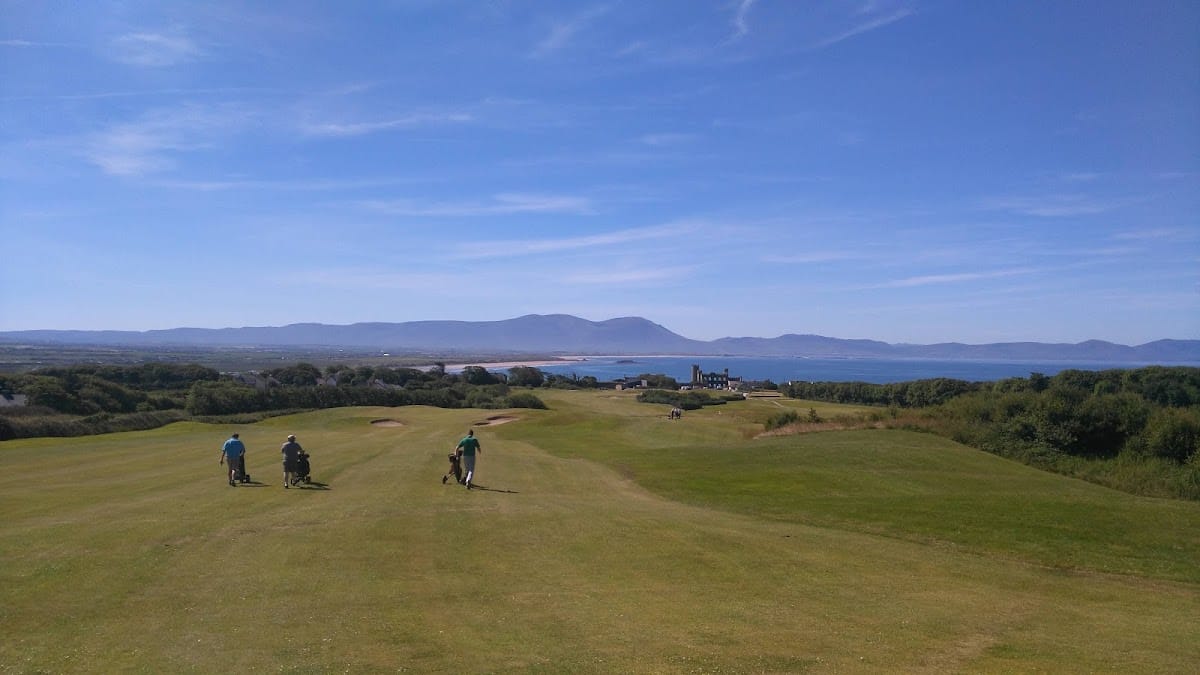
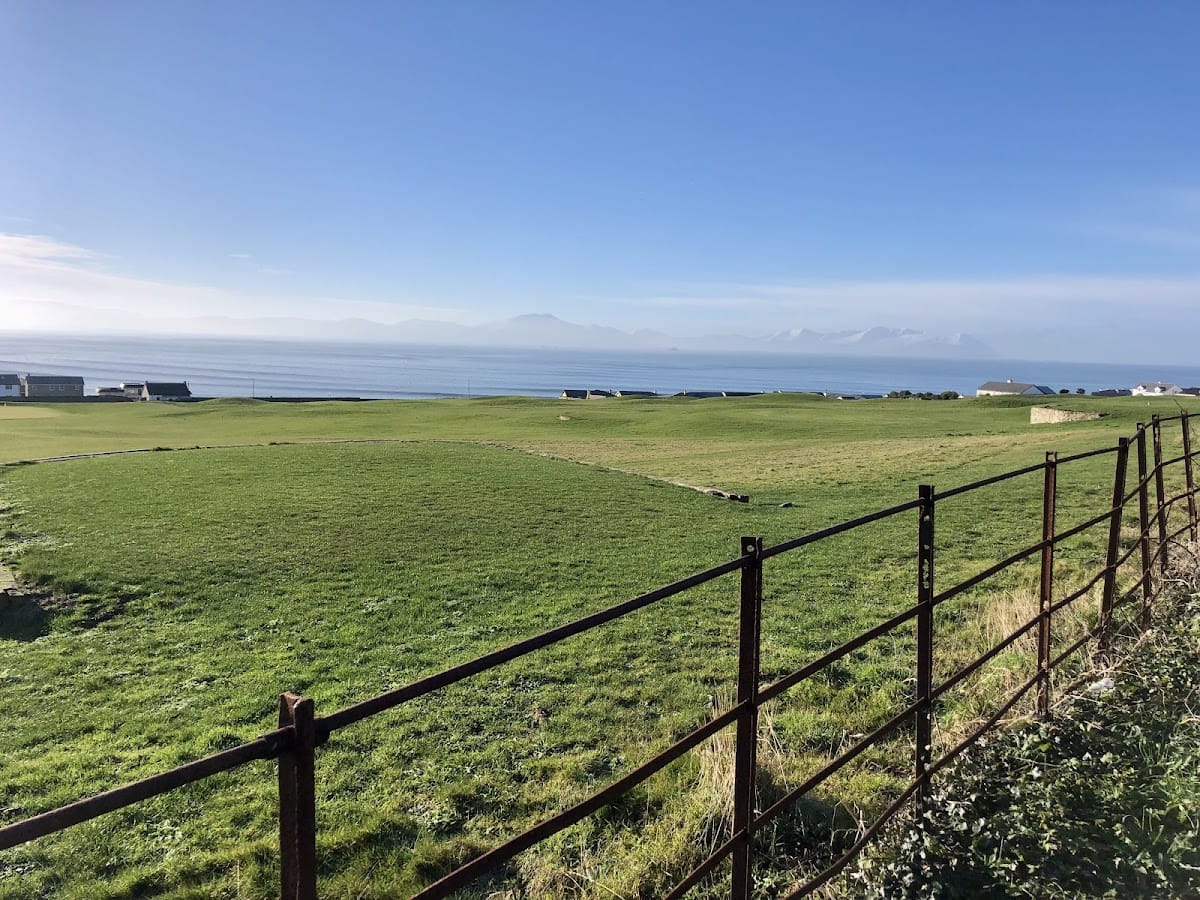
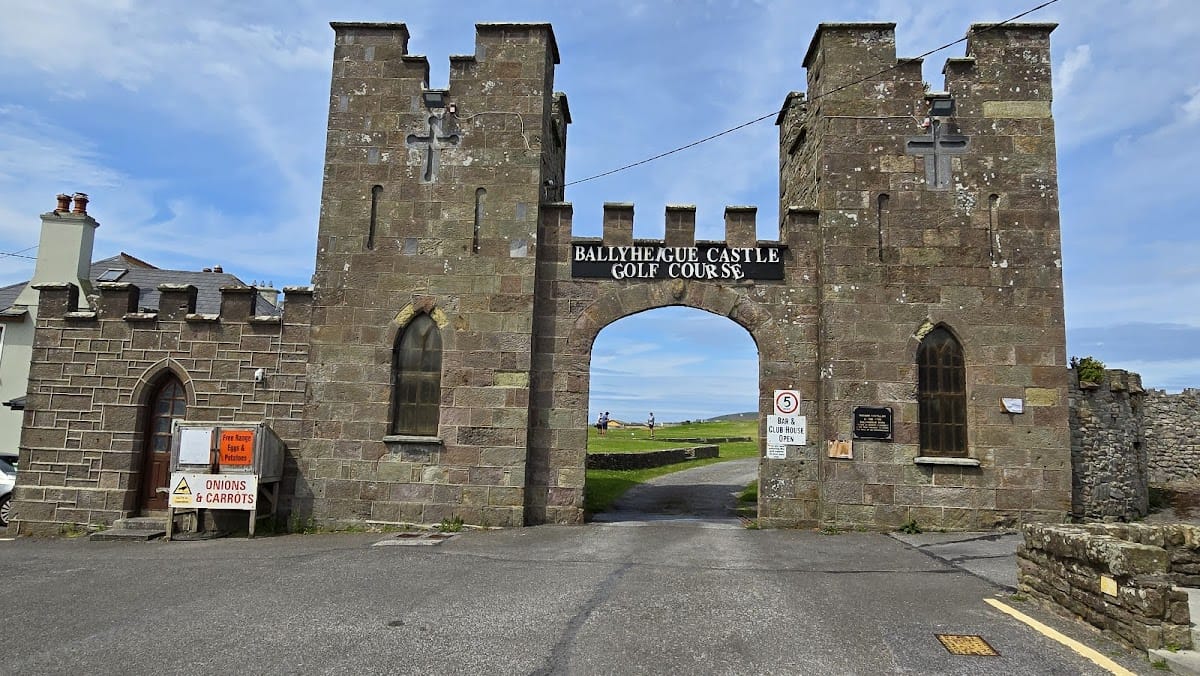
A low section was reconstructed and converted into apartments in 1975. Ballyheigue Castle Golf Course officially opened in 1998, and the ruined castle now forms part of the course.
Remains
The surviving mansion
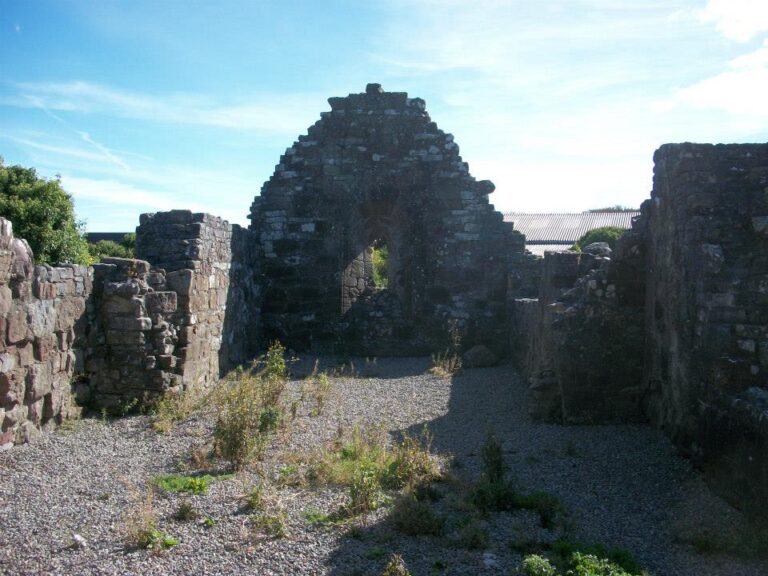
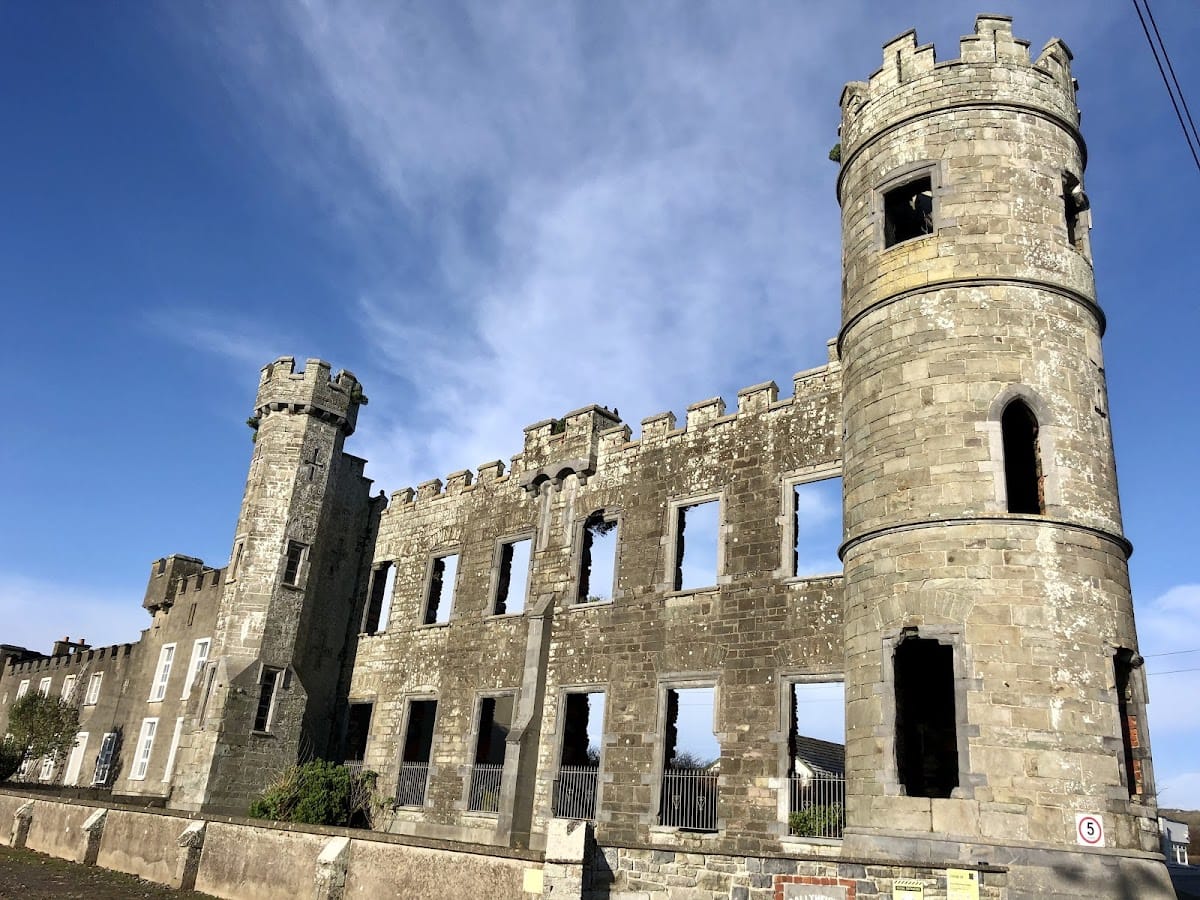
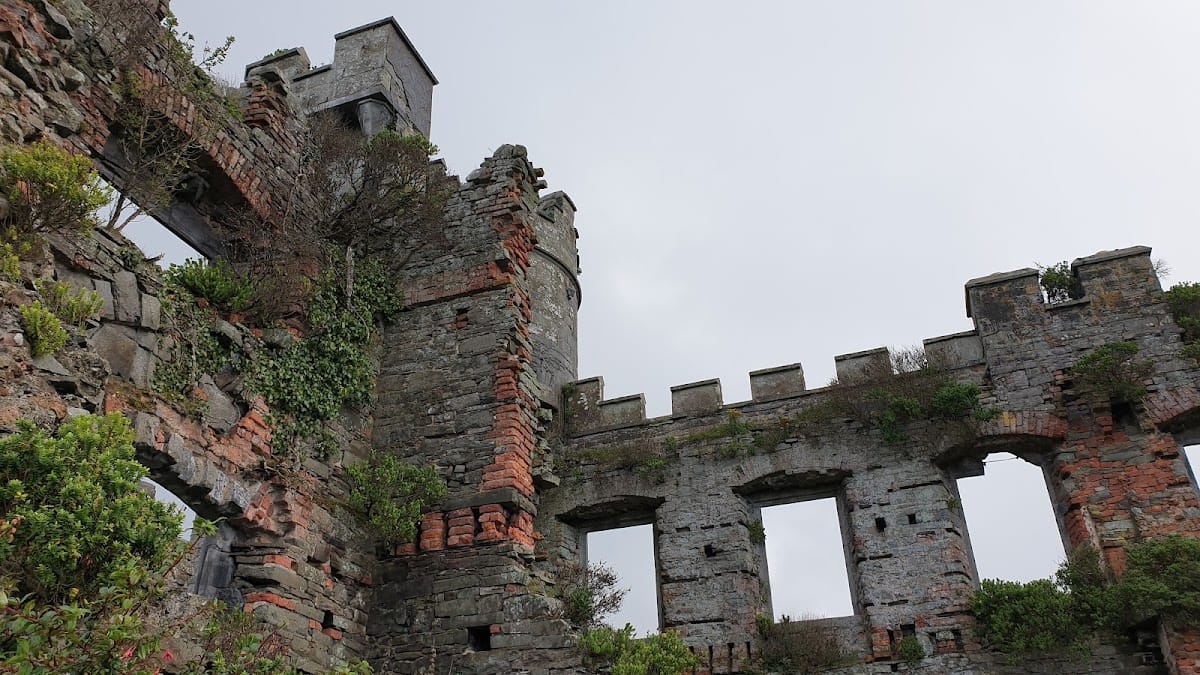
Ballyheigue Castle survives as a ruined mansion in the Tudor Gothic Revival style. Its castle-like character comes from crenellations along the parapet. The principal elevation faces south and consists of a large two-storey front with an entrance and six bays. Three-storey, single-bay circular turrets occupy the corners.
The building was originally thatched and stood around an enclosed courtyard. The 1809 enlargement incorporated fabric from the 1758 house, leaving the later mansion as a combination of the earlier building and Morrison’s enlargement. The main structure is now in ruins.
The reconstructed low section
The low section to the left of the south-facing front was reconstructed and remodelled as apartments in 1975. It forms the surviving adapted part of the building, while the ruined mansion and its architectural features remain within the grounds of the golf course.