Brownsea Castle: A Tudor Coastal Fort and Country House near Poole


Site at a Glance
- Rating
- 4.8
- Popularity
- Low
- Country
- United Kingdom
- Primary era
- Modern
- External website
- Open
- Eras represented
- Early Modern, Modern
- Civilizations
- British, English
- Site type
- Domestic
- Remains
- Castle
On this page15 sections
History
Brownsea Castle is a Tudor coastal fortification on Brownsea Island near Poole, United Kingdom, built between 1545 and 1547 as a Device Fort, a compact defensive work created under Henry VIII’s programme of coastal fortification. Its guns were intended to protect the entrance to Poole Harbour during renewed fears of a French invasion supported by Scotland. The castle later became a private residence and country house, but its original military purpose remained visible in its early history and surviving artillery.
Foundation under Henry VIII
Brownsea Island became Crown property after it was confiscated from Cerne Abbey during the Dissolution of the Monasteries, the sixteenth-century closure and seizure of England’s monastic houses under Henry VIII. The castle formed part of a wider defensive response to renewed tension between England, France, and the Holy Roman Empire during the final years of Henry’s reign. Construction was financed jointly by the Crown and the town of Poole, which also accepted responsibility for maintaining the fort and providing its garrison.
The original arrangement was intended to defend the harbour approach with artillery. In the early Elizabethan period, the normal garrison consisted of six men equipped with eight guns. The fort remained in military use after the immediate invasion danger had passed, and its condition and armament continued to concern Poole.
Elizabethan repairs and disputes
Work on the gun platform cost £56 in 1548, while Poole funded further defensive improvements costing £133 in 1552. In 1551, workers drove 101 piles into the ground, probably to resist coastal erosion. Poole petitioned the Crown for repairs and new cannons in 1561 and again in 1571. The second petition resulted in repairs in 1573, costing £520 and requiring about 4,000 tonnes of stone. Further work in 1585 added a wall approximately four feet high around the castle.
In 1576, Elizabeth I granted Brownsea and Corfe castles to Sir Christopher Hatton for life and appointed him Admiral of Purbeck, a regional maritime office connected with authority over coastal waters and shipping. Hatton challenged Poole’s rights to inspect ships and collect ferry revenues. He lost the case over the ferry rights in 1581.
The castle’s authority over shipping led to a deadly incident in 1589. The vessel Bountiful Gift refused inspection and came under fire from the castle, killing two crew members. Walter Partridge, the castle captain, was convicted of manslaughter and later received a pardon.
Parliamentary garrison and decline
Brownsea Castle remained garrisoned through much of the seventeenth century. During the English Civil War, the conflict of the 1640s between supporters of Charles I and Parliament, it was held for Parliament under the Governor of Poole. The defences were strengthened in 1644, and Parliament ordered four guns and four chests of muskets to be sent to the castle. The garrison numbered 20 men in 1646.
During the Interregnum, the period of republican government between the execution of Charles I and the restoration of the monarchy under Charles II, the surrounding island was purchased by the wealthy merchant Sir Robert Clayton. He probably did not live in the castle, which fell into disrepair. By the end of the seventeenth century, Poole refused to maintain a garrison in its deteriorating defences.
Conversion into a country house
William Benson, an amateur architect, bought the island from Clayton’s heirs in 1726 for £300. He converted the former fort into a private residence despite objections from Poole. The town argued that Benson had acquired the island but not the castle, which it regarded as a national fortification belonging to Poole. The dispute was eventually abandoned.
Benson removed the outer defensive works and created a Great Hall. He also planted trees and rare plants, beginning the transformation of the island’s military landscape into an ornamental estate. Later owners developed gardens and artificial lakes around the former blockhouse. After the property passed to Mr Chamberlayne, it was sold to Sir Gerard Sturt in 1762 and to his cousin Sir Humphrey Sturt in 1765.
Sir Humphrey expanded the sixteenth-century core into a private country residence. His son Charles Sturt made Brownsea Castle his principal home, although his involvement in the Napoleonic Wars frequently kept him elsewhere. Charles Sturt’s son inherited the property and sold it to Sir Charles Chad in 1817. Chad invested heavily in the castle, and Prince George visited in 1818, receiving a salute from its guns.
Nineteenth-century owners and rebuilding
Sir Augustus Foster, a diplomat, acquired the castle on his retirement in 1840. He died there by suicide in 1848. His inquest described him as suffering temporary insanity following a disease of the heart and lungs.
Colonel William Waugh, a retired Indian Army officer, bought the island in 1852 intending to establish a profitable pottery works. The venture failed, and he fled his creditors to Spain in 1857. A later owner, Mr Faulkner, continued the pottery scheme until George Cavendish-Bentinck purchased the estate in 1873 for £30,000 and closed the works.
Cavendish-Bentinck was a politician and lawyer who furnished the castle with an extensive collection of Italian Renaissance sculpture. He also financed major renovations for his son William, who moved into the castle with his wife Ruth in 1888. Cavendish-Bentinck’s debts after his death in 1891 forced the sale of the estate to Major Kenneth Robert Balfour.
After electric lighting was installed, a serious fire on 26 January 1896 gutted the castle’s interiors. Balfour commissioned the architect Philip Brown to rebuild the building, simplifying its more elaborate design. Balfour sold the island in 1901 after his wife, Margaret Anne, became ill.
Van Raalte, Bonham-Christie, and preservation
The stockbroker Charles van Raalte bought the island in 1901. He used the castle for an affluent household and assembled about 250 historical musical instruments from Europe, Asia, and Africa. After his death in 1908, his wife Florence continued to live there until 1925.
Sir Arthur Wheeler bought the castle in 1927 after Florence’s death and planned to demolish it after selling its contents. The auction included some of van Raalte’s instruments and paintings, together with a library of 5,000 books, and raised £22,300. The castle was not demolished. Mary Bonham-Christie bought it later that year for £125,000, although she lived in a nearby house rather than in the castle. During her ownership, the island became increasingly wild and the castle deteriorated.
In 1932, Bonham-Christie allowed celebrations for the Silver Jubilee of the first Scout camp to take place on Brownsea Island. Five hundred Scouts camped on the original campsite. A bush fire in 1934 burned for three days and caused extensive damage.
When Bonham-Christie died in 1961, the castle was in very poor condition. A proposal by her grandson to develop 400 luxury houses on the island was rejected after public opposition. The island was then transferred to the United Kingdom in lieu of death duties. HM Treasury offered it to the National Trust, a British conservation organization, for £100,000. The National Trust raised £25,000, while the Boy Scout and Girl Guide movements, the predecessor of the Dorset Wildlife Trust, and the John Lewis Partnership provided the remaining £75,000.
The National Trust acquired Brownsea Castle and the island in 1962. It leased the castle and gardens to the John Lewis Partnership on a 99-year repairing lease, and the Partnership restored the buildings in stages over many years. The castle continues to be used as a corporate hotel for current and retired John Lewis Partnership employees. It has been protected as a Grade II listed building, a category for buildings of special architectural or historic interest in England, since 13 December 1984.
Remains
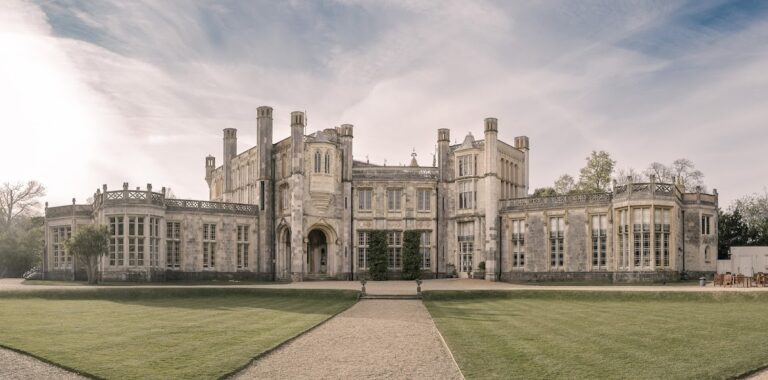
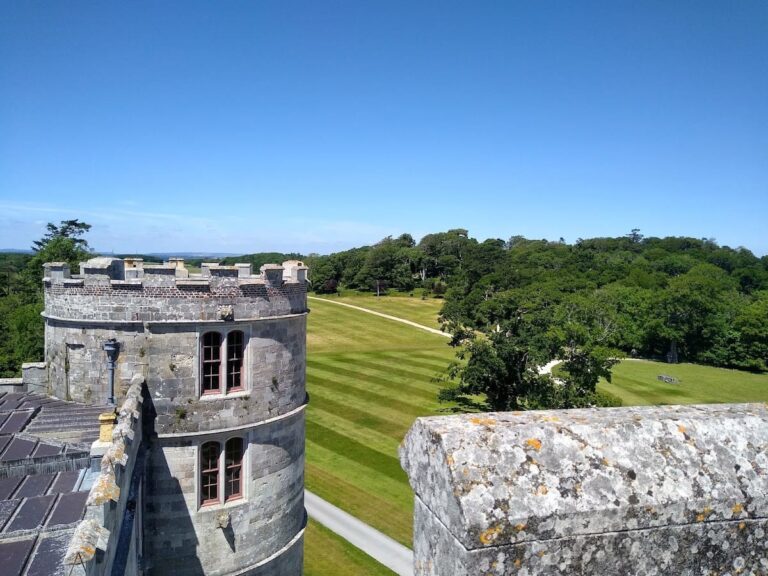
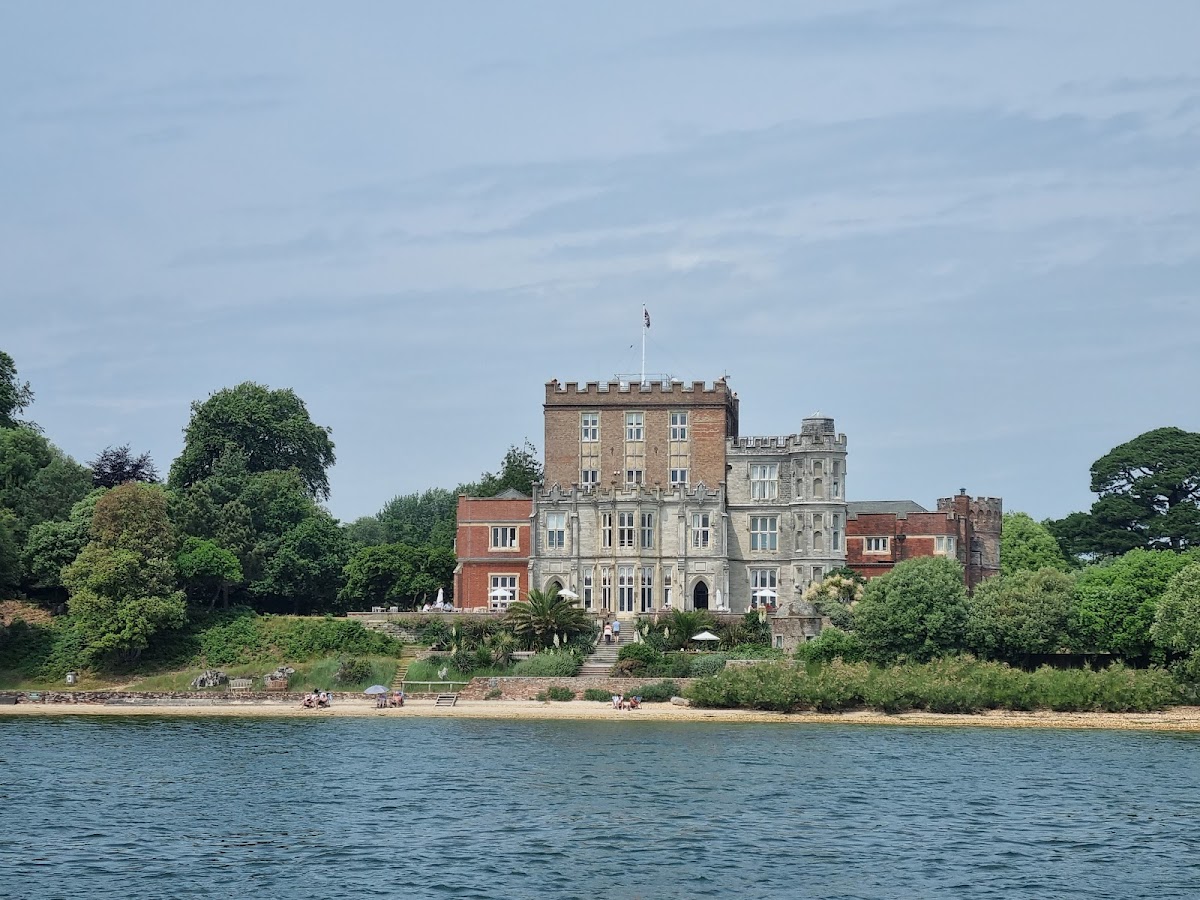
Brownsea Castle combines a small sixteenth-century gun fort with later residential additions made between the eighteenth and nineteenth centuries. The original defensive core stood at the south-east corner of the island. It was a square stone blockhouse with a seaward gun platform, a moat on its landward sides, and a drawbridge approach. Later owners removed the outer fortifications and enlarged the building into a country house surrounded by courtyards, gardens, and lakes.
The Tudor blockhouse
Blockhouse and gun platform
The original blockhouse was a conservative, one-storey square stone structure measuring about 44 feet, or 13 metres, across. It was divided into three rooms, and its design provided for a second storey. The roof was intended to carry guns. A hexagonal gun platform surrounded the building on the seaward side, while a moat protected the other three sides.
Drawbridge and outer defences
Entry was reached across a drawbridge about 24 feet, or 7.3 metres, long, positioned on the south-west side. The defensive arrangement was altered in 1585 when an additional wall, approximately four feet, or 1.2 metres, high, was built around the castle. William Benson later removed the external fortifications during the conversion of the fort into a residence.
Country-house additions
Sturt’s Palladian expansion
Sir Humphrey Sturt enlarged the Tudor core into a four-storey tower in the Palladian style, a classical architectural form based on balanced proportions and designs associated with Andrea Palladio. The tower had battlements and new wings extending along three sides. Sturt also built a walled courtyard with hothouses beside the castle and reshaped the island with two lakes and numerous fir trees.
Waugh’s Jacobethan range
Colonel William Waugh added a Jacobethan range along the south and east sides. Jacobethan architecture combines features associated with the English Jacobean and Elizabethan styles, including gables, battlements, and elaborate historicist details. Waugh also built a crenellated gatehouse and clock tower at the entrance to the courtyard, along with a family pier in the same style on the shore below the castle.
Interiors, collections, and restoration
During Charles van Raalte’s ownership, the castle contained 38 bedrooms. Its rooms also held his collection of about 250 historical musical instruments, assembled from Europe, Asia, and Africa. Some of the instruments were dispersed at the 1927 auction. The 1896 fire destroyed the interiors, after which Philip Brown rebuilt the castle with a simpler treatment of its earlier complex design.
Several nineteenth-century interior elements survive, including wood panelling, ornamental ceilings, and carved stone fireplaces from Venice. Four cannons remain at the castle and probably date from the seventeenth or early eighteenth century. The castle and its surrounding gardens were progressively restored after the National Trust acquired the property in 1962, preserving the buildings and enabling their continued use.