Christchurch Castle: A Norman Motte-and-Bailey Fortress


Site at a Glance
- Rating
- 4.5
- Popularity
- Medium
- Country
- United Kingdom
- Primary era
- Medieval
- External website
- Open
- Eras represented
- Medieval
- Civilizations
- English, Norman
- Site type
- Military
- Remains
- Castle
On this page9 sections
History
Christchurch Castle is a Norman motte-and-bailey fortress in the United Kingdom, built during the Norman period within an earlier Saxon burh. Its earliest stonework dates to around 1160, and its position above the lowest crossing of the River Avon gave it importance in controlling the harbor and inland routes along the Avon and Stour.
Saxon origins and Norman expansion
The site may have been occupied by a wooden fort built in 924, after King Æthelwold of Wessex captured Christchurch’s ramparts in 901. Edward the Elder, the Anglo-Saxon king who ruled from 899 to 924, subsequently fortified the position with a motte. A Saxon burh was a fortified settlement or stronghold intended to protect a town and control an important route or river crossing.
After the Norman Conquest of 1066, the defenses were strengthened with a ditch and a bailey, an enclosed courtyard adjoining the defended mound. A wooden palisade surrounded the bailey, while the earlier timber fort was eventually replaced by a stone keep. The Norman castle appears to have occupied the site of the earlier Saxon fortress. Its role extended beyond defense, serving to subdue the local population, enforce the New Forest Laws, and control movement between the harbor and the inland waterways.
Feudal administration and civil war
The castle was initially controlled by the king’s constable. Henry I, king of England from 1100 to 1135, granted it as the caput, or principal administrative center, of a feudal barony to his cousin Richard de Redvers. Richard is often identified as the castle’s first builder, although little documentary evidence supports that attribution.
In 1147, during the Anarchy, the civil war between King Stephen and the Empress Matilda, Baldwin de Redvers rebuilt the castle to resist Stephen. A great tower was probably added around 1300, extending the fortress’s medieval development.
Christchurch Castle was involved in the English Civil War, the conflicts fought from 1642 to 1651 between Royalists supporting the monarchy and Parliamentarians supporting Parliament. Parliamentarian forces took control of the castle in 1644. Royalist troops then besieged it for three days, demolishing houses at the junction of Church Street and Castle Street to place their cannons. The assault failed, and Oliver Cromwell ordered the stronghold to be slighted in 1652 because he feared its military potential.
Protection and management
The castle and the Constable’s House are Grade I listed buildings, a designation for structures of exceptional national architectural or historic interest in England. The area containing the priory, castle, and Constable’s House is also a Scheduled Monument, meaning that it receives legal protection as an archaeological or historic site. English Heritage manages the property.
Remains
Castle earthworks and fortifications
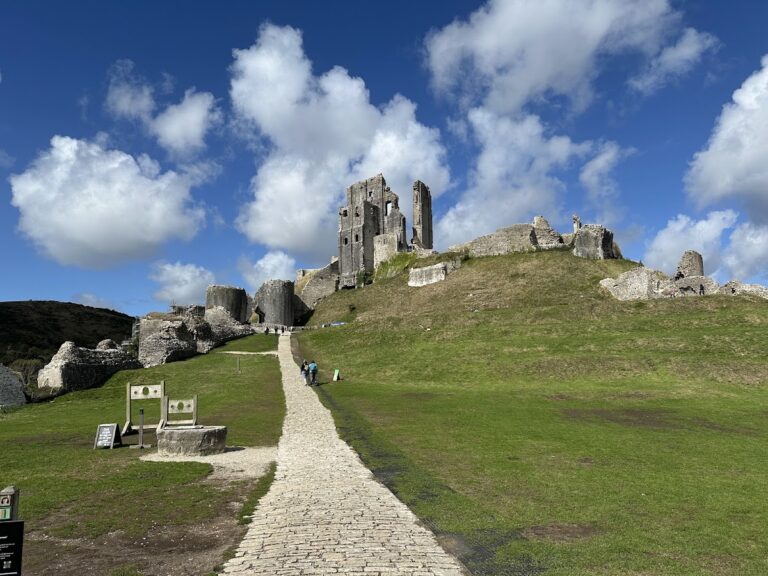
Christchurch Castle survives as a ruinous Norman motte-and-bailey complex. Its defensive arrangement consisted of a raised motte, a surrounding ditch, an enclosed bailey, and a wooden palisade, later supplemented by a stone keep and probably a great tower. Parts of the keep remain, including two of its walls. The original ditch has been filled, but sections of the rectangular moat survive. The bailey is now occupied by a bowling green and gardens, preserving the position of the former enclosed courtyard.
Domestic buildings
Constable’s House
The Constable’s House is a domestic Norman building constructed within the original bailey around 1160. It measures approximately 67 by 23 feet, or 20 by 7 metres, and was built from Purbeck marble. Much of its stonework survives. Its ground floor contains four slit windows and served as a storeroom, while the upper floor held the main hall and was reached by external steps and an internal staircase.
Garderobe tower
A garderobe tower projects over the mill stream. Added in the early thirteenth century, it provided sanitary arrangements through a medieval privy positioned above or toward a drainage channel or stream. The building also retains a rare Norman chimney, described as one of only five of its kind in England.