St. Aldhelm’s Chapel, St. Aldhelm’s Head: A Norman Coastal Chapel


Site at a Glance
- Rating
- 4.7
- Popularity
- Low
- Country
- United Kingdom
- Primary era
- Medieval
- Eras represented
- Medieval
- Civilizations
- Norman
- Site type
- Religious
- Remains
- Chapel
On this page7 sections
History
St. Aldhelm’s Chapel is a Norman chapel on St. Aldhelm’s Head in the United Kingdom, near Worth Matravers in Dorset. Its construction date is uncertain, but its round-arched masonry and vaulted form place it within the Norman period. The chapel is dedicated to St. Aldhelm, an Anglo-Saxon churchman who became the first Bishop of Sherborne and died in 709. It belongs to the Church of England, within the Diocese of Salisbury and the Province of Canterbury, having formerly been Roman Catholic.
Medieval origins and use
The building’s unusual square form, together with the lack of evidence for an original altar or basin for washing sacred vessels, has led to questions about its first purpose. One interpretation is that it began as a watchtower serving Corfe Castle, a medieval castle in Dorset, and monitoring the sea approaches to it. Its use as a chapel is supported by payments made to a chaplain during the reign of King Henry III. The chaplain served both St. Aldhelm’s Chapel and the chapel of St. Mary at Corfe Castle, receiving 50 shillings each year from the county sheriff on behalf of the Crown.
In 1291, the chapel parish was assessed for taxation at 20 shillings. The same assessment was recorded in 1428, when the parish was described as having no inhabitants. The sale of the nearby Manor of Renscombe in 1557 or 1558 included the advowson of Renscombe Chapel, meaning the legal right to nominate its chaplain. This may have referred to St. Aldhelm’s Chapel, which a 1737 map shows within the manor under the name “St Abbon’s Chapel.”
Decline and nineteenth-century reconstruction
By 1625, the chapel had apparently ceased religious use and was serving as a sea mark. Seventeenth-century dates and initials carved into the central column show that people continued to visit the building while it deteriorated. A hole in the column appears to have been used for making wishes by dropping pins or hairpins into it.
The roof had partly collapsed by 1797. William Morton Pitt, owner of the neighbouring Encombe estate, became interested in repairs in 1800 and may have carried out minor work. After Pitt sold Encombe to the 1st Earl of Eldon in 1807, Eldon acquired Renscombe in 1811 and ordered repairs to the vaults, although a major restoration did not immediately follow. Local landowners repaired the chapel during the nineteenth century, and the building had been reconstructed by 1873. It reopened for church services in 1874, with financial support from the 3rd Earl of Eldon, who also gave the baptismal font.
The reopening service took place on 18 July 1874, when Alfred Gibson, son of the chief boatman of the coastguards, was baptised. Regular Sunday-evening services followed. During the late nineteenth and early twentieth centuries, coastguards and their families from nearby cottages attended weekly services. Whit Thursday observances included a procession from Worth Matravers to the headland, music, the decoration of the chapel with flags and flowers, and dancing. Other processions and dances accompanied Worth Fair Day and Club Day. The chapel also appears to have served as a coastguard store during this period.
Twentieth-century care and continuing religious use
By the 1930s, severe damp had required the service organ to be stored elsewhere when it was not being used. Services were held approximately fortnightly and at Rogationtide, the period before Ascension Day associated with processions and prayers for the protection and fertility of the land. During the Second World War, nearby Renscombe Farm was used for radar research, and the chapel was used only infrequently.
A gate and fence were installed to keep cattle out of the building and were removed in 1963. In November 1965, the Encombe Estate gave the chapel to Worth Matravers Parochial Church Council, the local governing body of the Church of England parish. The council then arranged further repairs with help from voluntary donations. The chapel itself became a Grade I listed building in 1955, a designation for structures of exceptional architectural or historic interest in England. The surrounding earthworks were designated an Early Christian enclosure and a Scheduled Monument in 2000, giving legal protection to an archaeological site of national importance.
In 2005, celebrations marking 1,300 years since St. Aldhelm’s consecration as Bishop of Sherborne included the creation of a new altar table from stone taken from St. Aldhelm’s quarry. Rowan Williams, Archbishop of Canterbury, consecrated the table on 4 June 2005.
Remains
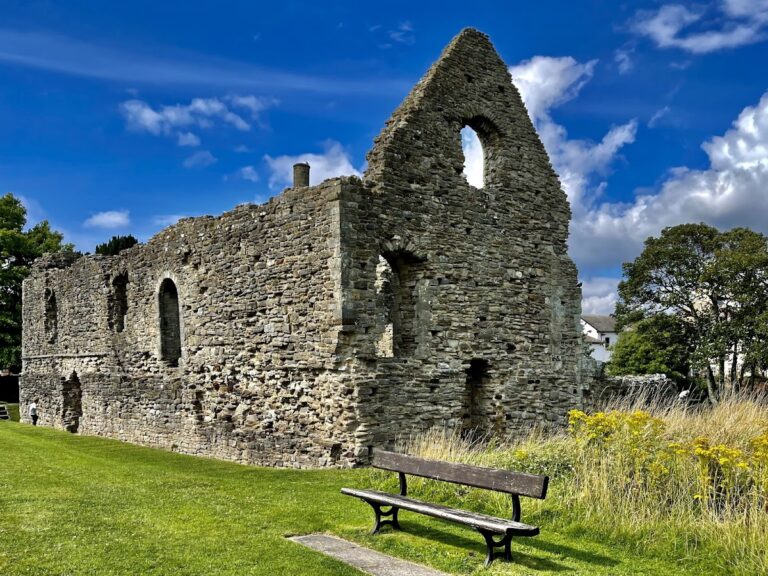
St. Aldhelm’s Chapel stands close to the cliffs of St. Aldhelm’s Head, approximately 108 metres above sea level, within a low circular earthwork that may preserve a pre-Conquest Christian enclosure. The chapel is a plain, square rubble-stone building with its corners directed toward the cardinal points. Projecting support walls strengthen the corners and sides, while a flat pyramidal roof completes the exterior form.
The chapel building
The interior measures approximately 7.7 metres square. A square central pier divides the space and carries four square-ribbed vaults. The heavy ribs lead into transverse arches and have chamfered edges that end before reaching the ends of the structural members. A groin vault, formed where two barrel vaults intersect, is described as dating from the twelfth century. Evidence found during twentieth-century roof repairs suggests that the building may once have carried a beacon. The present roof supports a stone cross erected in 1873.
The north-west side contains a Norman round-arched doorway with a Romanesque double arch, together with a small window of the same period nearby. The building’s form and its internal arrangement have contributed to the interpretation that it may have originated as a watchtower rather than as a purpose-built chapel. The lack of physical evidence for an altar or piscina, a shallow basin for washing sacred vessels, is another reason for questioning its original function.
Earthworks and burial evidence
The low circular earthwork around the chapel forms a distinct archaeological feature of the headland. Its possible connection with a pre-Conquest Christian enclosure provides a setting for the later Norman building and contributes to the site’s interpretation as a place with an early religious association.
In 1957, ploughing uncovered a Purbeck-stone monumental slab in a field approximately 400 metres north-north-east of the chapel. The slab is about 2 metres long and 0.75 metres wide at the head, with a Celtic-style cross carved in relief. A grave beneath it contained the skeleton of a woman aged approximately 30 to 40 years. Her arms were crossed, and the grave was formed within a row of upright stones. Eight pieces of iron bearing traces of wood were found in the grave, which was dated to the late thirteenth century. The slab is now kept in the porch of St. Nicholas’ Church in Worth Matravers. Foundations of a building approximately 2 metres square were also found nearby.