Anaktoropolis: A Byzantine Coastal Fortress in Greece


Site at a Glance
- Rating
- 4.3
- Popularity
- Low
- Country
- Greece
- Primary era
- Medieval
- External website
- Open
- Eras represented
- Medieval
- Civilizations
- Byzantine
- Site type
- Military
- Remains
- Fort
On this page12 sections
History
Anaktoropolis is a coastal Byzantine fortress in Greece, about 500 metres south of modern Nea Peramos in eastern Macedonia. Its foundation date is uncertain, but the settlement succeeded the ancient city of Oisyme and was initially known as Alektryopolis. The earliest fortification walls were built between the sixth and ninth centuries, placing the site within the long development of the Byzantine Empire, the medieval Roman state centred on Constantinople.
From Alektryopolis to Anaktoropolis
The settlement became an episcopal centre by the tenth century. An episcopal list from that period records the bishopric of Alektryopolis under the archbishopric of Philippi, an important regional church centre whose archbishop supervised subordinate bishoprics. An eleventh-century lead seal names Georgios as bishop. Documents from the same century use the forms Alektoroupolis and Anaktoroupolis, showing that the place-name was not fixed in a single form.
The fortifications were repaired during the twelfth and thirteenth centuries. Their continued maintenance reflects the settlement’s enduring role on the coast and its position beside the Bay of Eleftheres. An inscription formed from bricks in the southern wall may belong to this period, although its date remains disputed. One interpretation places it between 1167 and 1170, while another associates it with the reign of Emperor Andronikos III Palaiologos, who ruled from 1328 to 1341.
Fourteenth-century importance and political change
Alektryopolis appears to have gained particular importance during the fourteenth century, when its name changed to Eleftheroupolis. Under Andronikos III, the fortifications were renovated. The settlement was controlled by Alexios Apokaukos until 1345. Apokaukos was a prominent Byzantine statesman and military official, and his control formed part of the wider political struggles of the period.
After 1345, Eleftheroupolis passed to the brothers Alexios and Ioannis of Velikani in Bithynia. They were Byzantine army mercenaries related by marriage to Emperor Johannes V Palaiologos, who ruled, with interruptions, from 1341 to 1391. The brothers established a partly independent principality and engaged in piracy, giving the fortress a role in the unstable political and military world of the later Byzantine period.
Destruction, reuse, and conservation
Ottoman forces captured and destroyed Eleftheroupolis between 1383 and 1387. The bishopric of Eleftheroupolis was mentioned again in the second half of the fifteenth century, indicating that the ecclesiastical name continued after the destruction of the fortified settlement.
The ruins acquired new military and social uses in the modern period. During the First World War, in 1916, the Bulgarian army developed them into a military base and established artillery positions south of the fortress, at the western end of the Brasidas Peninsula. In 1922, the ruins temporarily housed Greek refugees from Asia Minor and were also used as a stone quarry.
Trial excavations within the fortress took place from 1974 to 1983, and a small chapel was discovered in 1989. Restoration between 2011 and 2014 was carried out by the Region of Eastern Macedonia and Thrace and the 12th Ephorate of Byzantine Antiquities. The Ephorate of Antiquities of Kavala and Thasos continued the work in 2014 and 2015. The programme sought to preserve the surviving masonry and recover the fortress’s original appearance, rebuilding 1,250 cubic metres of masonry.
Remains
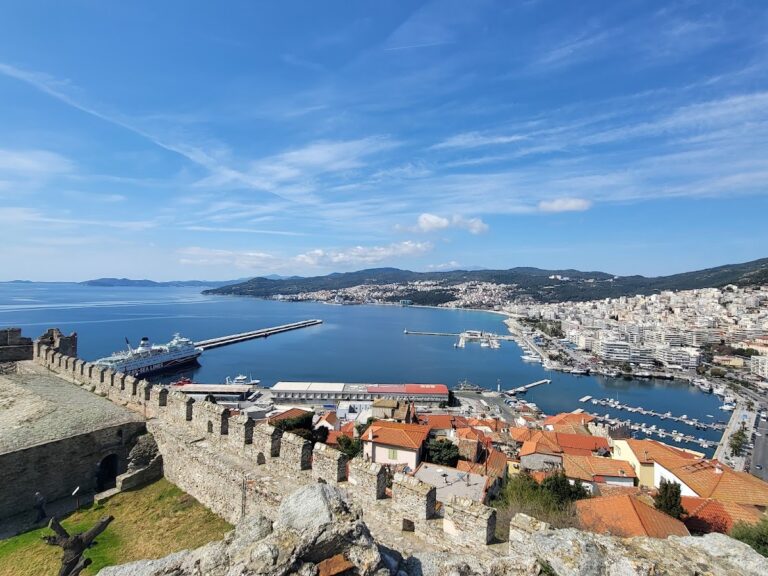
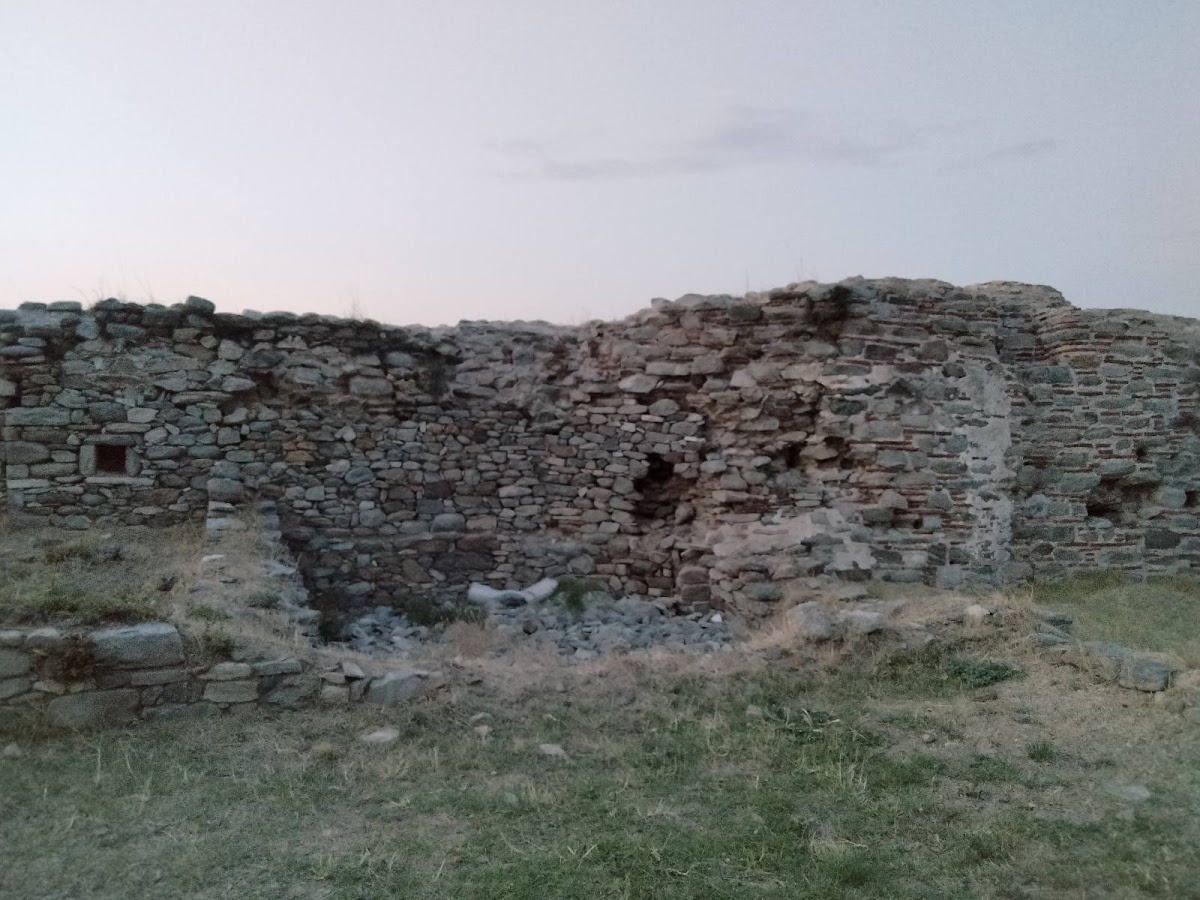
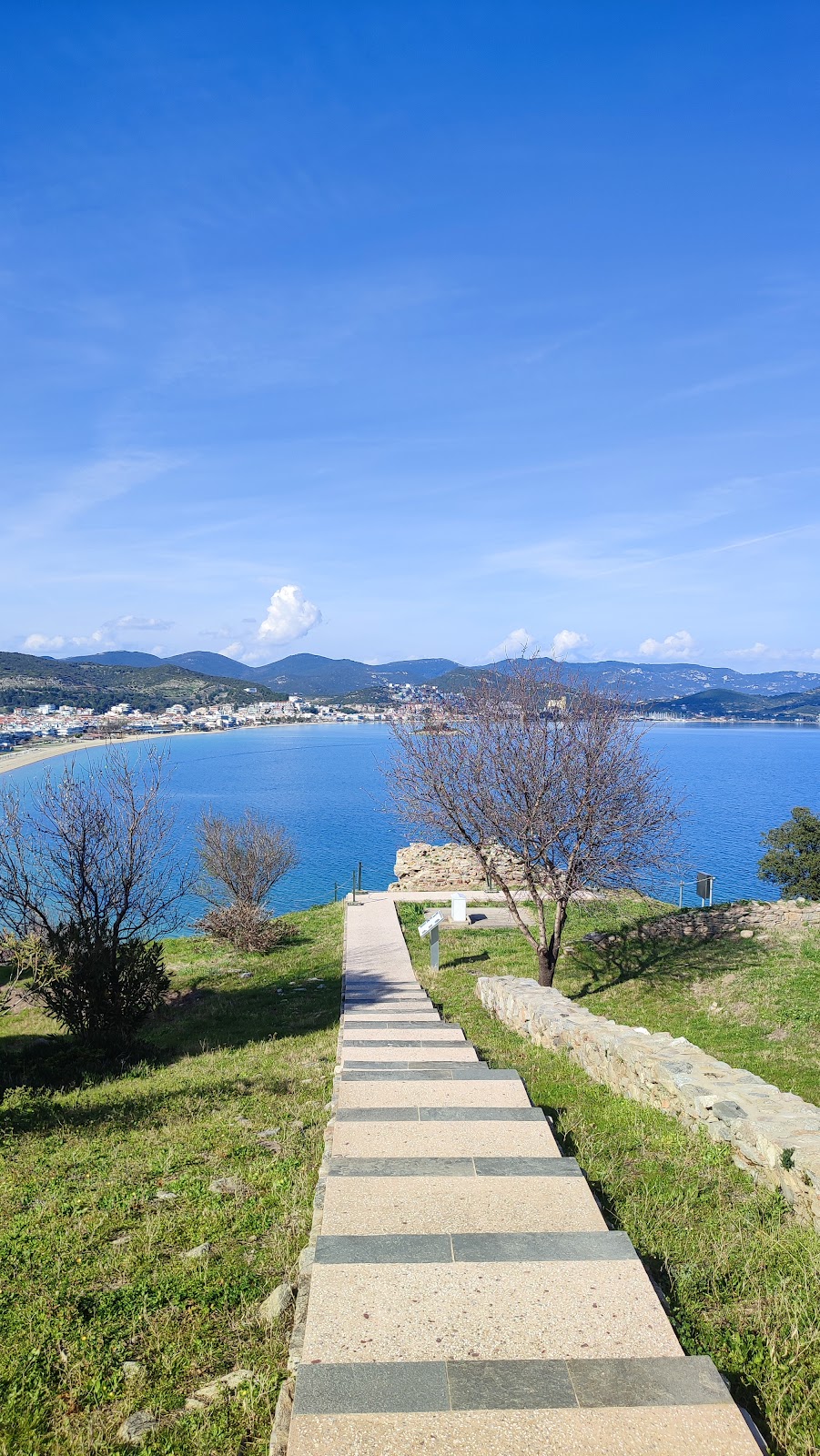
Anaktoropolis occupies the northern slope of a low hill at the southern end of the Bay of Eleftheres. The fortress extends approximately 150 metres from north to south and 100 metres from east to west. Its circuit wall encloses 1.55 hectares and follows a perimeter of 648.91 metres. Substantial sections survive, including the walling, towers, entrances, and remains connected with the settlement’s religious, water-supply, funerary, and harbour facilities.
Fortifications and entrances
Circuit wall and towers
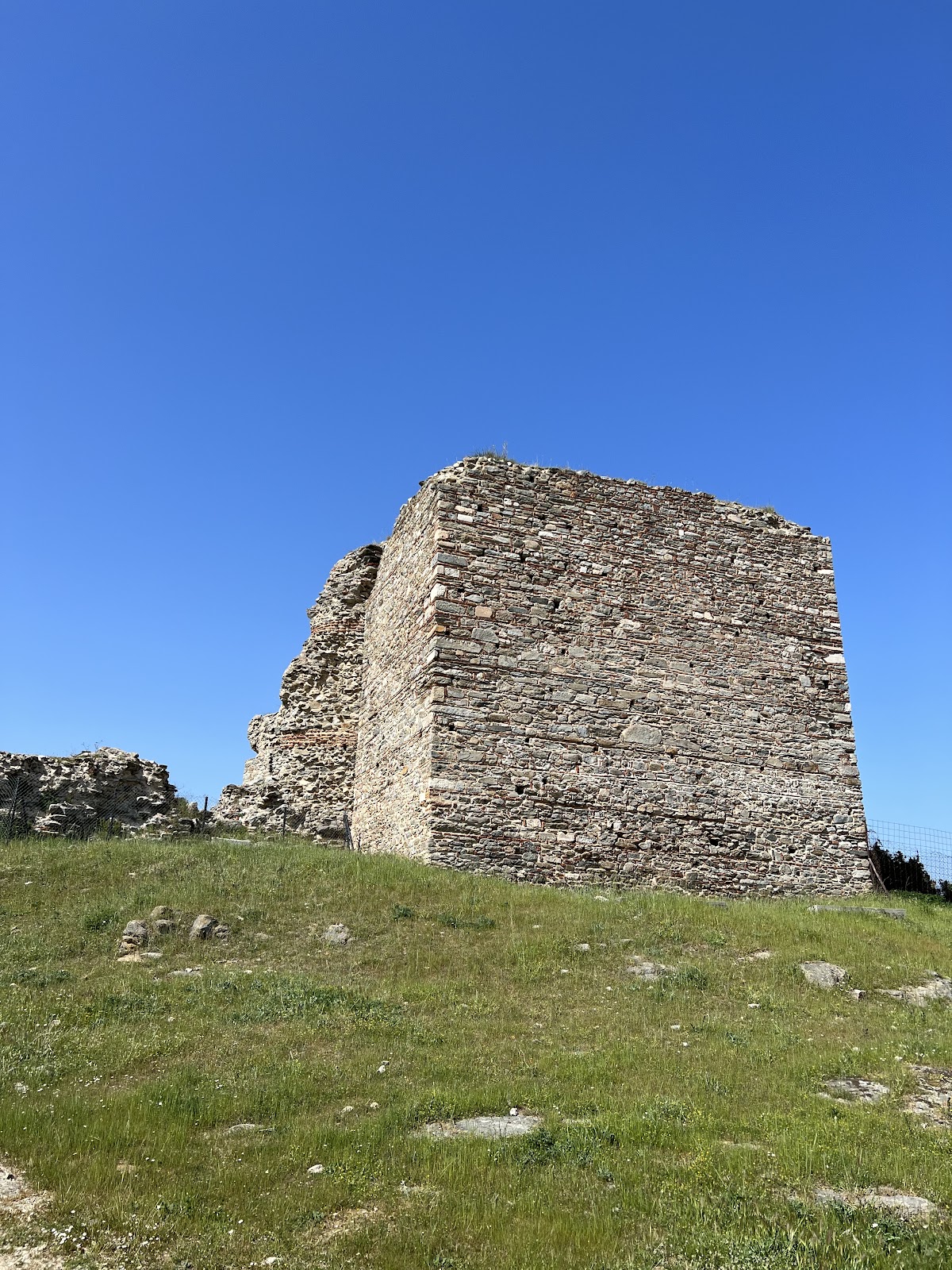
The circuit wall is about 2 metres thick. It originally rose between 6.50 and 8.50 metres above the ground, creating the principal defensive enclosure. Thirteen towers were placed irregularly around it, with shorter intervals at locations that were easier to approach. Eight towers have rectangular plans, three are round, and two are polygonal. Most stood between 7.50 and 9.50 metres high, while the powerful southeastern tower reached 11.50 metres.
Gates and outer defence
The main entrance was positioned on the western side. A northern gate connected the fortress with the harbour, and a smaller southern gate stood beside the large southeastern tower. Another entrance probably existed on the eastern side. A lower outer wall strengthened the eastern defences, adding a second line of protection to that side of the fortress.
Religious and settlement features
Chapel and bishop’s church
Foundations of a small chapel lie in the southeastern part of the fortress. Four column capitals, the upper parts of columns, were also found. They belonged to a cross-domed church, a Byzantine church type arranged around a central dome supported by a cross-shaped structure, and probably came from the bishop’s church. No further remains of that church have been identified.
Well, cemetery, and harbour
A well stood near the western gate, providing a water feature within the fortified settlement. The cemetery lay west of the fortress. To the north, in the sea, remains of the harbour mole survive, linking the enclosed settlement with its coastal setting and the harbour entrance.
Southern wall inscription
The outer face of the southern fortress wall contains an inscription made from bricks. Flat, elongated bricks were set within the masonry to form letters, but the text is heavily damaged and its meaning is only partly secure. Its date is debated. An early reading places it between 1167 and 1170. A later interpretation assigns it to the reign of Andronikos III, because the eighth indiction, a year within a recurring fifteen-year Byzantine dating cycle, occurred only once during his twelve-year reign, in 1340.
Nearby sites