Castelo de Germanelo: A Romanesque Frontier Fortress in Portugal


Site at a Glance
- Rating
- 4.1
- Popularity
- Low
- Country
- Portugal
- Primary era
- Medieval
- Eras represented
- Medieval
- Civilizations
- Portuguese
- Site type
- Military
- Remains
- Castle
On this page8 sections
History
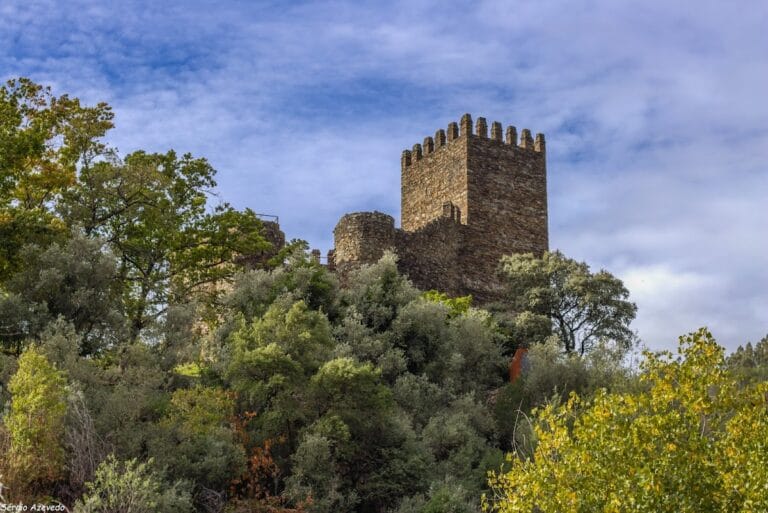
Castelo de Germanelo is a small Romanesque fortress in Portugal, near Coimbra and Penela, whose medieval construction or reconstruction probably dates to 1142. It occupies a hill near the Rabaçal Valley and was established as an advanced defensive post during the formation of the Portuguese kingdom.
Foundation as a frontier settlement
In 1142, Afonso Henriques, also known as Afonso I of Portugal and the country’s first king, created the Municipality of Germanelo and issued its charter. A charter was a formal legal instrument that set out a settlement’s rights, obligations, privileges, and government. The Germanelo charter exempted residents from taxes and offered peace, pardon, and legal immunity to people who had committed homicide, theft, or other public disturbances, provided that they took refuge at Germanelo, cultivated its lands, and defended them against enemy attacks.
The castle probably took shape or was rebuilt during this period. It stood on the Ansião to Condeixa route through the Rabaçal Valley and formed part of the defenses around Coimbra and the Mondego River against frequent Moorish raids. The hill had been occupied earlier by a Romanized hillfort, a pre-existing fortified settlement that adopted elements of Roman material culture, organization, or construction.
Abandonment and later preservation
As the frontier moved southward, Castelo de Germanelo lost its strategic purpose and was abandoned. Centuries later, its owner, the Penela historian Professor Salvador Dias Arnaut (1913 to 1995), partially reconstructed the northern section of the walls along their original line. After his death, ownership passed to his son, Salvador Jorge Arnaut.
In 2000, public mobilization led the municipal council to ask the Portuguese Institute for Architectural Heritage to classify the property as a site of municipal value, with the aim of preserving its cultural interest. Castelo de Germanelo has been classified as a Site of Public Interest since 2014.
Legend of the twin blacksmiths
A traditional legend associates the castle’s landscape with two giant twin brothers who worked as blacksmiths. One lived on Mount Melo to the north and the other on Mount Gerumelo to the south. According to the story, the southern brother angrily threw their shared hammer. Its iron head created a spring of iron-rich water at the foot of Mount Melo, while the handle, made from wild olive wood, fell farther away and gave rise to a wild-olive grove.
Remains
Hilltop enclosure
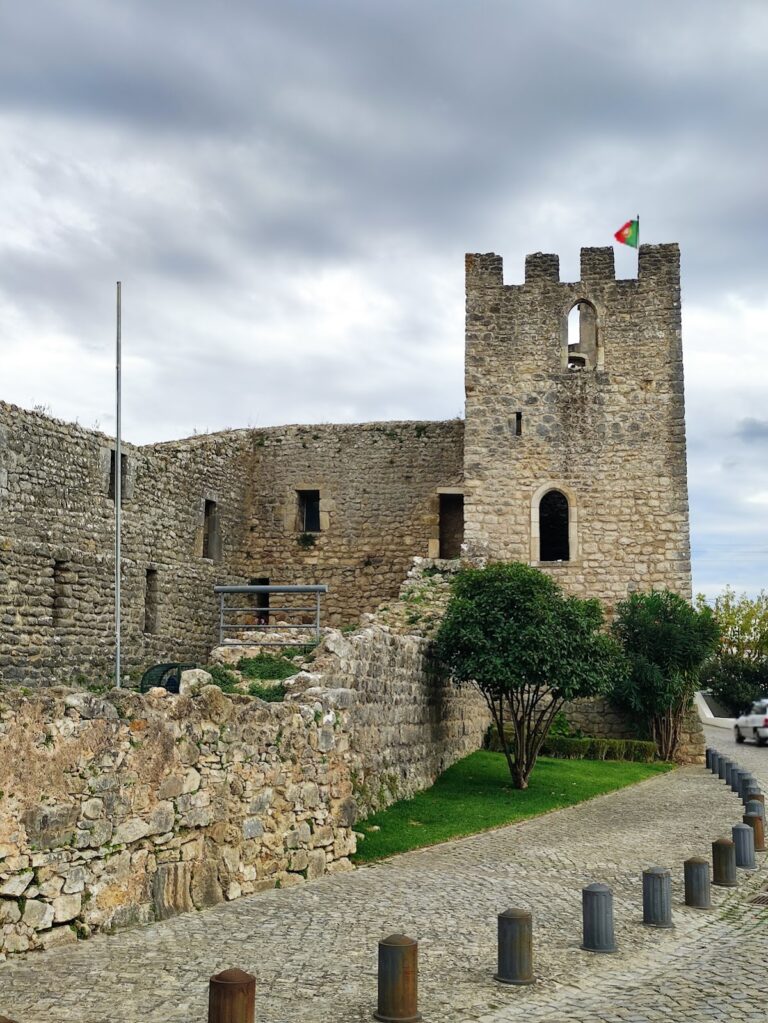
The fortress occupies the summit of a hill near Coimbra and Penela within an area of approximately 80,000 square metres that includes surrounding woodland. Its surviving enclosure is formed by crenellated walls, reflecting the strongly defensive character associated with Romanesque architecture, a medieval style known for substantial masonry, rounded arches, and fortified-looking forms.
Reconstructed northern wall
The northern section of the walls was partially rebuilt in the twentieth century, following the original alignment. This work preserved part of the historic outline while retaining the castle’s present crenellated appearance.
Geodetic marker
A geodetic marker is fixed in the castle walls. It is a precisely positioned surveying point used for geographic measurement and mapping, adding a modern measuring function to the medieval structure.