Valeria: A Roman Municipal City in Spain


Site at a Glance
- Rating
- 4.4
- Popularity
- Low
- Country
- Spain
- Primary era
- Classical
- External website
- Open
- Eras represented
- Classical, Medieval
- Civilizations
- Roman
- Site type
- City
On this page16 sections
History
Valeria is a Roman city in Spain, founded between 93 and 82 BC on land conquered from the Celtiberians. The settlement was created during the Roman period as part of a policy of establishing urban centres organized according to Roman civic institutions. It was named after its founder, the consul Gaius Valerius Flaccus, and kept its Roman name throughout its history.
Foundation and Roman administration
The area had previously been inhabited by Celtiberian and Olcade peoples and was conquered by Rome in 179 BC. Valeria did not replace a major indigenous settlement. Instead, it represented a new urban foundation that introduced Roman forms of administration and public life. The city later became an important municipium, a Roman town whose inhabitants held a recognized civic relationship with Rome and were governed through municipal institutions. Augustus granted Valeria city status.
Valeria belonged to the province of Hispania Tarraconensis and, from approximately AD 298, to the province of Carthaginensis. It was one of the three major Roman cities in the territory of the modern province of Cuenca, together with Segobriga and Ercavica. Secondary routes connected it with the road from Complutum to Carthago Nova, as well as with Ercavica and Segobriga. Pliny the Elder and Ptolemy both included Valeria in their writings.
Urban development and decline
The main period of urban development came during the first century AD, when the forum complex was constructed. Its public buildings and hydraulic installations formed the centre of civic life. The forum was later altered, and during the third century it declined as a public space. The Nymphaeum, a monumental fountain associated with nymphs and water deities, had fallen out of use by the fourth century AD and was partly dismantled after possible damage.
The Exedra, an architectural hall used for the imperial cult, also changed over time. During a renovation in the second century, its doors leading to the Cryptoporticus were blocked. After the forum ceased to function as a public area, the building was converted into a private dwelling in the fourth century. Its collapse debris remained in place while walls, room divisions, and doorways were modified. Valeria eventually disappeared as an urban centre around the middle of the ninth century.
Excavation and later history
Excavation began in the 1950s, with the first campaign and study taking place in 1951 under Francisco Suay Martínez, then mayor of Valera de Arriba. Work became systematic and more scientific from 1974, concentrating on the forum and also examining areas of private urbanism. Because much of the ruin remained visible, the modern history of Valeria has centred on excavation and study rather than on a sudden discovery.
The investigations clarified the organization and development of the public area and revealed one of the most complete Roman fora in the Meseta, the elevated interior plateau of the Iberian Peninsula. Objects recovered at Valeria led to the creation of the Museum of Cuenca; before that, they had been displayed in the lower part of the municipal building at the former Valera de Arriba. The silver-coin hoard known as the Valeria Treasure dates to approximately 185 BC, after the Second Punic War. The archaeological zone of Las Valeras has been protected as an Asset of Cultural Interest since 1977. In the medieval period, the site included a wall, the chapel of Santa Catalina, and an associated necropolis.
Remains
Valeria occupies a limestone tongue between the gorges of the Gritos and Zahorra rivers, at approximately 1,000 metres above sea level. Steep ground bounds the site, including a cliff along one side of the urban area. The walled enclosure covered about 27 hectares, and the settlement was organized around a central forum built on a large raised platform. Public buildings stood at different levels around the platform, while cisterns were incorporated beneath the forum square. Streets bounded the complex, and an articulated system of channels, including passages carved or adapted in the rock, supplied water to cisterns and monumental fountains.
Forum buildings
Basilica
The Basilica occupied the north side of the forum. This civil building was used for commercial transactions and money-changing, forming part of the public facilities arranged around the raised forum platform.
Domus Publica and Exedra
On the western side stood the pre-basilica building, or Domus Publica, together with the Exedra. The Exedra was a hall for the imperial cult, with access from the adjoining north-south street through two doors in its eastern wall. Its later conversion into a private dwelling altered its internal arrangement and left the debris from its collapse within the building.
Cryptoporticus
The Cryptoporticus was a vaulted underground gallery that served either as a covered street or as storage space. It ran along the forum platform from the Basilica to the southern edge of the complex and also supported the floor of the Exedra. A monumental staircase on the southern side led to the forum square. Shops, known as tabernae, stood beside the southern structures and in front of the Nymphaeum.
Nymphaeum and water installations
Nymphaeum
The Nymphaeum stood on the eastern side of the forum and was the characteristic monument of Valeria. It extended for approximately 100 metres overall, with more than 80 metres belonging to the fountain itself. The structure was built against a high retaining wall where the hillside fell sharply. Rectangular niches and alcoves decorated the wall, while shops stood at its foot. Their roofs formed part of a lower, elongated terrace divided into an open section overlooking the city and a covered section attached to the fountain.
A longitudinal gallery behind the terrace contained a channel linked to the city’s water tanks. Water emerged through openings in the wall’s niches and flowed into ornamental fountains below. The hydraulic supply and recovery circuit formed a substantial engineering system, of which little survives. The Nymphaeum may have been added when the forum was raised and remodelled during the first century AD, possibly in the Claudian period, although its construction is also dated more generally to the early first century AD. Its interpretation remains disputed because the structure may instead have been a vaulted drainage channel for water collected from the forum installations.
Cisterns and aqueduct channels
Four cisterns supplied the city. Aqueduct channels carved or adapted in the rock connected the water system with the cisterns and monumental fountains. The cisterns were built into the forum platform, beneath the square, and formed part of the infrastructure that supported the public complex.
Private houses and medieval remains
Roman houses
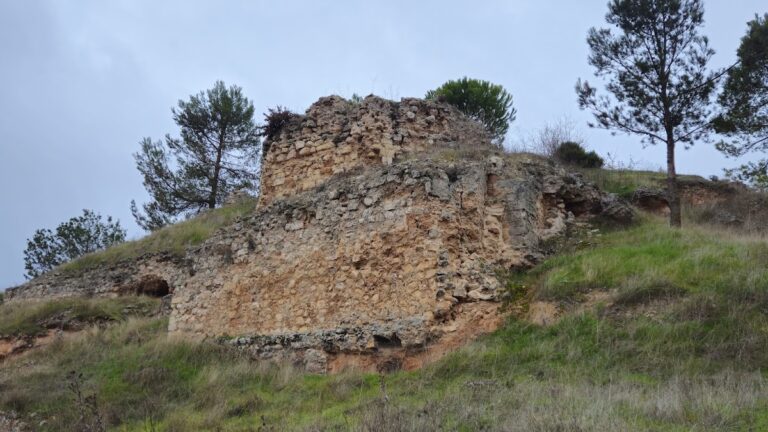
The House of the Adobe stood among the buildings on the southern side of the forum. Other examples of private urbanism include the House of the Hoyo and the Hanging House. Roman dwellings at Valeria included rectangular houses built on terraces, as well as hanging houses whose openings faced the cliff. Their beams were set into the rock, leaving half of each dwelling suspended over the void.
Medieval structures
The medieval remains include the wall, the chapel of Santa Catalina, and the chapel’s associated necropolis. These features represent a later phase of occupation on the site after Valeria had ceased to function as a Roman urban centre.
Recovered objects
The Valeria Treasure consists of silver coins dating to approximately 185 BC. Recovered objects from the site are preserved in the Museum of Cuenca, where they contribute to the interpretation of Valeria’s early history and its later Roman development.