Segóbriga Archaeological Park: A Celtiberian and Roman City in Spain



Site at a Glance
- Rating
- 4.6
- Popularity
- Medium
- Country
- Spain
- Primary era
- Classical
- External website
- Open
- Eras represented
- Classical, Medieval
- Civilizations
- Celtiberian, Roman, Visigothic
- Site type
- City
On this page23 sections
History
Segóbriga Archaeological Park is the ruined Celtiberian and Roman city of Segóbriga near Saelices in Spain. Occupation of the area reaches back to the fifth century BC, while the city developed into a Roman urban center whose major monumental buildings were completed largely during the Flavian period in the first century AD. Its elevated status, regional administration, communications, coinage, and gypsum trade made it an important center in inland Hispania.
Origins and the Celtiberian city
Segóbriga stood on the hill of Cabeza de Griego, overlooking the basin to the north. The area was associated with ancient peoples such as the Olcades and Carpetani, who belonged to the wider population of inland Iberia known as the Celtiberians. The name Segóbriga probably combines the Celtiberian elements sego-, meaning “victory,” and -briga, meaning “city” or “fortress.” It can therefore be understood as “Victory City” or “Victorious City.”
The earliest settlement at the city site may have been a fortified Celtiberian settlement. Its defensive position was supported by the Cigüela River, which formed a natural ditch along the northern basin. The remains of that settlement have not been identified, although a fragment of Attic pottery places occupation in the fifth century BC. The first settlement may also have stood somewhat farther away before the community moved to the hill.
A separate Bronze Age burial site was found in the nearby Segóbriga Cave in 1888. Cut into limestone, the cave contained a collective burial dating to the second millennium BC, with human remains and everyday tools and supplies. The discovery was published in 1893 and provides evidence for activity in the surrounding landscape long before the urban history of Segóbriga.
Conflict and Roman conquest
The Greek geographer Strabo preserved the first brief reference to Segóbriga. He associated the city with fighting between the Roman commander Quintus Caecilius Metellus Pius and Sertorius, a Roman military leader who headed a major rebellion in Hispania. The conflict formed part of the Sertorian Wars, fought approximately from 80 to 72 BC. The earlier Olcade settlement was devastated during this period and was replaced by Roman Segóbriga.
Earlier Roman expansion had already brought the region into the wars of conquest against the Celtiberians in the early second century BC. After that conquest, Segóbriga became a Celtiberian oppidum, meaning a fortified urban settlement. Sextus Julius Frontinus later described two attacks on Segóbriga by Viriathus, a Lusitanian leader who resisted Roman expansion in Hispania. The attacks probably took place in 146 BC and were connected with the city’s alliance with Rome. One account involves an ambush during cattle raiding, while another places the people of Segóbriga at a sacrifice when Viriathus attacked. The suggestion that the sacrifice was a funerary rite for those killed in the first encounter remains uncertain.
Territorial center and Roman municipium
After the Sertorian Wars, Segóbriga became the center of a large territory covering much of the western half of the present province of Cuenca. Its territory extended broadly from the Bascuñana range and the Júcar River toward the borders of Madrid and Toledo. Pliny the Elder called Segóbriga the caput Celtiberiae, or “head of Celtiberia,” and placed it toward Clunia, probably near the boundary between the Celtiberians and Carpetani.
Pliny also described Segóbriga as a stipendiary city within the administrative and judicial district, or conventus, of Carthago Nova, the Roman city now known as Cartagena. A stipendiary city was subject to Rome and paid tribute without possessing the higher civic status of a Roman municipium. That position changed during the reign of Augustus, around 12 BC, when Segóbriga became a municipium. Its inhabitants then operated under Roman municipal institutions and possessed Roman citizenship or civic rights.
The promotion stimulated economic growth and a major program of monumental construction. Much of this work was completed during the Flavian period, the reigns of Vespasian and his successors Titus and Domitian, around AD 80. Segóbriga also became an important communications center and issued coinage from its own mint. By the end of Vespasian’s reign, its theatre and amphitheatre were complete and the city was fully integrated into the social and economic structures of the Roman Empire.
Gypsum wealth and local elites
A major source of prosperity was lapis specularis, a translucent form of gypsum that could be split into thin sheets and used in windows as an ancient substitute for glass. The material was extracted from deep wells in the region around Segóbriga. One mine near Carrascosa del Campo was connected with a manufacturing and mining settlement serving the city, while related remains extend across several municipalities in Cuenca.
The gypsum trade enriched local families, some of whose members entered the Roman Senate. Manio Octavio Novato, a Roman senator and son of a praefectus fabrum, a Roman military engineering or technical officer, became the principal patron of the theatre. His family’s villa at present-day Noheda was linked with the place-name derived from Novata, a name associated with his cognomen Novatus.
Late antiquity and the Visigothic period
Important urban elites still lived at Segóbriga in the third century. During the fourth century, however, the principal monuments were abandoned and the settlement progressively changed into a rural center. From the fifth century onward, it remained an important settlement under the Visigoths. Finds made between 1760 and 1790 revealed several basilicas and an extensive necropolis, or cemetery.
The city retained an ecclesiastical role during this period. Its bishops attended the Third Council of Toledo in 589 and the Sixteenth Council of Toledo in 693. The Visigothic basilica of Cabeza de Griego stood outside the city walls, while other basilicas are known from archaeological remains.
Medieval abandonment and modern protection
Segóbriga’s final depopulation probably began after the Muslim conquest of the Iberian Peninsula, when its bishops and governing elites fled north toward Christian kingdoms. A Muslim fortification was established on the summit of the hill. After the Christian Reconquista, the surrounding population moved to Saelices, about 3 km north, beside the spring that supplied the ancient aqueduct.
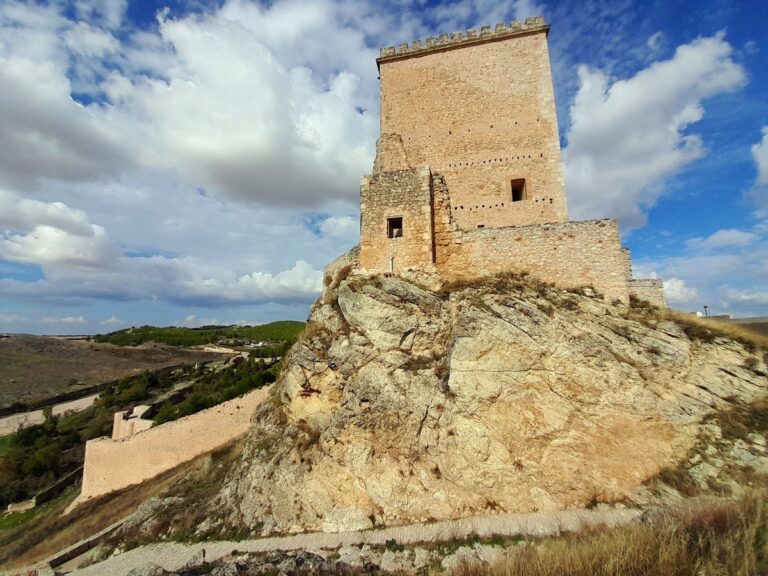
The ancient name gradually disappeared, and the hill became known as Cabeza del Griego. Its small rural population depended on Uclés, about 10 km away. The convent-fortress at Uclés was built partly with ashlar blocks taken from the ruins. Abandonment continued until only a small hermitage, built over the ancient monumental baths, remained as the last surviving structure associated with the city.
The hill was declared a Historic-Artistic Monument in 1931. In 2002, the Segóbriga Archaeological Park received protected cultural heritage status, with its archaeological zones entered under two official heritage-registration identifiers. A proposed wind farm later threatened the archaeological landscape and the Historic Site of Uclés with fourteen turbines, each 121 m high. The project led to the park’s inclusion on Hispania Nostra’s Red List of endangered heritage. After the wind farm was moved to Honrubia, both historic complexes entered the association’s Green List in 2018.
Remains
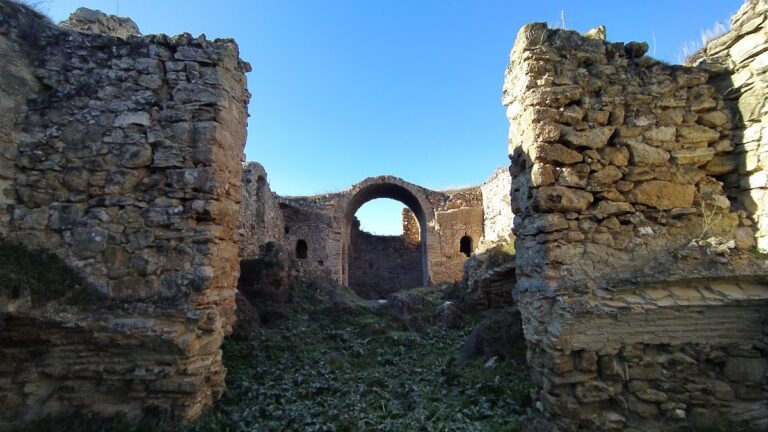
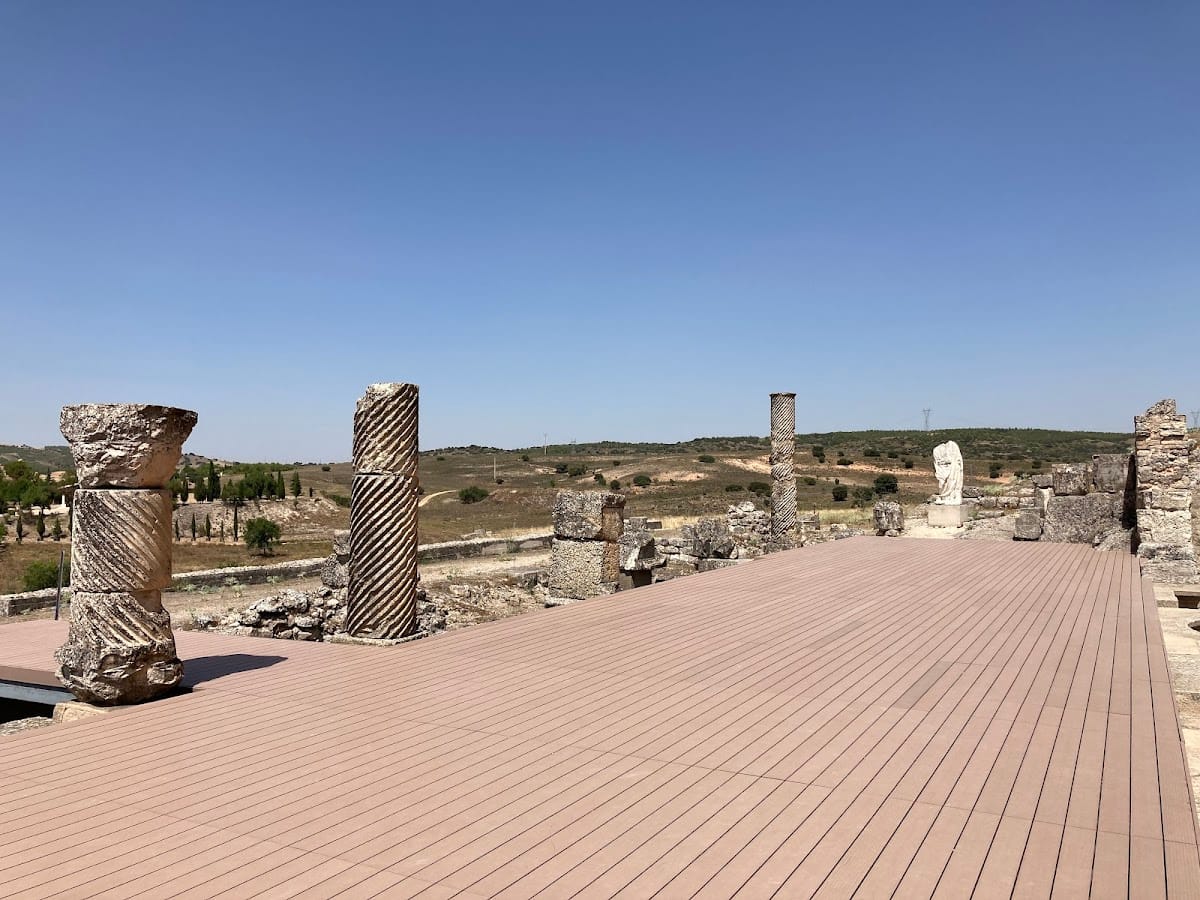
The archaeological park occupies the hill of Cabeza de Griego, where the ruined city remains comparatively well preserved. Its visible layout includes the Roman defensive wall and North Gate, civic and religious buildings, entertainment venues, bathing complexes, an unfinished circus, and remains outside the walls. The earlier Celtiberian defenses have not been identified, although the northern basin and the Cigüela River formed part of the settlement’s defensive setting.
City walls and civic buildings
North Gate and defensive wall
The Roman city was enclosed by a wall that included a North Gate. Part of the wall belongs to the monumental building program associated with Segóbriga’s promotion to municipium and the later Flavian period. The defensive circuit formed the principal boundary of the Roman settlement, while several important structures, including the circus, sanctuary, aqueduct, quarries, and Visigothic basilica, lay outside it.
Forum and acropolis
The Roman urban complex included a forum, the civic public square, and an acropolis, the high or fortified part of a city. These formed part of the built environment that developed as Segóbriga acquired municipal status and expanded its public architecture. The surviving remains are preserved within the archaeological park together with the other visible components of the Roman city.
Theatre and amphitheatre
Theatre
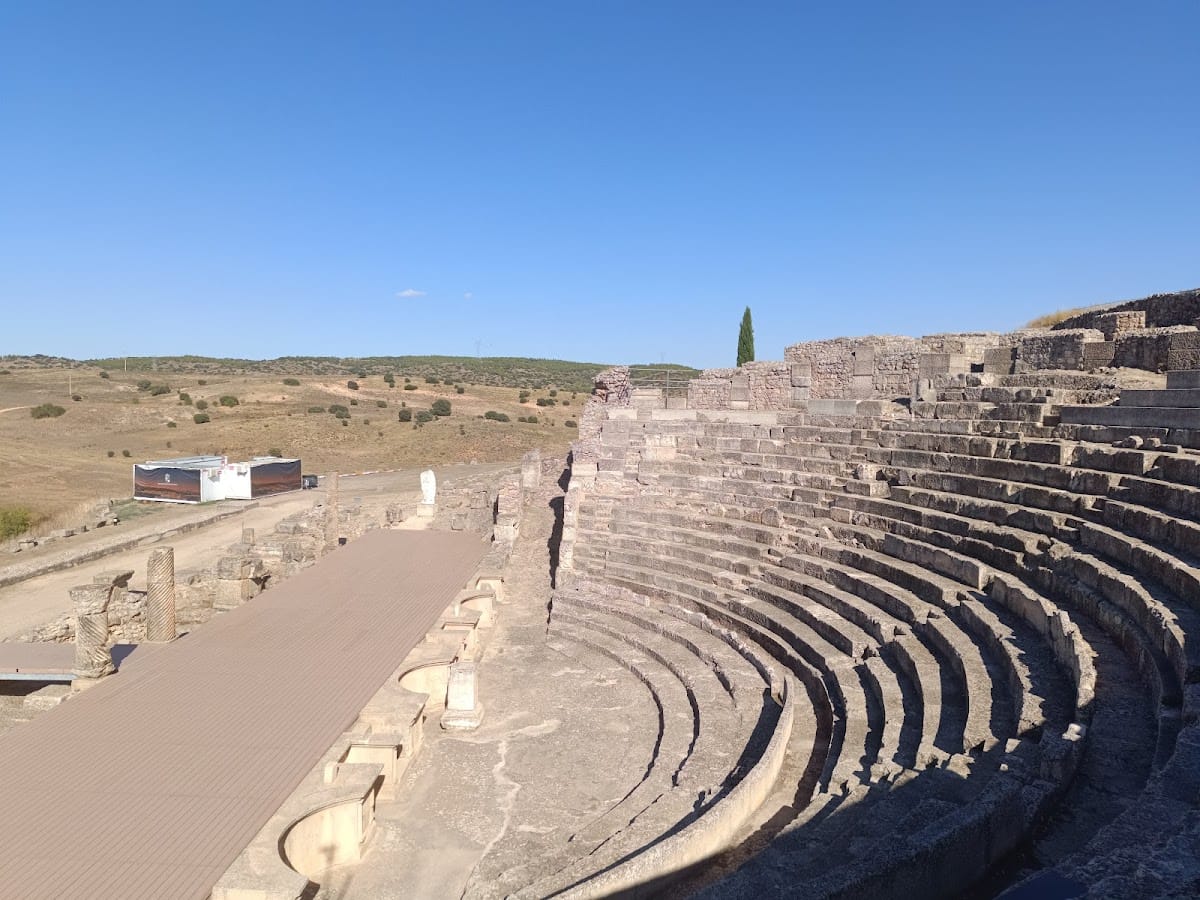
Construction of the theatre began during the reign of Tiberius and probably ended under Vespasian around AD 79. Its seating is relatively well preserved and was divided into three sections, separating spectators according to social class. The theatre also had an associated gymnasium and bathing complex, linking public performance with exercise and bathing facilities.
Amphitheatre
The amphitheatre stood opposite the theatre and was complete by the end of Vespasian’s reign. It has an elliptical plan measuring approximately 75 m in length and could accommodate about 5,500 spectators. Together, the two buildings formed the principal entertainment complex of the Roman city and were among the monuments completed during its period of greatest urban development.
Baths, water supply, and production
Monumental baths
The monumental baths formed one of the principal Roman complexes at Segóbriga. The theatre’s associated gymnasium and bathing facilities were also part of the city’s public architecture. A small hermitage was later built over the ancient monumental baths and remained as the last surviving structure connected with the abandoned settlement.
Aqueduct and quarries
An aqueduct outside the walls brought water from the spring near present-day Saelices to the ancient city. The site also included quarries outside the walls, providing building material for the urban complex. Their relationship with the city’s construction reflects the infrastructure needed to sustain its monumental development.
Lapis specularis mines
The economic landscape extended beyond the city to the regional mines of lapis specularis. Workers extracted the translucent gypsum through deep shafts, producing sheets suitable for window panes. Near Carrascosa del Campo, a mine was associated with a manufacturing and mining enclave serving Segóbriga. Other mining remains occur in several Cuenca municipalities connected with the same regional industry.
Religious and funerary areas
Diana sanctuary
A rock sanctuary dedicated to Diana stood outside the city walls. Diana was a Roman goddess associated especially with the countryside, hunting, and the moon. The sanctuary formed part of the religious landscape beyond the urban boundary.
Circus and necropolis
The Roman circus, a venue designed primarily for chariot racing, was built over a necropolis outside the walls but remained unfinished. A separate Celtiberian necropolis also lay outside the city. These funerary areas and the later circus represent successive uses of the space surrounding the urban settlement.
Visigothic basilicas
The Visigothic basilica of Cabeza de Griego stood beyond the Roman walls. Several other basilicas are known from archaeological remains, together with an extensive necropolis associated with the late-antique settlement. Their remains reflect the continuing religious importance of Segóbriga after the principal Roman monuments had been abandoned.
Segóbriga Cave
The nearby Segóbriga Cave is cut into limestone and contained the collective Bronze Age burial discovered in 1888. Human remains, everyday tools, and supplies were found within the cave. Dating to the second millennium BC, the burial belongs to a period many centuries earlier than the Celtiberian and Roman city and extends the archaeological history of the surrounding landscape beyond the hilltop settlement.