Masyaf Castle: A Nizari Ismaili Fortress in Syria


Site at a Glance
- Rating
- 4.8
- Popularity
- Low
- Country
- Syria
- Primary era
- Medieval
- Eras represented
- Classical, Medieval, Early Modern
- Civilizations
- Byzantine, Mamluk, Nizari Ismaili State, Ottoman, Roman
- Site type
- Military
- Remains
- Castle
On this page21 sections
History
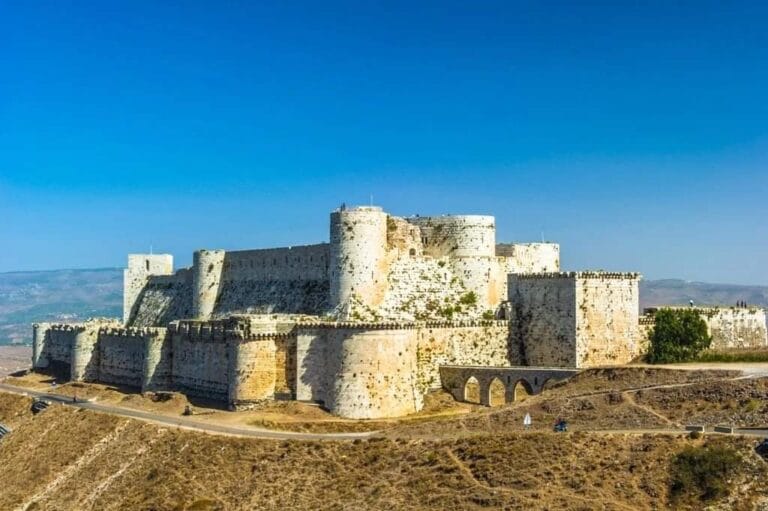
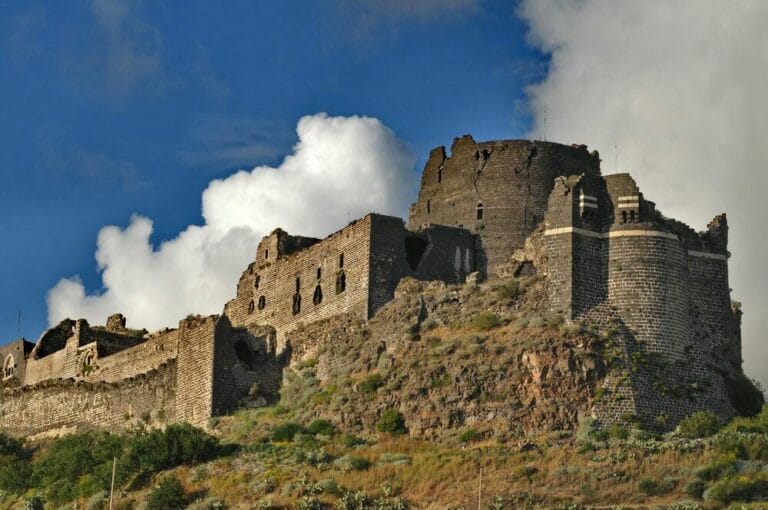
Masyaf Castle is a fortified site in Syria, situated in the town of Masyaf in the Orontes Valley about 40 kilometres west of Hama. Its lower foundations are Byzantine, while its most important surviving phase belongs to the Nizari Ismaili period of the twelfth century. Built and altered over several centuries, the castle controlled routes leading inland and protected approaches to other Ismaili strongholds in the Syrian Coastal Mountain Range.
Roman and Byzantine foundations
The castle’s original construction date remains uncertain. One proposed date places Roman fortifications and military positions at Masyaf in 44 BC, when major routes through the region were being controlled. Archaeological investigation has identified Byzantine layers and foundations beneath later work, linking the earliest substantial remains to the eastern Roman Empire, whose Syrian territories retained Roman military and administrative traditions.
Under the Umayyads, Masyaf was attached to Homs. It later came under the Tulunids of Egypt, and its strategic value increased under the Ikhshidids and Hamdanids as ruling powers in Syria and Egypt competed for control. The Hamdanids held the site in 967 under Sayf al-Dawla, a ruler based in Aleppo. The Byzantines seized it in 969 under the emperor and commander Nikephoros Phokas. Masyaf subsequently passed to the Fatimids, the Mirdasids, and, by 1081, the Munqidhids of Shaizar.
Rival dynasties and the Ismaili takeover
In 1101, Masyaf was held by the Mirdasid prince Wathab ibn Mahmud ibn Nasr ibn Salih of the Banu Kilab, who died there that year. His son, Nasr al-Din Sabiq, sold the castle in 1127 to Izz al-Din Abu al-Asakir Sultan ibn Munqidh, a ruler of the Munqidh family of Shaizar. Sultan appointed Sanqur as governor.
Raymond of Saint-Gilles, a leading Frankish commander during the First Crusade, briefly captured Masyaf in 1103 while advancing toward Tripoli. The Ismailis seized the fortress from Sanqur in 1141, killing him in the process, and then strengthened its defenses. From the middle of the twelfth century until the end of the thirteenth century, Masyaf and the surrounding town served as the capital of a Nizari Ismaili emirate. The Nizari Ismailis were a Shia Ismaili community that maintained fortified centres in Syria and emphasized the authority of the Nizari line of Ismaili imams.
Rashid al-Din Sinan and the Ayyubid period
Masyaf became particularly associated with Rashid al-Din Sinan, the leader of the Syrian branch of the Nizari Ismailis. He ruled from the castle between 1166 and 1193 and directed a major phase of refortification. Medieval European writers often called the Nizaris the “Assassins,” while the title “Old Man of the Mountain” became associated with Sinan.
Saladin, founder of the Ayyubid dynasty, besieged Masyaf in May 1176. The siege ended shortly afterward in a truce with Sinan, and the castle remained in Nizari Ismaili possession. A later rebuilding phase at the end of the twelfth century added new defensive works, while a palace was constructed in the upper fortress at the beginning of the thirteenth century.
Mongol and Mamluk control
In 1260, Masyaf was surrendered to the Mongols together with three other Nizari fortresses. Later that year, the Nizaris allied with the victorious Mamluks and recovered four castles, including Masyaf. The Mamluk sultan Baybars took control of Masyaf in 1270. The Mamluks, a military ruling dynasty that governed Egypt and Syria from the thirteenth to the sixteenth century, altered the castle after taking possession, including a major restoration of its entrance.
Masyaf continued to have a military role in the early fifteenth century. Its bathhouse reportedly remained in use until the Tatar invasion of 1401. These later phases added to a fortress whose fabric already contained Roman, Byzantine, and Nizari Ismaili elements.
Ottoman, local, and modern phases
After the Ottoman conquest, an Ottoman garrison occupied the castle from the second half of the sixteenth century. Masyaf then served as a provincial administrative centre. By the end of the eighteenth century, the fortress had become the residence of a ruling Nizari Ismaili family. In 1793, Prince Mustafa al-Mulhim built a residence on the eastern side of the outer castle. Public housing later spread through the fortress, which remained inhabited until the French Mandate, the period of French administration over Syria from 1920 to 1946. A French garrison also occupied the castle during that period.
In 1808, Nusayris, also known as Alawites, killed the Ismaili emir of Masyaf and seized the castle. The Ismailis later recovered it through mediation by Ottoman authorities. During the 1830s, troops commanded by Ibrahim Pasha, the Egyptian governor and military commander, caused serious damage to the castle and to Ismaili villages while suppressing a Syrian revolt.
Restoration by Syria’s Directorate-General of Antiquities and Museums, in cooperation with the Aga Khan Trust for Culture, began in 2000 and ended in 2005. The work removed extensive debris and exposed chambers, passages, coins, and twelfth-century pottery. Most of the restoration used hand methods, traditional techniques, and historically similar materials. Cement repairs made during the 1980s were replaced with more traditional materials. The castle remains part of Masyaf’s urban fabric. During the French Mandate, a circular road was laid around it, while the surrounding settlement continued to incorporate the fortress.
Remains
Masyaf Castle occupies a rocky platform approximately 20 metres above the surrounding plain. Its inner fortress stands on the elevated southern part of a rocky plateau and has an approximately square plan. An outer wall follows the edge of the plateau, while successive building campaigns added towers, halls, passages, terraces, and defensive layers around the central stronghold. The surviving remains are predominantly associated with the Nizari construction phase of the twelfth century, although Mamluk and Ottoman work was added over earlier Roman and Byzantine fabric.
Inner fortress and outer defenses
Inner fortress
The inner fortress has nearly rectangular corner towers arranged on two defensive levels. At ground level, these enclose a central open courtyard. A further enclosure wall surrounds the upper rocky plateau, where five rectangular supporting towers form the upper fortress. Lower vaults resting directly on the rock belong to the Roman and Byzantine structural phases, while later construction incorporated and extended these foundations.
Outer fortifications
The outer wall traces the edges of the rocky platform and contains rectangular towers fitted with small arrow slits, narrow openings used for defensive shooting. Later strengthening added rectangular and polygonal towers built from large and small stones. In both the inner and outer defenses, older walls were in places covered or reinforced by double walls. Repeated earthquakes brought down peripheral sections that lacked firm foundations on the underlying rock, leading to successive repairs and alterations.
Entrance passages and defensive works
Main entrance
The principal entrance is at the southwest corner of the outer castle. Its Arabic-Islamic arrangement consists of two large halls connected by a long passage. The route turns at a right angle from the first hall into the second. From there, the passage opens into a space with two routes leading farther into the fortress.
Rock-cut routes
The main route runs north to a passage approximately 65 metres long. Sections of this passage were cut into the rock, and its western side contains a series of arrow slits and towers. A third large hall closes the passage at its far end and gives access to the castle’s interior. The second route runs south through a doorway cut into the rock and reaches the upper part of the fortress by a stairway made within the rock mass.
Polygonal towers and outer gate
The refortification associated with Rashid al-Din Sinan added polygonal towers, particularly along the western and northern sides. Each had five large arrow slits distributed across two defensive levels. Halls were built in the space between the inner and outer walls. A smaller projecting gate was later placed in front of the original entrance, strengthening the approach, and a fortified area was constructed outside it.
Palace, bathhouse, and water systems
Upper palace
A palace was built in the upper part of the inner fortress at the beginning of the thirteenth century. Its finely decorated doorway carries an inscription naming Kamal al-Dunya wa al-Din al-Hasan ibn Masud and giving the date 1226. The doorway provides a surviving link between the upper fortress and the building activity of the Nizari Ismaili period.
Bathhouse and concealed passage
The fortified area outside the projecting gate included a bathhouse dated to the middle of the thirteenth century. Restoration also exposed old public baths and a tunnel believed to have served as a secret escape passage. These features belong to the castle’s later defensive and communal infrastructure.
Rainwater channels and cisterns
A system of channels directed rainwater into cisterns beneath the castle. A cistern is a reservoir used to store water. The channels and underground reservoirs formed part of the fortress’s water-management system within its rocky setting.
Archaeological finds
Pottery and glass
Excavations recovered pottery including bowls, dishes, and jars. Some vessels were made locally, while others came from Raqqa, Hama, and Damascus. Glazed examples provide evidence of ceramic technology available in the region. Glass fragments included pieces bearing an impression of a Chinese character. These finds have been interpreted as evidence that Masyaf lay along the Silk Road and received products from the East and Iran during the medieval period, especially under the Ayyubids.
Coins
Three hundred and sixty coins came from pre-Islamic, Islamic, Mamluk, Ottoman, and later periods. The collection includes eleventh-century Byzantine imperial coins; coins connected with the twelfth- to fourteenth-century rule of Nur al-Din Zengi, Saladin, and al-Malik al-Zahir Ghazi; and Mamluk coins dating from the fourteenth through the sixteenth century. It also includes a Mongol coin from the period of Hulagu and currency from the Ottoman period.
Two coins are associated with the First Crusade in the late eleventh or early twelfth century, including one struck in southern France. Another important piece was minted in Germany in the sixteenth century and is associated with a major feudal family. Together, these coins reflect the succession of political powers at Masyaf and its commercial connections with Europe through the Ottoman Empire.