Castello di Monte Tauro: The Lower Fortress of Taormina


Site at a Glance
- Rating
- 4.3
- Popularity
- Low
- Country
- Italy
- Primary era
- Medieval
- External website
- Open
- Eras represented
- Medieval
- Civilizations
- Byzantine, Kingdom of Sicily, Norman
- Site type
- Military
- Remains
- Castle
On this page7 sections
History
Castello di Monte Tauro is a medieval fortress in Taormina, Italy, occupying the lower acropolis of the ancient Greek and Roman city of Tauromenion. Its earliest fortification probably dates from the Byzantine period, when the eastern Roman Empire governed Sicily, and the site served as a defensive outpost against Arab attacks. In the ancient defensive arrangement, Monte Tauro formed the castrum inferius, or lower fort, while the upper acropolis and castrum superius, or upper fort, stood at present-day Castello di Mola.
Byzantine and Arab struggles
Protohistoric settlements have been identified on Monte Tauro, and a Byzantine garrison was stationed at the fortification. In the ninth century, Constantine Caramalo, a Byzantine patrician and Taormina’s last military governor, strengthened the fortifications of Castelmola. Taormina and its stronghold resisted the first Arab invasion of Sicily for a prolonged period.
In 827, Eufemius, prefect of Sicily, allied with Ziyadat Allah I and handed the island to Asad ibn al-Furat, beginning the conquest that established the Emirate of Sicily, the Muslim polity that ruled much of the island before the Norman takeover. In July 902, Ibrahim II besieged Taormina and captured it in August during the reign of the Byzantine emperor Leo VI the Philosopher. The inhabitants were massacred, although the Taorminese later retook the city when Arab forces temporarily withdrew.
Arab forces besieged Taormina again in 961 and 962 under the governor Achmed and the commander Alcaid-Ben-Ammer. After about five months, the city capitulated. The Byzantine emperor Nikephoros II Phokas attempted to recover Sicily, entrusting the expedition to Patrikios Emanuele in 964 and 965. Taormina was definitively captured after a five-year siege that ended in 969. Sicily was then divided into five administrative units governed from Taormina, Palermo, Messina, Syracuse, and Trapani.
Norman and Frederician rule
Count Roger I of Sicily ended Arab rule at Taormina in the late 1070s. During the siege, he blockaded the port and constructed twenty-two wooden towers around the city to restrict communication and supplies. The Arab defenders and the population within the fortifications eventually surrendered, bringing Monte Tauro into the Norman sphere.
In 1134, control of the settlement was assigned to the monastery of San Salvatore della Placa near Francavilla di Sicilia, making the fortress a coastal outpost of the monastery. By about 1150, a defensible fortress on the summit of the rock was being distinguished from the fortified settlement. The geographer al-Idrisi described it in the Book of Roger, a geographical work compiled at the Norman court of Roger II, in 1154.
During the reign of William II of Sicily, known as William the Good, the castle returned to military custodians. Under Frederick II of Swabia, the medieval Holy Roman emperor and king of Sicily, it was entrusted to a noble castellan. Although its origins were Norman, the surviving structure is characterized mainly by Frederician features, associated with Frederick II’s architectural and political period. In 1239, members of the Lucchesi Palli family, military captains previously appointed by Queen Margaret of Navarre, were reconfirmed by Frederick II.
Aragonese administration and religious transformation
A document of 1353 distinguishes Monte Tauro from the castle of Mola and identifies it with the lower castrum inferius. Under the Aragonese rulers, royal appointees continued to administer the castle. Recorded castellans and captains included Riccardo Marchese, Bernardo Orioles, Federico Spadafora, and Pietro Candiani. Spadafora became castellan and governor in 1391, while Candiani served as captain in 1435 under Alfonso V of Aragon.
During the Spanish viceregal period, the site acquired renewed religious importance through worship dedicated to the Madonna della Rocca, a title meaning “Madonna of the Rock” and referring to the Virgin Mary. Girolamo Campolo was appointed captain around 1500, Antonio Balsamo held the captaincy before 1538 under Charles V, and Giacomo Balsamo became vicar-general of Taormina in 1547. The Sanctuary of the Madonna della Rocca was founded around 1640, with the devotion supported by Geronimo Venero, archbishop of Messina.
After the sixteenth century, the castle’s military importance declined and it partly fell into ruin. It is recognized as Italian national heritage.
Remains
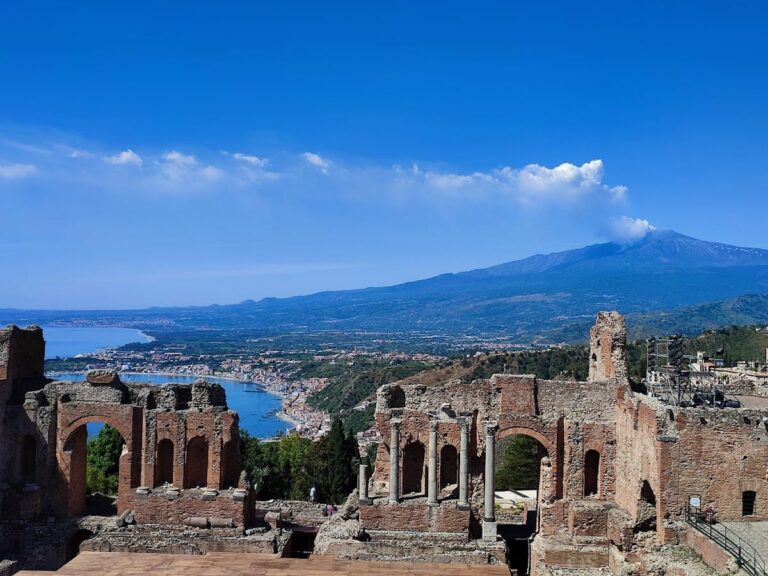
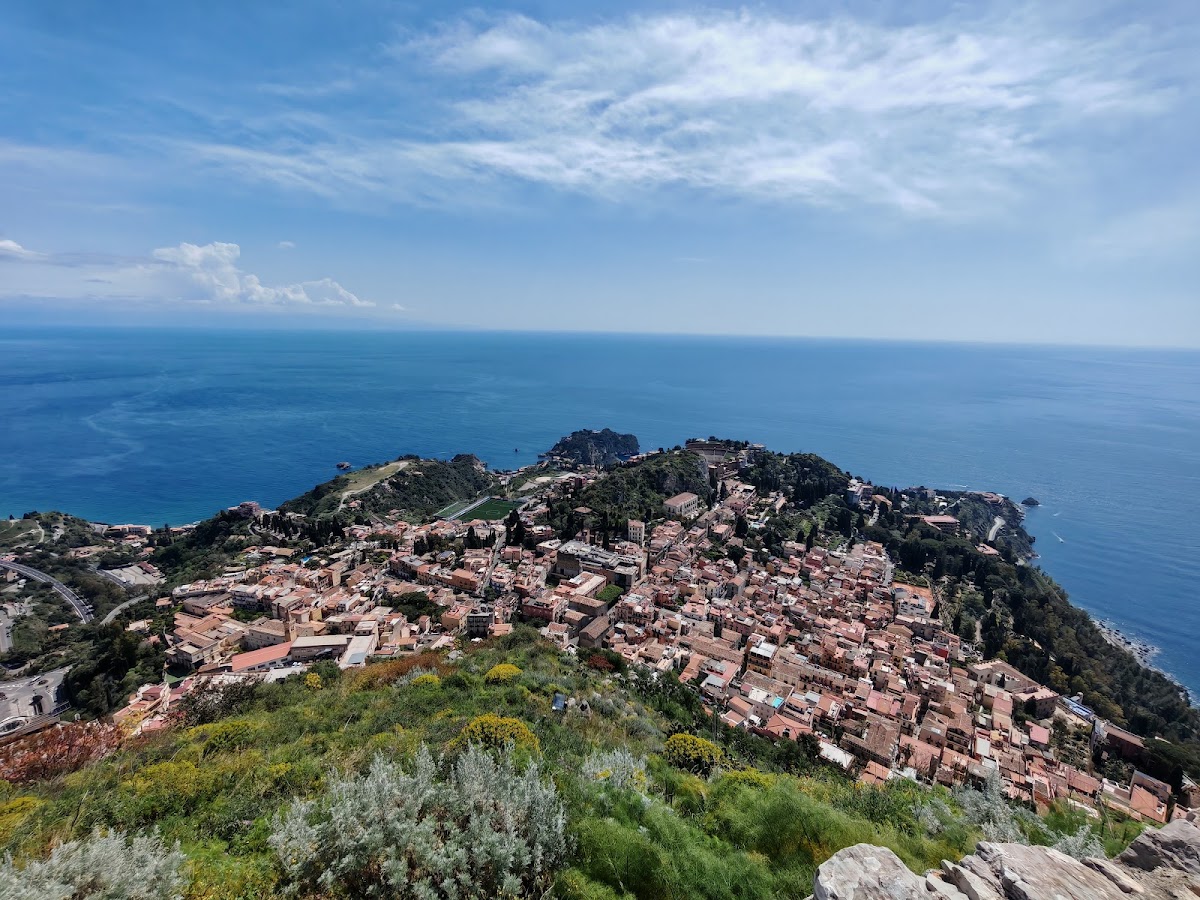
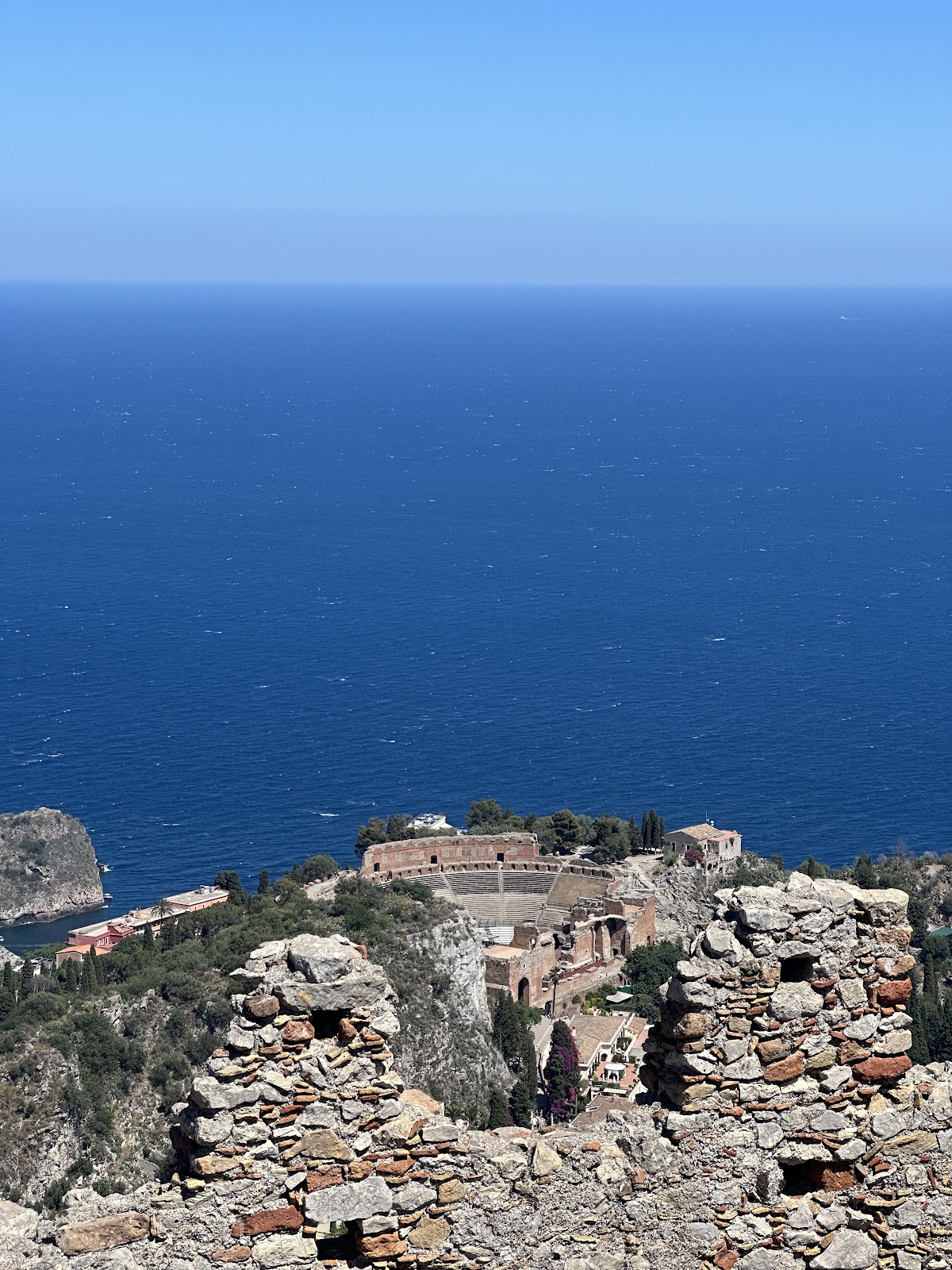
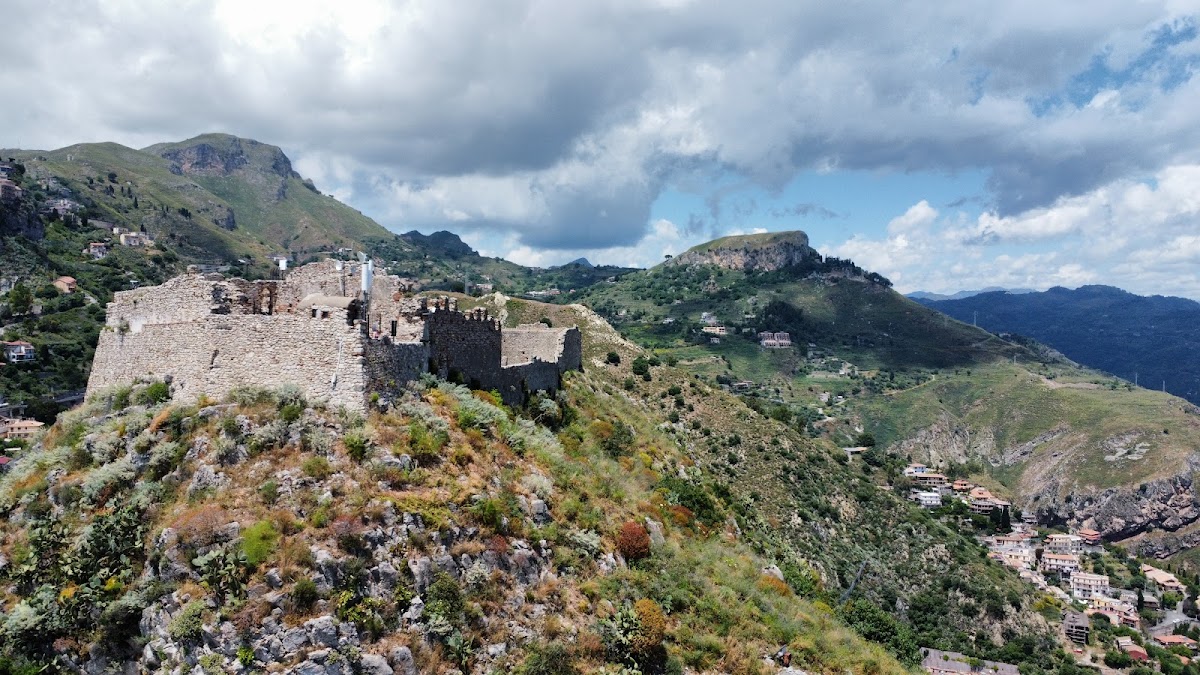
Castello di Monte Tauro stands on the rocky summit of Monte Tauro at approximately 397 to 400 metres above sea level. Its elevated position overlooks the Ionian coast, with the Strait of Messina to the north, the Alcantara valley and the lower slopes of Mount Etna to the south, Catania visible in the distance, and the Peloritani Mountains to the west. The position controlled the coastal road between Messina and Catania and formed the lower level of a defensive system paired with the higher fortification at Mola.
Fortress structure
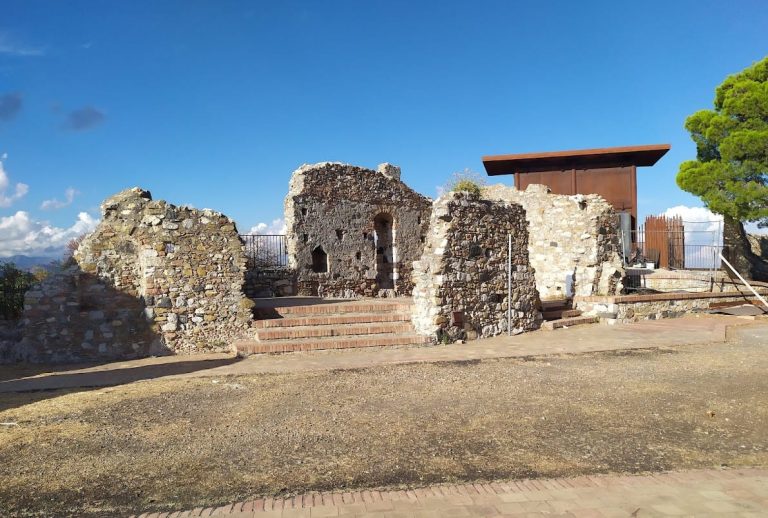
The castle has a trapezoidal ground plan. Its outer walls survive, while the interior walls and roof timbers have collapsed. The first fortification probably belonged to the Byzantine period, but the date of construction of the later castle remains uncertain. Norman alterations followed, and the surviving form is characterized mainly by Frederician architectural features.
Repairs and modifications to the fortress walls took place in the fifteenth century. The Torre Malvicino, built by order of King Louis of Sicily, stood between the fortifications of Monte Tauro and Mola, contributing to the defensive organization of the two elevations.
Sanctuary of the Madonna della Rocca
The Sanctuary of the Madonna della Rocca is an associated place of worship developed on the rock during the Spanish viceregal period. It was founded as a sanctuary around 1640 and reflects the later religious importance that became attached to the fortress site after its military role had declined.