Huntingtower Castle: A Ruthven Fortress and Royal Residence in Scotland


Site at a Glance
- Rating
- 4.5
- Popularity
- Low
- Country
- United Kingdom
- Primary era
- Medieval
- External website
- Open
- Eras represented
- Medieval, Early Modern
- Civilizations
- Kingdom of Scotland
- Site type
- Military
- Remains
- Castle
On this page11 sections
History
Huntingtower Castle is a fifteenth-century castle in Scotland, United Kingdom, near Perth. Formerly known as Ruthven Castle, the Place of Ruthven, House of Ruthven, or Ryffane, it developed as a complex of residential and defensive towers. Its oldest surviving parts date from around 1480, although a castle stood on the site by at least the fourteenth century. The castle is especially associated with the Ruthven family and with the 1582 seizure of the young King James VI, an episode known as the Raid of Ruthven.
Medieval origins and the Ruthven family
A castle existed here by the fourteenth century, when the site was among the possessions of the Lords of Badenoch. This medieval lordship was centred on Badenoch in the Highlands. Alexander Stewart, Earl of Buchan, a Stewart nobleman nicknamed the Wolf of Badenoch because of his violent and destructive conduct, died at the castle in 1394. It remains uncertain whether that earlier Ruthven castle occupied exactly the same site as the surviving buildings.
The Ruthven family had established itself in Perthshire by the twelfth century. Walter Ruthven supported Robert the Bruce during the Scottish Wars of Independence, helping William Wallace at the siege of Perth and Robert the Bruce during the capture of Jedburgh Castle in 1314. In the fifteenth century, ownership or occupation of the castle was claimed either by the Huntly family or by Clan Ruthven, and the precise attribution remains uncertain. The Ruthvens also held Gowrie House, a substantial townhouse in nearby Perth.
The surviving castle is principally a fifteenth-century complex. Its oldest parts date to around 1480, while the Eastern Tower may possibly have been built as early as about 1460. The Western Tower was constructed beside it around the end of the fifteenth century. The two towers were initially separated by a gap of about three metres, creating an unusual arrangement of two substantial residential buildings rather than a single large tower.
Royal visits and the Raid of Ruthven
Huntingtower became closely connected with Scotland’s monarchy during the sixteenth century. Mary, Queen of Scots visited on 25 June and 16 September 1565. During her honeymoon that year, Patrick Ruthven received Mary and her husband, Henry Stuart, Lord Darnley, at the castle. In September 1575, Regent Morton was summoned from Ballinbreich Castle for the christening of James Ruthven, heir to the Ruthven family.
In the summer of 1582, William Ruthven, 4th Lord Ruthven and 1st Earl of Gowrie, occupied the castle with his family. On 22 or 23 August, he and Protestant associates seized the sixteen-year-old James VI after a hunting excursion. The king was held for approximately ten months at different locations in an attempt to give the conspirators control over royal government. James Stewart, Earl of Arran, was also imprisoned at Ruthven Castle. This seizure and political detention became known as the Raid of Ruthven.
James VI escaped at St Andrews on 27 June 1583. He initially pardoned William Ruthven, but Ruthven was captured and executed in 1584 after another unsuccessful attempt to overthrow the king. His estates, including Huntingtower, were forfeited to the Crown. In May that year, the Crown ordered Dorothea Stewart, Countess of Gowrie, to surrender Dirleton, Huntingtower, Cousland, and the Gowrie lodging in Perth. The castle and its lands were restored to the Ruthven family in 1586, and James VI returned for a week in September 1587.
From royal property to private ownership
James VI and his cousin Ludovic, Duke of Lennox, stayed at Huntingtower in September 1584. When plague was reported in Perth, the king and some followers departed for Tullibardine Castle and Stirling Castle, while the rest of the royal household remained quarantined at Huntingtower. In 1600, John and Alexander Ruthven were killed at Gowrie House in circumstances that remain disputed. James VI accused them of attempting to kidnap him, while other traditions describe the deaths as a deliberate royal action or an unexplained fight.
The Ruthven estates were seized again after the deaths. The name Ruthven was suppressed by royal proclamation and Act of Parliament, and the castle was renamed Huntingtower. David Murray, 1st Viscount of Stormont, became its keeper. James VI stayed at the castle in April 1601 and used the name Huntingtower in his letters. In 1605, damage to the woods, yards, gardens, and windows was attributed to members of Clan Gregor. In 1623, James VI ordered his surveyor James Murray to investigate the need for repairs, although no repairs are recorded for that year.
Huntingtower remained Crown property until 1643, when it passed to the Murray family of Tullibardine, ancestors of the Dukes of Atholl and Mansfield. It stayed with the Murray family by inheritance before being sold several times during the nineteenth century. The castle entered state management in 1912. John Murray, 1st Duke of Atholl, lived there, and his wife, Lady Mary Ross, gave birth to a son at Huntingtower on 7 February 1717. After Lady Mary’s death in 1767, the castle ceased to be a residence and served as accommodation for farm labourers.
The last resident household was that of the custodian, Niel Cowan. Niel, Margaret, Alexander, and Lorraine Cowan left the castle in late 2002. Historic Environment Scotland now manages the property. It is a Scheduled Monument, a legally protected archaeological or historic site considered nationally important for preservation.
Traditions associated with the castle
Local tradition describes Huntingtower as haunted by Lady Greensleeves, identified in the legend as Dorothea Ruthven, daughter of the first Earl of Gowrie. The story tells that she secretly met a castle servant, or in another version John Wemyss, in the Eastern Tower. She is said to have escaped her mother by leaping between the towers and later eloped with her lover. Traditional sightings of a tall young woman in a green silk dress were regarded as an omen of disaster.
Another tradition concerns St Conval’s Well beside the road below the castle. Its water was believed to have healing powers, but it had to be collected in silence. Visitors were expected to leave a small offering, such as a coin or charm. The well remains in good condition and produces clear water.
Remains
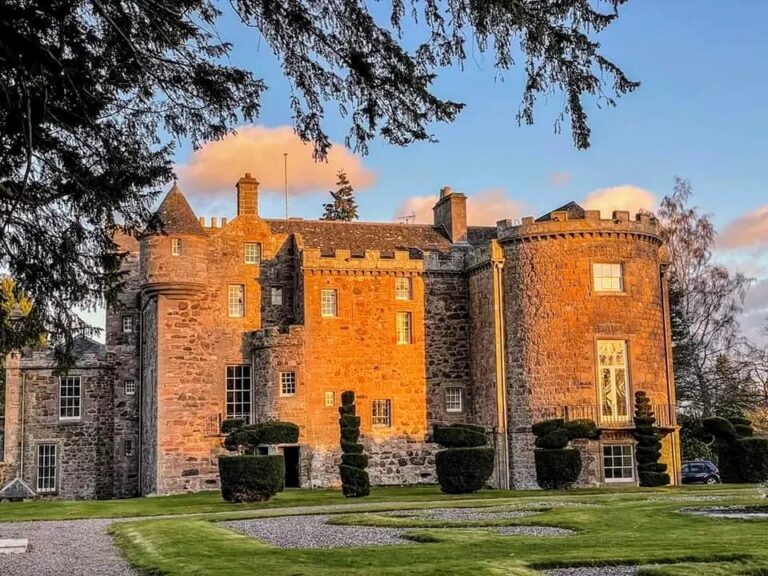
Huntingtower survives as two adjoining towers whose original separation was later filled in. The buildings combine defensive planning with domestic accommodation. The Eastern Tower is the earlier and smaller structure, while the larger Western Tower was built beside it near the end of the fifteenth century. A wooden bridge once linked them below the battlement level. The arrangement may have allowed occupants to retreat into one tower and raise the bridge if the other was captured.
The two towers
Eastern Tower
The Eastern Tower, now the original Huntingtower, was freestanding and served primarily as a gatehouse. It has three storeys and a garret, an enclosed room beneath the roof. The tower retains early sixteenth-century painted decoration on its first floor. The fragmentary wall paintings include flowers, animals, and biblical scenes, providing evidence of the building’s domestic decoration during the period when the Ruthvens occupied the castle.
Western Tower
The Western Tower was built beside the Eastern Tower around the end of the fifteenth century. It has an L-shaped plan and is larger than its neighbour. The reason for constructing two separate residential towers is unresolved. One possibility is that the buildings were intended for two sons of Sir William Ruthven after he divided his lands between them in 1480. The gap between the towers was filled during the late seventeenth century, producing the castle’s present form. At the same time, the number and size of the windows increased substantially, especially in the Western Tower.
Painted interiors and former buildings
The Eastern Tower contains a largely complete painted wooden ceiling. Grotesque animals, including a version of the Green Man, appear on the main beams. Renaissance-style knotwork decorates the planks above them. The Green Man is a traditional motif showing a human or mask-like face surrounded by, or producing, foliage. The ceiling is regarded as one of Scotland’s earliest substantially surviving examples of its type. Smaller fragments of wall painting survive in the Western Tower, and these paintings are also dated to around 1540.
Early preservation work was undertaken on the painted ceiling by the Office of Works. In 1912, Frank Baines sought advice from Arthur Pillans Laurie of Heriot-Watt University, who recommended a weak gelatine solution to secure flaking pigment. A great hall was added against the north side of the Western Tower during the sixteenth century. The building itself no longer survives above ground, but a raggle, a groove or masonry trace marking a former roof junction, remains on the tower. Defensive walls once enclosed the castle, probably with subsidiary buildings, but those walls and associated structures have been removed.
St Conval’s Well
St Conval’s Well lies beside the road below the castle. The well is in good condition and produces clear water. Its physical survival preserves a feature linked with the local tradition of healing water, silent collection, and offerings.
Nearby sites