Castle of Vinhais: A Medieval Frontier Fortification in Portugal


Site at a Glance
- Rating
- 4.3
- Popularity
- Low
- Country
- Portugal
- Primary era
- Medieval
- Eras represented
- Medieval, Early Modern
- Civilizations
- Portuguese
- Site type
- Military
- Remains
- Castle
On this page9 sections
History
Castle of Vinhais is a medieval frontier fortification in Portugal, shaped by the settlement’s position close to Castile and by communication across the border. Its enclosure probably took form during the reign of Dinis, who ruled Portugal from 1279 to 1325, possibly in the late thirteenth century, and its design belongs to the Gothic period.
Early settlement and the medieval town
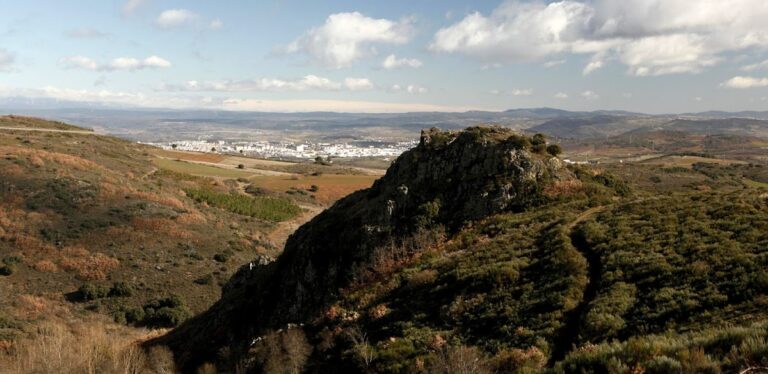
Human occupation in the wider region reaches back to prehistoric times, represented by rock art, megalithic monuments, and fortified settlements. Vinhais began as a Galician settlement and later became a Galician-Roman fortified settlement during the Roman conquest of Iberia. Suebi and Visigothic rule, followed by the Muslim invasion, added further phases to the region’s defensive development.
The location of the earliest settlement remains uncertain. Possible sites include a hill beside the right bank of the Tuela River, the hill of Vidueira, and Mount Cidadela or Cidadelha. Roman coins were found at Vidueira, while the other proposed locations have been associated with remains linked to the Roman city of Veniatia and with the military road connecting Braga and Astorga.
The medieval town emerged through the Portuguese Crown’s policy of establishing centrally controlled new towns in Trás-os-Montes, a frontier region where population and authority were being organized. An initial initiative took place under Sancho II, followed by a second under Afonso III. On 20 May 1253, Afonso III granted Vinhais a charter. The town was established on a hill opposite Crespos around an existing settlement connected with the Church of São Facundo.
In the mid-thirteenth century, Vinhais appeared in a donation to the Leonese monastery of São Martinho da Castanheira. At that time, the name referred to a wider region or territory rather than only to the settlement. The fortification itself was probably completed during Dinis’s reign. Under him, the town was enclosed by a wall strengthened with five or six towers, including two beside the principal entrance.
Conflict and royal reforms
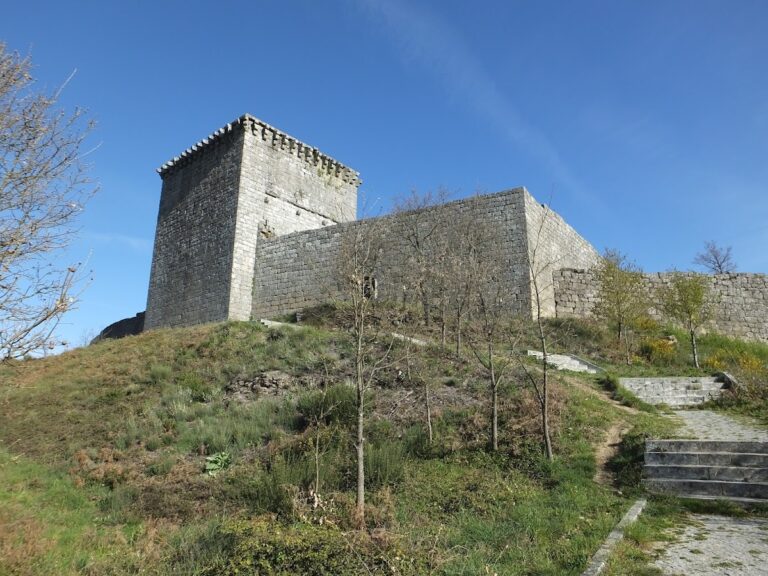
The keep, the castle’s principal fortified tower, formed part of the enclosure and was integrated into the wall. Under Afonso V, who ruled from 1438 to 1481, the town and castle belonged to the Counts of Atouguia, a Portuguese noble family, and the stronghold underwent reforms.
Castilian forces occupied the castle between 1369 and 1371. During the political crisis of 1383–1385, which divided Portugal over the succession to the Portuguese throne, Vinhais’s senior castellan, or alcaide-mor, initially supported Beatriz but later recognized John I. João Afonso Pimentel rebelled against John I in 1397 and defected to Castile. Portuguese control returned in 1403.
Around 1509, the military surveyor and illustrator Duarte de Armas recorded the castle in the Book of Fortresses, showing it in generally poor condition. Manuel I granted Vinhais a new charter on 4 May 1512. From the sixteenth century, a barbican, meaning an outer defensive enclosure protecting an entrance, and additional towers were built. As the town expanded, houses became attached to the older walls, which were already partly ruined by 1527.
The Restoration War and later preservation
During the Restoration War of 1640–1668, Vinhais and its castle faced repeated attacks. In 1659, a Spanish general entered the region with 1,700 men. The castle resisted, and the attackers withdrew across the frontier after burning houses outside the walls and settlements along their route.
In 1666, the Galician general Baltazar Pantoja surrounded the castle. Estêvão de Maris, the villagers, and fifty additional auxiliaries defended it. An inscription on a house commissioned by Estêvão de Maris commemorates this defense.
Repairs during the seventeenth and eighteenth centuries were limited. The surviving remains received National Monument classification in 1947 under a decree dated 28 June. In the early 1960s, the municipal council proposed demolishing what remained, but local residents opposed the plan because of the castle’s importance to their collective memory. The Directorate-General of National Buildings and Monuments subsequently carried out consolidation and restoration. A historic tower has more recently been identified as being at risk of collapse, endangering pedestrians and vehicles.
Remains
The medieval enclosure followed an irregular oval plan with a perimeter of approximately 500 paces. Stone, including granite and slate, formed the fortification. Five or six towers reinforced the circuit, while three additional square-plan turrets strengthened its defenses. The keep was incorporated into the wall rather than positioned in a separate inner citadel, a layout associated with the castle’s Gothic form.
Gates and defensive towers
Principal entrance and keep
In Duarte de Armas’s early sixteenth-century representation, the keep dominated the complex and protected the principal entrance. The gate was surmounted by a solid tower supported on two rectangular pillars on its outer face. A second entrance passed through the barbican on the opposite side of the keep.
Valley gate and western defenses
A smaller gate facing the valley was flanked by two turrets with battlements. Near the western turret, a well was reached by a winding staircase attached to the barbican. The arrangement joined water access to the outer defenses and formed part of the castle’s surviving defensive organization.
Enclosed settlement
Houses and the Church of Our Lady of the Assumption stood within the fortified area. By the early sixteenth century, the inner face of the keep facing the town had fallen into ruin, while two other towers had deteriorated at their foundations. Restoration and consolidation addressed three gates, two towers, and sections of the former enclosure on the eastern side of the town.