Fortaleza do Outeiro: A Medieval Frontier Fortification in Portugal


Site at a Glance
- Rating
- 4.1
- Popularity
- Very Low
- Country
- Portugal
- Primary era
- Medieval
- Eras represented
- Medieval
- Civilizations
- Portuguese
- Site type
- Military
- Remains
- Castle
On this page7 sections
History
Fortaleza do Outeiro is a medieval Portuguese fortification at Outeiro, Portugal, built during the reign of King Denis I in 1287 to guard the Trás-os-Montes frontier with the Kingdom of León. Also known as the Castle Hill of Miranda or Fortress Hill, it occupies a site whose human use reaches back at least to the Roman period.
Roman and Medieval Foundations
The arrival of the Romans changed the surrounding landscape, which became an agricultural settlement. The present stronghold belongs to a later period, when the Portuguese monarchy developed defenses along the northeastern frontier. Its construction in 1287 took place under Denis I, who ruled Portugal from 1279 to 1325.
The fortification and settlement faced military danger during the reign of Ferdinand I, king of Portugal from 1367 to 1383. In the summer of 1369, forces led by Henry II of Castile overran the village through a ruse. Henry II was the Castilian ruler whose troops carried out the attack.
Rebuilding and Royal Administration
During the Portuguese succession crisis of 1383 to 1385, a conflict over the monarchy after Ferdinand I’s death, the village supported Beatrice, Ferdinand’s daughter and a claimant connected with the rival succession. The monarchy sought to reinforce both the population and the defenses. Residents who built houses inside the castle’s outer walls were exempted from tribute, encouraging settlement within the fortified area.
Reconstruction was completed in 1414, and the municipality’s territory was enlarged in 1418. This rebuilding substantially increased the extent of the walls around the village. In 1449, King Afonso V released residents from the obligation to man the Castle Hill of Miranda. His successor, King John II, ordered the defenses rebuilt in 1493 as part of the wider fortification system of Trás-os-Montes.
Decline and Later Preservation
Duarte de Armas, a Portuguese military surveyor and illustrator, portrayed the fortification around 1509 in his Book of Fortresses, an early sixteenth-century record of Portuguese strongholds. King Manuel I, who reigned from 1495 to 1521, later granted the settlement a charter. Afterward, the town moved from the hill into the valley, and the medieval castle entered a long period of abandonment and ruin.
The site continued to have a military role during the Portuguese War of Restoration, the conflict with Spain that followed Portugal’s restoration of independence in 1640. Spanish troops unsuccessfully attacked the castle during that war, and another Spanish assault in 1762 also failed.
Fortaleza do Outeiro became a Property of Public Interest, a Portuguese heritage designation for culturally significant monuments and sites, on 20 October 1955. Improvement and reconstruction works followed in 1993 under the Directorate-General for National Buildings and Monuments.
Remains
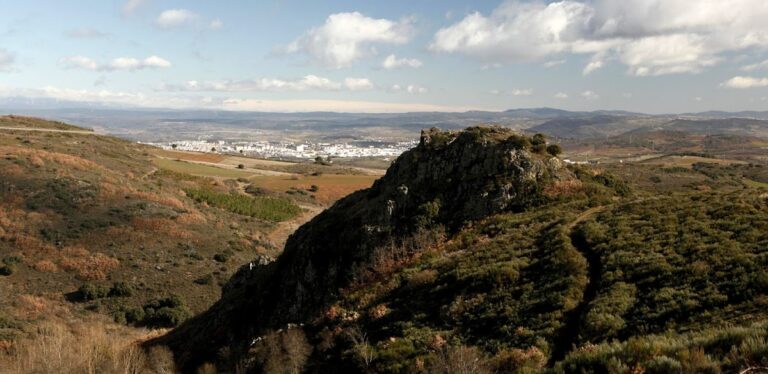
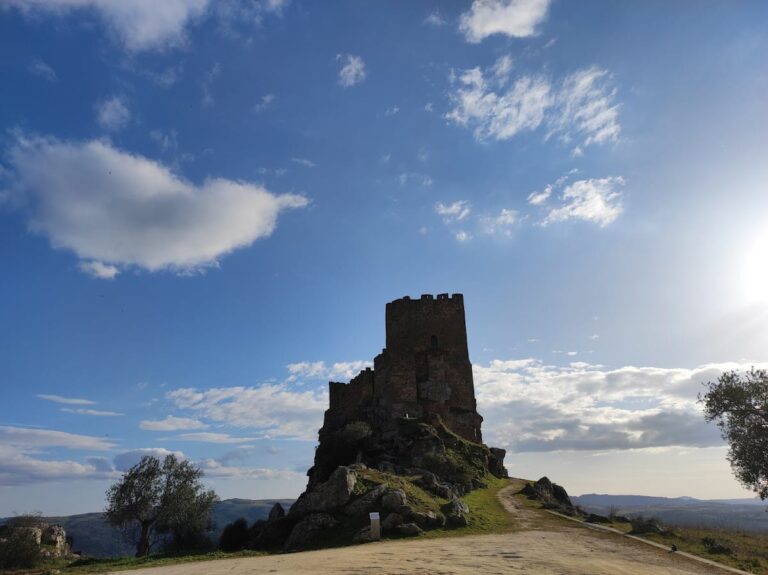
Fortaleza do Outeiro occupies a commanding position on Castle Hill at about 812 metres above sea level, roughly one kilometre east of Outeiro and between Bragança and Vimioso. The fortification follows an irregular oval plan enclosed by thick granite walls, using a stone that is abundant in the surrounding region. A round-arched doorway provided access through the defenses.
Walls and Defensive Works
The surviving walls preserve the outline of the hilltop stronghold and the enlarged defensive enclosure associated with the medieval settlement. On the southern side, a crumbling bulwark, a projecting defensive work, remains as part of the fortification. The fabric reflects the long history of rebuilding and later deterioration, alongside the improvement and reconstruction works carried out in 1993.
Watchtower and Stronghold
Duarte de Armas’s depiction from around 1509 shows a complex combining a rectangular watchtower with a stronghold. This image provides evidence for the form of the fortification during the early sixteenth century, before the town’s transfer from the hill to the valley and the castle’s subsequent decline.
Nearby sites