Castle of Castelo Mendo: A Portuguese Frontier Fortification


Site at a Glance
- Rating
- 4.6
- Popularity
- Low
- Country
- Portugal
- Primary era
- Medieval
- Eras represented
- Medieval
- Civilizations
- Portuguese
- Site type
- Military
- Remains
- Fortified Town
On this page6 sections
History
The Castle of Castelo Mendo is a Gothic fortification in Portugal, developed as a Portuguese medieval frontier stronghold on a site first occupied by a protohistoric hillfort and later Romanized. Its first castle is thought to have been built around the transition from the twelfth to the thirteenth century, during the reign of Sancho I. The settlement later became an important fortified centre in Ribacôa, a frontier territory contested by Portugal and León.
Foundation and royal privileges
Castelo Mendo received a charter from Sancho II at Vila do Touro on 15 March 1229. The document mentions both the castle and its commander, Mendo Mendes. It also established the kingdom’s first officially sanctioned fair, which lasted eight days and was held three times each year, at Easter, Saint John’s Day, and Saint Michael’s Day. The settlement’s first defensive wall was built during this period.
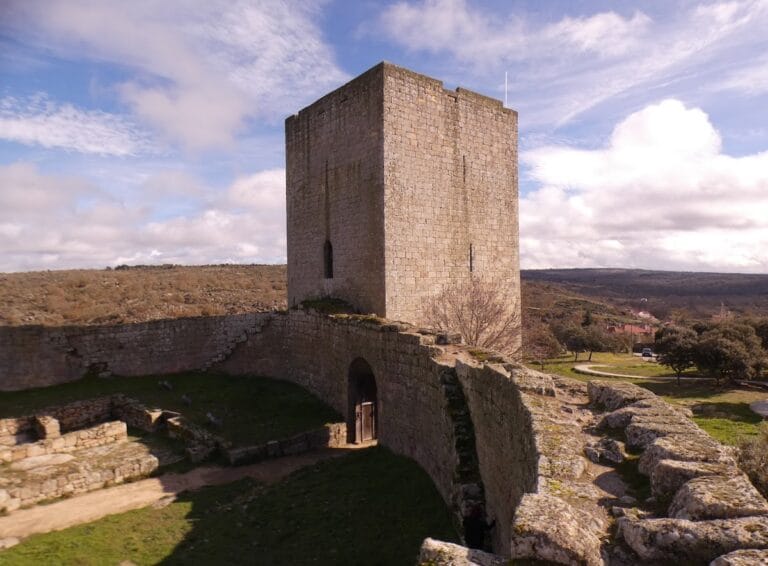
Ribacôa remained disputed until the Treaty of Alcañices in 1297, the agreement that confirmed the boundary and secured the territory for Portugal. Dinis of Portugal then consolidated the frontier and ordered the rebuilding of Castelo Mendo and other castles. During his reign, the town’s charter was confirmed on 16 December 1281, and a tax-exempt fair was established two days later at Devessa. These arrangements provided resources for a second defensive enclosure and the construction of the keep tower, the castle’s principal fortified and administrative tower.
Decline and later history
After peace was restored along the frontier, Castelo Mendo declined because its economic and demographic resources were limited. At the beginning of João I’s reign, the settlement became a couto de homiziados, a privileged jurisdiction where designated fugitives or offenders could obtain protection from prosecution. The town and castle were already showing signs of decline in the illustration prepared by Duarte de Armas for his Book of Fortresses around 1509.
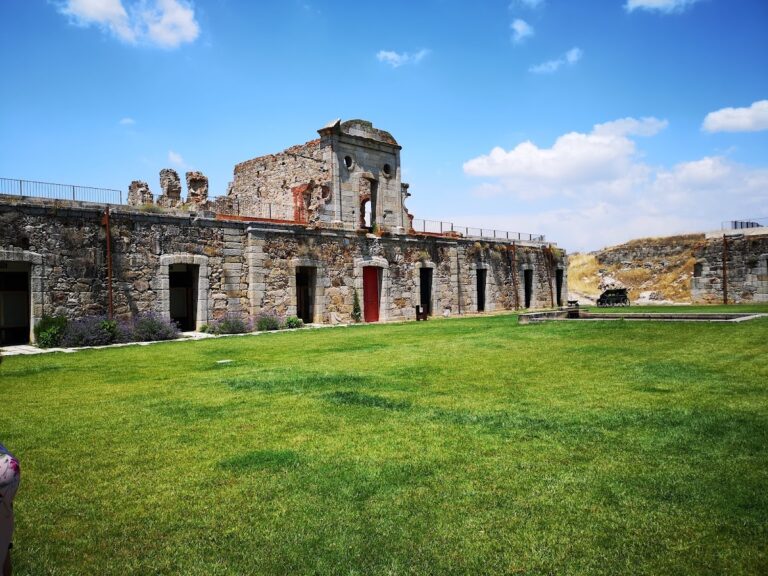
During the Peninsular War, a garrison of nineteen men in Castelo Mendo resisted French troops commanded by André Massena, a marshal of the French Empire. Castelo Mendo ceased to be a municipal seat in 1855, after which its decline intensified. The castle was declared a National Monument by a decree published on 2 January 1946. Later consolidation and restoration reconstructed sections of the walls, gates, and towers, although scholars have argued that these interventions changed the complex’s original appearance. The former town hall and jail were adapted as a museum displaying Roman-period artefacts.
Remains
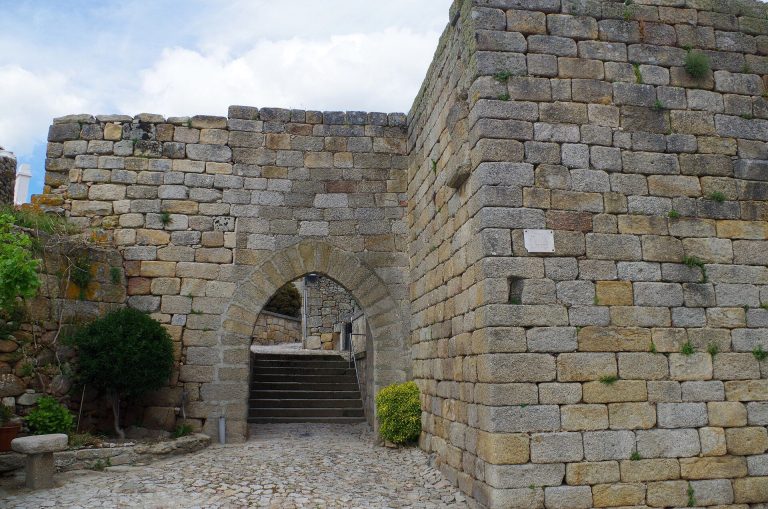
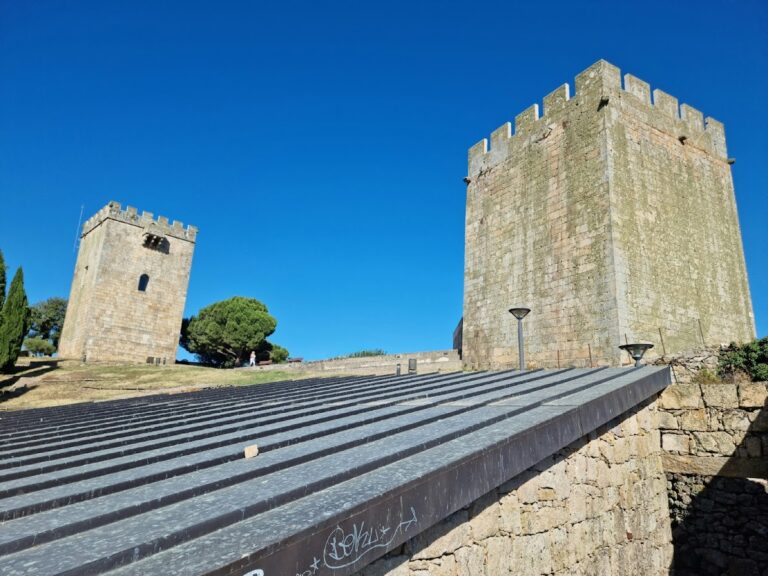
The castle stands 762 metres above sea level on a rocky elevation overlooking the Cadelos stream and the Côa River. Its irregular oval plan forms part of the medieval settlement, and the fortification is organized into two defensive nuclei: an eastern citadel within an inner enclosure and the irregular enclosure of the town. The two areas are connected by the Porta da Vila, a monumental gate with a pointed arch, meaning an arch whose curves meet at an apex, and two square-plan towers.
The eastern citadel
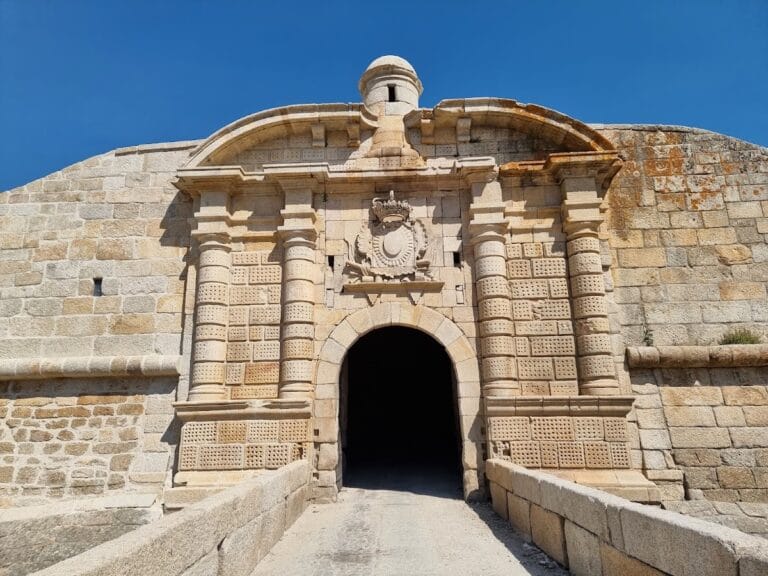
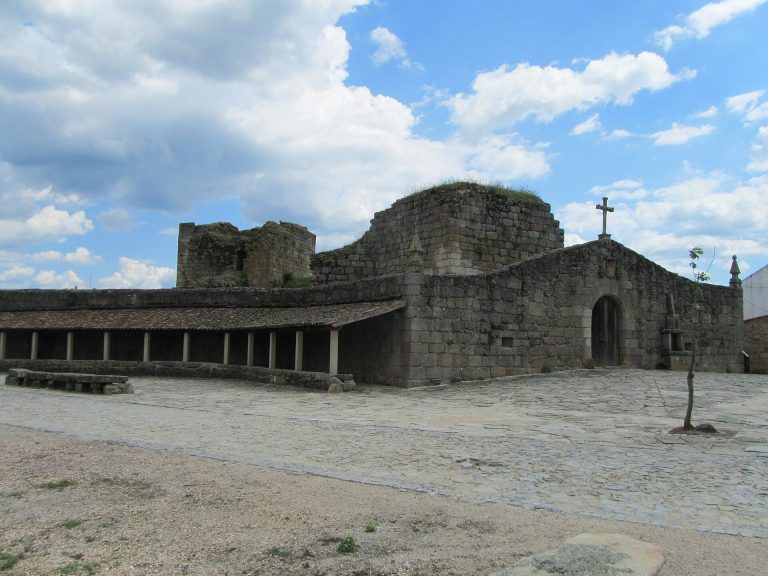
The eastern citadel contains the keep tower, which is attached to a section of the defensive wall. Its principal gate opens on the western side. Within the enclosure are a square cistern, the Church of Santa Maria do Castelo, and the former town hall. The former town hall and jail now contain museum space where Roman-period artefacts are displayed.
The town enclosure
The town enclosure dates predominantly from the reign of Dinis and was originally reinforced by several towers. Three gates provided access, including the Porta do Sol and the Porta dos Berrões, each associated with small towers. The churches of São Pedro and São Vicente were among the enclosure’s principal buildings.
The Porta da Vila carries a coat of arms associated with Dinis. Two pre-Roman granite zoomorphic sculptures flank the gate. Dating to the fourth century BC, they represent pigs or wild boars. Their snouts were cut off because they were believed to frighten animals that sheltered near them.