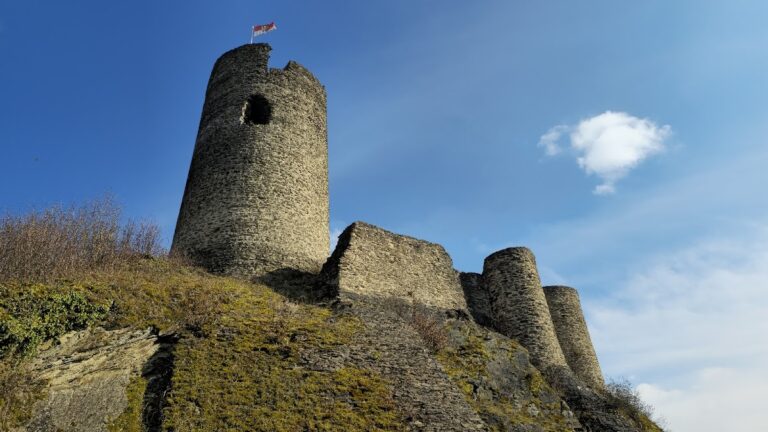
Burg Arras: A Hilltop Castle on the Moselle in Germany


Site at a Glance
- Rating
- 3.7
- Popularity
- Medium
- Country
- Germany
- Primary era
- Medieval
- External website
- Open
- Eras represented
- Medieval
- Civilizations
- Holy Roman Empire
- Site type
- Military
- Remains
- Castle
On this page11 sections
History
Burg Arras is a hilltop castle near Alf in Germany, built in the early twelfth century above the Moselle. The site had earlier served as a fortified Roman horse station, but the medieval castle became associated with the counts palatine and later with the archbishops and electors of Trier, whose ecclesiastical and political territory was known as Electoral Trier.
Roman and Medieval Origins
During Late Antiquity, the hill contained a fortified Roman horse station of a type also found in the Eifel and Hunsrück. After the Roman withdrawal, the site remained abandoned for several centuries before the construction of the castle.
Burg Arras was first recorded in 1120, in a charter concerning the consecration of its chapel, under the name castrum atrebatum. Claims of tenth-century references are probably legendary. Later medieval traditions connected the castle with the Hungarian invasions, but the often-repeated claim that its keep was completed around 936 is incorrect.
A document from about 1140 describes a division of the castle. It refers to a gate, chapel, and well used jointly, while a curtain wall, moat, and tower were assigned to Count Friedrich I of Vianden. The lords of Entersburg captured the castle in 1137, but Archbishop Albero of Trier besieged it successfully and recovered it for Trier.
From 1179, the knightly family of Arras maintained its residence at the castle. In that year, Hermann of Arras, bailiff of Eller, identified himself in a charter as its owner. Later records describe the division of the property among holders of castle fiefs, feudal grants connected with the maintenance or use of a castle. Ludwig Zandt of Merl received such a fief from Archbishop Raban in 1439, while members of the Metzenhausen family held another part in 1439 and 1493. Near the end of the seventeenth century, Lieutenant Colonel Adam Heinrich Baron of Breiten-Landenberg acquired an Arras share through his marriage to Ottilia Anna Zandt of Merl.
Destruction and State Ownership
In October 1689, during the War of the Palatine Succession, a European conflict in which France fought a coalition including the Holy Roman Empire and several German states, French troops from the nearby Mont Royal fortress demolished Burg Arras down to its foundations. The keep resisted every attempt to blow it up.
In October 1794, the administration established by French revolutionary forces declared the ruined castle and its associated lands state property. The planned sale took place only after 1815, when the former Trier territory had passed to Prussia. Ferdinand Remy, a member of the industrial Remy family of Bendorf, purchased the ruins and their 70-hectare forest in 1826. After his death, his three daughters inherited the property and sold it around 1850 to Barzen, a wine-grower from Alf.
Reconstruction and Modern Use
Mining director Traugott Wilhelm Dyckerhoff of Herne bought the ruins in 1895 and began rebuilding the castle in 1907. The monument-protection authority of the former Rhine Province approved the project, which incorporated the surviving keep and wall remains. Trier church architect Peter Marx prepared the plans. Dyckerhoff was buried on the castle grounds under a burial right associated with the castle since the Middle Ages, a right confirmed by the authorities in 1952.
Dyckerhoff’s heirs sold Burg Arras in November 1938 to Ernst Rademacher, an art dealer from Bochum, and Judge Theo Homburg. They had the Cavalier Wing rebuilt in 1954. Maria and Otto Keuthen of Briedel acquired the castle in 1978 and 1984 and established a hotel and restaurant there. The castle also contains a museum and is recognized as a cultural monument.
Remains
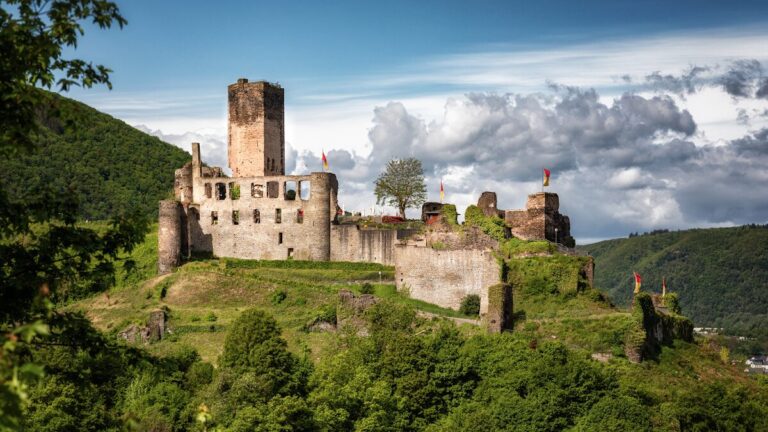
Burg Arras survives as a hilltop castle with substantial masonry, including carefully constructed bossed ashlar. This masonry uses stones whose outer faces project in a roughly dressed, cushion-like form. The surviving medieval elements were incorporated into the twentieth-century reconstruction, allowing the keep and sections of the enclosing walls to remain central parts of the present complex.
The Keep and Water Supply
The Keep
The rectangular keep rises 20 metres and has walls four metres thick, built from carefully layered masonry. It was traditionally regarded as a defensive and residential tower from the Salian period, when the Salian dynasty ruled the German kingdom and Holy Roman Empire during the eleventh and early twelfth centuries. Recent castle research by Stefan Ulrich instead considers it more likely to have been newly built in the mid-thirteenth century, probably during the tenure of Archbishop Arnold II of Trier from 1242 to 1259. The use of bossed ashlar forms a central part of this interpretation.
The Cistern and Well
The keep originally had a single high entrance on an upper storey. This elevated doorway, designed to make direct attack more difficult, led into the upper floor of the residential building and is now blocked. Beneath the keep, a cistern, or tank for collecting and storing water, holds 3.6 cubic metres and received rainwater from the roofs. It was needed because the 34-metre-deep castle well lies outside the walls.
Enclosure and Internal Structures
The castle complex included a gate, chapel, communal well, curtain wall, moat, and tower. A curtain wall is the main enclosing defensive wall of a castle. A well-preserved, two-storey dungeon lay beneath one of the wall towers. Other surviving wall sections, together with the keep, were incorporated into the twentieth-century reconstruction.
Rebuilt Buildings and Collections
The reconstructed complex includes the Cavalier Wing, rebuilt in 1954. The castle museum presents armor, weapons, and archival material from Electoral Trier. It also contains a private collection of about 200 historic views of the Moselle, described as the largest private collection of its kind.
A memorial room contains part of the estate of Federal President Heinrich Lübke, made available by Otto Keuthen, Lübke’s nephew by marriage. The material includes a wall hanging once owned by Madame de Pompadour and given to Lübke by French President Charles de Gaulle in the 1960s. Further Lübke memorabilia is exhibited at the Heinrich Lübke House in his birthplace.
Heideburg
The ruins of the former Heideburg lie north of Burg Arras. Several walls survive, and the ruins are enclosed by a castle moat.