Crecchio Ducal Castle: An Aristocratic Residence in Italy
Site at a Glance
- Rating
- 4.6
- Popularity
- Medium
- Country
- Italy
- Primary era
- Medieval
- External website
- Open
- Eras represented
- Medieval, Early Modern
- Civilizations
- Norman
- Site type
- Domestic
- Remains
- Castle
On this page13 sections
History
Crecchio Ducal Castle is a medieval castle in Crecchio, Italy, in the province of Chieti, Abruzzo. It developed around the eleventh-century Norman Torre dell’Ulivo, while construction of the wider castle is dated to the thirteenth century. From the fifteenth century onward, successive alterations changed the complex from a defensive stronghold into an aristocratic residence.
Origins and aristocratic transformation
The early history of the castle is only partly known. Its surviving historical record contains fragmentary information about its origins and occupants, and the earliest description preserved in the archives is an account written by Scipione Paternò in 1633. The complex grew from the Torre dell’Ulivo, an older tower that formed the core of the later castle.
The residential expansion took place in two main stages. The first added the southern loggia, a covered open-sided gallery, and the western wing. The second introduced an upper loggia and the main floor of the adjoining wing. Raising the buildings by another level removed the earlier battlements and altered the defensive appearance of the complex.
Earthquake, war, and reconstruction
One of the four towers was destroyed by an earthquake in 1881 and rebuilt in 1904. The Aragonese Tower was rebuilt again after 1943, following the damage inflicted during the Second World War.
On 9 September 1943, after the Cassibile Armistice, the agreement through which Italy ended its wartime alliance with Nazi Germany, the castle sheltered the Savoy royal family during its movement from Rome toward Brindisi. In the following June, bombing heavily damaged the complex. The adjacent church of San Rocco was completely destroyed and was not rebuilt during the restoration. Construction of an elementary school also reduced the large ducal garden.
The interiors were reconstructed during the 1960s in accordance with their earlier form. The castle later became public property. During the 1980s it housed the municipal administration, which subsequently moved elsewhere, making it possible to establish the Museum of Byzantine and Early Medieval Abruzzo. Byzantine refers to the culture and institutions of the eastern Roman Empire, while early medieval describes the centuries following the decline of the western Roman imperial system. The museum now occupies the castle and presents archaeological discoveries.
The De Riseis-D’Aragona association
The castle is also known as the Castello Ducale De Riseis-D’Aragona. Its connection with the De Riseis family and Vittorio Emanuele III, king of Italy from 1900 to 1946, is preserved through historical photographs displayed in the museum. These images include scenes of the royal family’s stay in 1943 and photographs of Prince Umberto II, Vittorio Emanuele III’s son, during visits in the 1930s. Umberto II briefly succeeded his father as king in 1946.
Remains
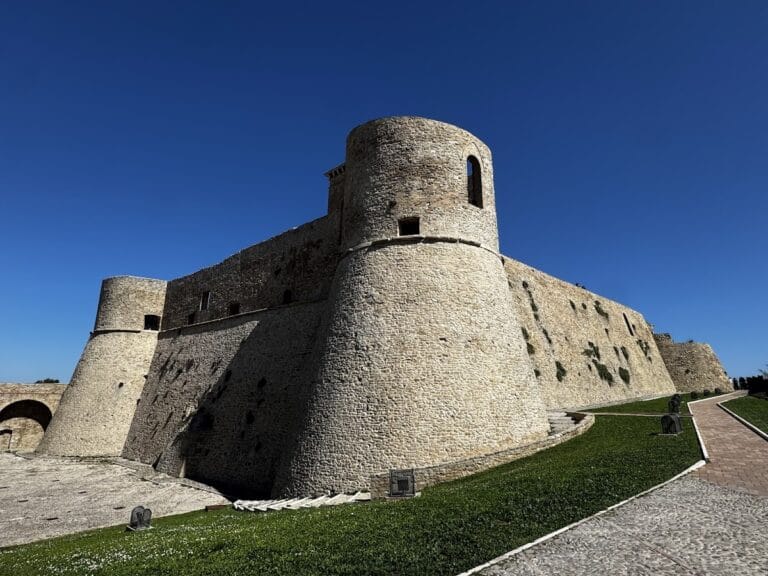
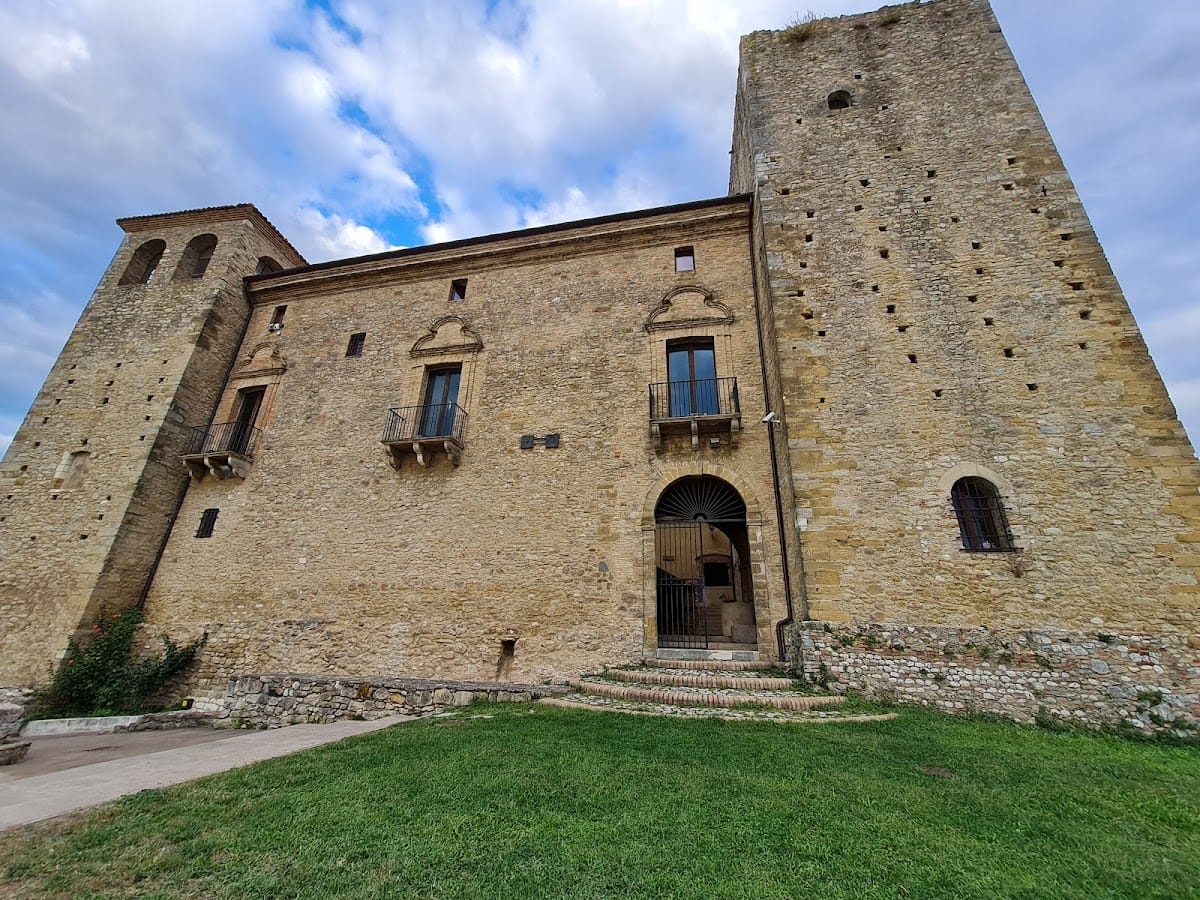
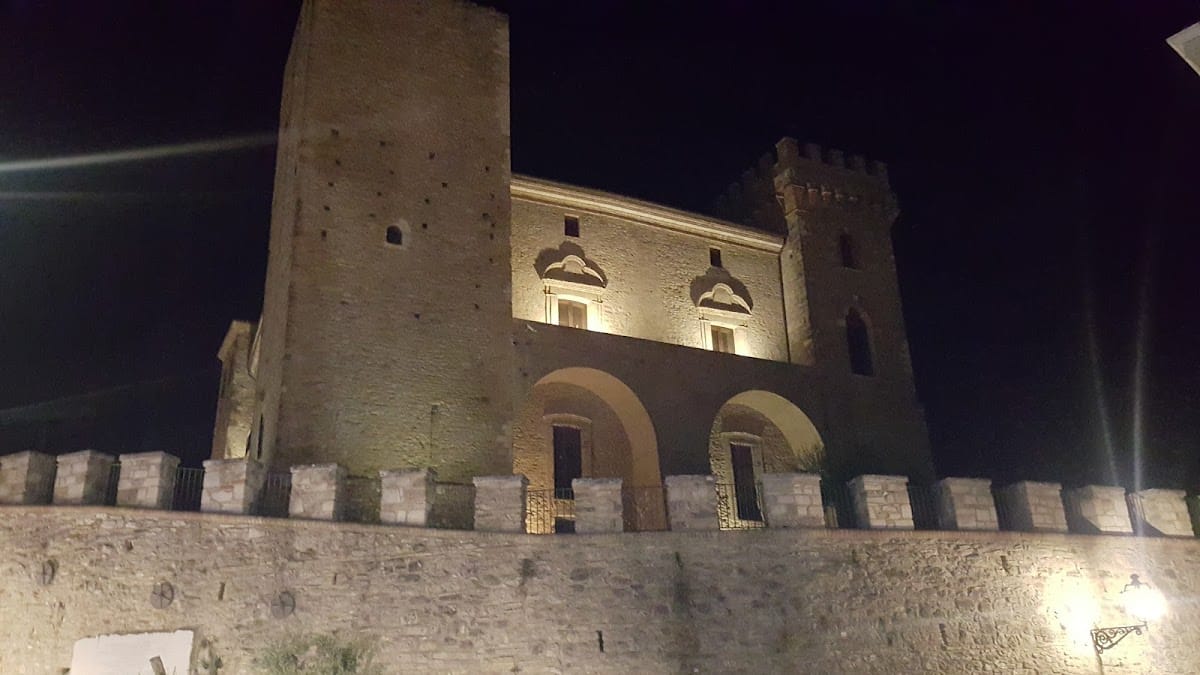
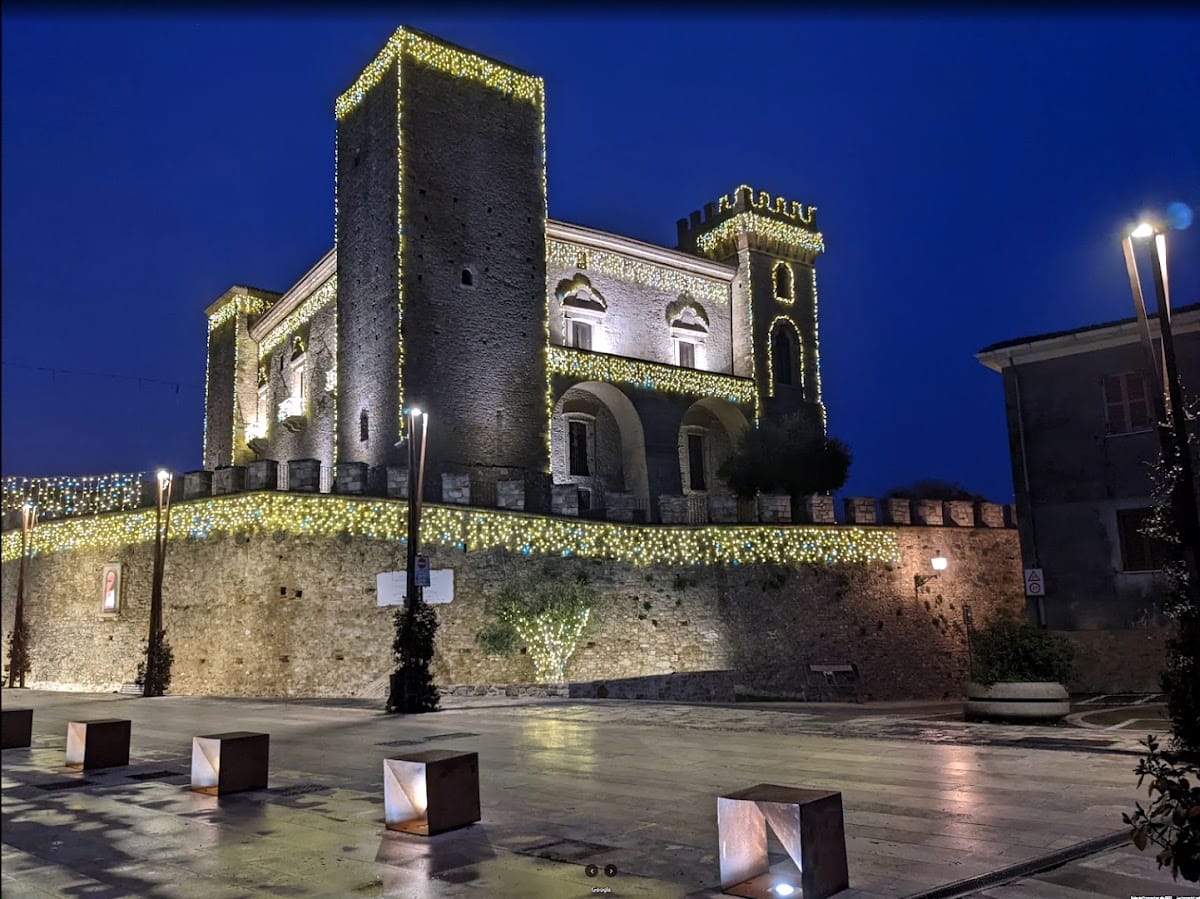
The castle stands on a hill between the Arielli and Rifago rivers. It has a square plan formed by four interconnected wings enclosed by four corner towers, giving the complex the appearance of an aristocratic residential castle. A perimeter wall surrounds both the buildings and a garden, while a bridge provides access to the enclosed compound.
Corner towers and defensive elements
Torre dell’Ulivo
The Torre dell’Ulivo is the largest of the four towers and the oldest element associated with the complex. This three-level Norman tower is built from roughly dressed stone blocks and has a raised ground floor. Its lower level served as a food store, and a narrow spiral staircase provided access between the floors. The staircase was formerly used by guards on patrol.
Aragonese Tower
The square Aragonese Tower stands beside the Torre dell’Ulivo and dates from the fifteenth century. Its upper section has battlements supported by corbels, projecting stone supports beneath the wall. The tower was rebuilt after the damage of 1943.
De Riseis Towers
The two De Riseis Towers are eighteenth-century twin structures with square plans and pitched roofs. Each side has paired round-arched windows, while deep blind arches at the bases recall the bastions of the medieval fortress. On the entrance side, an arch leads toward a cloister and a monumental staircase. A pillar bears the De Riseis family coat of arms, dated 1789.
One of the De Riseis Towers, beside the large ground-floor wing, retains a barrel vault, a continuous semicircular ceiling, with late Baroque stucco decoration.
Courtyard and residential rooms
Courtyard buildings
Paternò’s 1633 description records a level courtyard near the entrance, together with a stable and an adjoining room. On the left was a cellar containing a food store, cisterns, and other facilities. A masonry staircase rose to a covered loggia overlooking the courtyard. This gallery opened onto a large bedroom with two adjoining rooms, while a separate entrance led to a small hall containing another bedroom, a small chamber, and a kitchen.
Tower apartments and upper areas
The historical description presents the complex as generally flat-roofed, with a covered balcony and brick flooring facing the courtyard. It also describes a square tower divided into three vertically arranged apartments. Each apartment contained a large room and a smaller room, with access provided by a stone staircase. Views toward the coast and a garden beside the castle, known as the “walled ditch,” were also part of the described setting. A small annex connected the main entrance with the road.
Reconstructed interiors and museum displays
Bombing in 1943 damaged the interior rooms, which were reconstructed in the 1960s according to their earlier arrangement. Most rooms are sparsely furnished and contain display cases with archaeological finds presented by the museum. In the room before the entrance to the Norman tower are a canopied bed resembling an original bed of the Dukes of Bovino, holders of the ducal title associated with Bovino in southern Italy, and a chest. Both objects came from outside the castle and were installed to recreate the room in which Vittorio Emanuele III slept.
Photographs displayed inside the castle preserve visual evidence of Prince Umberto II’s visits in the 1930s and of the royal family’s residence there in 1943. Together with the archaeological displays, the reconstructed rooms and surviving towers convey the castle’s transition from a medieval defensive complex to a ducal residence and museum.
Nearby sites