Museo Archeologico Nazionale d’Abruzzo: Archaeological Museum of Chieti


Site at a Glance
- Rating
- 4.6
- Popularity
- Low
- Country
- Italy
- Primary era
- Iron Age
- External website
- Open
- Eras represented
- Iron Age, Classical, Medieval, Early Modern, Modern
- Civilizations
- Byzantine, Crown of Aragon, Lombard, Norman, Roman, Spanish
- Site type
- Museum
On this page14 sections
History
The Museo Archeologico Nazionale d’Abruzzo is an archaeological museum in Chieti, Italy, housed in Villa Frigerj, a neoclassical residence constructed around 1830. Its collections trace the ancient cultures of Abruzzo from prehistory and protohistory through Late Antiquity, while its numismatic holdings extend from the fourth century BC to the nineteenth century. The museum is especially known for presenting the different cultural traditions of the Vestini, Peligni, Marrucini, and Carricini, with strong emphasis on funerary material from the ninth to the fourth centuries BC.
From municipal collections to a national museum
The museum grew from collecting and excavation initiatives in Chieti. In the late nineteenth century, inspector Vincenzo Zecca proposed an archaeological cabinet after research and discoveries in the surrounding area. Financial difficulties prevented the project from being completed. A later collection, formed through excavations directed by archaeological superintendent Desiderato Scenna, was displayed near Chieti’s Roman temples. Together with Zecca’s collection, it is now exhibited at the Museo Archeologico Nazionale “La Civitella”.
Professor and archaeological superintendent Valerio Cianfarani revived the project in the late 1930s. The museum opened at Villa Frigerj on 14 June 1959, in an inauguration attended by Giovanni Gronchi, then President of the Italian Republic. The villa had originally been commissioned around 1830 by Baron Ferrante Frigerj. After its sale to the Municipality of Chieti, it housed an agricultural institute and, in the early twentieth century, the Istituto Tecnico “Ferdinando Galiani”, founded in 1865. After the Second World War, the municipality transferred the property to the state.
Institutional changes and reorganization
Villa Frigerj briefly served as the rectorate of the University of Chieti, established in 1965, before the university administration moved to the campus at Chieti Scalo. The museum’s collections were reorganized in 1984 following the acquisition of new archaeological material and numerous private donations. Giovanni Pansa’s collection received a dedicated area in 1992. Pansa, an influential lawyer and scholar from Sulmona, had studied and collected antiquities associated with the ancient Italic peoples of Abruzzo and donated his holdings to the Chieti museum in 1954.
After the 2009 L’Aquila earthquake, the museum’s material was temporarily secured while the stability of the building was assessed. A general reorganization of the displays followed in 2011, including a new hall for the Warrior of Capestrano. The statue had earlier been taken temporarily to L’Aquila for an exhibition on Abruzzo held during the G8 summit, where it was shown to Barack Obama, and was later returned to Chieti.
Since December 2014, the museum has been administered by the Ministry of Cultural Heritage through the Abruzzo museum network, which became the Regional Museums Directorate in December 2019. From July 2023, the National Archaeological Museums and Archaeological Park of Chieti, under the Regional Directorate of National Museums of Abruzzo, have held the status of an institution of significant national interest with administrative autonomy.
Remains
Villa Frigerj and the museum layout
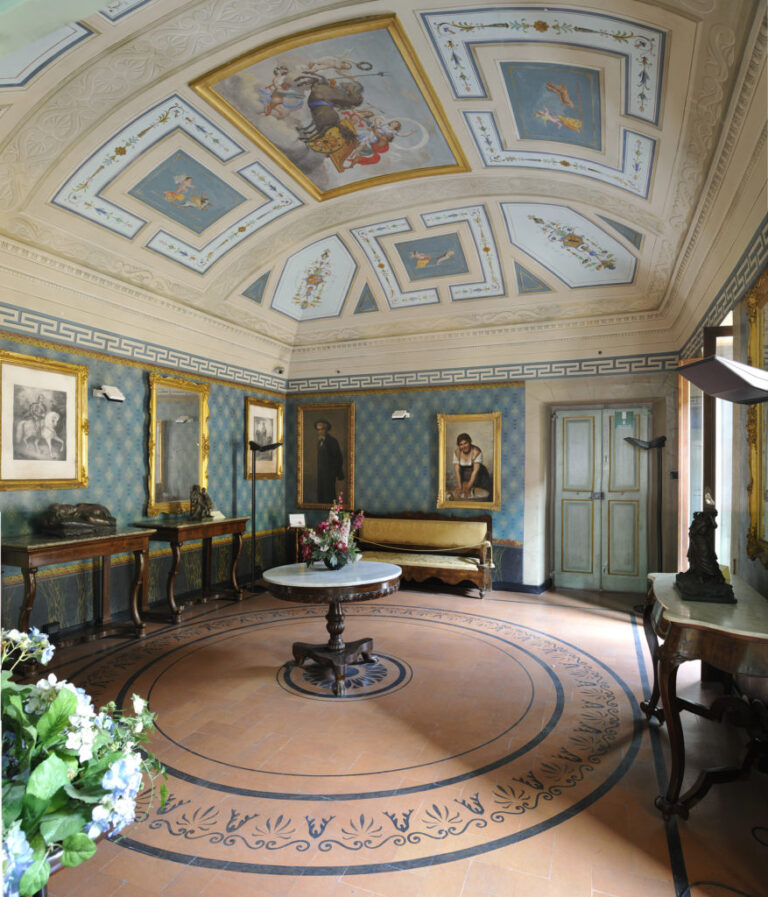
Villa Frigerj is a neoclassical building designed by the Neapolitan architect Enrico Riccio and built around 1830. It stands within Chieti’s municipal gardens and urban park. Smoothly finished brickwork and windows with gables characterize the exterior. The former carriage passage now forms the main entrance and leads to the ground-floor gallery, while a monumental scissor staircase supported by Doric columns connects the ground floor and first floor.
Ground-floor collections
Warrior of Capestrano Hall
The Sala del Guerriero di Capestrano was designed by the contemporary Italian artist Mimmo Paladino and installed at the entrance in 2011. It presents the funerary Italic statue known as the Warrior of Capestrano, attributed to King Nevio Pompuledio and dated to the second half of the sixth century BC. The statue was discovered in the necropolis, or cemetery, of Capestrano. The hall also contains a headless female torso from Capestrano, dated to the sixth century BC, three funerary stelae, or upright commemorative stones, from Penna Sant’Andrea with inscriptions in Southern Picene, and a detail of the Warrior.
Pansa Collection
The Pansa Collection brings together bronzes, figurative bronzes, jewelry, glass, ivory, combs, vessels for ointments and perfumes, armor, helmets, fibulae, funerary stelae, and objects used in everyday life. It also includes a sixth-century BC funerary assemblage, a dagger with its sheath, and a dice game. These objects form a broad material record of ancient life and burial customs in Abruzzo.
Coins and Roman sculpture
The numismatic collection contains approximately 15,000 coins found in Abruzzo. It begins with issues associated with the Samnite-period peoples of the region, including the Marrucini, Peligni, Frentani, Marsi, and Vestini, and continues through Byzantine, Lombard, Norman, Frederician, Angevin, Aragonese, Durazzo, and Spanish coinage. It also includes coins used in the Spanish-era administrative territories of Abruzzo Ultra and Abruzzo Citra. The oldest coin dates to the fourth century BC, while the most recent is an 1858 francescone. Among the displays are a gold aureus, a Roman gold coin, bearing the image of the emperor Galba, who ruled in AD 68–69, and a Roman limestone stele showing a metalworker making a coin.
The ground-floor sculpture displays range from the late Republican period to the early Roman Empire. They include a colossal first-century BC statue of Hercules Epitrapezios from Alba Fucens, a monumental marble Hercules from the same site, Roman portraits, and the Roman lapidary, a display of worked or inscribed stone. The area also contains a bone funerary bed from Collelongo, the temple-shaped tomb of the magistrate Lusius Storax, and mosaic material from Alba Fucens. Roman iconography and pre-Roman sculpture complete the ground-floor presentation.
First-floor funerary and religious collections
Funerary assemblages
The first-floor displays contain funerary assemblages dating from the tenth to the fourth centuries BC. They come from the necropolises of Loreto Aprutino, Civitella Casanova, Nocciano, Campovalano, Penna Sant’Andrea, Capestrano, Alfedena, Le Castagne, Scurcola Marsicana, and Pennapiedimonte. Tableware, weapons, two Phoenician glass-paste pendants, a calyx-shaped cup, footwear decorated in repoussé, a technique that raises designs by hammering metal from the reverse, and disks forming part of armor illustrate the variety of these burials.
Anthropological material
Anthropological displays include biological and human remains, including material from the fifth-century BC necropolis of Alfedena. The remains provide evidence about the physical characteristics, sex, age at death, diet, health, and fertility of the ancient population.
Hercules Curinus
The exhibition “Behold… Hercules Appears” centers on a small bronze statue of Hercules at rest. It was found in the sanctuary of Hercules Curinus on Mount Morrone above Sulmona. The display includes a full-scale reconstruction of the shrine that contained the statue and archaeological material from the sanctuary. Hercules Curinus was the form of the classical deity worshipped at that site.
Additional Italic and Roman works
Other notable works include the seventh-century BC Stele of Guardiagrele and the contemporary Torso of Rapino. The collections also include aristocratic funerary beds associated with the Vestini and a bronze eagle from Amiternum, an object carried by a legion in battle. Together with the museum’s funerary, sculptural, anthropological, and coin displays, these works present the changing cultural traditions of Abruzzo across the Iron Age, Roman period, and early medieval era.
Nearby sites