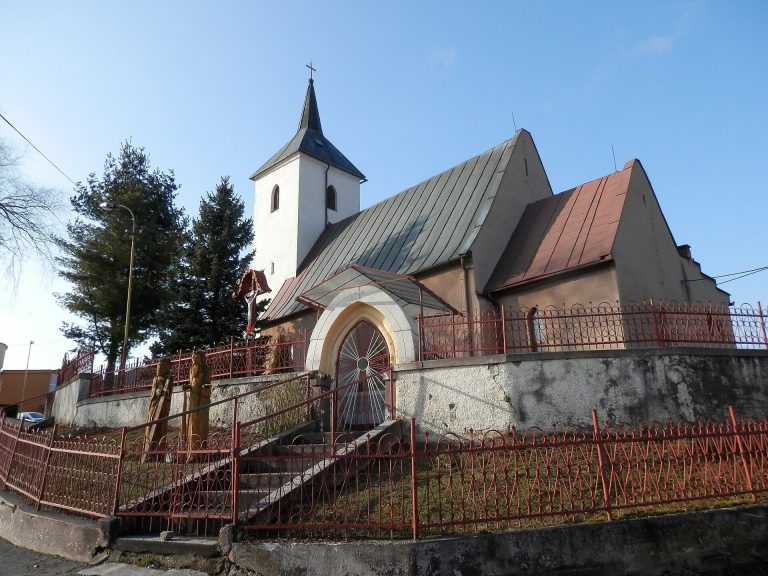
Šariš Castle: Royal Fortress and County Center in Slovakia



Site at a Glance
- Rating
- 4.7
- Popularity
- Medium
- Country
- Slovakia
- Primary era
- Medieval
- External website
- Open
- Eras represented
- Medieval, Early Modern
- Civilizations
- Habsburg, Hungarian
- Site type
- Military
- Remains
- Castle
On this page13 sections
History
Šariš Castle is a medieval royal fortress in Slovakia, above Veľký Šariš in the Torysa valley. Built by the Hungarian crown, its new castle began in the thirteenth century to protect the north–south trade route through the valley. It also served as a royal residence and, after the creation of Šariš County in the 1240s, became the county’s administrative center and the seat of its counts.
Early settlement and the royal castle
The castle hill had been occupied long before the medieval fortress. Settlement occurred during the Neolithic period, in the Late Bronze Age between the thirteenth and eleventh centuries BC, and again from around the beginning of the Common Era until the fourth century AD. After an interruption, occupation resumed between the tenth and twelfth centuries. The exact date of the earliest medieval masonry is unknown, but construction of the new castle began in the thirteenth century. It was first recorded in 1245 as castrum Sarus, with the form castrum de Saarus appearing in 1312.
From the start, Šariš was a royal castle, meaning a fortress controlled by the Hungarian crown for administrative, residential, military, and territorial purposes. Its position allowed the crown to oversee the route and the surrounding county. The count of Šariš, the crown’s local representative, administered the county from the castle.
Amade seizure and royal recovery
In the early fourteenth century, the powerful Amade, or Omodej, family seized Šariš while opposing King Charles Robert of Hungary. They enlarged the residential and economic facilities and reinforced the defenses. The castle captain Demeter used the stronghold as a base for terrorizing nearby towns and nobles who remained loyal to the king.
Royal control was restored after the Battle of Rozhanovce in 1312, a conflict that ended the Amade family’s challenge to Charles Robert. The castle then returned to the administration of royal castellans and Šariš County officials.
Fifteenth- and sixteenth-century conflicts
During the fifteenth century, Šariš passed to the Perényi family, briefly came into the possession of the Soós family, and later returned to the Perényis. Ján Jiskra of Brandýs and his captains occupied the castle from 1441 to 1460 during the conflicts surrounding the Hungarian succession. Following a siege and negotiations, King Matthias Corvinus recovered the fortress and restored it to the Perényi family.
The Perényis expanded and strengthened Šariš again during the fifteenth and sixteenth centuries. After the Battle of Mohács in 1526, which opened a prolonged struggle for the Hungarian throne and increased the Ottoman threat, they supported John Zápolya and occupied Košice in 1536. Imperial forces besieged the castle and captured it in 1537. Authorities from the province were then moved there from the royal house in Košice.
Habsburg fortress and destruction
Concern over Ottoman raids brought further improvements to the defenses. Under Habsburg rule, Šariš was rebuilt as a major military fortress and became the center of a Habsburg-controlled region stretching from the Tatra Mountains to the Tisza. Its permanent garrison numbered about 200 infantrymen, and the fortress held a substantial arsenal.
In 1642, the castle passed to the Rákóczi family, who occupied an imposing manor in the settlement below the hill. A gunpowder store exploded in 1660 and heavily damaged the fortress. Afterward, the castle was used only to house troops. It burned in 1687 and was never rebuilt.
After Francis II Rákóczi, the last member of the family, died in exile in the Ottoman Empire, ownership passed through the female line to the Aspremont family and later to the Szirmay family. The final owner was Géza Pulszky, a royal chamberlain. Brewing was also associated with the castle and nearby Veľký Šariš during the Middle Ages. Guild records from 1506 preserve a special privilege for brewers who used hops growing beneath the castle, a tradition later recalled by a modern brewery.
Protection and conservation
Šariš Castle became a National Cultural Monument in 1963, and the entire castle hill was designated a national nature reserve in 1964. Volunteers have since cleared uncontrolled shrub growth from the castle area and helped maintain the ruins.
Remains
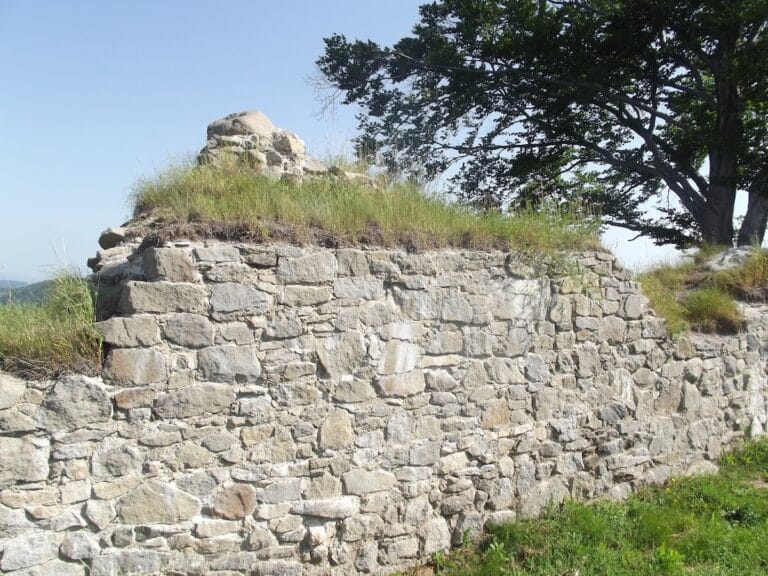
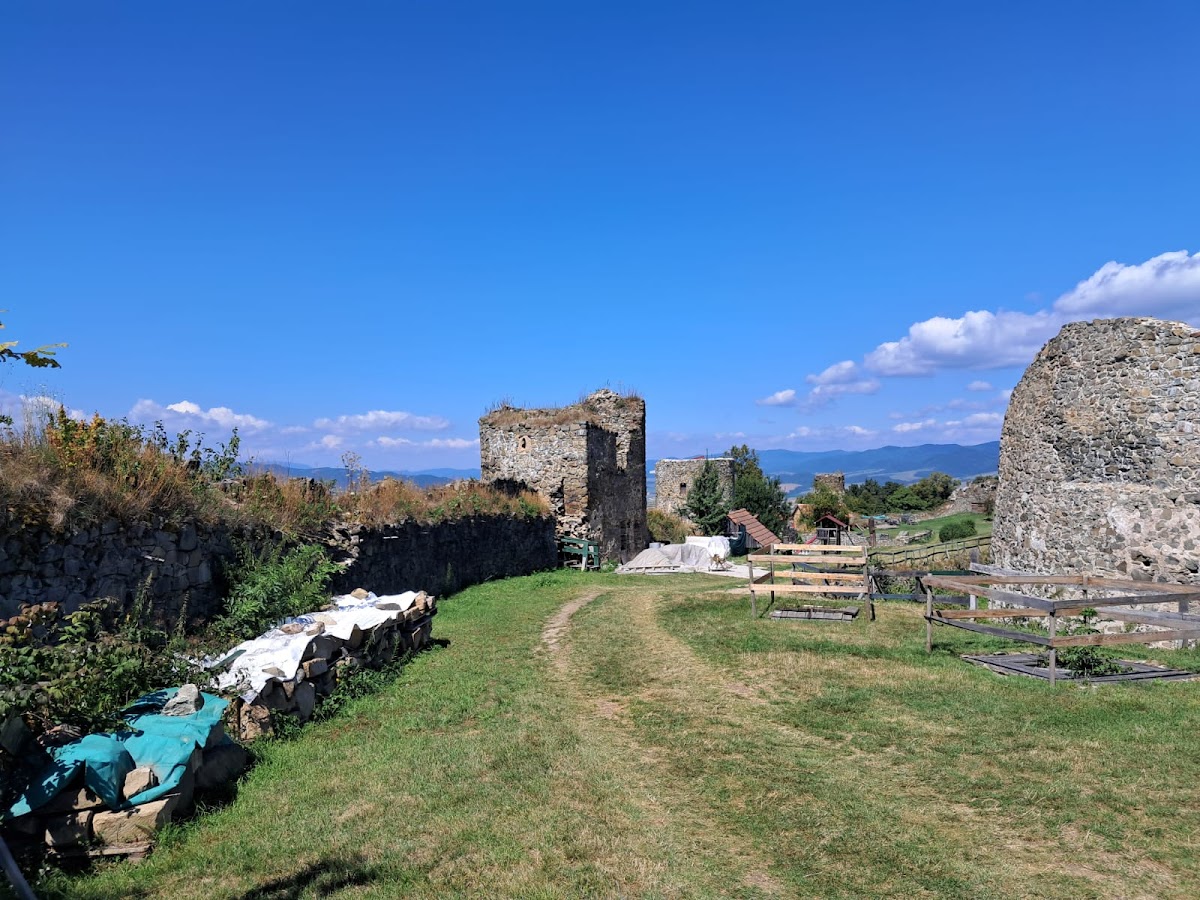
The ruins occupy the summit of Šariš Hill, a conical andesite elevation rising to 570 metres above sea level over Veľký Šariš. The castle’s built-up area exceeded 2.7 hectares, while the surviving ruins cover about 4.5 hectares. Local andesite forms the principal building material, with sandstone reinforcing the corners. The later fortress developed into a multi-part complex of walls, towers, artillery towers, and bastions built partly over the earthworks of an earlier Slavic fortified settlement.
Central tower and entrance defenses
Donjon
The central structure was a square, prismatic donjon, the castle’s principal fortified tower, which could combine defensive and residential functions. It measured 13.2 by 13.2 metres, and its walls were 4.5 metres thick. The tower has been partially reconstructed and provides views across the High Tatras, the Levočské Mountains, Čergov, and the Slanské Mountains. Other medieval castle ruins, including Kapušany and Kamenica, are also visible from it.
Barbican and moat
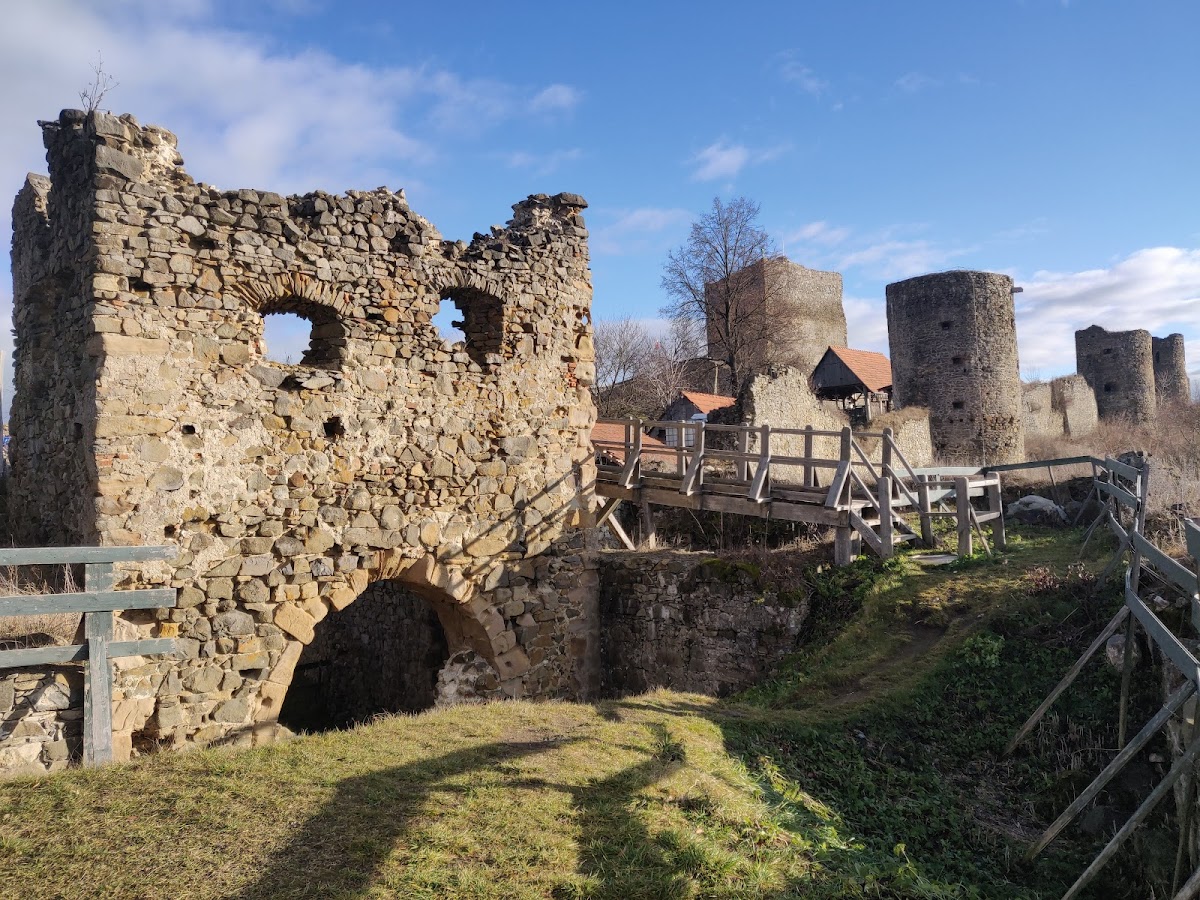
Access on the northwestern side passed through a barbican, an outer defensive structure protecting an entrance, with a double gate. A drawbridge crossed the moat, which remains visible in the ruins.
Walls and archaeological evidence
Bastions and curtain walls
Fourteen bastions were incorporated into the line of the curtain walls, each with openings for firearms. A later bastion occupied the position of the fourteenth-century gate, while a new circuit of walls was raised on earlier earthworks. The surviving fortifications and bastions remain visible among the ruined buildings.
Early occupation remains
The earliest settlement evidence from the hill consists of Neolithic pottery and chipped-stone products. Later occupation, dating from around the beginning of the Common Era to the fourth century AD, is represented by Late La Tène graphite pottery and a cast bronze brooch. The La Tène period was an Iron Age archaeological culture of central and western Europe.