Château de Comper: A Renaissance Manor and Former Fortress in France


Site at a Glance
- Rating
- 4.2
- Popularity
- Medium
- Country
- France
- Primary era
- Medieval
- External website
- Open
- Eras represented
- Medieval
- Civilizations
- Duchy of Brittany
- Site type
- Domestic
- Remains
- Elite Residence
On this page13 sections
History
Château de Comper is a Renaissance-style manor in France, on the western edge of Paimpont Forest in Brittany, about three kilometres east of Concoret. The present building occupies the site of an earlier fortified castle whose history reaches back to the ninth century. The surrounding forest was later associated with the legendary forest of Brocéliande, linking Comper to Arthurian traditions as well as to the political and military history of Upper Brittany.
Early references and medieval lordship
Menhir alignments found near Comper indicate that the area was occupied in antiquity. The earliest written reference dates to 868, when Salomon, a ninth-century king of Brittany, was said to inhabit a castle called Campie. The identification of that castle with Comper belongs to an early tradition rather than an unquestioned fact.
Possession of Comper was later claimed by the barons of Gaël-Montfort. The property subsequently passed through the Laval, Rieux, Coligny, and La Trémoille families. From the thirteenth century, the castle was regarded as one of the strongest positions in Upper Brittany and was drawn repeatedly into battles and sieges, including conflicts in the prolonged struggle between the houses of Blois and Montfort.
Bertrand du Guesclin, a prominent Breton-born commander and constable of France, ravaged Comper in 1370. Repairs and new construction followed in 1375 or 1376 after the damage caused by his armies and by the Breton War of Succession. At the beginning of the fifteenth century, Comper became a fief of the Laval family.
The Laval period and religious change
On 30 August 1467, Guy XIV, Count of Laval, had the charter known as the “Uses and Customs of the Forest of Brecilien” drawn up at Comper by his chaplain, O. Lorence. The charter divided the forest into parcels and set out the rights and obligations of its users. It also connected the forest of Paimpont with the legendary forest of Brocéliande and mentioned the Barenton Fountain, helping to give Comper a lasting place in the literary geography of Arthurian tradition.
Anne de Montmorency, the second wife of the Count of Laval, died in childbirth at Comper on 9 June 1525. During the sixteenth century, the castle passed first to the Rieux family and then to the Coligny family. François de Coligny, Lord of Andelot and colonel general of the French infantry, stayed at Comper and established a Calvinist preaching station there. Calvinism was the Reformed Protestant tradition that was spreading through France during this period.
After the death of Guy XIX de Laval, the Laval succession passed to Henri III de La Trémoille through his great-grandmother Anne de Laval. Guy XIX’s only son had been killed in Hungary in 1605, leaving the succession to continue through this inheritance.
The Wars of the Catholic League
In 1595, during the Wars of the Catholic League, Comper was occupied by troops of Philippe-Emmanuel de Lorraine, Duke of Mercœur. The Catholic League was a late-sixteenth-century political and military movement opposed to the rule of Henri IV, while Mercœur led its Breton branch. Comper’s position allowed the garrison to maintain communications between the southern and northern coasts of Brittany, find refuge near the forest, and disrupt commerce between Rennes, Ploërmel, and Lower Brittany. Two cavalry companies and three infantry companies formed the garrison.
Jean d’Aumont, commanding forces for King Henri IV, began a five-month siege in June 1595 in an attempt to retake the castle. The rocky ground made it difficult to dig trenches, and many soldiers died. During a reconnaissance on 3 July, d’Aumont was struck by an arquebus shot, an early shoulder-fired firearm, which fractured both bones of his arm. He died at Rennes on 19 August 1595.
The siege was initially abandoned when the Duke of Mercœur approached with Spanish assistance. Comper nevertheless fell to the royalist side on 10 October 1595 after prolonged resistance. The manner of its capture remains uncertain in the surviving traditions. One version attributes it to the two D’Andigné brothers, who allegedly used a ruse with sixteen men, while another names the brothers of Malaguez.
Dismantling, revolution, and rebuilding
Henri IV reportedly ordered the dismantling of Comper in 1598, partly in reprisal for the death of Jean d’Aumont. Complaints from the inhabitants of Ploërmel about soldiers passing through the castle may also have influenced the decision. Two towers were demolished, while the other two, including the Gaillarde Tower, were severely damaged. From this time, Comper ceased to function as a fortress, although disputes over possession continued.
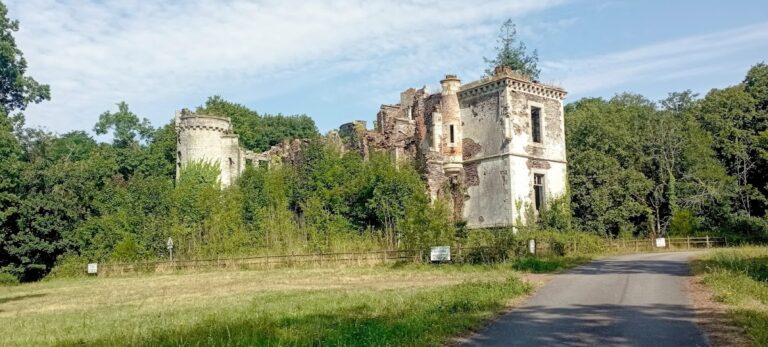
Revolutionary unrest caused the western half of the central residential building to burn on 28 January 1790. The remaining structures gradually fell into ruin, and by the mid-nineteenth century the property belonged to the Duchess of Narbonne. The Renaissance-style residential manor was restored during the nineteenth century and substantially rebuilt late in that century by Armand de Charette. The right wing, destroyed during the Revolution, was rebuilt in 1874.
Since 1990, the manor has housed exhibitions of the Centre de l’imaginaire arthurien, founded by Claudine Glot. The centre interprets Arthurian traditions through exhibitions and cultural activities. Château de Comper is described as the only one of the five castles historically associated with Paimpont Forest and Arthurian legend that survives today. Its enclosure, manor, courtyard, dike, and moats have been partially listed as a historic monument since May 1996.
Arthurian and local traditions
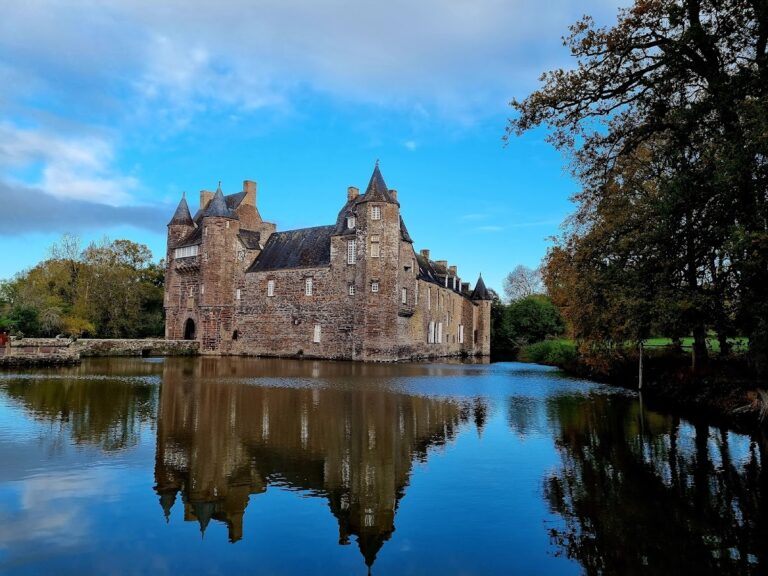
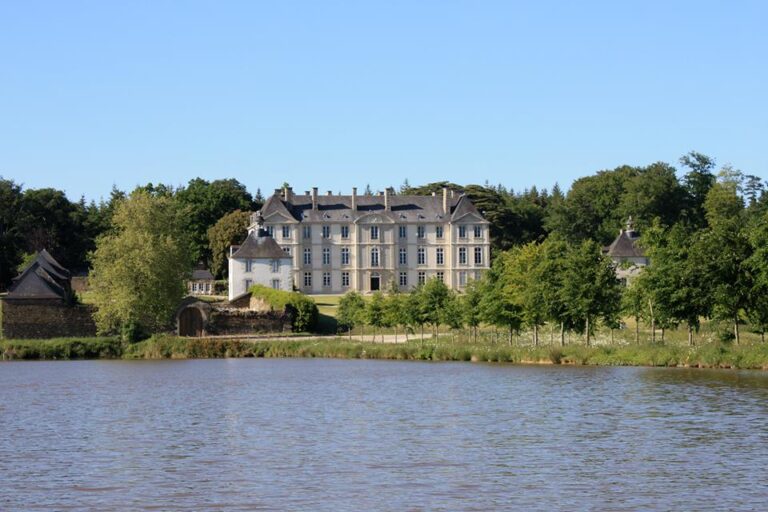
Several traditions identify Comper as the birthplace and residence of Viviane, the Lady of the Lake, an Arthurian enchantress associated with Merlin and Lancelot. One legend says that the huntress Diana first built a castle at the site and gave it to Lord Dymas, whose daughter was Viviane. Another says that Merlin created a crystal castle beneath the waters of the great pond for Viviane, who raised the young Lancelot there. The story may have developed from the reflection of the manor in the pond.
A nineteenth-century tradition concerns Louise de Bréciliane, who lived at the castle, and Jallu the tailor, whose father was reputed to be a sorcerer. In a Gallo-language tale by Ernestine Lorand, the last wolf of the forest races a snail to the castle, loses through the snail’s trickery, and dies of frustration. The tale explains the supposed disappearance of wolves from Brocéliande.
Remains
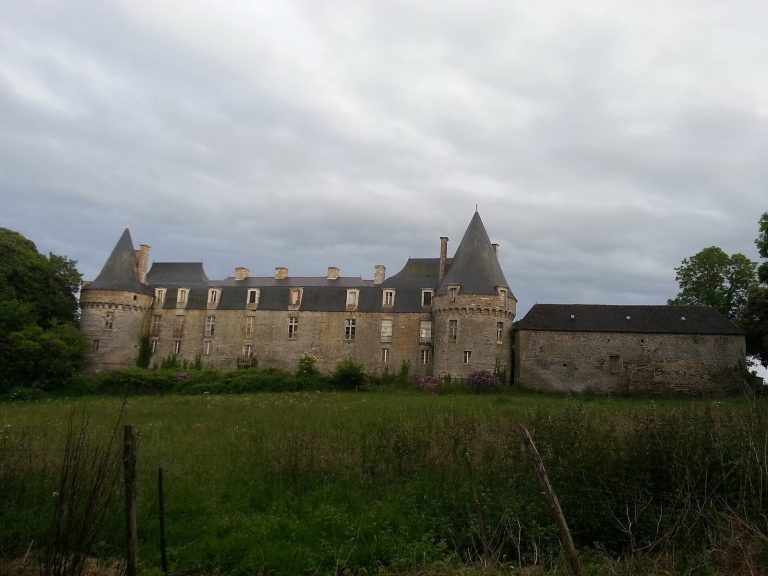
Château de Comper combines the remains of a medieval fortress with a Renaissance-style residential manor. The fortress occupied an elongated rectangular block of red schist, while the present manor forms the principal inhabited part of the complex. The enclosure, courtyard, dike, and moats remain part of the protected historic complex, together with surviving sections of the medieval defenses.
Medieval fortifications
Walls, towers, and entrances
The medieval fortress had four corner towers joined by strong curtain walls, meaning fortified walls connecting defensive towers. A main gate with a drawbridge provided the principal entrance. Its pointed arch retained loopholes and traces of a portcullis, a vertically sliding defensive gate. By 2010, the main surviving medieval elements were the enclosing ramparts, two curtain walls, the postern, which was a small secondary entrance, and the large tower known as the Gaillarde Tower.
Fortress construction and surviving fabric
Irregular red schist formed the fortress walls, which were thick and contained large rooms with substantial fireplaces. Square stone-mullioned windows had broad internal embrasures with built-in seats. By the middle of the nineteenth century, the fortress had largely become ruins, including a split tower and fire-blackened remains. The later destruction and rebuilding of the site left the surviving defensive elements as parts of a complex that no longer served its former military purpose.
Water defenses and landscape setting
Paimpont Forest provided a natural defensive setting, while a large, deep pond surrounded the castle on three sides and joined the lake of Diane. The pond formerly washed one of the castle walls and fed two deep moats cut into the bedrock. These moats were about ten metres wide and are described as dry today. Red-schist outcrops remain visible near the pond, whose waters and the surrounding forest continue to form part of the site’s physical setting.
Renaissance manor
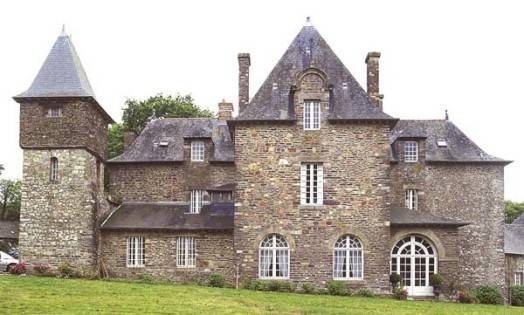
The surviving residential building is described as a double Renaissance manor dating from the fifteenth century. Its numerous fireplaces and timber roof structure are notable features, although the building was restored and substantially rebuilt during the nineteenth century. Armand de Charette’s initials remain on the fireplace in the great hall. The right wing, destroyed during the Revolution, was rebuilt in 1874, giving the residential complex much of its present form.
Legend and physical interpretation
The crystal palace associated with Viviane and Merlin belongs to legend rather than to the documented architectural remains. In the tradition, it lies beneath the deep waters of the great pond and can be seen only by those who believe in it. The pond, manor, enclosure, and surviving fortress fabric provide the physical setting in which this Arthurian story has continued to be connected with Comper.