Château du Bois-du-Loup: A Neo-Gothic Estate and Military Ruin in France


Site at a Glance
- Rating
- 3.8
- Popularity
- Very Low
- Country
- France
- Primary era
- Modern
- Eras represented
- Medieval, Modern
- Civilizations
- Duchy of Brittany, French
- Site type
- Domestic
- Remains
- Castle
On this page10 sections
History
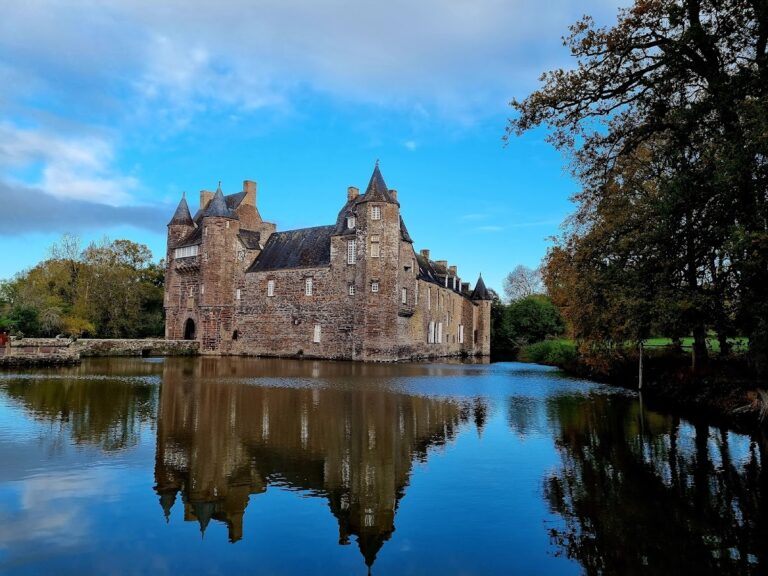
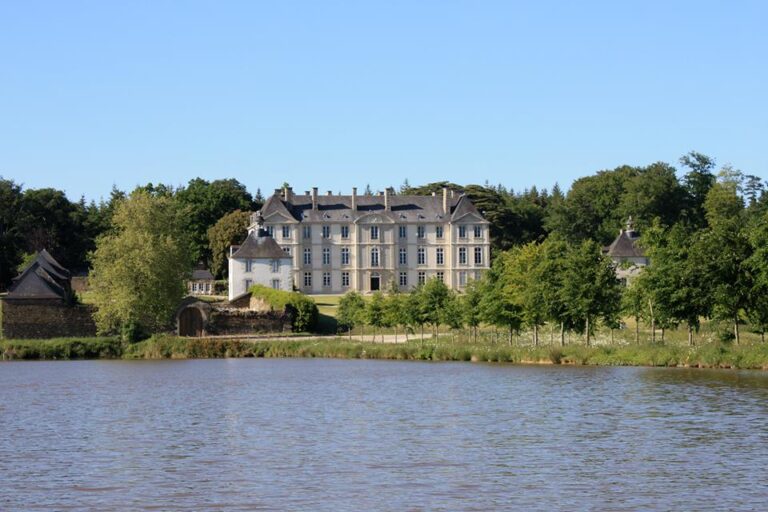
Château du Bois-du-Loup is a Neo-Gothic château in Augan, France, built between 1871 and 1874 as part of the nineteenth-century revival of medieval Gothic architecture. It developed on an estate whose history reaches back to ninth-century Brittany and later became part of the Coëtquidan military domain.
Medieval estate and lordship
The land of Bois-du-Loup was known in the ninth century as “tigran de Botlowernoc.” It formed an agricultural and forest estate with probably a wooden residence. The property belonged to Riwalt d’Algam, a machtiern, meaning a locally influential official or landholder in medieval Brittany, who served as a vassal of Nominoé, the ninth-century Breton ruler associated with the consolidation of Breton political power.
By at least the twelfth century, the lordship exercised high, middle, and low justice. These were the three levels of seigneurial authority, ranging from major criminal cases to lesser civil and local disputes. Surveys made between 1440 and 1536 described Bois-du-Loup as a noble house with noble farmsteads, while a 1679 survey of the royal domain of Ploërmel called it the Lordship of Bois-du-Loup.
The Bellouan and Larcher families
During the fifteenth century, Bois-du-Loup was held by the knight Pierre Grégoire de Bellouan, also known as Perrot de Bellouan. He served as captain of the artillery of the Duke of Brittany during the siege of Champtoceaux in 1420 and became captain of Ploërmel in 1426. His sons Benoît and Guillaume de Bellouan later served as lieutenants of Ploërmel.
The lordship subsequently passed through the families of Scépeaux, Saint-Gilles, Arradon, Yvignac, Coetquen, Albret, and Larcher. The Larcher family inherited it by marriage in 1660. Jean-François Larcher, lord of Bois-du-Loup and a colonel of the king’s dragoons, enlarged the original residence in 1686.
Revolutionary upheaval and rebuilding
In 1732, Isidore Larcher moved to Château de la Touraille, leaving Bois-du-Loup to the descendants of his elder brother. His son Jean Chrysostome Larcher, Count of La Touraille, was born at Bois-du-Loup on 5 April 1720. A soldier and writer, he was executed in Paris during the French Revolution on 8 Thermidor, Year II.
On 19 January 1790, rioters demanding the abolition of feudal rights invaded the château. Auguste-Hyacinthe de Langan, the owner, was suspected of helping to inspire the peasant revolt and was presumed to have been one of its victims. The former château still appeared on the 1812 cadastral plan, a land-survey map recording properties and parcels for administrative purposes. Adolphe de la Fonchais had acquired the estate in 1805, but the former château and its outbuildings were later completely demolished to make way for a new residence.
The Neo-Gothic residence and military occupation
Count Roland des Clos de la Fonchais commissioned the present château, which was constructed between 1871 and 1874 with rendered schist rubble masonry. In 1880, the Clos de la Fonchais family was expropriated from a substantial part of its land for an artillery firing range. The range later became part of the Coëtquidan military camp, a military training area in Brittany.
The château was sold to the state on 16 April 1910, and the family withdrew to Château des Landrieux. The inhabitants of the surrounding village, which contained about forty houses, were also expropriated by the Ministry of War in 1910. From 1911 to 1940, the French Army maintained the château as quarters for staff officers conducting manoeuvres. In the late 1930s, it was assigned in particular to the Toulouse company of military balloonists, who operated lighter-than-air equipment for observation and communications.
War damage and abandonment
In 1939, Spanish Republicans who had taken refuge at Coëtquidan built five parallel barrack buildings beside the château. At the beginning of the Second World War, these barracks housed a Polish garrison. The German Army took possession of the château in June 1940 and held it until the liberation of Brittany in June and July 1944.
During the American Army’s stay at Coëtquidan between January and June 1945, the château was destroyed during artillery-firing and bombing exercises. It was never restored and has remained in ruins since 1945. The Ministry of the Armed Forces has owned the military property since 1910.
Remains
Setting and earlier manor
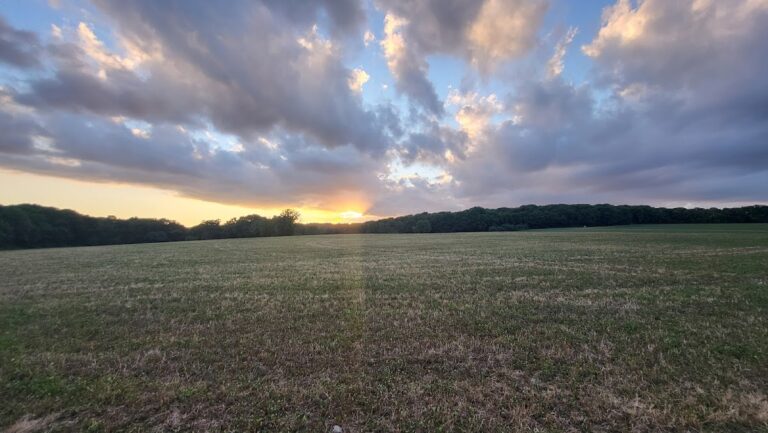
Château du Bois-du-Loup stands within the Coëtquidan military domain on the northern edge of Augan, near the boundary with Campénéac. The site occupies a hillside overlooking the Oyon valley on a slope of the Vobulo stream, a few hundred metres from National Route 24. Extensive woodland and heathland surround the property.
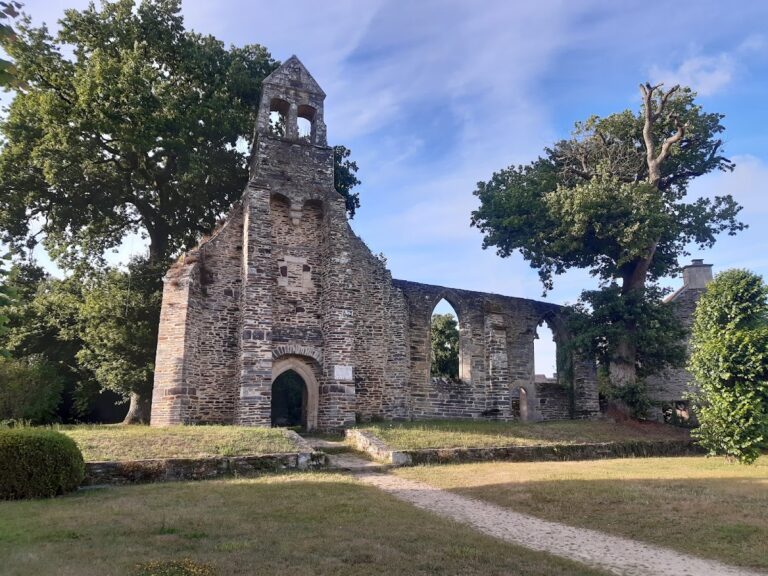
The earlier fortified manor stood approximately 200 metres southeast of the present château. Part of its enclosing wall survives and was later used as a stone quarry. The former residence had an associated chapel and numerous outbuildings, while another chapel stood behind the later château toward the north.
The Neo-Gothic château
The nineteenth-century château occupied approximately 650 square metres on the ground and contained about 2,000 square metres of habitable space before its destruction. Its main façade faced southeast and was built entirely of ashlar, meaning regularly cut and finely finished stone blocks. The northern façade combined granite surrounds and openings with walls made of purple schist rubble.
The building has survived as a ruin since 1945 and is threatened with collapse. Its ruined fabric remains within the military property, alongside the associated remains created by the twentieth-century occupation of the estate.
Barracks and surviving parkland
Five parallel barrack buildings adjoin the château ruins. They were built with schist rubble recovered from the ruins of the thirty-seven houses that formed the surrounding village, whose inhabitants had been expropriated in 1910.
Many trees that once adorned the park survived after the estate was abandoned. Several very old specimens, especially Lambert cypresses, are included in the inventory of remarkable trees of Morbihan.
Nearby sites