Burg Hülshoff: A Renaissance Moated Castle in Germany


Site at a Glance
- Rating
- 4.5
- Popularity
- Medium
- Country
- Germany
- Primary era
- Early Modern
- External website
- Open
- Eras represented
- Medieval, Early Modern, Modern
- Civilizations
- German, Holy Roman Empire, Kingdom of Prussia
- Site type
- Military
- Remains
- Castle
On this page13 sections
History
Burg Hülshoff is a moated castle near Havixbeck in Germany, whose enclosed Renaissance complex developed from an eleventh-century estate and later became the birthplace and childhood home of the poet Annette von Droste-Hülshoff. The castle lies between Havixbeck and Roxel, now a district of Münster, and has belonged to Havixbeck since 1975.
Medieval estate and the rise of the Droste family
The site was first mentioned in the eleventh century as the Oberhof “Hoff von Hulshove,” meaning the court at Hülshoff. Archaeological evidence indicates that a water-filled defensive ditch already surrounded the bailey at that time. The name probably derives from the noble ministerial family Hüls, or Hulse, of Kleve, who may have built a fortified house near the later castle. The family traced its descent to the counts of Tecklenburg.
During the eleventh century, the estate belonged to the Überwasser convent, a community of noblewomen in Münster. The convent successively granted it to the Lords of Hoerde, the noble Lords of Steinfurt before 1301, and the Knights of Schonebeck. The substantial Schonebeck castle stood within sight of Hülshoff until it was destroyed in 1282.
Everwin I von Deckenbrock, a knight and drost in the Münster cathedral chapter, entered the Schonebeck family through his marriage to Hadewich von Schonebeck. A drost was a high-ranking administrative and judicial official. Their son Alhard I von Deckenbrock, a judge of Münster’s free court, acquired the nearby Wittover estate in 1388. The family later adopted the name associated with its hereditary office.
Johann IV. Droste, mayor of Münster, bought part of Hülshoff in 1414. In 1417 he acquired the Oberhof Hülshoff and Haus Tor Kulen, a property known since 1347, from his distant relative Jutta von Schonebeck. From this period the family used the name Droste zu Hülshoff. Hülshoff remained a majorat, an inheritance arrangement that kept an estate within a designated family line, for almost six centuries, from 1417 until 2012.
Fortification and expansion
The Droste zu Hülshoff family first used the castle as a country residence, particularly during the summer. After Münster’s Anabaptist regime, a radical Protestant government established in the city during the Reformation, Heinrich I. von Droste zu Hülshoff moved the family’s principal residence from its Münster town house to Hülshoff. The town property remained in use as a residence.
Heinrich I. enlarged and fortified the castle between 1540 and 1545. His son Bernhard II. strengthened it again in 1580, and his grandson Heinrich II. reinforced the defenses after the castle suffered repeated sieges and plundering during the Spanish-Dutch War and the Thirty Years’ War. Heinrich II. created the present Linden Avenue as the principal approach in 1628 by raising and paving it. In the eighteenth century, the castle could still be defended by 18 men equipped with 18 permanently loaded firearms.
Hülshoff served as the administrative center of its manor. The estate grew through purchases and included surrounding properties, Burgmann estates in Telgte and Heek during the eighteenth century, and former town residences and estates such as Rüschhaus, Haus Vögeding, and Haus Brock during the nineteenth century. A Burgmann estate was a landed holding connected with a castle official who received property in return for military or administrative service. Together, the holdings covered more than 1,250 hectares, while Füchtel and Welpe near Vechta were also held for periods.
The castle was never conquered, but its closeness to Münster brought repeated military billeting. During his third siege of Münster, Prince-Bishop Christoph Bernhard von Galen seized Hülshoff. During the Seven Years’ War, the French commander Louis de Conflans, Marquis d’Armentières, occupied it. From 1789 to 1798, the Comte de Buisseret de Blaringhem and his daughter found refuge at the castle after being displaced by the French Revolution.
Family residence and literary association
Hülshoff was closely linked with the old parish church of St. Pantaleon in Roxel. The heads of the family endowed its furnishings, and family members were baptized and buried there. In the late eighteenth century, General Heinrich-Johann von Droste zu Hülshoff, governor of Münster, remodeled the interior of the manor house. The work included inserting new interior walls and was completed in 1796, shortly before Annette von Droste-Hülshoff was born.
Annette von Droste-Hülshoff was born at Burg Hülshoff on 10 January 1797. She spent her childhood and youth there until 1826, making the castle both her birthplace and her family home. After her father’s death, it passed to her brother Werner.
During the Napoleonic period, Annette’s father, Clemens-August II. von Droste zu Hülshoff, served first as maire and later as sous-préfet in the Grand Duchy of Berg, with occasional assistance from his son Werner-Constantin. The castle later served as the official residence of Heinrich von Droste zu Hülshoff, the Prussian district administrator.
From family estate to foundation
Werner von Droste zu Hülshoff and later Jutta Freifrau von Droste zu Hülshoff gradually sold the subsidiary estates as well as agricultural and forest land. Jutta established a museum dedicated to Annette von Droste-Hülshoff and a restaurant in the castle cellar. In 2012 she transferred the castle, its inventory, and its remaining land to the newly founded Annette von Droste zu Hülshoff Foundation.
The foundation was officially recognized in 2012 to preserve the birthplace for public use, literary events, exhibitions, and research. Extensive conservation followed in 2014, after the roof structure dating from 1417 was found to be in immediate danger of collapse. The work renewed the main house’s roof structure and covering, reroofed the chapel with historically faithful slate shingles, and refitted the chapel windows. The literature center Burg Hülshoff, Center for Literature, opened at the castle on 24 August 2018, with Jörg Albrecht as artistic director.
Remains
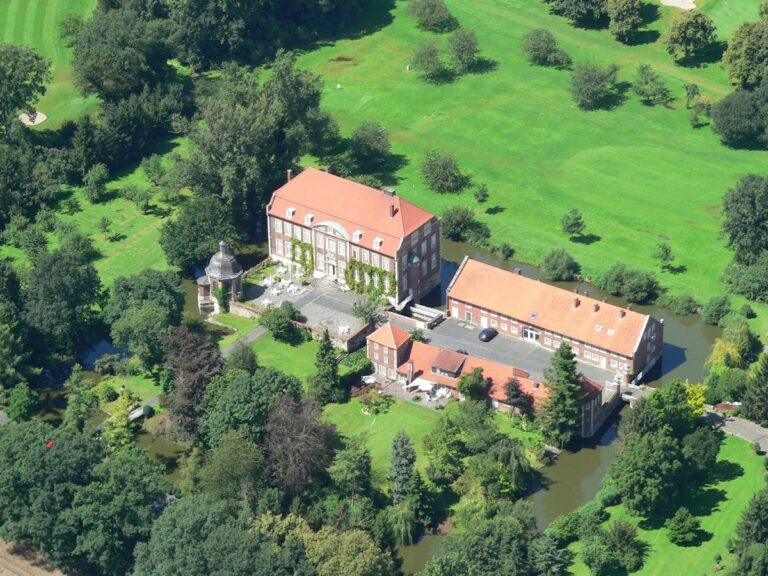
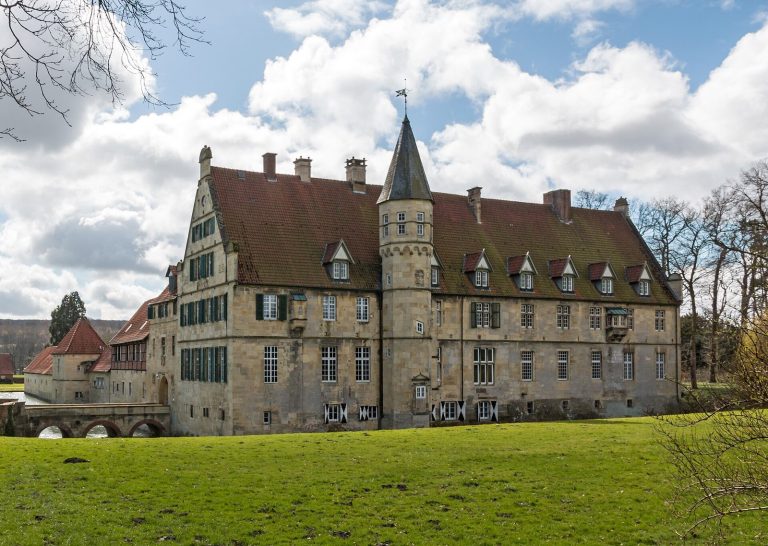
Burg Hülshoff survives as an enclosed Renaissance lowland moated castle, or a fortified residence on relatively flat ground protected partly by water rather than by a naturally elevated site. Its principal buildings occupy two islands linked by a bridge. The central castle stands on one island, while square towers formerly used by household servants occupy the other. Baumberg sandstone and brick masonry form the complex, whose main building is marked by high, plain stepped gables. A small roof turret carries a storm bell that could sound an alarm across a wide area.
Castle islands and principal buildings
Main house
The earliest medieval arrangement appears to have consisted of a single thick-walled house on an island in the initially smaller Hausteich. The later bailey had a ditch along its southern side, where the entrance was located. The ground floor probably already included a very large knights’ hall with Gothic windows and an equally large kitchen with a massive hearth. Three long tables served the lord, the retainers, and construction workers. A cabinet with a bay window was later added beside the kitchen.
Between 1540 and 1545, Heinrich I. von Droste zu Hülshoff added the western wing to the main house and enlarged the surrounding water area through a canal. The interior was remodeled at the end of the eighteenth century, and its roof structure, dating from 1417, was renewed during the 2014 conservation work.
Chapels
A chapel beside the castle was destroyed during the Münster Diocesan Feud of 1450 to 1457. A replacement was later built in the castle courtyard. Its arrangement allowed the household to see the altar from the castle through a window. By the nineteenth century, this chapel had probably been demolished, and services were held in the library.
After 1875, Heinrich von Droste zu Hülshoff added a Neo-Gothic chapel. Its slate shingles and window surrounds were renewed during the 2014 conservation campaign.
Defensive and service towers
Bernhard II. von Droste zu Hülshoff added enclosing walls, a three-storey watchtower, the Old Dog Tower, and a Renaissance bay window. The watchtower was later demolished, as was the Old Dog Tower in the nineteenth century. The double coat of arms of Droste zu Hülshoff and Travelmann above the main entrance originally decorated the bay window, which was removed in the eighteenth century.
Heinrich II. von Droste-Hülshoff built the gatehouse and drawbridge that once marked the principal approach, although the gatehouse was demolished in the nineteenth century. He also built the Gardener’s Tower in 1628. Its weather vane bears his double Droste-Nehem coat of arms. Since the nineteenth century, the tower has displayed an equestrian relief of Heinrich I. von Droste zu Hülshoff, who took part in the recapture of Münster from the Anabaptists. The relief had originally stood elsewhere.
The New Dog Tower was built in 1868 at the expense of the ornithologist Ferdinand von Droste zu Hülshoff. It now displays the weather vane bearing the Droste-Travelmann arms, formerly mounted on the Old Dog Tower.
Park, water, and avenues
Landscape park
The northern grounds form a landscape park with woodland, a summer bosquet, a rose garden, and a lawn. A bosquet is a formal garden area planted as a small enclosed grove. A small pavilion known as the Tea House stands in the woodland. Ferdinand Godfried von Droste zu Hülshoff, dean of Coesfeld, gave the Tea House as a gift.
Clemens-August II. von Droste zu Hülshoff shaped the southern grounds by draining marshy land through channels dug from the eastern and western towers of the bailey to the Hausteich. He also deepened the nearly silted-up ditch between the towers. These works established the park’s present form as a landscape garden. In the 1970s, the ditches around the bailey became broad enough to create its island setting. Jutta von Droste zu Hülshoff later enclosed the park and created the rose garden and lawn.
Avenues and planted areas
At the beginning of the eighteenth century, Heinrich Johann I. Droste zu Hülshoff planted four chestnut trees on the pond’s northern bank. Replacement trees have been planted repeatedly. He is also associated with the oak avenue running from the northwest toward Linden Avenue.
Ernst Constantin I., a canon of Osnabrück Cathedral and Heinrich Johann I.’s second son, planted the southern part of the summer bosquet and the predecessors of Chestnut Avenue, which leads northward toward the Hausteich. The present grounds preserve these avenues and planted areas as part of the castle’s wider landscape composition.