Castelo de Sesimbra: A Medieval Fortress in Portugal


Site at a Glance
- Rating
- 4.6
- Popularity
- Medium
- Country
- Portugal
- Primary era
- Medieval
- External website
- Open
- Eras represented
- Medieval, Early Modern
- Civilizations
- Portuguese, Umayyad
- Site type
- Military
- Remains
- Castle
On this page15 sections
History
Castelo de Sesimbra is a medieval fortress in Portugal, rebuilt under the Portuguese monarchy around 1200 on the site of an earlier Muslim citadel. Its history reflects the Christian Reconquista, the long expansion of Christian kingdoms into Muslim-ruled territories in the Iberian Peninsula, as well as the later growth of Sesimbra’s fishing and maritime community.
Early settlement and Muslim occupation
Human settlement occupied the site in prehistoric times. The cove below probably served as a natural anchorage for Mediterranean sailors, including Phoenicians, Greeks, and Carthaginians. Archaeological finds from the castle area, including pottery, especially amphorae, coins, and graves, show the process of Romanization. The area was later occupied successively by Visigoths and Muslims.
Muslim tradition credits the establishment of the original fortification to the Muslim period. In the ninth century, the site was a settlement known as an alcazaba, a fortified citadel or castle. Its position above the cove gave the settlement a defensible location overlooking a natural harbour on the Setúbal Peninsula.
Reconquest and rebuilding
After the conquest of Lisbon in 1147, control of the region shifted between Muslim and Christian forces. A lightly garrisoned fortification at Sesimbra was taken by the forces of Afonso Henriques, the first king of Portugal and a leading figure in the Portuguese Reconquista, on 21 February 1165. The fortification was then repaired and strengthened.
The settlement suffered a major reversal after Sancho I’s forces conquered Silves in 1189. An Almohad counteroffensive, carried out by a North African Berber Muslim dynasty that ruled parts of the Iberian Peninsula, recovered Silves and much of the Alentejo as far as the southern bank of the Tagus. Sesimbra’s inhabitants, weakened by plague and alarmed by the fall of Alcácer do Sal, abandoned the settlement. In 1191, the Almohad caliph Abu Yusuf Yaqub al-Mansur occupied Sesimbra and almost entirely destroyed it.
Sancho I regained Sesimbra around 1199 or 1200 with help from Frankish crusaders from northern Europe, who received land for colonization. On 15 August 1201, the king issued a charter ordering the town to rebuild the castle “from the foundations.” His successor, Afonso II, confirmed the charter. The medieval castle is generally dated to approximately 1200.
The Order of Santiago and municipal development
On 19 February 1236, during the reign of Sancho II, Sesimbra and its castle were granted to the Order of Santiago through its grand master, Paio Peres Correia. This military-religious order held territory and promoted Christian settlement and defense during the Reconquista. It encouraged repopulation by granting privileges to fishermen and establishing a sanctuary for fugitives. Afonso III confirmed the donation on 22 February 1255.
During the reign of Denis I, the royal charter was reconfirmed, Sesimbra was elevated to town status, and its municipal council was established in 1323. The nearby settlement of Póvoa da Ribeira de Sesimbra was created beside the port. Improvements to the castle’s defenses have been attributed by some scholars to this period. Afonso IV and Ferdinand I later confirmed Sesimbra’s charter.
Decline of the hilltop settlement
The castle began to lose importance during the fourteenth century. During the Portuguese succession crisis of 1383 to 1385, a conflict over the Portuguese crown that included war with Castile, Castilian vessels intermittently plundered Sesimbra in 1384. The castle also served as a refuge for John of Avis and his troops during the fighting.
From the fifteenth century onward, the settlement beside the bay grew beyond the older hilltop community in size and importance. Fishing, shipbuilding, and the provisioning of vessels expanded during Portugal’s maritime discoveries. Manuel I granted the town a new charter in 1514 and built the artillery fort of São Valentim, also called Forte da Marinha, beside the beach.
A 1516 inspection by Jorge de Lancastre, master of the Order of Santiago and an illegitimate son of John II, described the castle’s buildings and condition. Manuel I and his successor, John III, may have resided at the castle at certain periods. John III also created the new parish of Ribeira, now Santiago.
Artillery defenses and later damage
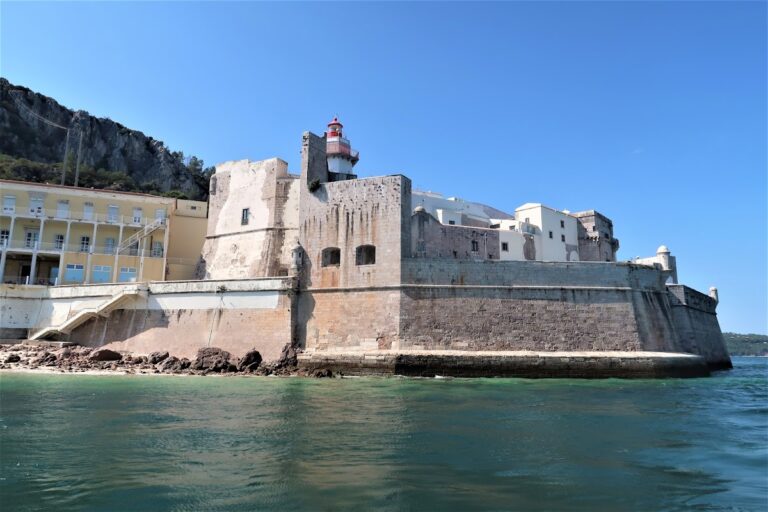
During the Portuguese Restoration of Independence, the revolt and ensuing conflict that ended Portugal’s rule within the Iberian Union, the medieval castle was adapted for artillery warfare. Triangular ravelins, artillery outworks placed beyond a fortress wall, were added. At the same time, the new Fort of Santiago de Sesimbra was built beside the beach over the remains of the ruined Fort of São Valentim.
The ramparts were reinforced in 1693. The earthquake of 1755 severely damaged the old castle and reduced its strategic importance. Sesimbra was later involved in the Peninsular War, the Iberian phase of the Napoleonic Wars, and the Portuguese Liberal Wars, nineteenth-century civil conflicts between constitutional liberals and absolutists, but no specific events at the castle during those conflicts are recorded. Part of the castle grounds was converted into a cemetery in 1875.
Protection and restoration
Public intervention began during the 1930s and 1940s, when the Directorate-General of Buildings and National Monuments carried out consolidation and restoration. Further restoration took place in 1998, and the castle is now in relatively good condition. It was classified as a National Monument in 1910 under a decree dated 16 June and published on 23 June. The Municipality of Sesimbra manages the site.
Remains
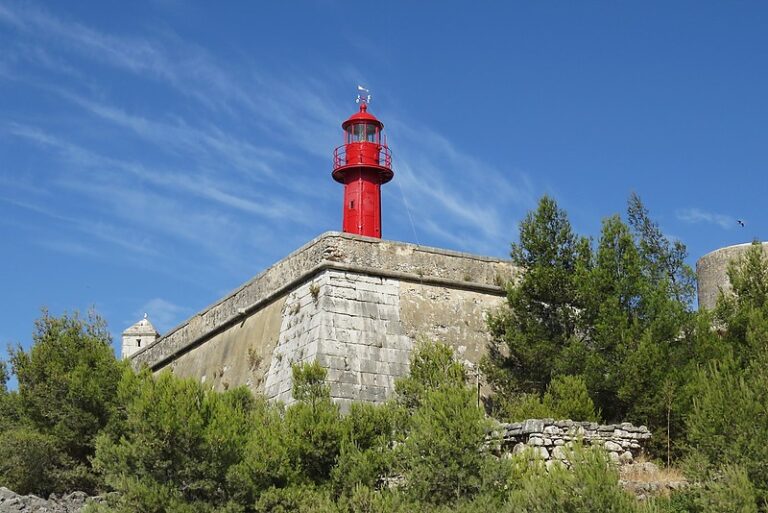
Castelo de Sesimbra stands approximately 240 metres above sea level on a dominant cliff above a cove that forms a natural harbour. The site lies on the Setúbal Peninsula between the estuaries of the Tagus and Sado rivers, a few kilometres from Cape Espichel. Its irregular, elongated plan follows a northeast to southwest axis. The northern end contains the medieval citadel, while walls, towers, gates, bastions, religious buildings, cisterns, and civic remains occupy the wider enclosure.
Citadel and defensive enclosure
Medieval citadel
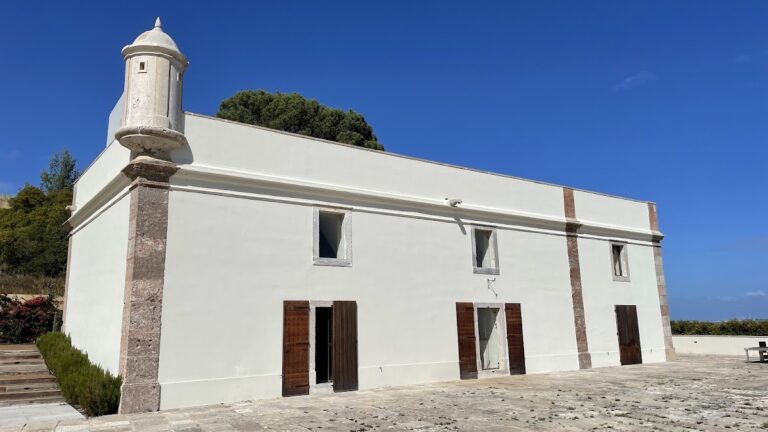
The northern alcazaba has an approximately quadrangular plan and is dominated by two towers. One is the quadrangular keep, the principal strong tower of a medieval castle. Its upper storey has a coffered vault, a vaulted ceiling decorated with recessed panels. At the opposite end of the castle stands a quadrangular watchtower, extending the defensive system across the elongated enclosure.
Walls, gates, and artillery works
The crenellated walls incorporate four seventeenth-century bastions, projecting fortifications designed to strengthen the walls and support defensive fire. Two bastions lie to the north and two to the south. The enclosure has two gates, the Porta do Sol on the northeast side and the Porta da Azóia on the northwest side. The ramparts were reinforced in 1693, and the later artillery adaptations included triangular ravelins.
Governor’s residence and internal buildings
The 1516 inspection described the principal stone gate between two strong, well-maintained turrets, with wooden elements that were new or had been repaired. To the right stood the castle governor’s residence. Its upper floor contained a hall, three bedrooms, and a kitchen above four ground-floor storerooms. One storeroom held a cistern, while the others served as a cellar, hayloft, and stable.
A corridor connected the upper part of the governor’s residence with the keep, which was already beginning to fall into ruin in 1516. A second similar house stood to the left of the entrance, although its function is now unknown. The surviving fabric was consolidated and restored during the twentieth century, with additional restoration in 1998.
Religious and civic remains
Church of Nossa Senhora do Castelo
The Church of Nossa Senhora do Castelo, also called Santa Maria do Castelo, stands on the central platform of the fortress. It was erected in 1160 and is attributed to Afonso Henriques. The church was restored in 1721, providing a religious structure within the castle’s defensive setting.
Town hall and water storage
The remains of the former town hall stand beside one of the castle’s three cisterns. These surviving civic and water-management features form part of the internal remains of the enclosure and complement the military structures, church, and residential buildings that shaped the castle’s use over time.