Chateau of Děčín: A Castle and Aristocratic Residence in Czechia
Site at a Glance
- Rating
- 4.6
- Popularity
- Medium
- Country
- Czechia
- Primary era
- Early Modern
- External website
- Open
- Eras represented
- Medieval, Early Modern, Modern
- Civilizations
- Habsburg, Holy Roman Empire, Kingdom of Bohemia
- Site type
- Domestic
- Remains
- Castle
On this page22 sections
History
The Chateau of Děčín in Czechia developed from a medieval fortified settlement and royal stone castle above the confluence of the Elbe and Ploučnice. A wooden Přemyslid fortification, associated with the medieval ruling dynasty of Bohemia, was mentioned in 1128 and apparently controlled navigation on the Elbe. A royal stone castle was built in the mid-thirteenth century, beginning the site’s long development from a military stronghold into an aristocratic residence.
Medieval royal castle
The earliest settlement at Děčín appears in written records from the tenth to thirteenth centuries, and a burgrave, an official responsible for administering and defending a castle, was associated with the site in 1199. Its early medieval form has not been confirmed through archaeology, although it is thought to have occupied the position later held by the castle and chateau. Historian August Sedláček attributed the foundation of the stone castle to Heřman of Šumburk, who received Děčín from King Wenceslas I in 1249.
After the death of King Přemysl Otakar II, Jan of Michalovice seized the castle, but returned it in 1283 in exchange for other property. Děčín had been intended as a pledge to Margrave Otto V of Brandenburg for the release of the king’s son Wenceslas II. King Rudolf I later annulled Otto’s claim. The castle remained royal property until 1305 or 1306, when King Wenceslas III granted it hereditarily to the brothers Jan, Beneš, and Václav of Vartenberg.
The Vartenbergs divided their family lands around 1350, assigning parts of Děčín Castle to Jan and Beneš. The castle burned shortly before 1370, after which Emperor Charles IV and King Wenceslas IV confirmed the brothers’ possession. Further divisions, inheritances, purchases, and guardianships shaped ownership during the later fourteenth century. By about 1383, Jan IV of Vartenberg was guardian of the sons of his deceased relative Jan III Gast. The brothers first held Děčín jointly, while Jan V retained most of the estate, Václav received a smaller portion and founded Blansko Castle, and Beneš was bought out.
Wars and destruction in the fifteenth century
After Jan V died around 1409 or 1410, his sons Zikmund and Jan VI divided the inheritance. They probably continued to own Děčín Castle jointly, although Zikmund exercised authority there. During the Hussite Wars, the fifteenth-century religious and political conflicts in Bohemia associated with the followers of Jan Hus, Zikmund initially supported the Catholic side. In 1423, a Hussite force led by the military commander Jan Žižka burned the town of Děčín.
Zikmund of Vartenberg also fought local wars against Saxony and the Lusatian League. After his death in 1438 or 1439, his sons Jindřich and Jan VII inherited half of Děčín, while the other half remained with their uncle Jan VI. In September 1444, Lusatian forces allied with the Litoměřice commander Jakoubek of Vřesovice besieged several Vartenberg castles. Děčín was captured and burned, and Jindřich probably died during the fighting.
Jan VII eventually brought the estate under his sole ownership. In 1453, Aleš Holický and Zdeněk Konopišťský of Šternberk obtained the inheritance rights of Anežka of Šternberk, the widow of Zikmund of Vartenberg, from the monarch. They sold her share to Jan VII in 1454, and he retained Děčín until his death in 1476. His sons then divided the inheritance. Děčín passed to Zikmund together with Ostrý, Vrabinec, and Kamenice, but his heavy debts led King Vladislav Jagellonský to approve a sale in 1504. Mikuláš Trčka of Lípa bought the entire estate in 1511 for 60,000 groschen.
Renaissance transformation and the Bünau estate
Mikuláš Trčka sold Děčín in 1515 to the brothers Hanuš, Volf, and Bedřich of Salhausen. Hanuš later bought out Volf, while Bedřich received Benešov nad Ploučnicí, Kamenice, and possibly a share of Děčín Castle. Hanuš sold Děčín to the knight Rudolf of Bünau in 1534. After Rudolf’s death in 1540, his sons inherited the estate, and Jindřich the Younger consolidated their shares in 1543. When he died childless in 1553, Děčín passed to Gynter of Bünau.
Gynter began converting part of the medieval castle into a Renaissance chateau in 1573. After his death in 1576, his four sons divided the property in 1579. Děčín and the villages on the right bank of the Elbe went to Jindřich the Elder of Bünau, who later also inherited Podmokly and settlements on the left bank after the death of his brother Jindřich the Younger. His widow Anna Trmická of Milina administered the estate, followed after 1615 by Anna Hyršpergárová of Kynykshain. Their heir Rudolf the Elder of Bünau took control shortly after 1623.
The Bünau family were Lutherans. Rudolf the Elder did not participate in the Bohemian Revolt of 1618 to 1620 because of his age, but enforcement of the Renewed Land Ordinance forced him to sell his Bohemian property and leave the country. Kryštof Šimon of Thun bought the Bünau estates in August 1628 and became a count the following year. His nephew Jan Zikmund of Thun inherited the Bohemian property in 1635, and the Catholic Thun-Hohenstein family retained Děčín until 1932.
Děčín in the Thirty Years’ War
Děčín was repeatedly occupied during the Thirty Years’ War, the European conflict of 1618 to 1648 that combined religious struggles with contests for political and territorial power. After the imperial defeat at Breitenfeld in 1631, Saxon troops entered Bohemia. Jindřich the Elder of Bünau and his brothers returned with them and took the castle on 4 November from its commander, Captain de la Marche, and 100 musketeers. A Saxon garrison remained until the Peace of Prague in 1635. Jindřich was then expelled and lost his claims to the estate because Kryštof Šimon of Thun had not paid the full agreed purchase price.
Swedish forces under General Pfuhl attacked the chateau in April 1639. After a three-day siege, the small garrison commanded by estate captain Jan Schober surrendered on 25 April because of the Swedish numerical advantage and the shortage of ammunition. The Swedish garrison remained until spring 1640. Schober and Jan Kryštof of Rubland then captured forty Swedish musketeers and occupied the town. After further fighting, the chateau surrendered on 13 May, and the Swedish troops handed over their weapons and were allowed to leave freely.
The chateau was besieged again in 1645 by the Swedish general Paykul, who sought its ammunition supplies, but the garrison under Jan Jiří Stüblinger resisted. Swedish forces under Jan Koppy captured Děčín in 1648, taking the town on 6 September and the chateau on 15 September. They remained until June 1649, despite the Peace of Westphalia.
Thun-Hohenstein residence and fortress
After Jan Zikmund of Thun died in 1646, the Děčín estate was divided into four parts in 1653, with Děčín going to Maxmilián of Thun. He began changing the Renaissance chateau into a Baroque residence while retaining its role as a fortress. The Thun brothers established the Děčín majorat, an inheritance arrangement intended to keep an aristocratic estate within one family rather than divide it among heirs. Rudolf transferred his share to Maxmilián in 1664, followed by Jan Arnošt and František Zikmund in 1671. Maxmilián administered the estate until his death in 1701.
Disputes between the Thun landlords and their subjects contributed to a peasant uprising in the Děčín region in 1680. Maxmilián’s son Jan Arnošt inherited the majorat but died in 1717. His elder brother Jan František combined the Děčín, Klášterec, and Choltice majorats before his death in 1720. During the minority of his son Jan Josef, his widow M. Filipína administered the estate. Jan Josef assumed control in 1732 and established a large library during the mid-eighteenth century. It was visited by Czech National Revival figures including František Martin Pelcl, Josef Dobrovský, Josef Jungmann, and František Palacký. Václav Vladivoj Tomek later used the chateau archive to write a history of the Děčín estate.
Děčín remained an important regional fortress during the eighteenth century. Saxon troops occupied it in 1741, Prussian troops under General Leopold Maximilian of Anhalt-Dessau replaced them in 1742, and French troops under General François-Marie de Broglie occupied the chateau on 2 October. His garrison surrendered to imperial forces on 11 December and was permitted to withdraw. An imperial garrison of ninety Croats was stationed there in 1744 but was defeated and captured by Prussian troops. Saxon forces occupied Děčín again until spring 1745, while tensions between subjects and estate authorities led to mass unrest in 1753.
At the beginning of the Seven Years’ War, an imperial garrison under Captain Mittelstetter occupied the chateau from 8 September 1756. Prussian General Christoph Hermann von Manstein captured it later that month, after which Croatian troops replaced the Prussians. The chateau changed hands again in 1757 and was occupied by Prussian troops in 1778 during the War of the Bavarian Succession. By then its fortifications no longer met contemporary military requirements. After visiting Děčín, Emperor Joseph II founded the new fortress of Terezín instead.
Jan Josef divided the property among his sons in 1785 and died three years later. Děčín passed to Field Marshal Count Václav of Thun-Hohenstein, who commissioned Jan Václav Kosch to carry out the final major rebuilding between 1786 and 1792. Václav’s son František Antonín I inherited Děčín in 1808. He hastily refortified the chateau in 1809 and 1813, when a Croatian garrison was again intended to defend it. He also developed the estate economically and established a new park.
Nineteenth and twentieth centuries
The chateau continued to receive prominent visitors. Fryderyk Chopin, the Polish composer and pianist, stayed there for five days in September 1835. During the visit he composed the A-flat-major Waltz, Op. 34, known as the Děčín Waltz, and dedicated it to Countess Josefína of Thun-Hohenstein. From 8 to 10 June 1854, Emperor Franz Joseph I and Empress Elisabeth met at Děčín with King Frederick William IV of Prussia and King Frederick Augustus II of Saxony and his queen during a state banquet.
František Antonín died in 1873. His son Bedřich František inherited the chateau in 1881, followed by his son František Antonín of Thun-Hohenstein. In 1932, František Antonín IV of Thun-Hohenstein sold the chateau to the Czechoslovak state for 4,750,000 crowns. The complex ceased to serve as an aristocratic residence and became barracks. From 1934 it was used by Czechoslovak border troops.
The German army occupied the complex during the Second World War. After the war it returned to Czech military use, and Soviet forces occupied it from 1968 to 1991, using part of the complex, including a hospital. Prolonged military occupation severely damaged the building fabric. The former library became a sports hall, and the historic interiors were extensively affected.
After the Soviet withdrawal in 1991, the chateau became the property of the city of Děčín. The city began extensive renovation, including renewed roofs and repaired facades. Parts of the complex now serve ceremonial and cultural purposes. The Chateau of Děčín is protected as a Czech cultural monument and is owned by the statutory city of Děčín.
Remains
Medieval castle core
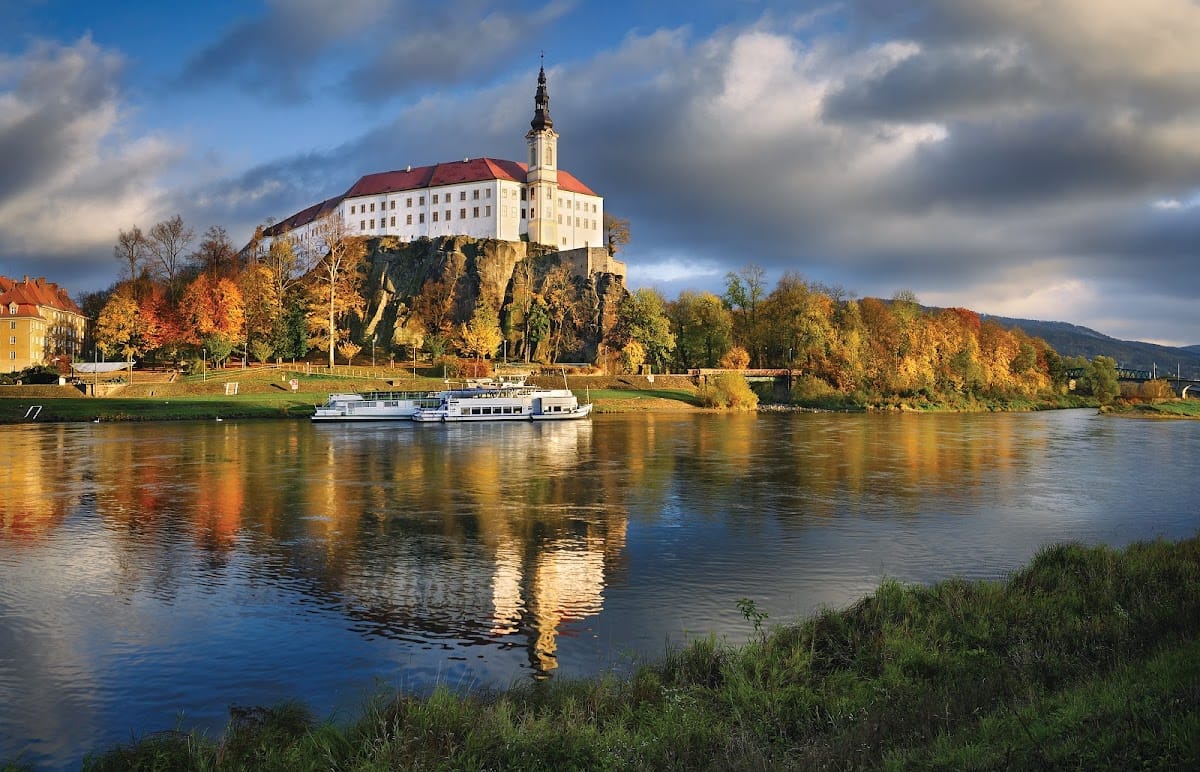
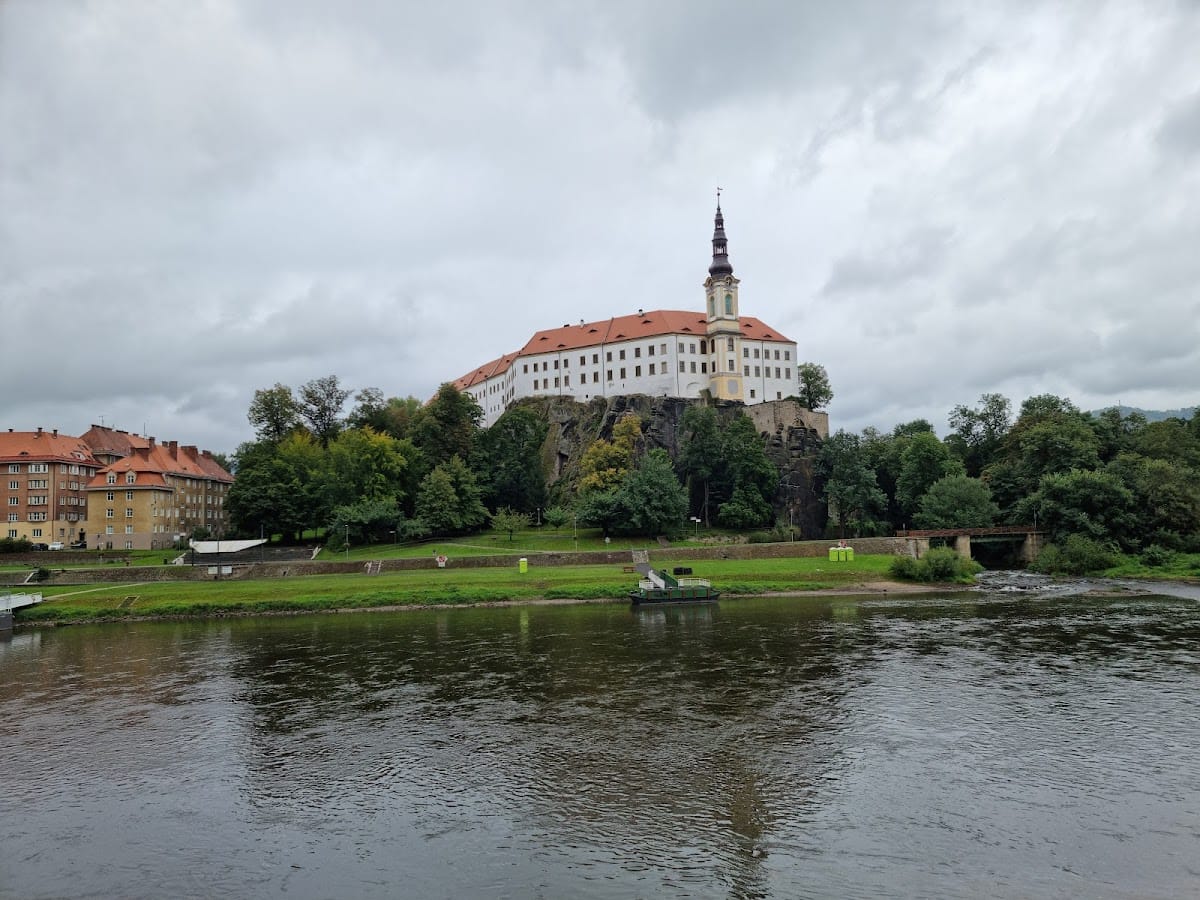
The chateau stands on a sandstone rock above the meeting point of the Elbe and Ploučnice. The medieval castle had two defensive zones. A round tower stood above the first moat, while a second moat protected the inner castle. The later building complex incorporated the second moat as cellars. The repeated rebuilding of the site makes the medieval appearance difficult to reconstruct, but surviving masonry and archaeological discoveries reveal parts of its earlier arrangement.
Square tower and palace
The inner castle once contained a square tower at its head, a palace with stepped gables behind it, and further buildings along the perimeter, probably enclosed by an outer defensive enclosure between the main fortification and a wall or ditch. Archaeological work in 2009 uncovered a fragment of the square tower. It measures 5 by 5 metres and retains traces of a spiral staircase within one wall. The staircase was entered from the courtyard through a Late Gothic portal.
Archaeological research also revealed masonry from an Early Gothic palace. Its principal space was a large hall with chambers on either side, illuminated by pointed windows with stone tracery. Vault ribs belong to a chapel mentioned in written records. Raising the courtyard level during the medieval period changed rooms that had originally been on the ground floor into basement spaces. Some cellars extend beneath the courtyard, and parts of the buildings remain below its level.
Baroque fortifications and approach
The Baroque chateau created for Maxmilián of Thun retained the medieval inner core and had a three-part arrangement. Later Baroque-classical rebuilding produced the present external form. The second moat was filled, the fortifications were abolished, and the buildings were arranged around a large central courtyard. Surviving defensive elements include semicircular bastions in the Rose Garden and the approach route known as Dlouhá jízda, or Long Ride. An earlier star-shaped fortification that protected the entrance later disappeared.
Dlouhá jízda and its gates
Dlouhá jízda is an approximately 270-metre-long and nine-metre-wide enclosed avenue leading between the town and the chateau. Its walls are about seven metres high and decorated with blind arcades. Completed in 1672, the avenue combined formal access with a defensive function that remained important in the eighteenth century.
The lower entrance is the pilaster-decorated Lower Gate. It contains two passages, one leading towards Křížová Street, together with two smaller gateways. At the opposite end stands the Early Baroque Upper Gate, which has pilasters and a triangular pediment. A Side Gate in the northern wall has rusticated pilasters, stone spheres, and two shallow chapel-like structures.
Gardens and secondary buildings
Rose Garden and gloriette
Maxmilián of Thun demolished the twenty-two houses of the former Rose Street north of Dlouhá jízda to create a French-style park. At a higher level he established the Rose Garden. Its eastern side is closed by a two-storey gloriette, a garden pavilion designed as a viewing and ornamental structure. It has a square plan, stairs, terraces, and a ground-floor three-aisled hall with cross vaults.
Two statues of warriors were added to the gloriette in the eighteenth century. Three further statues of ancient gods, made around 1700 by Abraham Felix Kitzinger, stand on the garden balustrade. Opposite the gloriette is a sala terrena, a garden hall opening onto the grounds through arcades. Its facade has three tall arches, while the interior is covered by a barrel vault with lunettes. G. Bragaglio created its frescoes and illusionistic paintings in 1678.
Passage to the church
A covered passage runs along the eastern part of the northern wall and connects the chateau with the Church of the Exaltation of the Holy Cross. The passage forms part of the surviving relationship between the aristocratic complex and the adjoining religious building.
Main chateau buildings
Courtyard and bridge
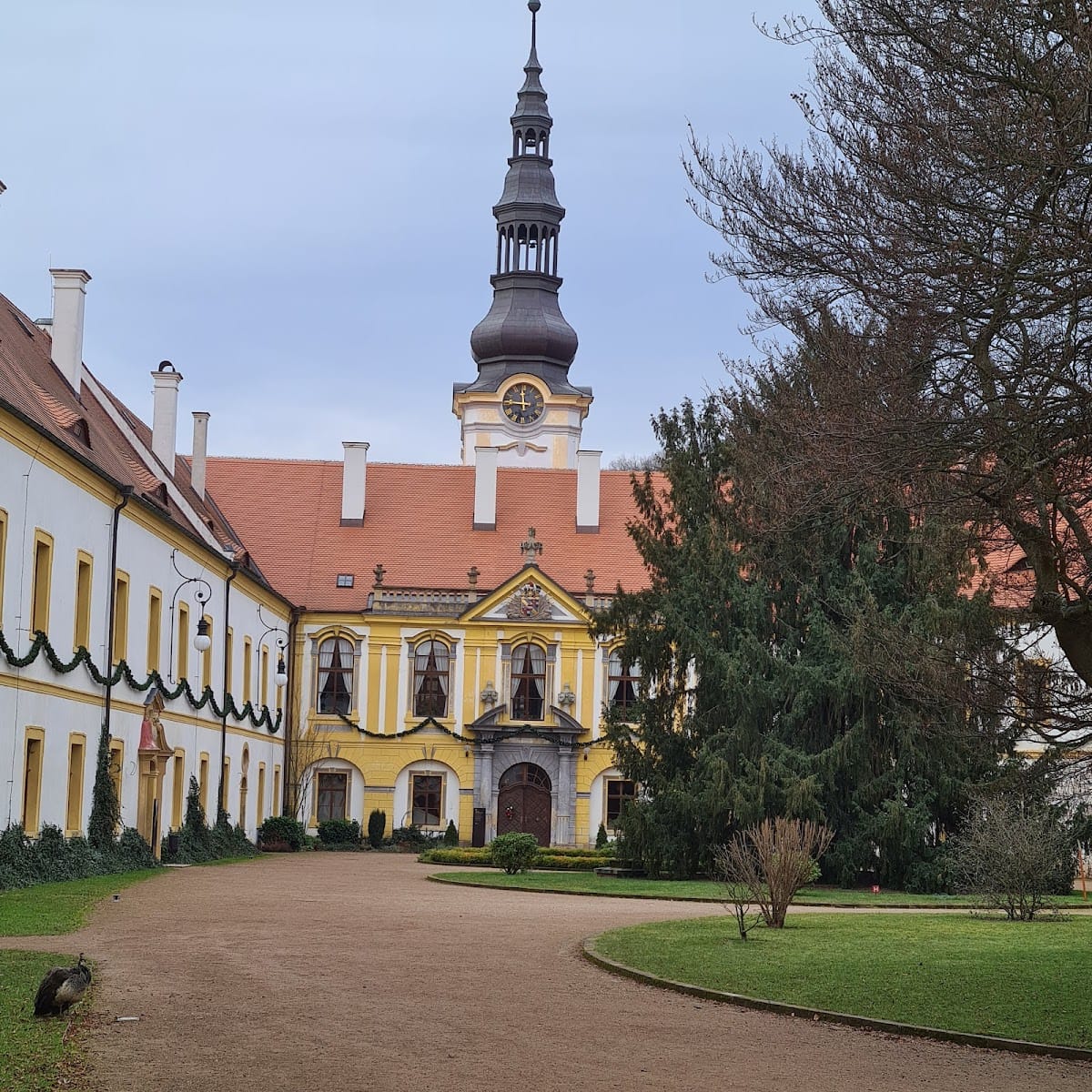
The main buildings stand beyond the surviving first moat, which is crossed by a stone bridge decorated with statues of women and amphorae. The buildings enclose an elongated, slightly irregular hexagonal courtyard. They have six wings, are two storeys high on the exterior, and rise one storey on the courtyard side. Their outer facades are largely undecorated and organized by rectangular windows.
Western and eastern facades
A prismatic tower dominates the western side. Its chamfered corners are decorated with pilasters, and an oriel supported by corbels projects from the northern side. The courtyard entrance has a portal with belted columns, pilasters, and a broken pediment, followed by a passage covered by a cross vault.
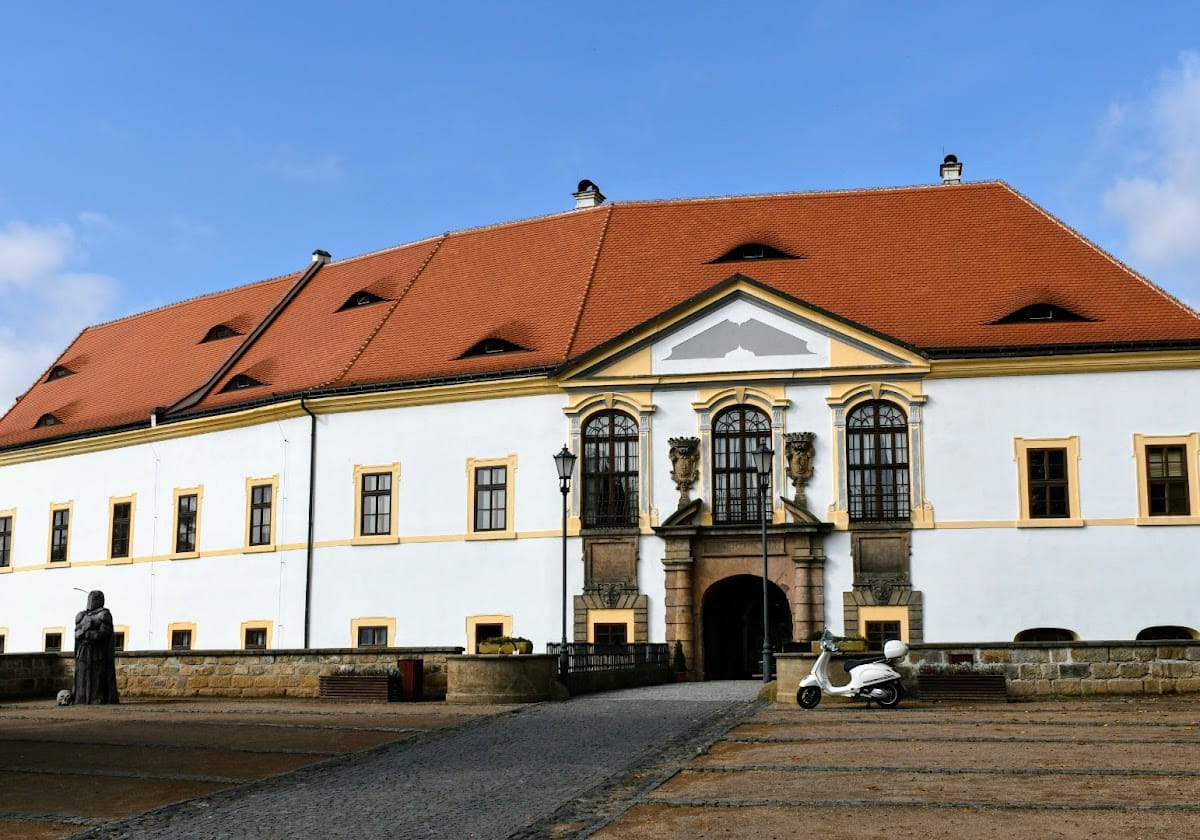
The principal building of the west wing has a five-bay facade with blind rusticated arcades, windows set in ear-shaped frames, and a semicircular entrance portal with a keystone. The eastern outer facade serves as the entrance facade and provides the only access to the inner courtyard through a passage. Its central entrance feature has an Early Baroque stone portal with a compressed, curled arch and pediment. The lintel carries the date 1674, a rectangular cartouche, and an inscription, while two smaller blind rectangular stone portals flank the main entrance.
South of the approach avenue
Granary and riding school
A riding school and a granary stand south of Dlouhá jízda. The granary was built in 1723, possibly to designs by Kilián Ignác Dientzenhofer. Its facade contains a niche with statues of a Turk and a peasant by Ferdinand Maximilian Brokoff, dated 1725.
Garden pavilion
West of the granary is a garden pavilion from the second third of the eighteenth century. Its rectangular central block has two short side wings, a mansard roof, and a domed central section. The principal facade contains windows with decorative ornament above them, a vase, a cornice, and a triangular pediment with statues. The entrance has a portal with a segmental head.
Southern park
A surviving fragment of the park occupies the southern side of the chateau rock and dates from the beginning of the first third of the nineteenth century. It connects with the northern gardens through a tunnel cut into the rock and a small chain bridge. The northern park was later altered by house construction in the 1830s, while a swimming bath existed south of the chateau from the mid-twentieth century.