Žleby Castle: A Gothic Fortress Transformed into a Neo-Gothic Residence

Site at a Glance
- Rating
- 4.8
- Popularity
- Medium
- Country
- Czechia
- Primary era
- Modern
- External website
- Open
- Eras represented
- Medieval, Early Modern, Modern
- Civilizations
- Holy Roman Empire, Kingdom of Bohemia
- Site type
- Domestic
- Remains
- Castle
On this page17 sections
History
Žleby Castle in Czechia is a medieval fortress founded by the Lichtenburk family in the thirteenth century and later transformed into a Renaissance, Baroque, and chiefly Neo-Gothic residence. It stands in the village of Žleby, about 7 kilometres east of Čáslav, on a spur enclosed on three sides by a meander of the Doubrava River.
Foundation and royal possession
The original Gothic castle was probably established by Smil of Lichtenburk or, possibly, by his son Henry. Žleby is indirectly documented in 1289 and appears in a direct documentary mention from 1297. Henry’s son Hynek was identified as lord of Žleby in 1289, while Hynek’s brothers Václav and Čeněk held the castle between 1302 and 1312. The property then remained within the Lichtenburk family for a time.
In 1356, Hynek’s widow, Anežka of Landštejn, sold Žleby and its estate to Charles IV, King of Bohemia and Holy Roman Emperor, for 3,300 kop of groschen. She retained the right to use the castle and estate for the rest of her life. Žleby thereby became royal property, although the Crown repeatedly pledged it or granted it to nobles in tenure.
Markvart of Vartenberk held Žleby during the 1370s and 1380s. After joining a revolt against King Wenceslaus IV, he lost the tenure, and royal forces besieged and captured the castle. Royal administrators included Milota of Svinčany, Beneš, Kunat Kaplíř of Sulevice, and Milota of Svinčany in his capacity as castellan of nearby Lichnice.
Transfers and the Hussite Wars
From 1396, Žleby belonged to Štěpán of Opočno, the royal governor of Wrocław. After Štěpán was murdered at Karlštejn in 1397, his brother Jindřich of Opočno received the castle. Jindřich pledged it to Jindřich Lacembok of Chlum in 1401. Sigismund of Luxembourg, Charles IV’s son and a later King of Bohemia and Holy Roman Emperor, probably captured Žleby in 1402 and pledged it to Oldřich of Hradec. In 1406, the Kutná Hora mintmaster Petr Zmrzlík of Svojšín acquired the property.
The Hussite Wars were the religious and political conflicts in fifteenth-century Bohemia associated with the reform movement founded around Jan Hus. Castles in the region were frequently attacked and transferred during these struggles. At the beginning of the wars, Prague forces besieged Žleby, and an agreement with the garrison allowed them to receive the castle on 25 April. The Hussites took possession about a month later and placed Petr Zmrzlík of Svojšín in charge. After his death in August 1421, Hašek of Valdštejn and Dětenice became the castle’s holder.
In 1427, radical Hussite forces besieged and captured Žleby again, partly demolishing it. Sigismund’s forces later took the castle by assault. In 1436, Sigismund pledged it to Jiří of Dubá and Vízmburk, who repaired the damaged stronghold and introduced late-Gothic alterations. After Jiří’s death in 1450, the estate passed to Hyněk and Jan Hlaváč of Dubá and Třebechovice, and then remained with Jan.
Sixteenth-century rebuilding
After the death of Jetřich of Janovice and Chlumec without male heirs, the estate passed to Jan of Janovice and later, before 1483, to Jan Špetle of Prudice. Jan Špetle transferred Žleby in 1510 to the brothers Jan and Diviš Žehušický of Nestajov. Around 1522, Václav and Bernard Žehušický transferred it to Kuneš Bohdanecký of Hodkov, who enlarged the estate with several villages.
In 1555, Kuneš’s sons Adam and Heřman divided the family property. Žleby, nearby villages, and the town of Příbram went to Adam. After Adam died in 1562, his widow Alžběta of Nestajov became guardian of their underage sons. A legal dispute with the royal treasury eventually enabled her to obtain Žleby as hereditary property. She briefly sold the estate to Václav Chotouchovský of Nebovidy, then reacquired it and had the transfer entered in the land registers in 1575.
A member of the Chotouchovský family converted the old castle into a Renaissance residence. Václav Chotouchovský sold Žleby in 1615 to Heřman Černín of Chudenice, who exchanged it in 1622 for Andělská Hora. Karel I of Liechtenstein arranged the exchange for Emperor Ferdinand II, after which the estate was sold to the Italian officers Rudolf, Filip, and František de Magni.
Aristocratic ownership and the Auerspergs
František de Magni acquired his brothers’ shares in 1625 and sold the estate in 1629 to Jan Rudolf Trčka of Lípa. Jan Rudolf used Žleby mainly for hunting in the nearby game preserve. After his death, the estate was confiscated and bought in 1636 by Leonard Helfried of Meggau. His daughters inherited it, and the co-owners sold Žleby in 1662 to Jan František of Kaiserstein. His son Jan Baptista inherited the castle in 1696.
Jan Václav of Kaiserstein sold Žleby in 1723 to Count Karel Jáchym of Breda. Financial difficulties and a failed sale led to an auction in 1736, when Josef František of Schönfeld bought the estate. His minor daughter Kateřina inherited it in 1737 and later bequeathed it to her husband, Jan Adam of Auersperg, in 1754.
A late-Baroque rebuilding took place in 1754. The Auersperg family retained Žleby until 1942, and the estate remained associated with aristocratic hunting. Francis Stephen of Lorraine attended a hunt there in 1753, followed by his sons Joseph and Leopold in 1754.
After Jan Adam of Auersperg died in 1795, the estate passed to his nephew Karel of Auersperg. Ownership subsequently went to Vincenc Nepomuk Auersperg, his posthumously born son Vincenc Karel, Vincenc Karel’s widow Vilemína, and their son František Josef Auersperg. When František Josef died in 1938, his son Ferdinand became the last male Auersperg owner. Ferdinand’s sister, Marie of Trauttmannsdorf, inherited the estate in 1942.
National administration and preservation
The castle was nationalized in 1945 under Presidential Decree No. 12/1945. During the second half of the twentieth century, the Central Bohemian state monument-preservation authority administered Žleby. The complex was opened to the public and partly used as a repository for furnishings from other castles. Between 1967 and 1969, the exhibition was expanded to include the principal representative rooms, important collections, and the apartments of the last owners.
Since 2002, Žleby Castle has been protected as a National Cultural Monument of the Czech Republic. It is owned by the Czech Republic and administered by the National Heritage Institute, the Czech state institution responsible for the administration and conservation of historic monuments.
Remains
Medieval castle core
The medieval castle had a two-part plan. Its core occupied a trapezoidal area at the far end of the spur, corresponding broadly to the position of the present château. The outer bailey has disappeared, while the surviving core preserves the basic ground plan of the medieval stronghold. Its position suggests a possible arrangement centered on a bergfried, a fortified tower used in some Central European castles, although the existence of such a tower at Žleby remains uncertain.
Early palace and northern gate
Massive walls from the earliest palace survive in the southern wing. Strong wall fragments and the remains of a gate can also be seen in the outer wall of the northern wing. These elements belong to the medieval fabric incorporated into the later residence and help define the original fortified complex.
Defensive enclosure
The castle core was surrounded by a zwinger, an outer defensive enclosure between the main fortification and an additional barrier. In the fifteenth century, this enclosure was strengthened with three semicircular bastions, or projecting defensive platforms. The bastions later disappeared, while the castle’s defensive outline was reshaped by subsequent rebuilding.
Renaissance and Baroque fabric
Renaissance residence
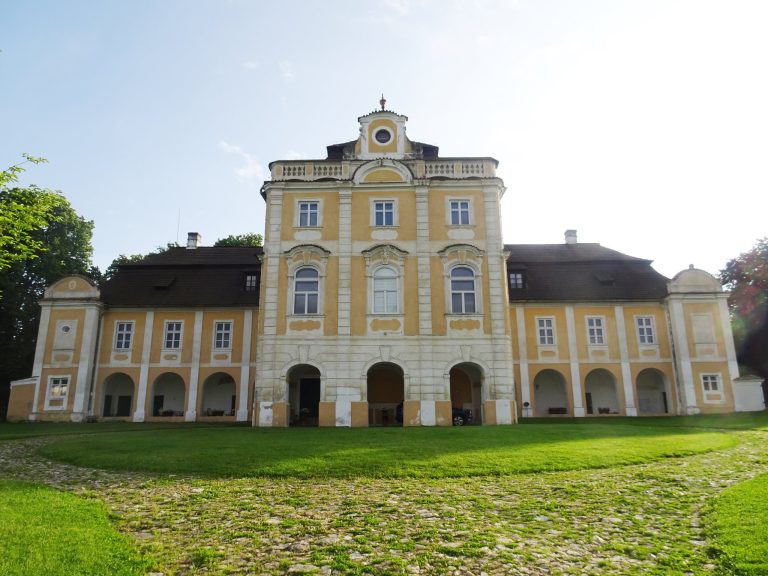
The eastern wing was built during the transition from the Late Gothic to the Renaissance period. The present one- to two-storey château retains Renaissance courtyard arcades, vaults in some ground-floor rooms, and fragments of sgraffito, a wall decoration made by scratching through one surface layer to reveal another beneath it.
Garden and court of honour
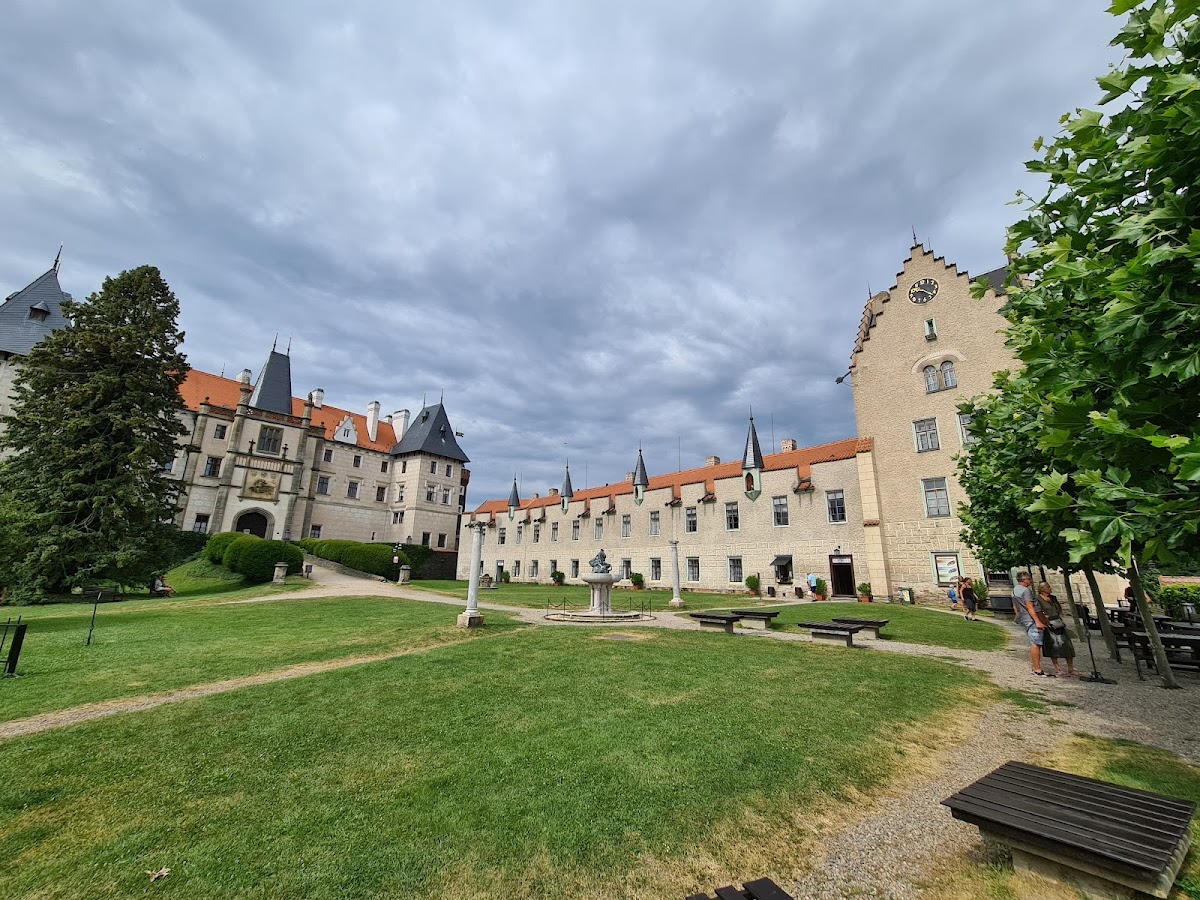
The Baroque court of honour was later converted into a garden, removing the former Baroque entrance from the town. Two columns brought from Pompeii stand in the garden. It also contains a fountain by Anton Dionysius Fernkorn, whose sculpture depicts an ancestor of the Auersperg family fighting a bison.
Romantic Neo-Gothic complex
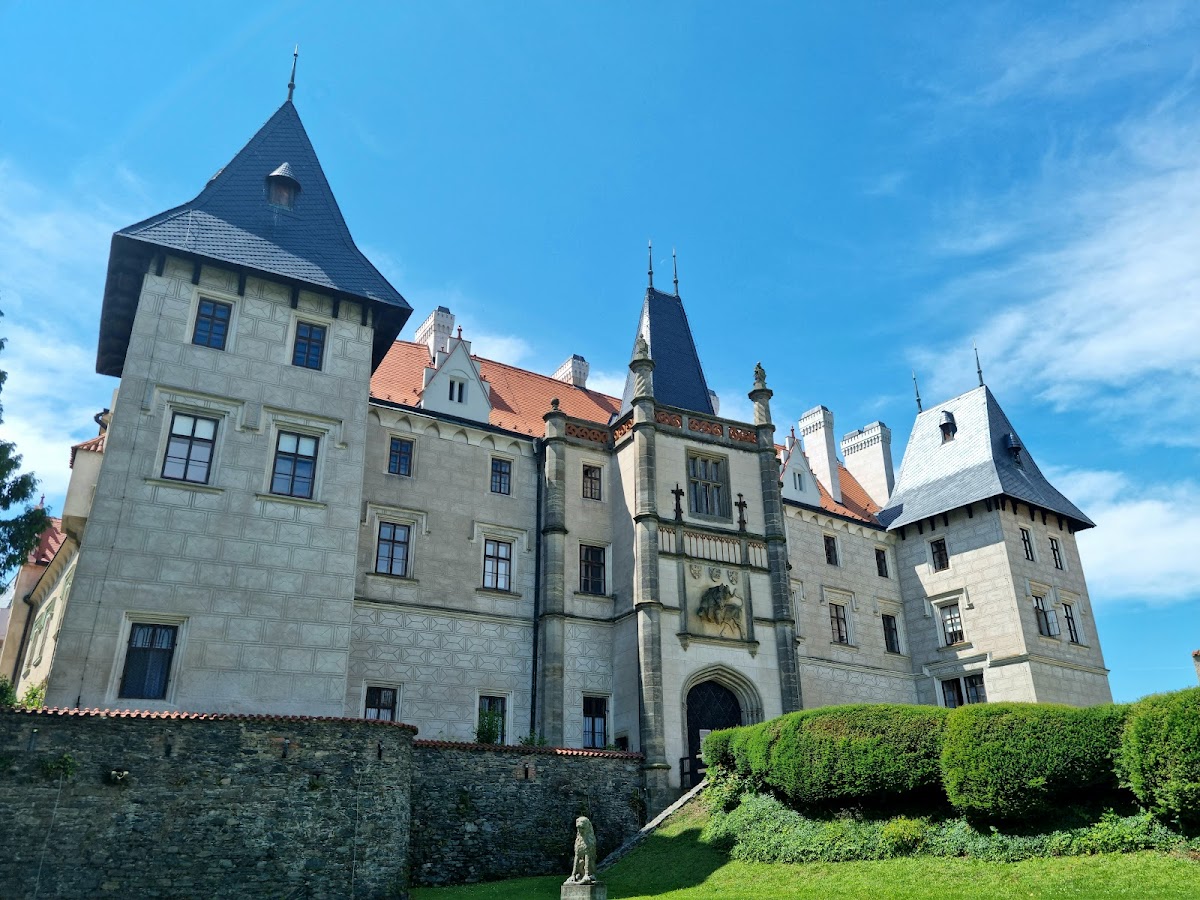
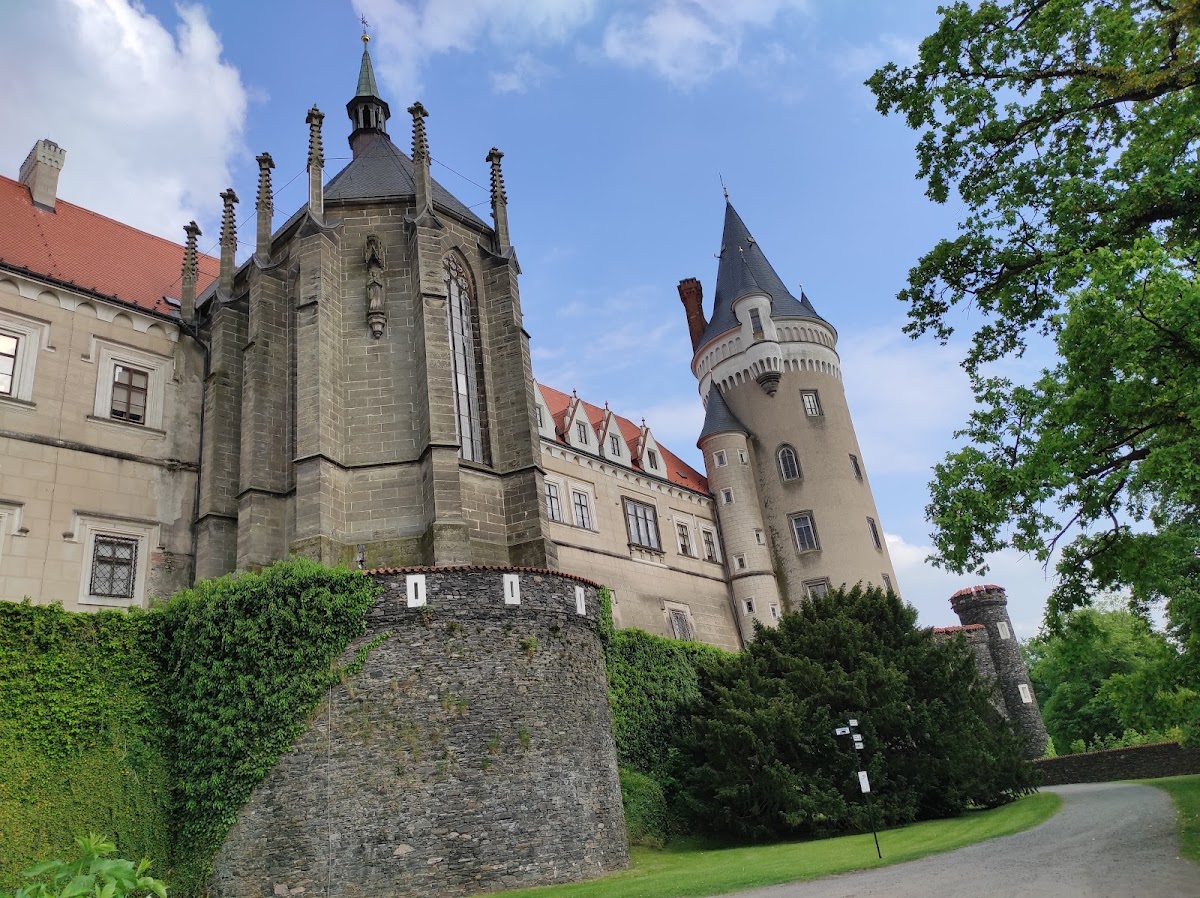
The nineteenth-century Romantic Neo-Gothic reconstruction gave Žleby much of its present appearance. It added three cylindrical towers, a chapel, and external perimeter walls designed to evoke medieval fortifications. A long access route passes through these walls and is interrupted by three gates. A two-storey tower with Gothicizing gables was also added on the western side of the garden.
Chapel and towers
František Schmoranz designed the chapel, which was built between 1852 and 1857. The Clock Tower followed in 1861 and 1862, when work also took place in the outer bailey. The Dove Tower, its third gate, and the outer-bailey fortifications date from 1864. The Great Tower and its second gate were built from 1864 to 1878, while the first gate was still being completed in 1878.
Entrances and exterior details
The main entrance is a portal topped by a bison relief by the sculptor Emanuel Max. Max also made statues of the first Auersperg and Emperor Lothair for the southern facade. During the Neo-Gothic alterations, some courtyard arcades were glazed and their balustrades were modified in the same style. High hipped roofs, oriel windows, Neo-Renaissance chimneys, gargoyles, and numerous smaller details reinforce the complex’s Romantic character. The completed nineteenth-century complex, including its service buildings, contained 116 rooms.
Park and surrounding landscape
An English-style park adjoins the castle and covers 24 hectares. This type of landscape uses irregular planting, lawns, water, and adapted terrain to create a naturalistic design. At Žleby, the park follows the steep slopes of the castle spur and the river valley. The Hostačovka stream passes through it, and a bridged waterfall was built near the stream’s mouth at the Doubrava.
The park contains exotic trees planted in the nineteenth century and several kinds of rhododendron. Free-ranging game and more than fifty recorded bird species are associated with the grounds. The park adjoins a game preserve where white deer and fallow deer are bred.