St Chad’s Church, Shrewsbury: A Church of England Parish Church
Site at a Glance
- Rating
- 4.7
- Popularity
- Medium
- Country
- United Kingdom
- Primary era
- Early Modern
- Eras represented
- Early Modern, Modern
- Civilizations
- British
- Site type
- Religious
- Remains
- Church
On this page15 sections
History
St Chad’s Church is a Church of England parish church in Shrewsbury, United Kingdom. The present circular building was completed in 1792, replacing an older church on College Hill. Dedicated to St Chad, a seventh-century bishop venerated as a saint, it belongs to the Diocese of Lichfield, the Church of England’s administrative district, and follows Liberal Catholic churchmanship, which combines Catholic worship practices with liberal theology within Anglicanism.
Early foundations and collegiate church
The church’s beginnings are traditionally placed in the Saxon period, perhaps around 560. Another tradition attributes its foundation to Offa, an eighth-century king of Mercia, after the subjugation of Pengwern, the early name associated with Shrewsbury. The church may have begun in buildings belonging to a sixth-century royal palace of Powys, a Welsh kingdom, at Pengwern. Tradition connects the palace with Brochwel Ysgithrog, a prince of Powys said to have granted estates for religious purposes, and also attributes the church’s foundation to his son Tysilio. An earlier Celtic Christian church may have existed in Shrewsbury, with its endowments possibly passing later to the bishops of Lichfield.
A Welsh poem containing a lament for Cynddylan survives in a written form dating to about 850 and is among the early evidence associated with the church’s endowments. By the Domesday Book of 1086, St Chad’s was already an ancient and well-endowed institution. Its collegiate church, served by a college of clergy, had a dean, ten secular canons who were not members of a monastic order, and two vicars choral attached to its choir. Its parish covered most of the town within the walls, and the church held several manors in Shropshire.
Medieval and early modern church
The church remained on College Hill for nearly a thousand years. The Great Fire of Shrewsbury consumed the old building in 1394. King Richard II granted the town a three-year remission of taxes to help fund repairs. In 1407, the priest William Thorpe preached at St Chad’s against important Catholic doctrines and was imprisoned. He was later taken to Lambeth Palace, where he admitted the charges against him.
Royal and civic celebrations continued at the collegiate church. Henry VII attended the feast of St George there in 1490 with his queen and Prince Arthur. In 1581, Sir Henry Sidney celebrated the feast at the church; a procession arrived from the Council House, and the choir was arranged to resemble the choir of St George’s Chapel at Windsor. The old church also had an altar dedicated to St Michael, the archangel, supported by the Mercers, who maintained a hall within the college complex. The college closed during the sixteenth-century Dissolution of the Monasteries, the suppression of England’s monastic institutions.
People buried at the old church included Rowland Lee, bishop of Coventry and Lichfield (1543); lawyer and politician Richard Onslow (1571); politicians Richard Mytton (1591), Robert Ireland (1599) and Thomas Owen (1661); Royalist colonel Sir Thomas Lyster (1655); Parliamentary major-general Thomas Mytton (1656); dancing master John Weaver (1760); and dissenting minister Job Orton (1783). Architect Edward Haycock Sr. and ironmaster William Hazledine were buried in the churchyard.
Collapse and rebuilding
In 1788 the old church’s central tower fell after work to enlarge the crypt had weakened the structure. Cracks had appeared in one of its piers. Thomas Telford, a civil engineer and architect then working on Shrewsbury Castle, warned that the building was in immediate danger and urged prompt action. The church council considered the proposed work too costly, and the tower collapsed two days after his warning.
The old church was replaced on a new site in the Quarry. Scottish architect George Steuart was commissioned to design the building. The committee first required an oblong plan, but Steuart’s later drawings proposed a circular church. Following disagreement and delay, the committee accepted the circular design. The foundation stone was laid on 2 March 1790; the church was completed, opened and consecrated in 1792.
Nineteenth and twentieth centuries
Charles Darwin was baptised at St Chad’s on 15 November 1809 and attended the church as a boy with his mother, Susannah. In 1888 the original pulpit was removed because it obscured the altar. In 1913, a vestry was made into a chapel of St Aidan, an early medieval Irish missionary and bishop, in memory of former vicar Richard Eden St Aubyn Arkwright. It became a regimental chapel for the King’s Shropshire Light Infantry (KSLI) in 1951, and regimental colours were placed there in 1952 and 1966. A second storey was added to the vestry opposite the entrance lobby in 1951.
After the First World War, the main sanctuary was refitted as a memorial to parishioners who had died in the conflict. The church received Grade I listed status in 1953, the highest category in England for buildings of exceptional architectural or historic interest. Its organ was restored in 1963 and 1985, and again in 2011. The church joined the Greater Churches Group, an association concerned with large churches, in 2010.
A period headstone in the disused churchyard was used in the 1984 film A Christmas Carol, rather than made as a prop. Its original inscription had worn badly before the words “Ebenezer Scrooge” were added, and part of the earlier inscription remained visible. Vandals damaged the stone in 2024, after which local stonemasons repaired it.
Remains
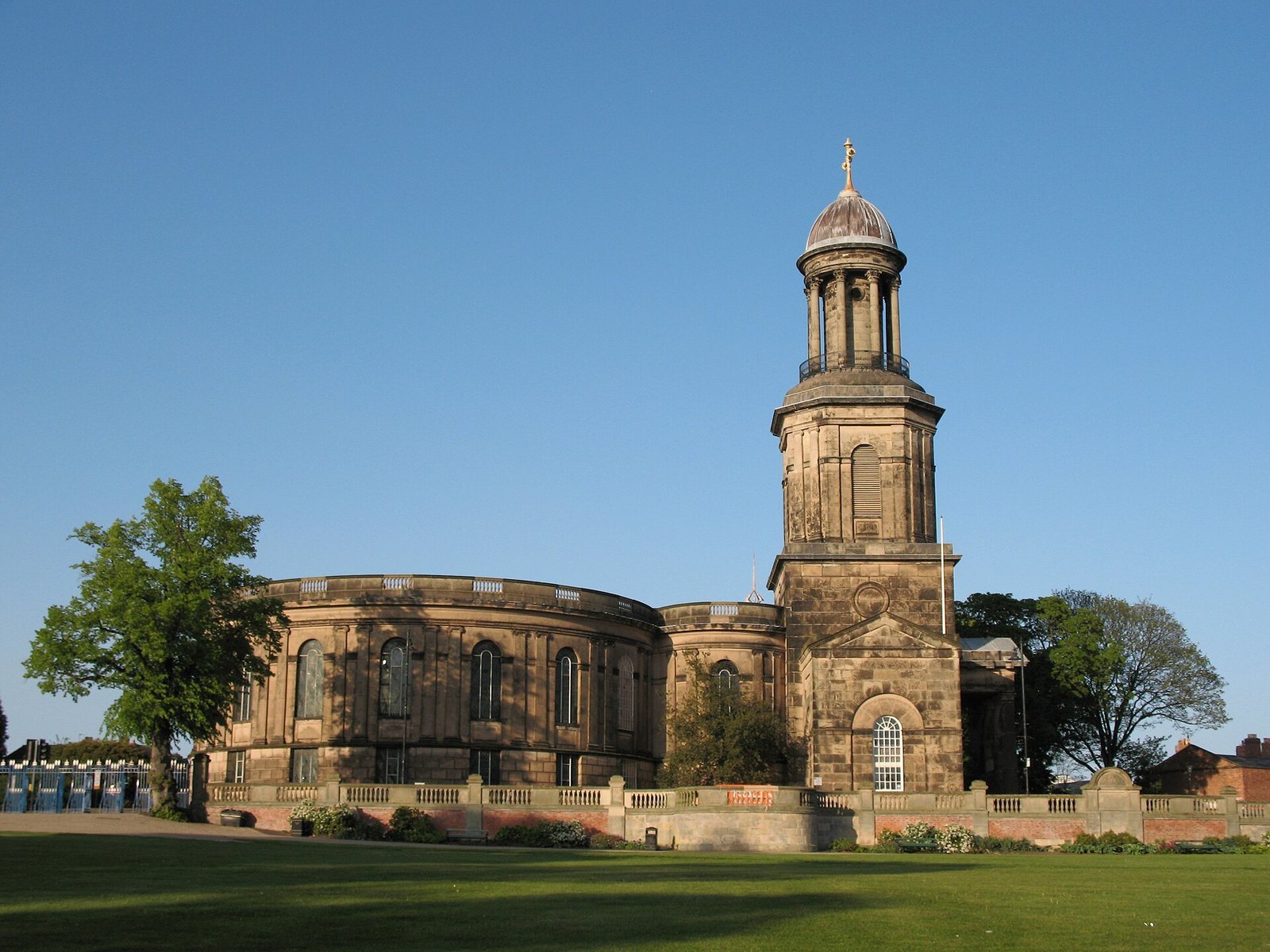
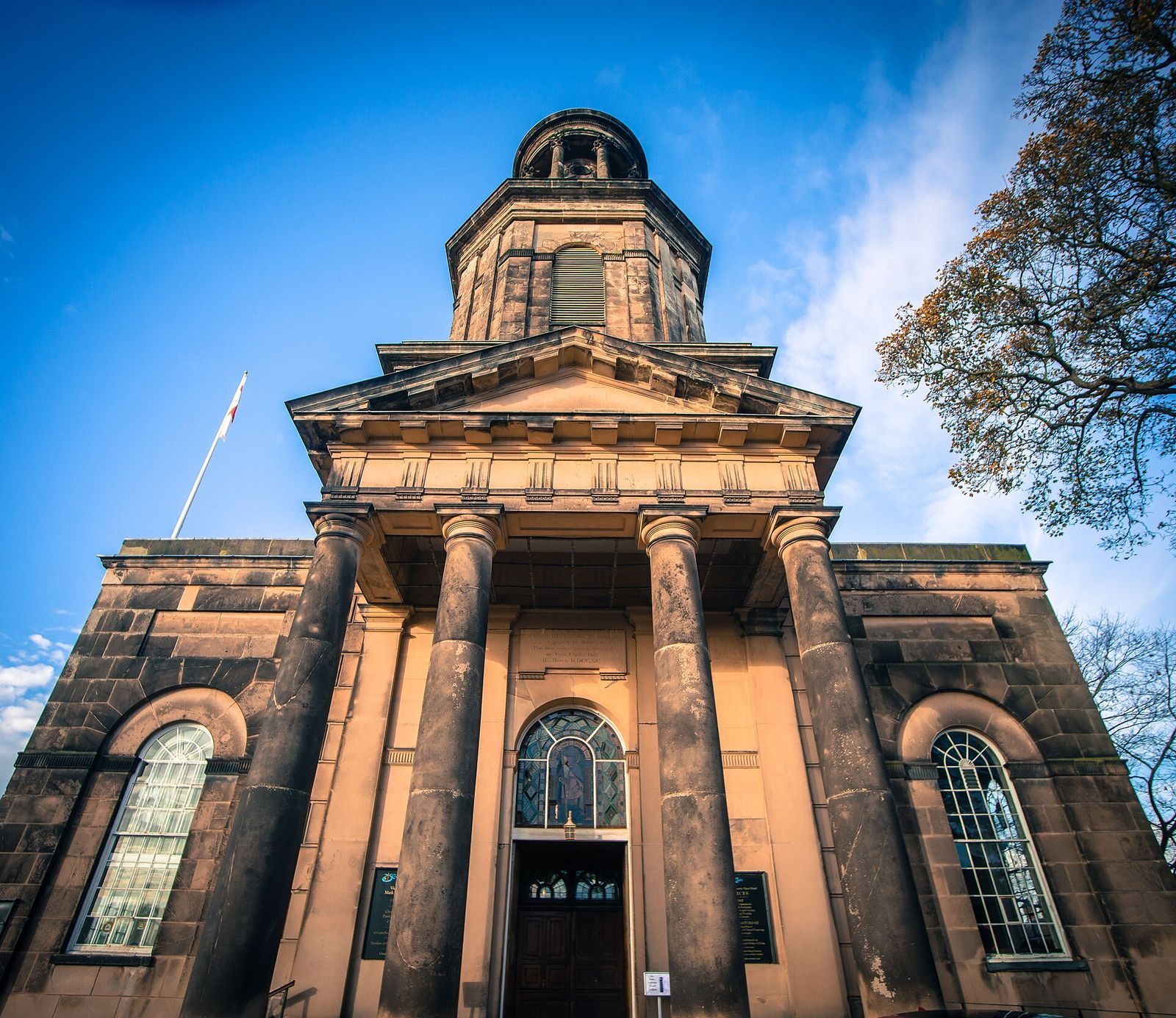
The present church has a circular plan beneath a high tower, with a portico at the entrance and galleries arranged around its circular interior. Built of white Grinshill stone, it combines masonry exterior walls with slender cast-iron gallery columns. The former church site on College Hill retains archaeological remains within a disused churchyard, as well as traces of the associated college.
The present church
Exterior and structure
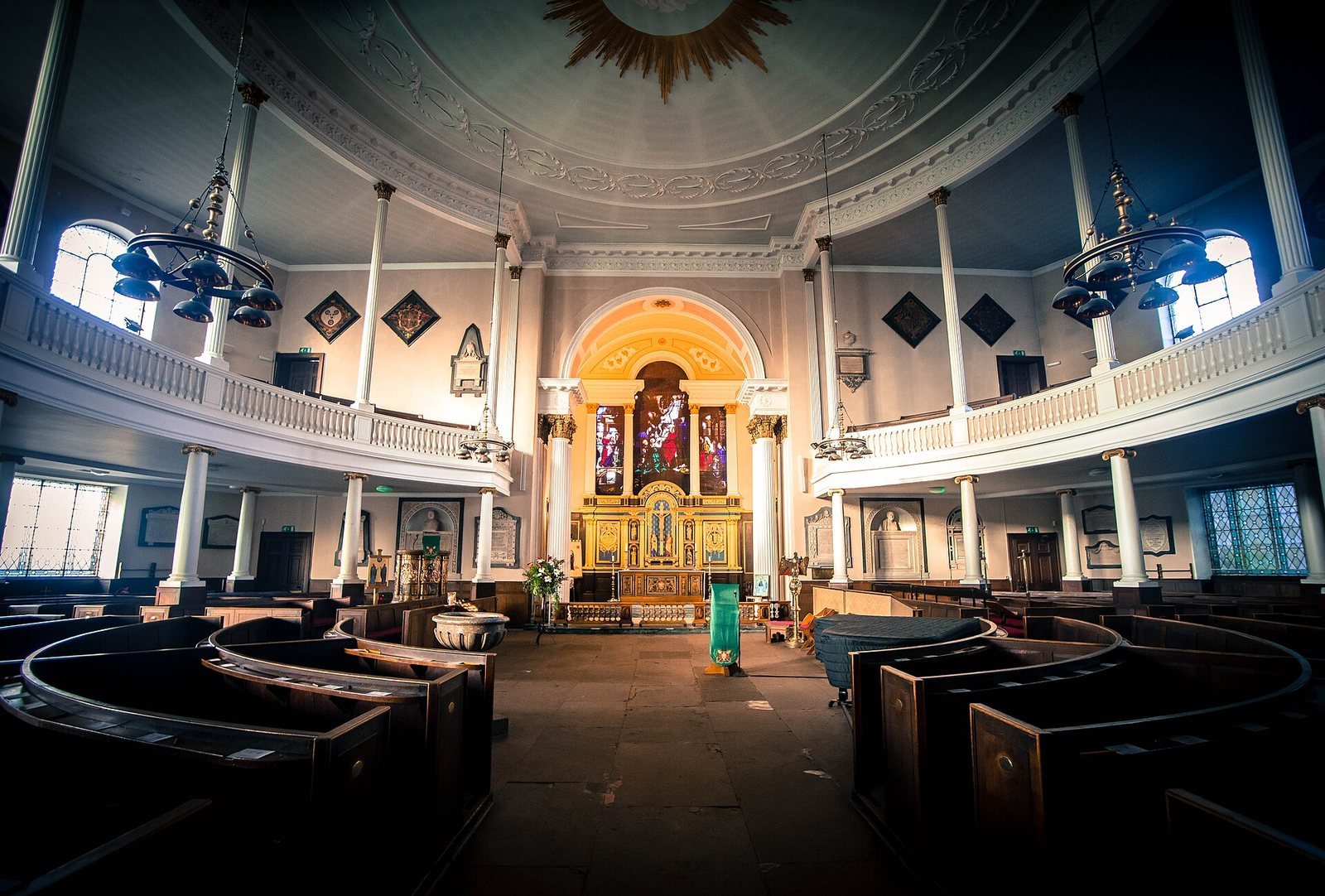
The church’s single tower contains twelve bells. It is square at its base, becomes octagonal higher up, and ends in a circular lantern that has no functional purpose. A portico, or covered entrance, is topped by a triangular pediment. Inside, galleries rest on columns made of cast iron by Shrewsbury ironmaster William Hazledine, an early use of the material for this purpose. The roof is flat, with a railing supported by a row of posts around its edge.
Sanctuary and fittings
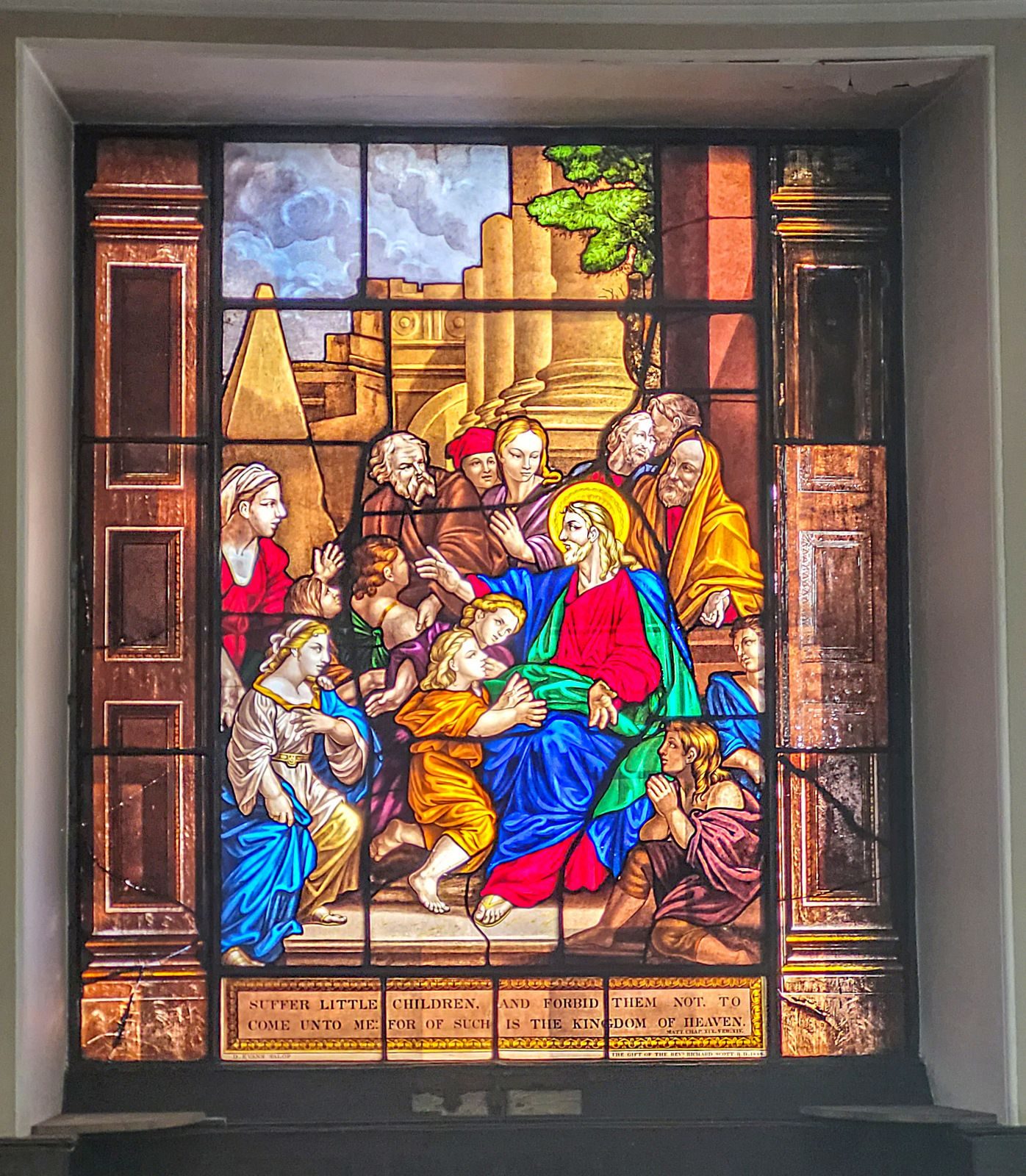
The sanctuary window contains a stained-glass interpretation of Peter Paul Rubens’s three-panel work The Elevation of the Cross in Antwerp Cathedral. Local artist David Evans made it around 1842, framing the central scene with two other biblical images. A copper-and-brass replacement pulpit in the Arts and Crafts style stands to one side, leaving the sanctuary more visible. Memorials to Hazledine and building supervisor John Simpson flank the sanctuary arch.
Regimental memorials
The entrance hall contains memorials to the 53rd Regiment of Foot and its successor, the KSLI. An alabaster tablet commemorates officers and men who died at the Battle of Sobraon, a decisive engagement in the First Anglo-Sikh War, in 1846. Another large tablet honours members of the regiment who died in the 1857–59 uprising against British rule in India. Further tablets commemorate the 1st Battalion KSLI dead of the Egyptian campaign of 1882 and the occupation of Suakin in Sudan in 1885–86. Above the vestibule entrance is a memorial to 4,700 KSLI personnel who died in the First World War. Poet laureate John Masefield attended its unveiling in 1930. Separate cases contain books of remembrance for KSLI dead in both world wars and for Shropshire’s war dead.
Chapels and sanctuary memorial
The St Aidan chapel has an enlarged apse, a semicircular space projecting from the chapel, along with an altar, rood screen, rails and chairs. A rood screen is a partition between the nave and chancel. The postwar sanctuary refitting included a light-oak decorative screen behind the altar, designed by Cecil Lightwood Hare, as well as a new altar, wood panelling and decoration in gold leaf and cobalt.
Organ
Norman and Beard built the church’s large pipe organ, with three keyboards, in 1904. It has been restored in 1963, 1985 and 2011.
College Hill remains
Former church and crypt
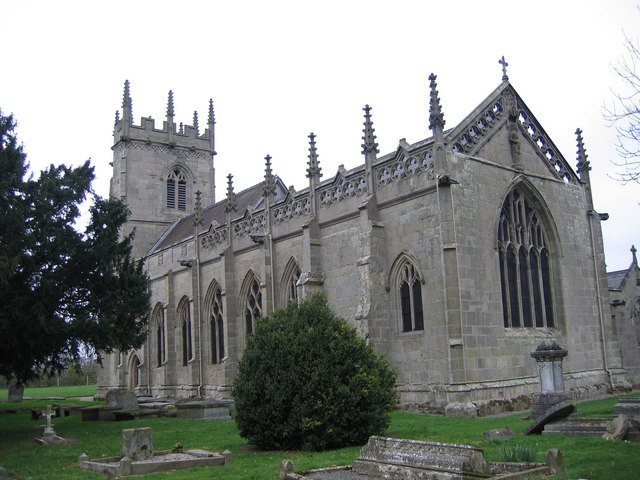
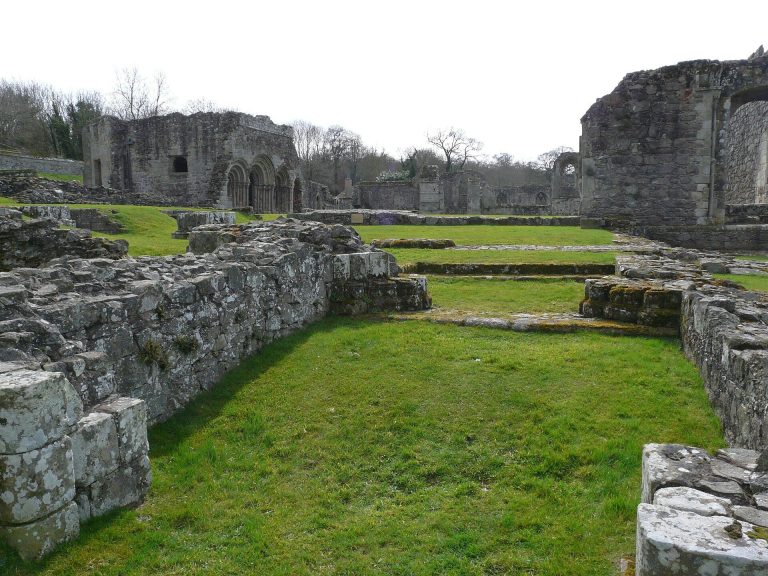
The disused churchyard contains a surviving side chapel and a partly exposed chamber identified as a crypt or baptistry, a space used for baptism. Excavation exposed part of the chamber in 1889, and pillar bases remain in its floor. The pillars were worked with an axe, a form associated with early Saxon construction. The crypt was the oldest part of the former church, whose roughly built lower wall sections may date to the ninth century. The crypt is in poor condition.
Burials had accumulated in the churchyard on the old church’s south side until the ground reached the level of the window sills, making the building damp. The old church had ten bells and included a monument to John Weaver. A Jesse window, depicting Christ’s ancestry, is now in St Mary’s Church, Shrewsbury. Tradition says it was transferred from Old St Chad’s during the Dissolution, while another tradition holds that it was made for Shrewsbury’s Franciscan church.
College structures
Traces of the old college survive beside the south-west end of the former church, with fragments of walls continuing into neighbouring gardens. An alcove with an inset oak frame in the drawing room of Clive House may preserve part of the college buttery, a room for storing provisions. A small patch of medieval sandstone, shaped and laid in horizontal courses, survives toward the south-east end of the east wall of No. 1 College Court. Remains of at least three timber buildings have been identified within No. 3 College Court. The old church precinct may have reached west to Swan Hill and included College Court on College Hill.