Susteren Abbey: An Early Medieval Monastery in the Netherlands
Site at a Glance
- Rating
- 4.4
- Popularity
- Medium
- Country
- Netherlands
- Primary era
- Medieval
- Eras represented
- Medieval, Modern
- Civilizations
- Dutch, Holy Roman Empire
- Site type
- Religious
- Remains
- Church
On this page14 sections
History
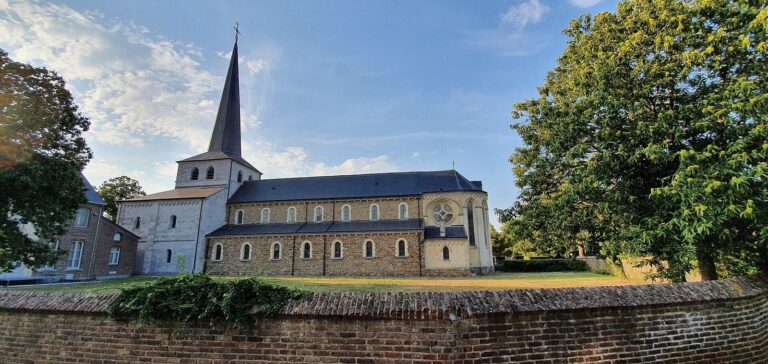
Susteren Abbey was an early medieval monastery in Susteren, the Netherlands, founded in 714 by Pepin of Herstal and Plectrude. Its surviving church, the St. Amelberga Basilica, is Romanesque and is thought to have been built shortly after 1060. Susteren is the first monastery in the lands now forming the Netherlands to appear in written records, though religious communities at Maastricht and Utrecht are believed to have existed earlier.
Foundation and royal monastery
A letter written in 711 by the monk Ansbald to Willibrord provides the earliest known written reference to Susteren’s monastery. Three years later, Pepin, a powerful Frankish royal administrator called a mayor of the palace, and his wife Plectrude established the abbey on land she had acquired near the Suestra stream. They granted the monastery to Willibrord and issued a charter protecting it and allowing the monks to choose their own abbot.
The abbey offered accommodation to missionaries and pilgrims travelling between Susteren and Echternach, where Willibrord was already abbot. Its community supported missionary work in Frisia, a coastal region along the North Sea, and elsewhere in the Low Countries. Willibrord, an Anglo-Saxon missionary and bishop active in the spread of Christianity, became Susteren’s first abbot. His mission centre at Utrecht later developed into the Diocese of Utrecht. The abbey church was dedicated to Christ the Savior and the apostles Peter and Paul.
Pepin and Plectrude’s grant made Susteren a proprietary monastery of the Carolingians, the Frankish royal dynasty. In 891 Arnulf, king of Lotharingia, granted the abbey to Prüm Abbey. Zwentibold confirmed that transfer in 895, as did Charles the Simple in 916.
A women’s monastery and chapter
By 991, Susteren had become a Benedictine women’s monastery. Benedictines follow the Rule of Saint Benedict, but the date when the male community changed is unknown; tradition places the transition in the late ninth century. Amelberga of Susteren is traditionally named as the first abbess. She was said to have been buried in the church and was venerated as a saint.
Traditions also associate the abbey with the burials of the princesses Benedicta and Cecilia and of Zwentibold around 900. Zwentibold was believed to have been either their father or their brother. Earlier burial traditions name Vastrada, the wife of Plectrude’s nephew Alberic, and Vastrada’s son and grandson, Gregory and Alberic, both bishops of Utrecht.
In 1312, the abbey was identified as a chapter of secular canonesses. These women belonged to a religious foundation but were not bound by the same vows as nuns. The chapter admitted noblewomen, who could own personal property and had greater freedom than members of a monastic community.
Parish church and later changes
The chapter was formally dissolved in 1802, shortly after the French Republic annexed the Southern Netherlands. Most of the canonesses had already left Susteren and did not return. By the end of the eighteenth century, the abbey church had become the parish church, and the old parish church to its south was demolished. In the nineteenth century the former abbey church acquired the name St. Amelberga Church. It was dedicated to Amelberga in 1886, following the authentication of relics kept there.
Major restoration and alteration work between 1885 and 1890 changed the church, particularly its western end. In 2007 Pope Benedict XVI granted it the honorary title of minor basilica.
Remains
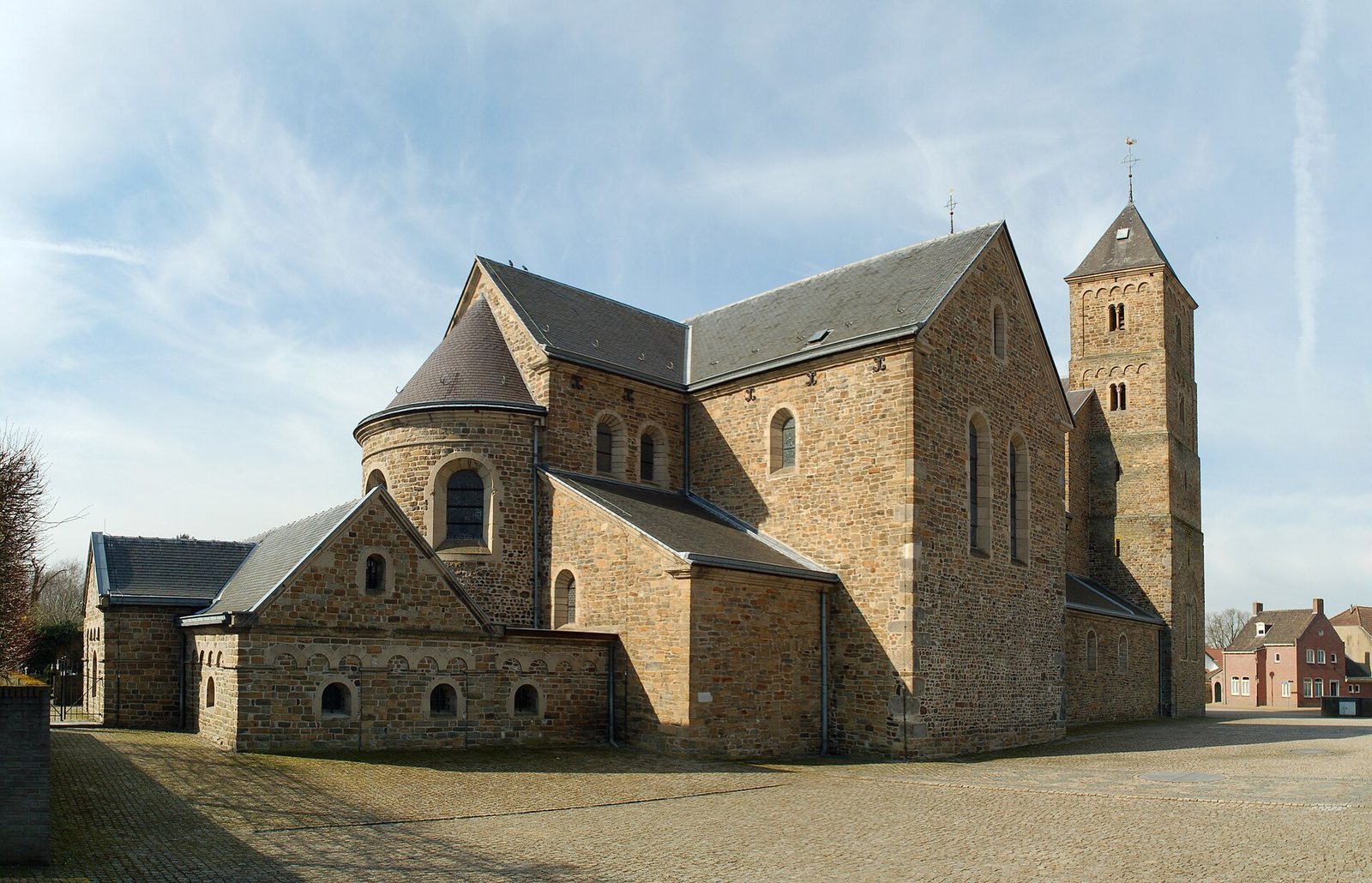
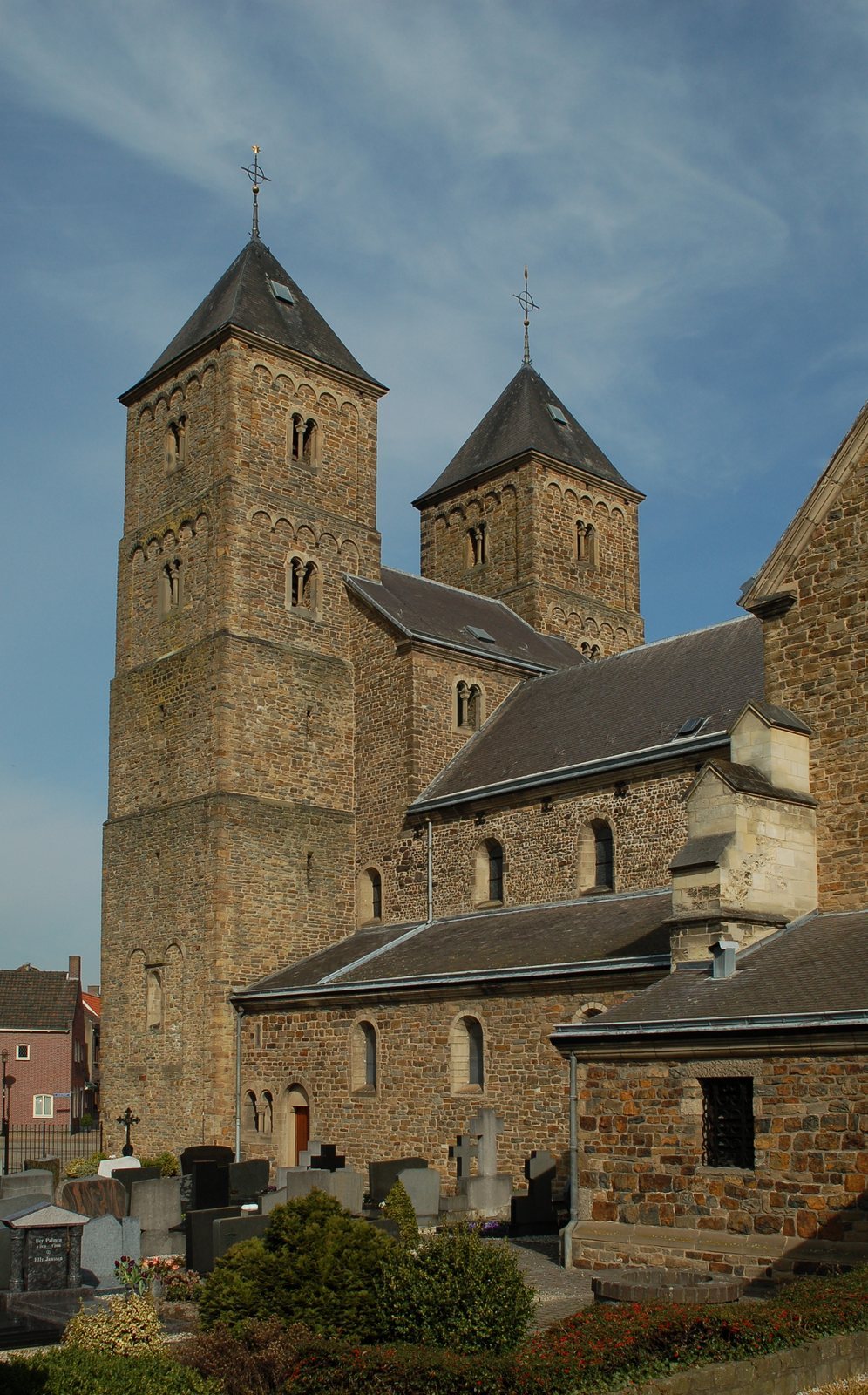
The surviving St. Amelberga Basilica stands beside the excavated remains of earlier monastery buildings. The archaeological evidence traces a changing complex north of the church, from small, separate structures beside a watercourse to a later monastery arranged around a courtyard. The present church has a cross-shaped layout and three aisles.
Early monastery and cemetery
Buildings and watercourse
Excavations at Salvatorplein, north of the church, uncovered at least two small, detached buildings from the earliest monastery. They used both timber and stone, including cobbles from the Meuse River. A wooden well and a stone cistern served the complex. The buildings stood beside a watercourse that was filled in during the tenth century. Rubble and household waste were deposited in it, including pottery, animal bones, metal, and glass fragments. Some of the glass was used for drinking vessels and windows. Pottery came from the Meuse region in the early eighth century, while ninth- and tenth-century pieces were associated with the Rhine region around Cologne and Koblenz.
A tenth-century wooden dwelling was enlarged once, and lime kilns at the site may relate to rebuilding the church that preceded the present basilica.
Cemetery and graves
About 140 graves of men and women, dating from the eighth to the eleventh centuries, lay between the monastery buildings and the predecessor of the surviving church. A small, round stone structure in the cemetery dates to around 800 and may have served as a chapel. The cemetery was later moved to the south side of the church.
Church and later monastery precinct
St. Amelberga Basilica
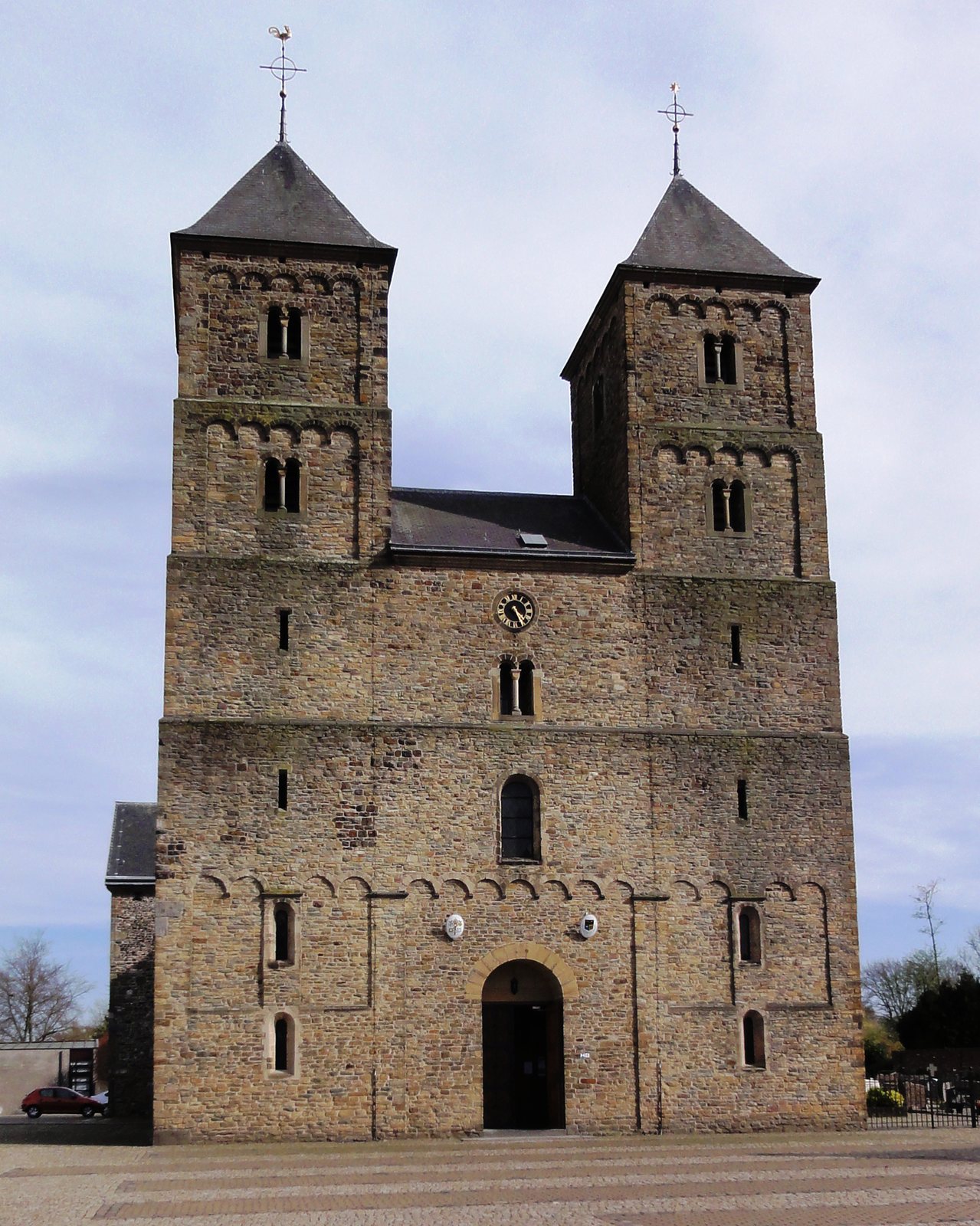
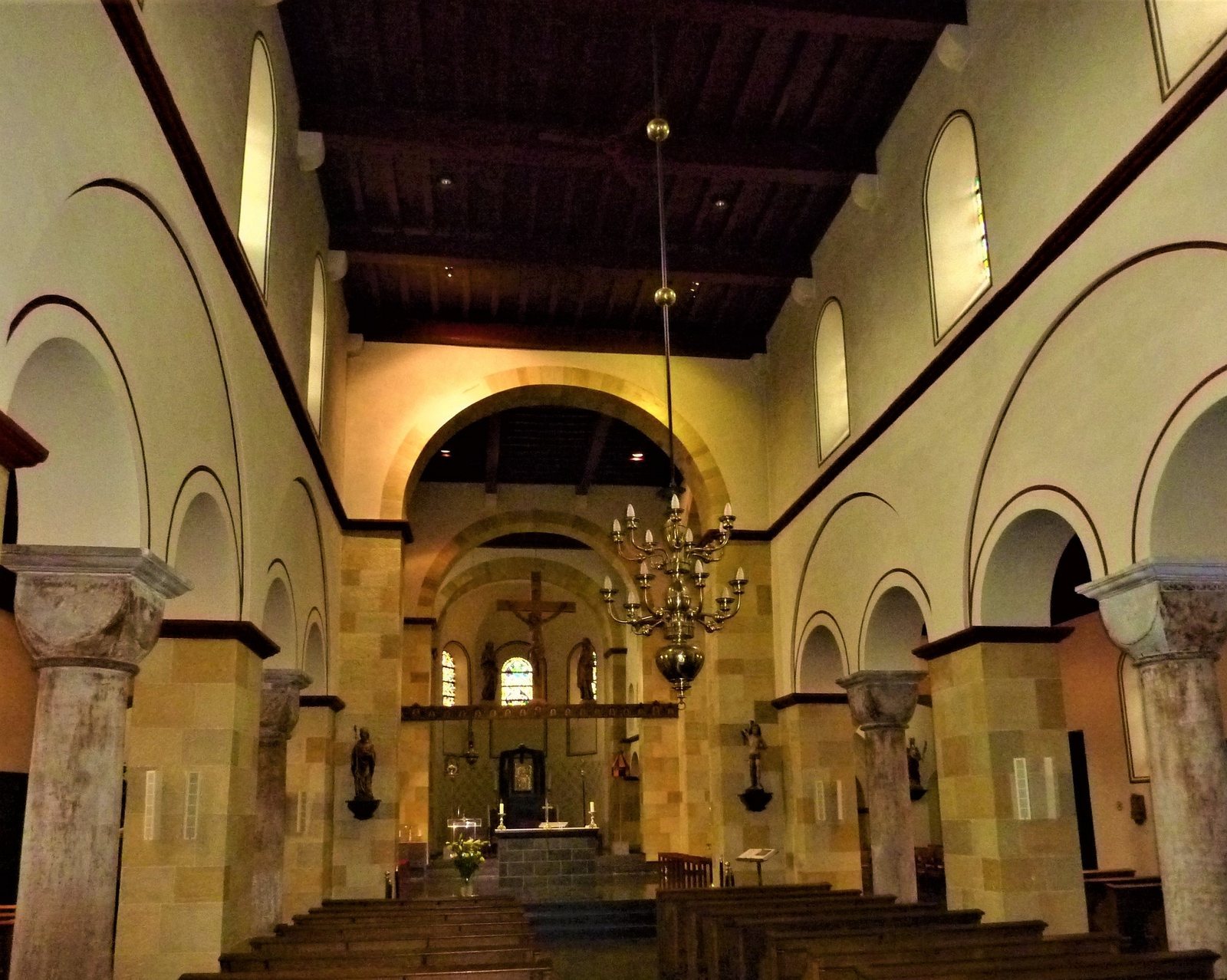
The present church is thought to have replaced an earlier building shortly after 1060. Its Romanesque design was strongly influenced by the minster church of Essen Abbey, part of the architectural culture associated with Ottonian rulers. The nave’s flat wooden ceiling contrasts with the vaulted areas in the westwork, the monumental western entrance and upper structure, and in the lower, semicircular apse, the rounded end of the sanctuary. The side aisles finish in straight walls. Arches between the nave and aisles rest on alternating rectangular piers and columns, whose tops have cushion-shaped capitals.
An exterior crypt, a church chamber often associated with burials or relics, extends east of the choir rather than beneath the main body of the church. Its intersecting vaults rest on square piers. Restoration altered the west end: the earlier arrangement of one large tower with two shorter stair towers gave way to a façade with twin towers. The church also contains a baptismal font dating to around 1200. A Calvary grouping, with sculptures of the Virgin Mary and Saint John from the fourteenth century, occupies the triumphal arch at the entrance to the sanctuary.
Medieval monastery precinct
In the eleventh century, a rectangular monastery arranged around a courtyard replaced the earlier complex and adjoined the church’s north side. The buildings were altered and enlarged several times, while the watercourse around the grounds was repeatedly recut. Wells and waste pits associated with the precinct yielded pottery and glass.
At the beginning of the nineteenth century, the abbey buildings were demolished apart from the church and the east wing. Part of the east wing remained standing until the middle of the twentieth century.
Burials and finds
Burial objects and relics
A late eleventh-century burial included a lead cross placed on the chest of a man estimated to have been about 35 years old. The church treasury preserves relics attributed to Amelberga, Benedicta, Cecilia, and Zwentibold, as well as skulls attributed to Gregory and Alberic and a tunic attributed to Alberic.
Objects from monastic life
Carolingian-period finds include colored glass beads and bronze fibulae, pins used to fasten clothing. They indicate that women at the monastery wore jewelry in the ninth century. Animal bones, including butchery waste, point to substantial meat consumption, especially pork, while study of the skeletons indicates that the population was well nourished. Together, these findings raise the possibility that Susteren had become a secular foundation during the ninth century.
Wooden toys from the sixteenth and seventeenth centuries may relate to girls being placed at the foundation when young. Excavated objects, including household items and pottery fragments, are held in the archaeological depot of Limburg province, with some in the Limburg Museum’s archaeological collection in Venlo.