St Mary Woolnoth: Hawksmoor’s Baroque Church in the City of London
Site at a Glance
- Rating
- 4.7
- Popularity
- Medium
- Country
- United Kingdom
- Primary era
- Early Modern
- Eras represented
- Early Modern, Modern
- Civilizations
- British
- Site type
- Religious
- Remains
- Church
On this page9 sections
History
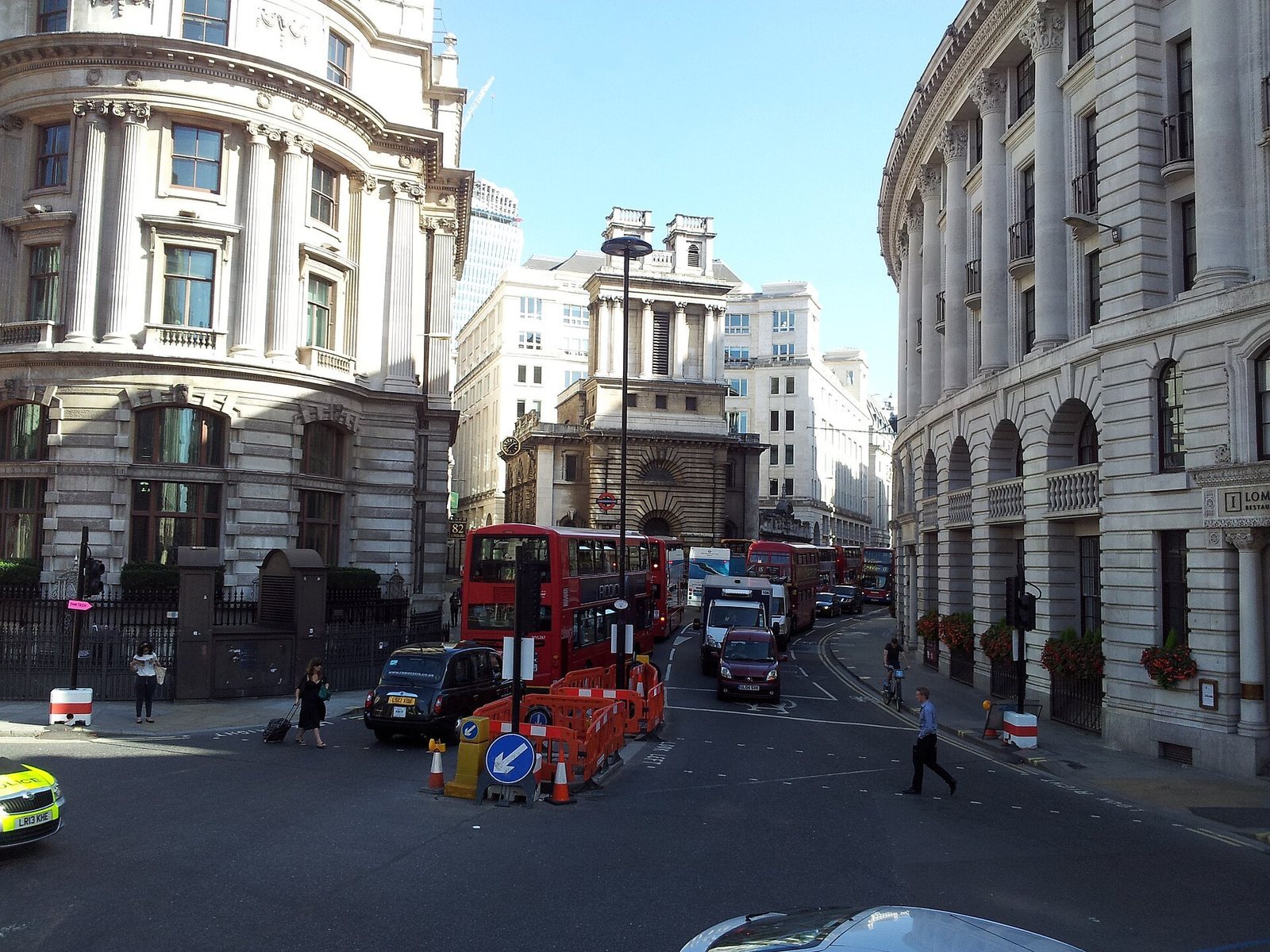
St Mary Woolnoth is an Anglican church at the corner of Lombard Street and King William Street in the City of London, United Kingdom; its present English Baroque building, designed by Nicholas Hawksmoor, was begun in 1716 and opened for worship in 1727. It is Hawksmoor’s only church in the City of London.
Origins and medieval rebuilding
A church was founded on the site in the twelfth century, but its founder is uncertain. The name “Woolnoth” may come from Wulnoth de Walebrok, who lived locally in the early twelfth century, or from Wulfnoth Cild, a South Saxon nobleman who died around 1014 and was the grandfather of Harold Godwinson, king of England in 1066. The church’s name first appears in 1191, in the form Wilnotmaricherche. Its dedication is to Saint Mary of the Nativity.
A Norman-period church, from the era following the Norman Conquest of 1066, stood on the site until 1445, when it was rebuilt. A spire was added in 1485. The church was Roman Catholic until 1538 and later became Anglican, in the Church of England.
Fire and the Hawksmoor church
The Great Fire of London, which devastated much of the City in 1666, badly damaged the church. Sir Christopher Wren repaired it, and its treble and tenor bells were cast in 1670, followed by a middle bell in 1672. The repaired building was later judged unsafe and demolished in 1711.
The Commission for Building Fifty New Churches, established as part of a London church-building programme, commissioned a replacement from Nicholas Hawksmoor, an English architect known for his Baroque churches. Work began in 1716, and worship resumed in the new church on Easter Day 1727. Before construction, the surrounding shops and houses were cleared along with the old church, leaving Hawksmoor an unusually open site.
Alterations and the railway
St Mary Woolnoth underwent substantial changes in the late nineteenth and early twentieth centuries, and proposals to demolish it were made several times before being dropped. In 1876, the architect William Butterfield removed the galleries because he considered them unsafe, and other major alterations were carried out at the same time.
Between 1897 and 1900, the City and South London Railway constructed Bank station beneath the church. Although the railway had authority to demolish the building, public protest led it to restrict its work to the ground below. The church’s crypt was sold to the railway, and the human remains buried there were reburied at the City of London Cemetery in Manor Park, Ilford. During the works, steel girders supported the church walls and interior columns as lift and staircase shafts were constructed below the floor. No plaster cracks or structural settlement occurred; the railway company later said that the work had strengthened the church.
Parish life and later associations
The church survived the Blitz of the Second World War with almost no bomb damage. It became a Grade I listed building on 4 January 1950, placing it in England’s highest category for buildings of special architectural or historic interest, and became a guild church in 1952. It remains an active parish church within the combined parish of St Edmund the King and Martyr and St Mary Woolnoth Lombard Street. The parish also includes St Nicholas Acons, All Hallows Lombard Street, St Benet Gracechurch, St Leonard Eastcheap, St Dionis Backchurch and St Mary Woolchurch Haw. Of these churches, only St Edmund’s and St Mary Woolnoth survive.
The church is used by London’s German-speaking Swiss community and serves as the London church of the government of British Columbia. Its parish registers record the 1629 baptisms of Andrew Blackmore and Timothy, both men of African origin. Timothy’s entry uses a racial and religious epithet current at the time.
Sir Martin Bowes, Lord Mayor in 1545–46 and Mint Master, married at the church and was buried there; his children and grandchildren were also baptized there. Thomas Kyd was baptized at St Mary Woolnoth, where his father, Francis, served as a churchwarden. Anne Hutchinson married William Hutchinson there in 1612. Sir William Phips was buried at the church on 18 February 1694/5.
John Newton, an Anglican clergyman, hymn writer and anti-slavery campaigner, served as incumbent from 1780 to 1807. William Wilberforce, a leading British anti-slavery campaigner, worshipped there. Other figures associated with the church include Josias Shute, rector from 1611; Ralph Robinson, a Presbyterian minister there in the 1640s; William Owtram, rector; Thomas Busby, organist from 1798; and William Josiah Irons, rector from 1872.
T. S. Eliot referred to St Mary Woolnoth in his 1922 poem The Waste Land, describing the church’s hours and the “dead sound” of the final stroke of nine. Eliot noted that he had often observed this effect.
Remains
Layout and exterior
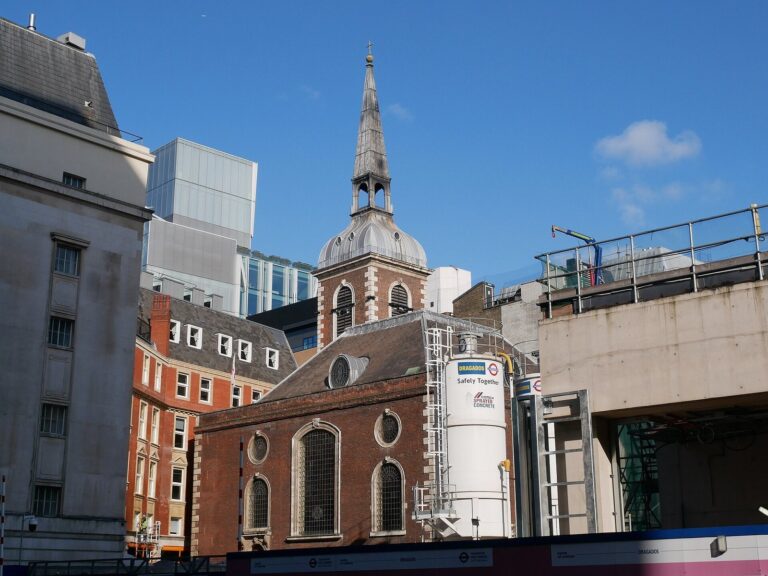
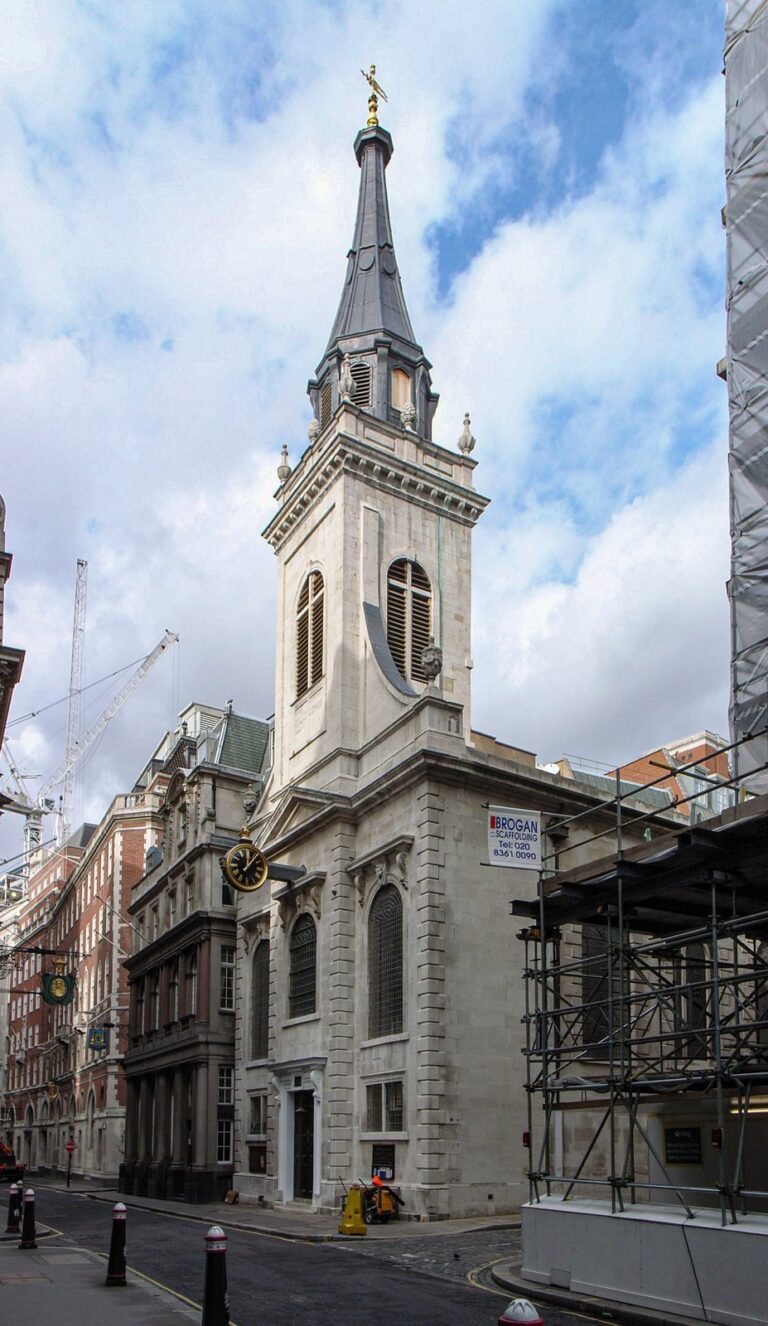
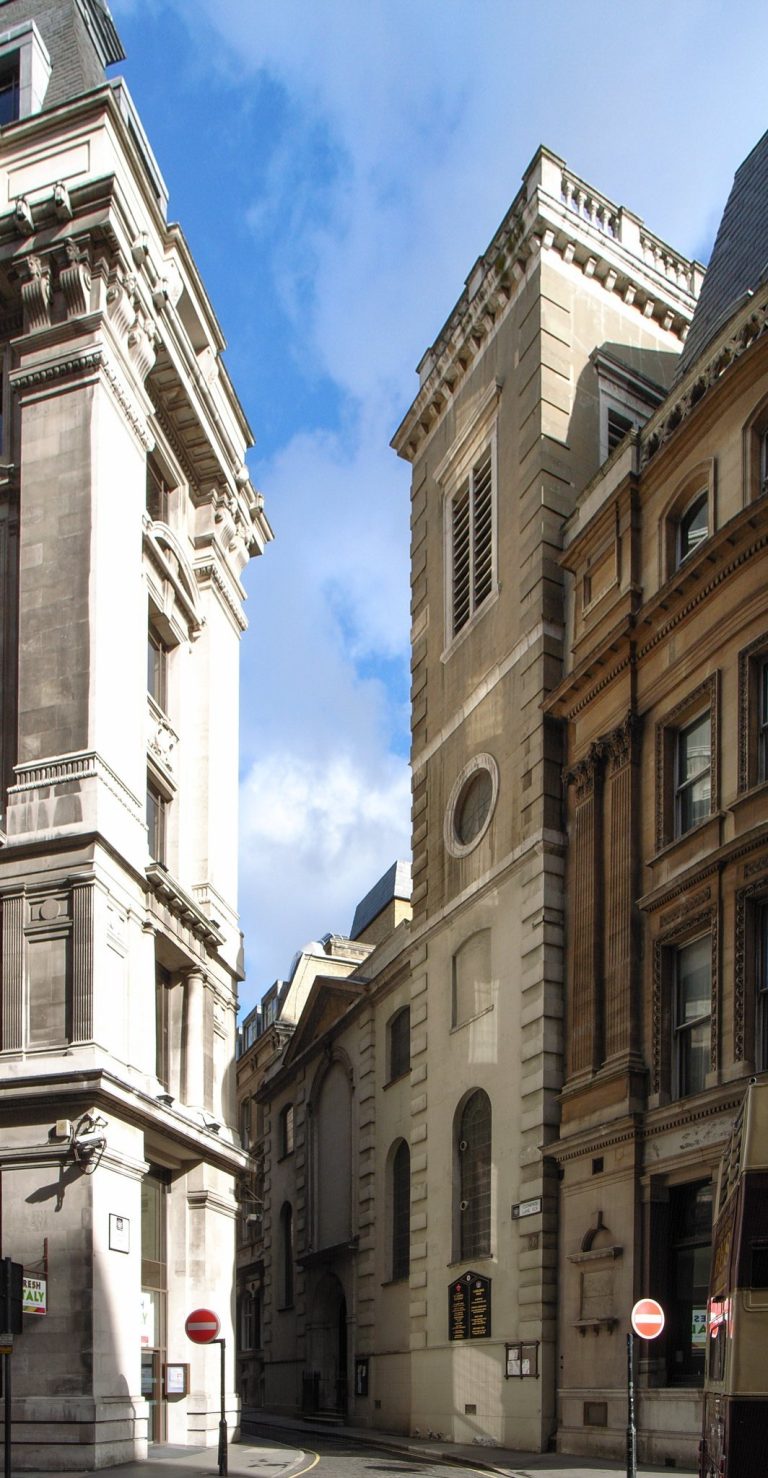
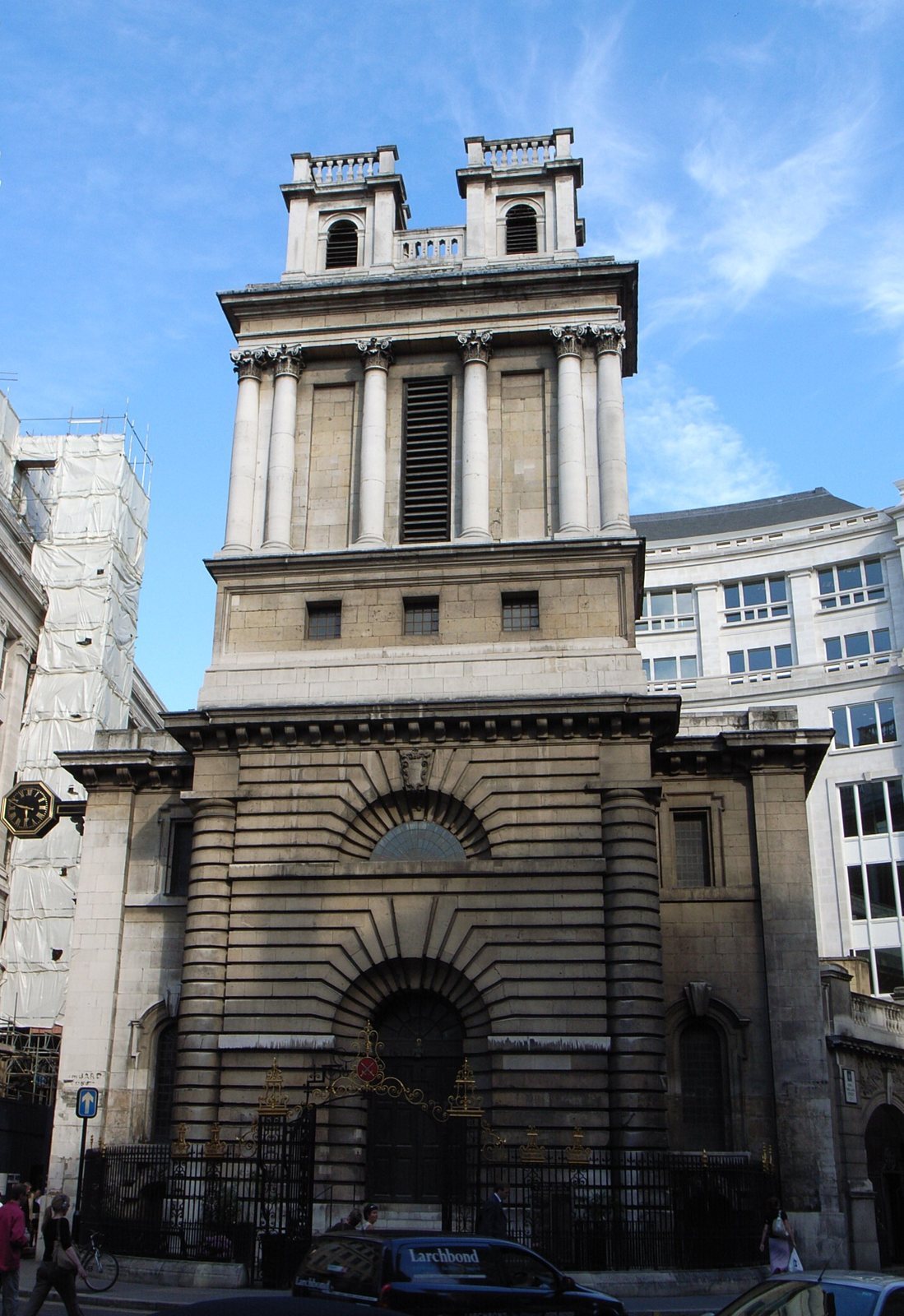
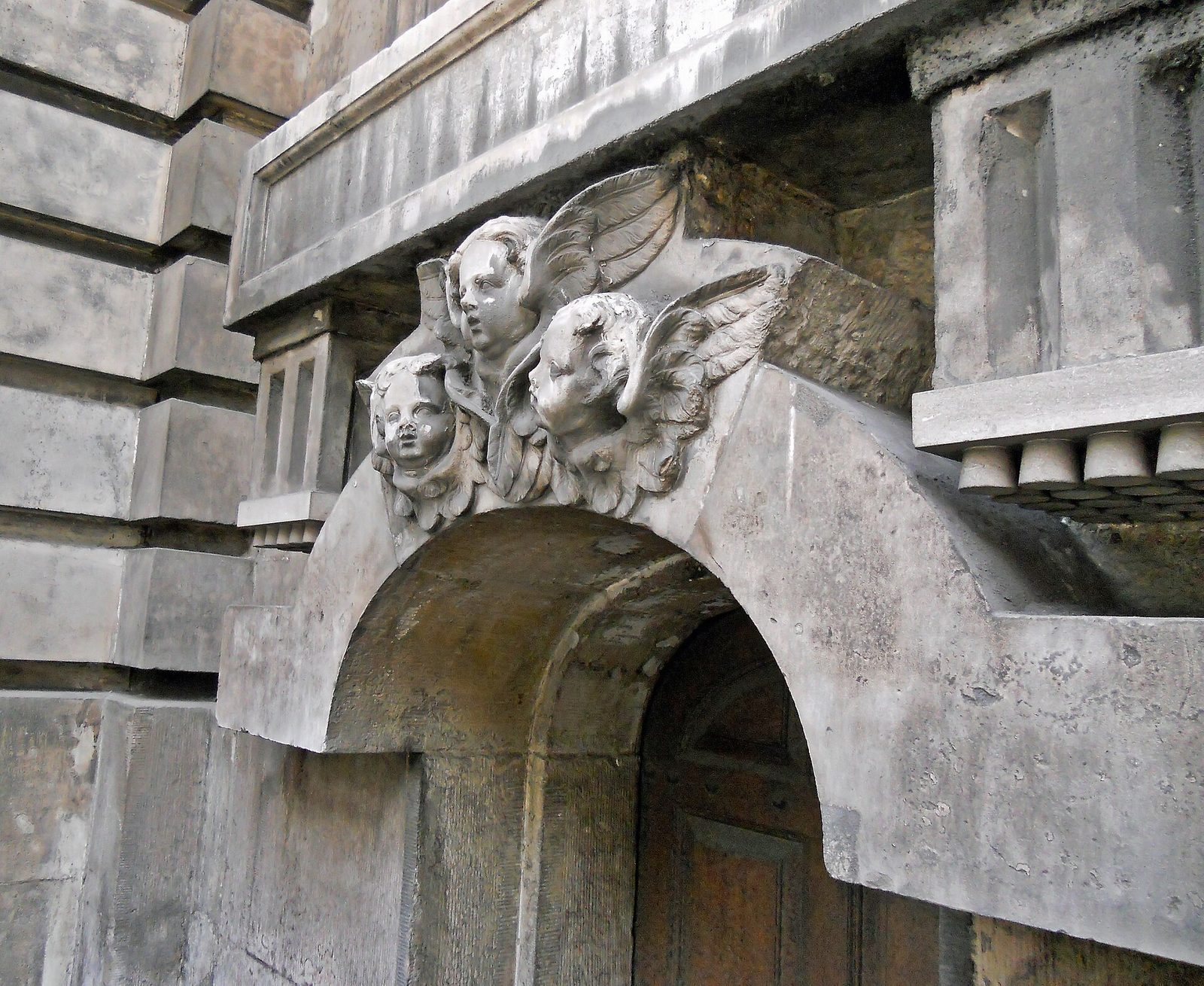
The church has a square plan and stands on the open site created when the older church and nearby shops and houses were cleared. Its exterior is arranged around a prominent façade with two flat-topped turrets carried on Corinthian columns, a classical type with elaborately decorated capitals. On the west side facing Lombard Street, recesses frame an inset, forward-curving pediment supported by angled columns. The tower rises from a block-like lower section with rustication, masonry finished to create a strongly textured surface, to a raised central section articulated with columns and two comparatively small upper turrets.
Interior
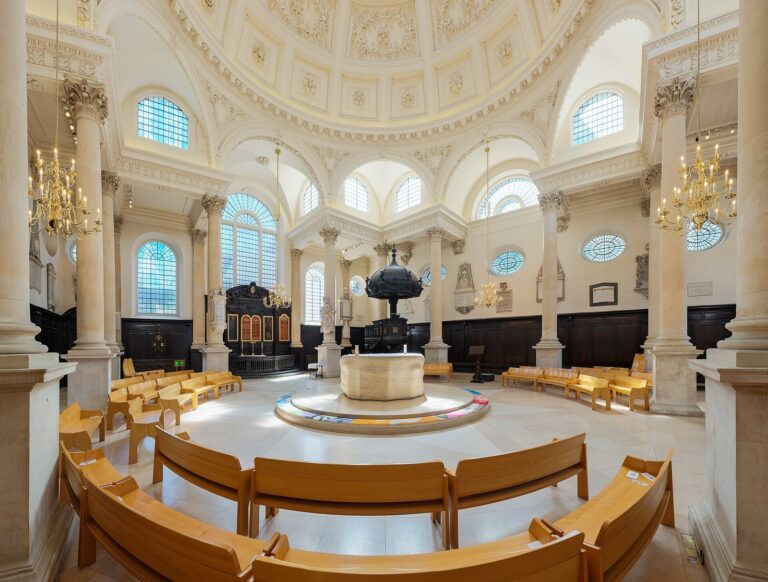
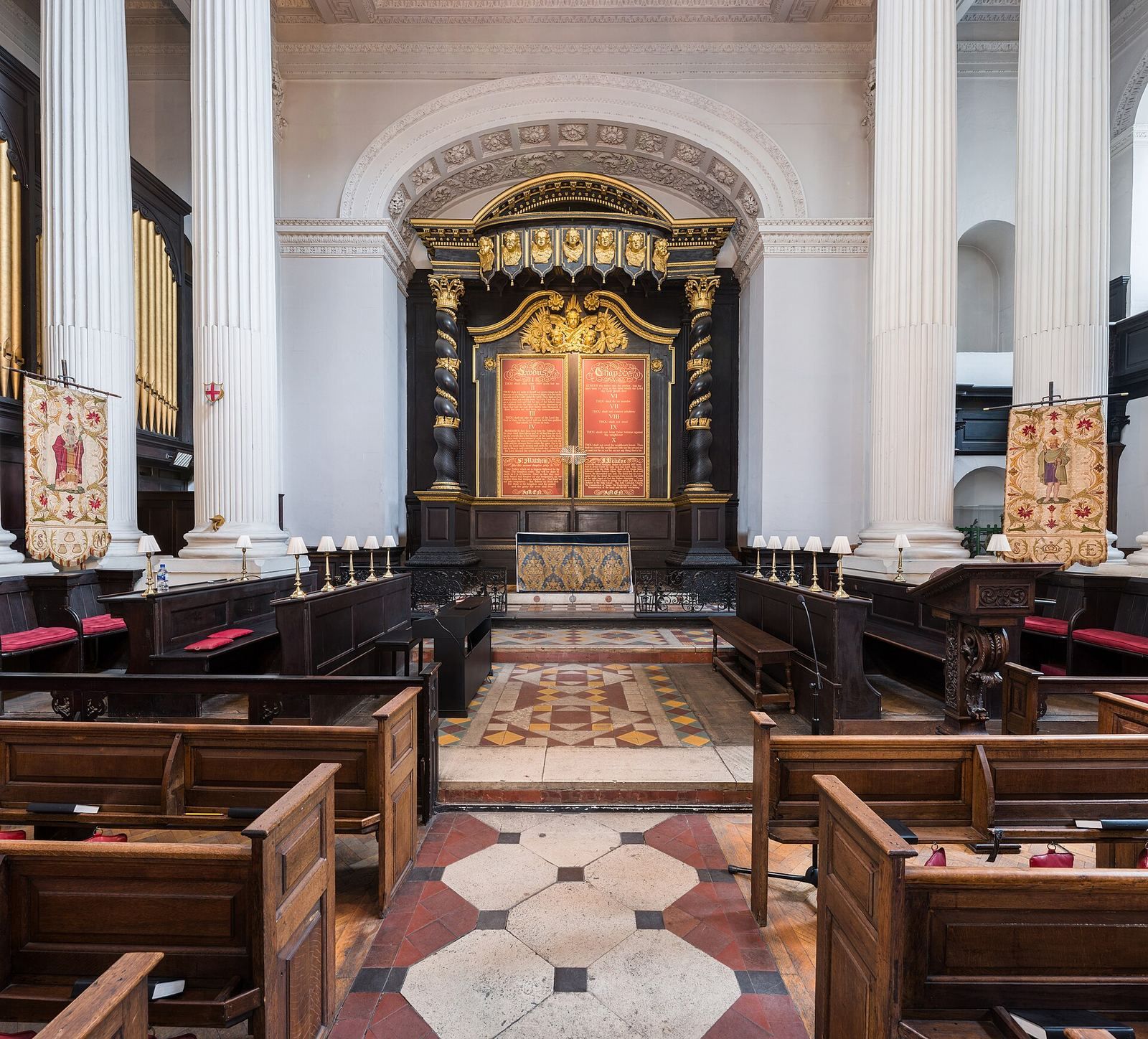
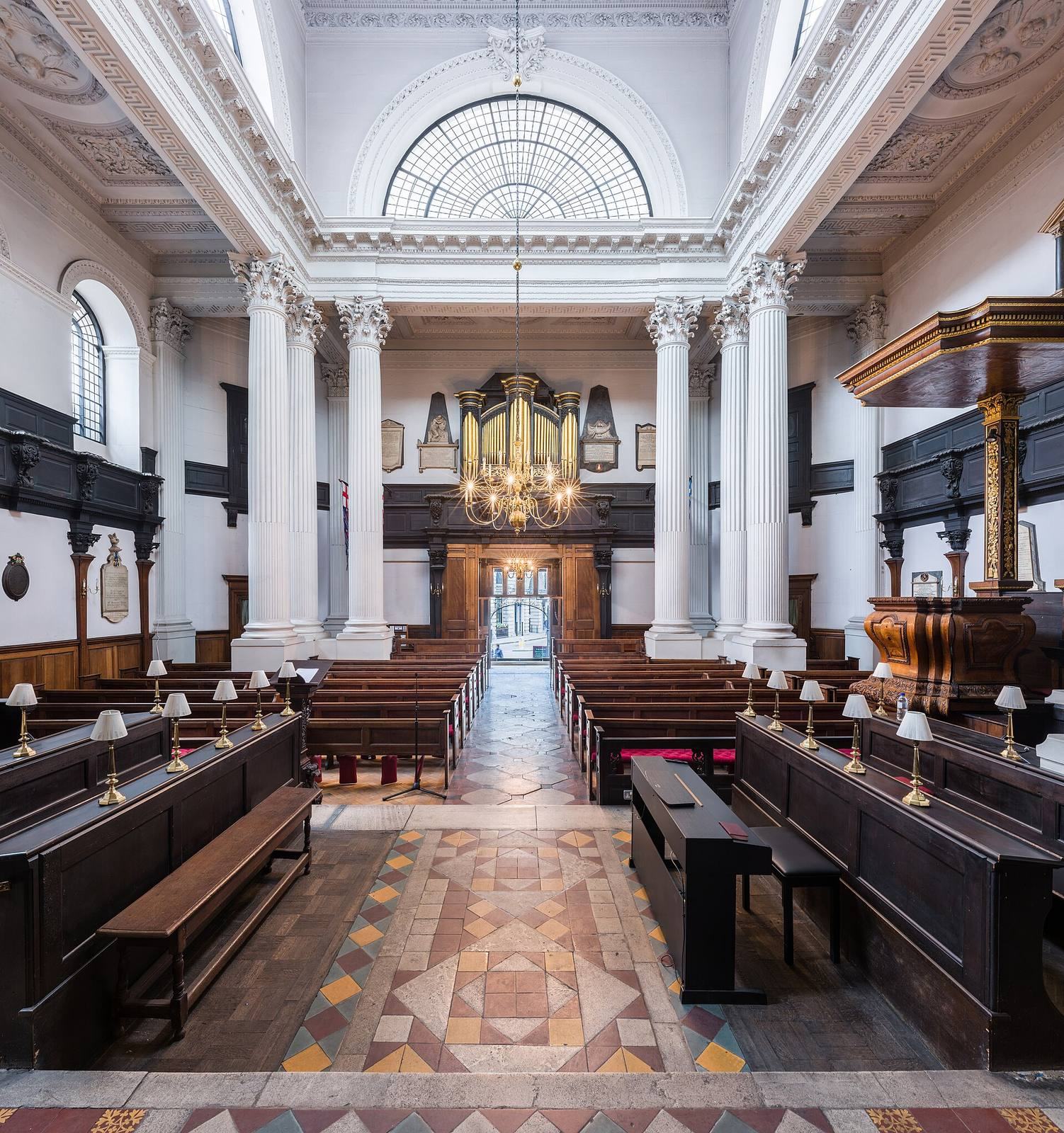
Inside the square building, three rows of four columns form a smaller square within the wider plan. Groups of three Corinthian columns at the corners support a raised clerestory, a section of upper wall lit by windows, including semicircular windows. A Baroque baldachin, or canopy-like architectural feature, dominates the interior. Its design was modelled on the baldachin in St Peter’s Basilica in Rome.
Subsurface remains
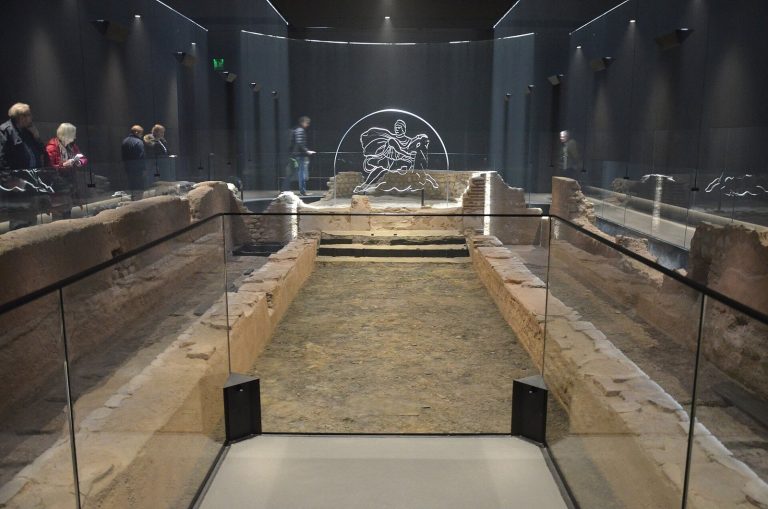
Roman remains and the remains of an Anglo-Saxon timber structure, from England’s pre-Norman period, were found beneath the site during Hawksmoor’s rebuilding. Bank Underground station lies below the church; its lift and staircase shafts were built directly beneath the church floor, in the area of the former crypt, an underground chamber used for burials.