Saint-Just Megalithic Site: A Prehistoric Monument Complex in Brittany
Site at a Glance
- Popularity
- Medium
- Country
- France
- Primary era
- Stone Age
- Eras represented
- Stone Age, Bronze Age
- Civilizations
- Unclassified
- Site type
- Religious
- Remains
- Sanctuary
On this page16 sections
History
The Saint-Just Megalithic Site is a prehistoric complex in Brittany, France, west of the village of Saint-Just. Its monuments were raised in successive phases from about 4500 to 1500 BCE, beginning in the Neolithic, the later Stone Age, and continuing into the Bronze Age, the succeeding period characterized by the use of bronze. It is described as Brittany’s second-largest megalithic area after Carnac. The complex may have served as an important Neolithic religious centre: some monuments were tombs, others had ritual uses, and structures interpreted as graves may in some cases have been sanctuaries.
Neolithic and Bronze Age
The range of burial structures reflects changes in funerary practice over time. Work on individual monuments also continued into the Bronze Age, when some earlier structures were altered and new stone-lined graves were made. The long sequence of construction and reuse means that the site’s monuments represent several periods rather than a single building phase.
Rediscovery and protection
The megaliths were described from the nineteenth century onward. Heath fires in 1976 and 1989 brought them to renewed attention. Excavations had begun in 1956, and later work combined archaeological research with efforts to present the site; the investigations also led to scientific publications.
The Ille-et-Vilaine department has owned the Cojoux and Tréal grounds since 1988. Following the 1989 fire, it acquired 150 hectares to restore the heath and develop the site. A major fire near Pichenais on 12 August 2026 severely affected the complex. Six of its monuments are classified or registered as historic monuments.
Remains
About 15 megalithic sites remain visible. Most monuments occupy an east–west rocky ridge nearly 1.5 kilometres long, bounded by the Canut de Renac valley to the west and the stream of the Saint-Just pond. Other megaliths extend across an area of about six kilometres, chiefly on Cojoux heath. The ridge group includes burial mounds, stone rows, an enclosure, and dolmens.
Monuments on the ridge
Croix-Madame
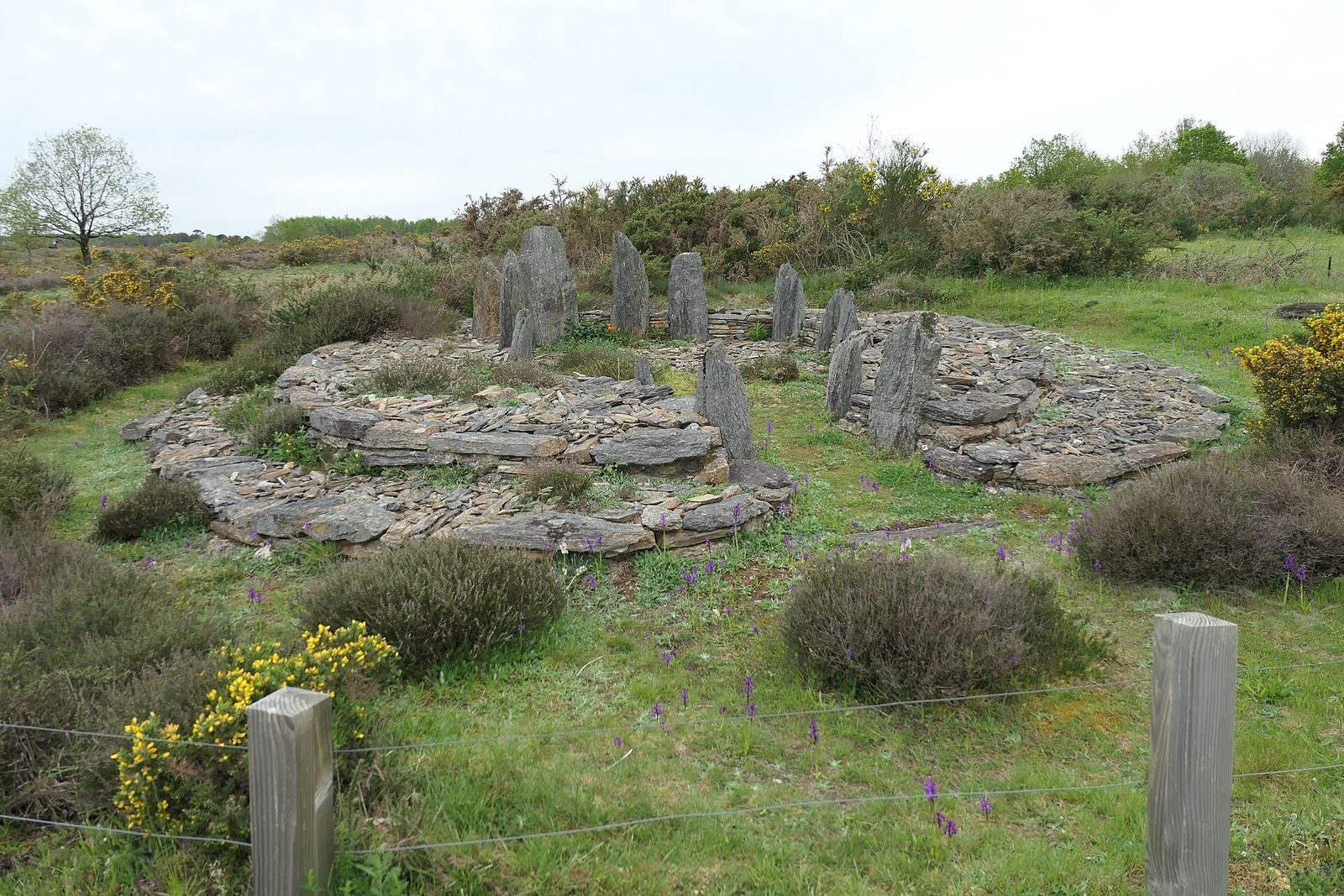
At Croix-Madame, middle Neolithic constructions included structures shaped like burial mounds.
Moulin alignments
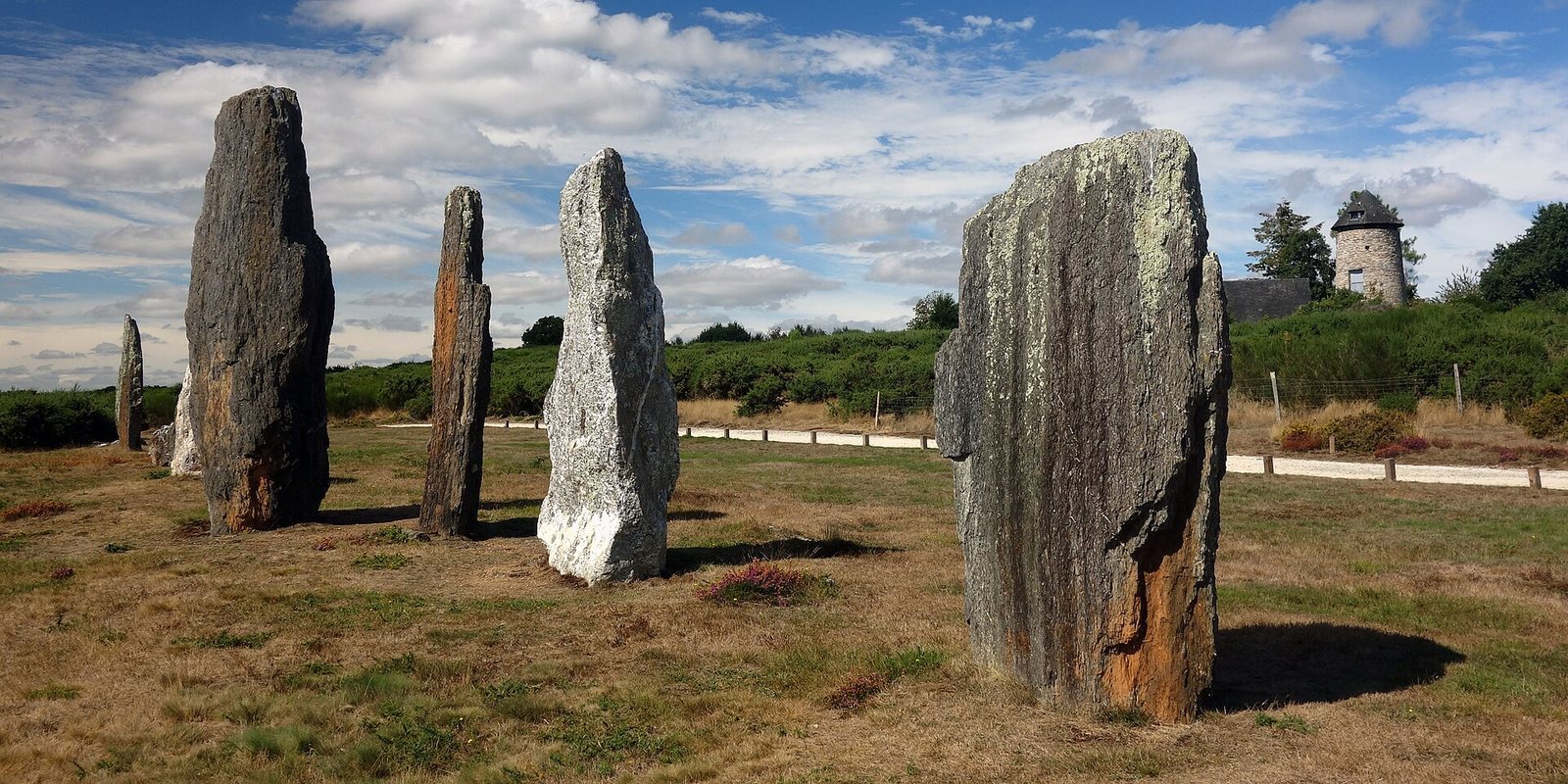
The Moulin alignments (groups of standing stones arranged in rows) date to about 4200–3700 BCE. Three rows of standing stones share the same orientation. During the Bronze Age, small stone-built graves called cists were made there, and a funerary vessel was buried at the site.
Roches Piquées
Also called the Demoiselles de Cojoux, the Roches Piquées consists of three stones, or possibly four. One has fallen, while the two upright principal stones stand about three metres high: one is quartz and the other is Gourin puddingstone, a natural rock formed from pebbles cemented together. A smaller stone lies a few metres east of the fallen block. Local legend says that three young women were turned to stone after dancing on the heath at twilight.
Château Bû
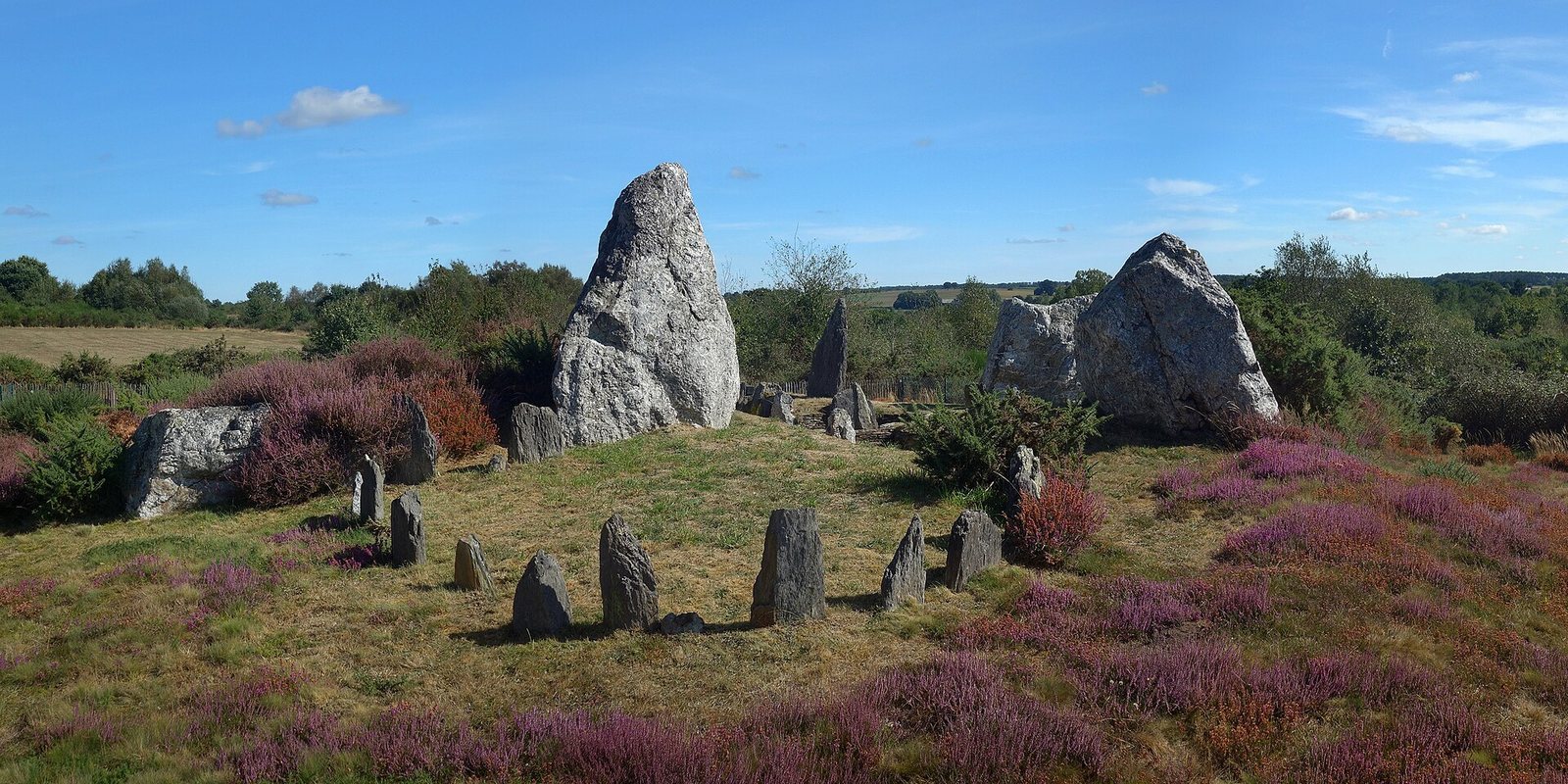
Dating to about 3500 BCE, Château Bû began as a dolmen (a chamber built from large stones) with side chambers. In the Bronze Age it was reshaped into a burial mound incorporating large pieces of quartz, with cist-shaped graves beneath it.
Croix-Saint-Pierre
The North Dolmen and West Dolmen at Croix-Saint-Pierre are collective burial structures dating to about 4500 BCE. They were modified in the Bronze Age, when cist-shaped graves were created. Other early features here include a tomb in a ditch and stone structures with passages. A separate mound, dated to about 3200 BCE, covered several cist-shaped graves.
Tribunal enclosure
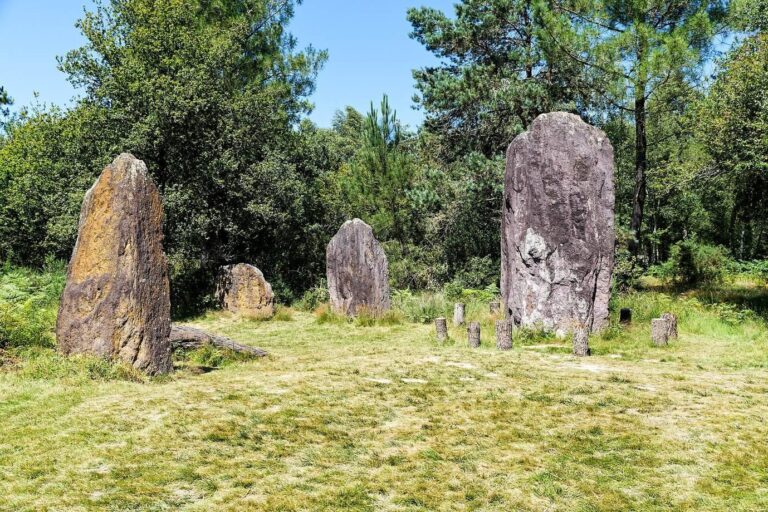
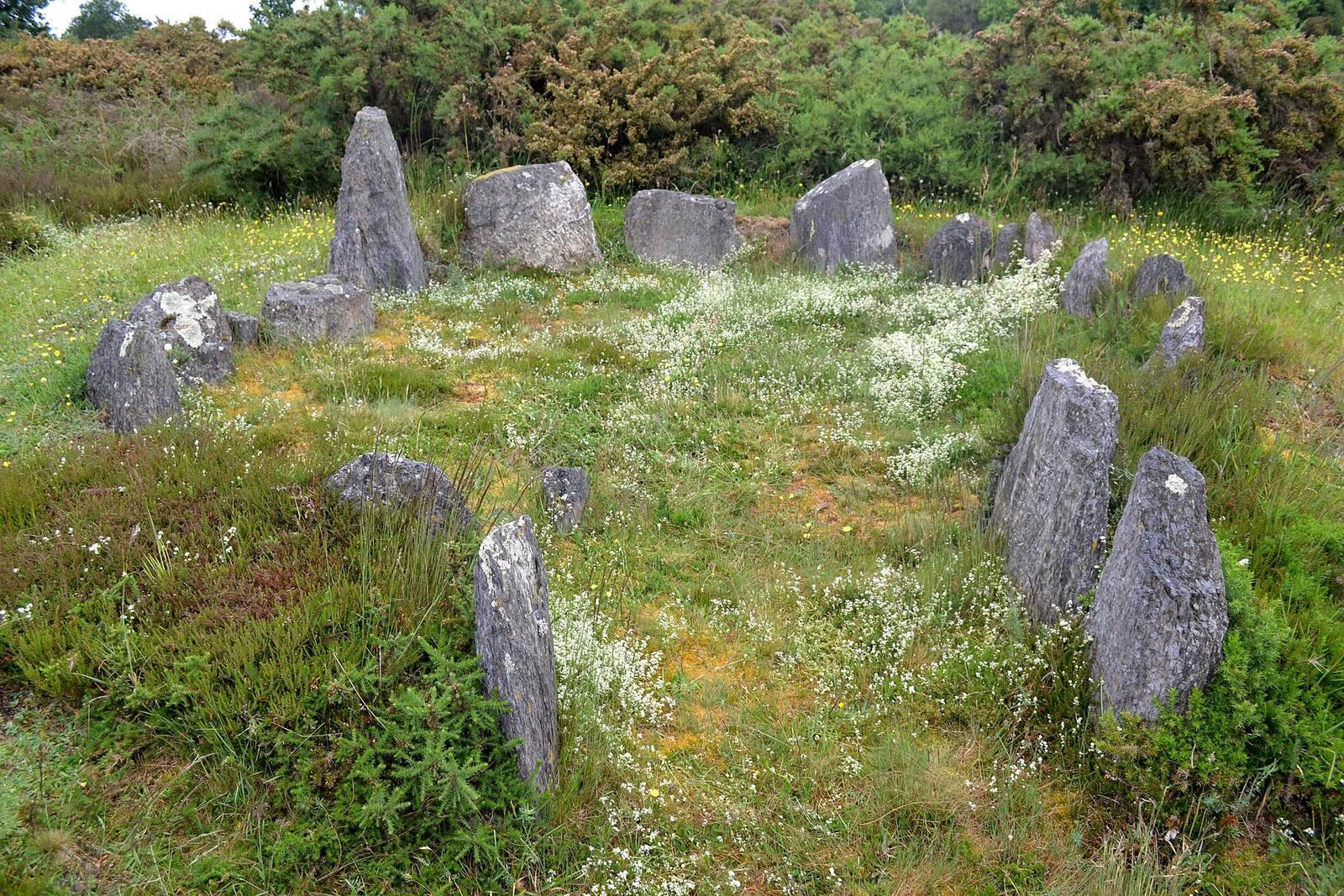
The Tribunal originally comprised 15 stones arranged in a semicircle opposite a solitary standing stone. It may have served to observe the setting sun at different times of year. Local tradition instead tells of an accused person standing before judges at the enclosure.
Four Sarrazin dolmen
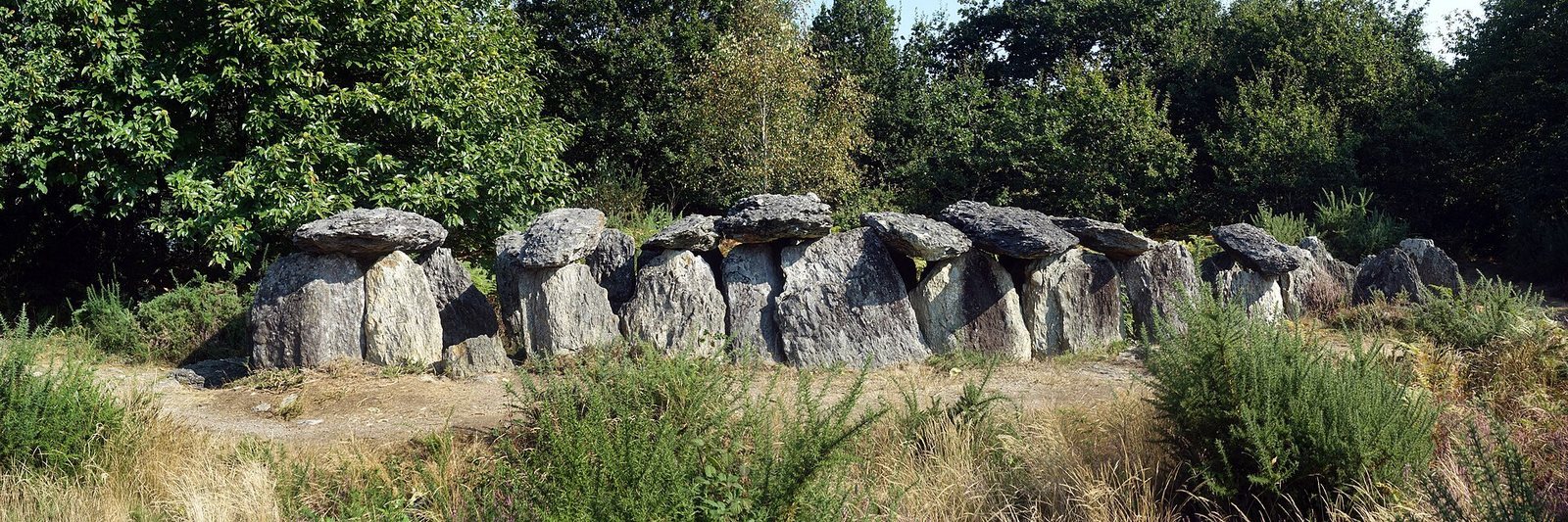
The Four Sarrazin is a communal passage grave (a burial chamber reached through a passage) dating to about 2500 BCE, of a type associated with northern Europe. A few upright stones survive beneath roof stones, one of which bears cup-shaped markings. The monument’s name may come from its resemblance to an oven used for baking rye bread.
Monuments west of the Canut
Tréal passage grave
Dating to about 2500 BCE, the Tréal passage grave stands on a hilltop in a small wood among unusual rock formations. A long, narrow rock nearby is identified in local legend as the first milk tooth lost by the giant Gargantua, a figure from French literary and folkloric tradition. In 1991–1992, the passage grave was restored by raising its upright stones and replacing its roof stones.
Bosné alignment
The Bosné alignment stood north of the village, at the place that gave it its name. Before it was dismantled, it extended about 30 metres and consisted of quartz stones. During land consolidation, the stones were moved to the edge of the parcel where the alignment had stood.
Other western groups
West of the Canut are the Bocadève alignment and menhir groups at Sévéroué, Bel Air, Lande de Parsac, Poubreuil, and Bois du Rocher. The Bel Air stones have fallen. The Lande de Parsac group has three stones, Poubreuil has four, and Bois du Rocher has two.