Harlowbury: A Medieval Manor Estate
Site at a Glance
- Popularity
- Medium
- Country
- United Kingdom
- Primary era
- Medieval
- Eras represented
- Medieval, Early Modern, Modern
- Civilizations
- Anglo-Saxon, English
- Site type
- Domestic
- Remains
- Manor House
On this page12 sections
History
Harlowbury is a medieval manor, a landed estate linked to local lordship and obligations, in the United Kingdom. It was established in 1044, when Thurstan son of Wine, a thegn (an Anglo-Saxon landholder who owed service to a ruler), granted the land to Bury St Edmunds Abbey, a major Benedictine monastery in Suffolk whose monks followed the Rule of St Benedict.
The abbey estate and medieval settlement
In 1066, Harlowbury was assessed at 1½ hides, a customary measure of landholding whose size could vary. The abbey may initially have combined its estate with holdings at Latton, where it controlled 3½ hides. By 1086, Harlowbury was assessed at 4½ hides divided among five men. These holdings probably later formed the manors of Hubbards Hall and Moor Hall.
The Domesday Book, a survey of English land and resources compiled in 1086, called Harlowbury the principal settlement in Harlow parish. It listed 31 villeins, bordars and serfs, all categories of dependent people, along with eight ploughteams, teams of animals used to pull ploughs. The recorded property also included a water mill, four rounceys (a type of horse), 25 beasts, 50 swine, 60 sheep, three colts and five hives of bees.
King Stephen enlarged the manor around 1150. A tax return of 1237–1238 used the name Herlaue Abbatis, meaning Harlow Abbotts; the name Harlowbury appears in a record from 1351. The village at the site continued through the Anglo-Saxon and medieval periods. By the late 11th century, its center had shifted south along Churchgate Street, and by 1287 Harlow’s center had moved to Mulberry Green. A deserted medieval village lay immediately south of Harlowbury.
Tenants and the estate’s changing use
Harlowbury supported farming and livestock raising, while tenants’ obligations to work for the manor declined over time. In 1287, tenants held land in 14 virgates and half-virgates; a virgate was another customary land measure whose size could vary. Records counted 138 tenants in 1360. By about 1430, the manor was leased to tenants who were no longer expected to provide labor services. John Dobbs held the lease around then, followed by Giles Mallory in the early 16th century.
In 1532, Thomas Cromwell, chief minister to Henry VIII, tried unsuccessfully to secure a lease and instead accepted a pension of £10 a year. William Sumner acquired the lease in 1536, and his family held it until 1610. From the 13th to the 15th centuries, Harlowbury shared grazing on Stanegrove Hill with Latton Hall and Mark Hall.
From abbey ownership to private estate
The abbey’s ownership ended in 1539 with the dissolution of the monasteries, when Harlowbury became Crown freehold land, held as property rather than under a lease. In 1544 it was sold to Catherine Addington, widow of Sir Thomas Addington, and her son Thomas. After the younger Thomas died in 1554, his cousin Ralph briefly inherited the manor. Ralph was judged insane in 1555, and the land was then granted to another cousin, John Addington. John’s male descendants held it until 1668, when it passed to his uncle Richard Addington. Following Richard’s death in 1670, his nephews Arthur Champernoun and Richard Way inherited it.
In debt, the Champernoun and Way families sold Harlowbury to Francis North, 1st Baron Guilford, in 1680. The estate remained with the North family for generations. Francis North, 2nd Baron Guilford, held it until 1729, followed by Francis North, 1st Earl of Guilford, from 1729 to 1790. Frederick North, known as Lord North, owned it from 1790 to 1792; he was a British statesman who served as prime minister from 1770 to 1782. George North, 3rd Earl of Guilford, held the manor until 1802, then Francis North, 4th Earl, until 1817, and Frederick North, 5th Earl, until 1827.
After 1827, George North’s daughters Maria, Susan and Georgiana held the estate jointly. Its division in 1831 gave Harlowbury to the Bute family. After John Crichton-Stuart, 2nd Marquess of Bute, died in 1848, the manor passed to Maria Bute’s nephew William North, who took possession when he came of age in 1861.
Tenancy, education and later ownership
The Addingtons and Norths did not live at Harlowbury. Richard Wall remained the tenant when the Norths acquired the manor in 1680. The Barnard family held the tenancy by the 1760s, and William and John Barnard were recorded as joint tenants in 1849.
Harlow Common Church of England established a school on unused manor land beside St. Mary Magdalene’s Church in 1835. The building was considered outdated and inadequate by 1884, and improvements followed over the next decade. A replacement school opened elsewhere in 1912, while the original building continued to serve educational purposes until 1958.
William North began selling parts of his Harlow estates in 1876. Around 1879, he sold Harlow Mill to the Barnards and Harlowbury to John Perry-Watlington, then owner of Moor Hall. Harlowbury and Moor Hall remained in the Perry-Watlington family until 1914, when they passed to the trustees of Robert Ethelston. Harlowbury manor house and chapel are Grade I listed, a category for buildings of exceptional architectural or historic interest. The manor estate and chapel are also scheduled monuments, a protected category for archaeological sites and historic structures.
Remains
Harlowbury’s physical remains center on the manor hall and chapel, with the wider estate and evidence of earlier occupation extending beyond the manor’s buildings. Both structures retain medieval fabric altered in later periods.
Manor buildings
Harlowbury Hall
Harlowbury Hall dates to the abbey period, and the present building was constructed around 1300. Its eastern wing was demolished around the turn of the 15th century and partly restored about a century later. The building’s monastic side aisles, ranges alongside the main hall, were probably removed in the late 16th century, when a fireplace and upper floor were installed. The staircase dates to the 18th century. In the 19th century, the hall was encased in brick, apart from its northern elevation.
Harlowbury Chapel
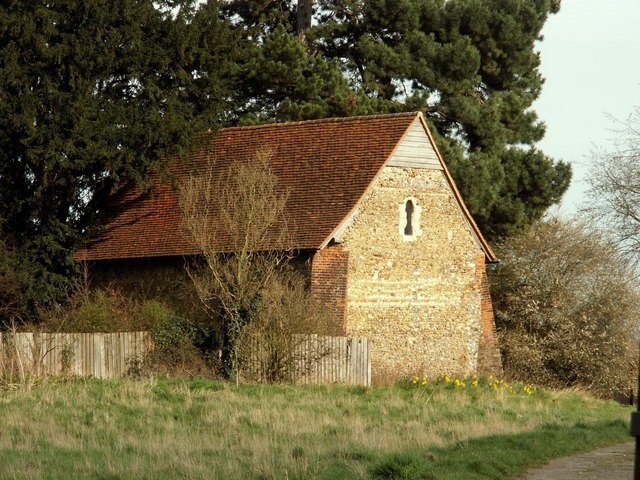
The chapel is a plain rectangular building of flint rubble, with stone dressings and restrained brick decoration on its buttresses. It retains an arched doorway and some rounded windows. Around 1300, crown posts, upright roof timbers supporting a horizontal beam, replaced the original rafters. The walls were heightened and the roof rebuilt in the 15th century. A second floor was added in the 17th century, when the chapel was used as a granary. It is identified as the oldest standing building in Harlow.
Excavations at the chapel in May 1984 uncovered evidence interpreted as an earlier Saxon temple. Post pits, holes that once held timber posts, were radiocarbon dated to about AD 640–820.
Estate landscape and nearby archaeology
Estate features and Ealing Bridge
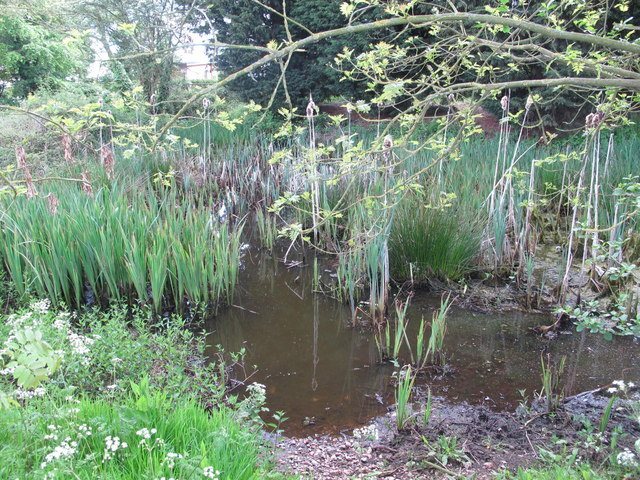
The manor’s grounds included farms and pastures, an orchard, a garden and fish ponds, as well as woodland extending south of the settlement’s common land. Ealing Bridge crosses Pincey Brook and was shared with Sheering manor.
Iron Age and Roman occupation
About 500 metres northeast of Harlowbury, 19th-century excavations uncovered a separate complex identified as a Roman villa or temple. It consisted of several rectangular buildings and patterned paths made from small pieces, beside a road leading to Pishiobury. Traces of an earlier Iron Age settlement lay beneath the complex.