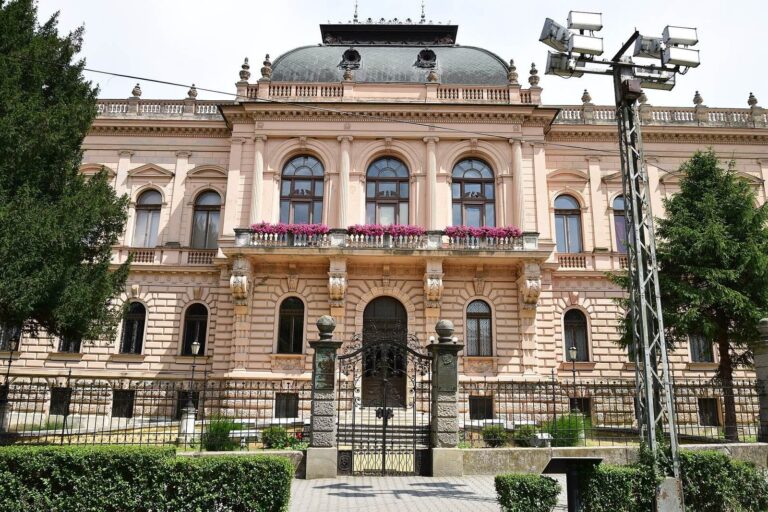
Krušedol Monastery: A Serbian Orthodox Monastic Foundation
Site at a Glance
- Rating
- 4.9
- Popularity
- Very High
- Country
- Serbia
- Primary era
- Early Modern
- Eras represented
- Early Modern, Modern
- Civilizations
- Austrian Empire, Habsburg, Habsburg Austria, Hungarian, Ottoman, Serbian
- Site type
- Religious
- Remains
- Monastery
On this page15 sections
History
Krušedol Monastery is a Serbian Orthodox monastery on the southeastern slopes of Fruška Gora in Serbia’s Vojvodina region. Maksim Branković, the monastic name of the late medieval Serbian ruler Đorđe Branković, and his mother Angelina founded it between 1509 and 1514 as a mausoleum for their family. Its principal church follows the Morava architectural school, a medieval Serbian church-building tradition, and is dedicated to the Annunciation, the feast commemorating the angel Gabriel’s announcement to Mary, honored in Orthodox tradition as the Theotokos, or “God-bearer.”
Foundation and Branković patronage
Maksim established the male monastery and its church on land belonging to Despot Jovan Branković. The church and residential buildings were constructed between 1509 and 1521. Jovan had issued a charter on 4 May 1496 granting the monastery 16 villages in Syrmia. Neagoe Basarab, ruler of Wallachia, and Vasili III, grand prince of Russia, also provided financial support.
Angelina established a separate women’s monastery, where she lived as a nun. Its church was dedicated to the Presentation of the Lord, which commemorates Jesus being presented at the Temple. The two foundations connected the Branković family’s monastic patronage with the religious life of the region.
Monastic and ecclesiastical center
By 1670, Krušedol had the largest monastic brotherhood on Fruška Gora, with 90 monks and 12 elders. During the Great Serbian Migration of 1690, a large-scale movement of Serbs, the monks fled to Szentendre, now in Hungary, taking valuables, relics, and other objects with them. They returned in 1697.
The monastery became the seat of the Belgrade-Syrmia metropolitanate, a church district led by a metropolitan, in 1708. Serbian church-and-national assemblies met there in 1706 and 1708. Its importance to Danubian Serbs has been compared with Studenica’s place in medieval Serbia.
War and reconstruction
During the Austro-Turkish War of 1716-1718, fought between the Habsburg monarchy and the Ottoman Empire, the monastery was looted amid fighting around the siege of Petrovaradin, a fortress settlement near Novi Sad. The church was burned, and the residential buildings were damaged.
Reconstruction began in 1721 and continued for 35 years. In 1724 the brotherhood numbered 26 monks. Metropolitan Vićentije Popović established a communal kitchen, refectory, and cellar. Nikanor Melentijević, bishop of Pécs and formerly the monastery’s archimandrite, a senior monastic cleric, left his episcopal seat after learning of the fire and devoted himself to rebuilding. He died at Krušedol in 1739.
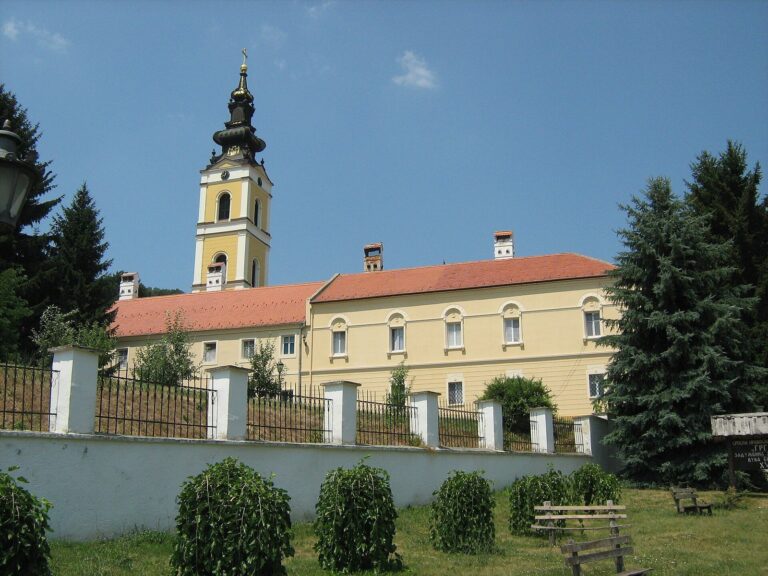
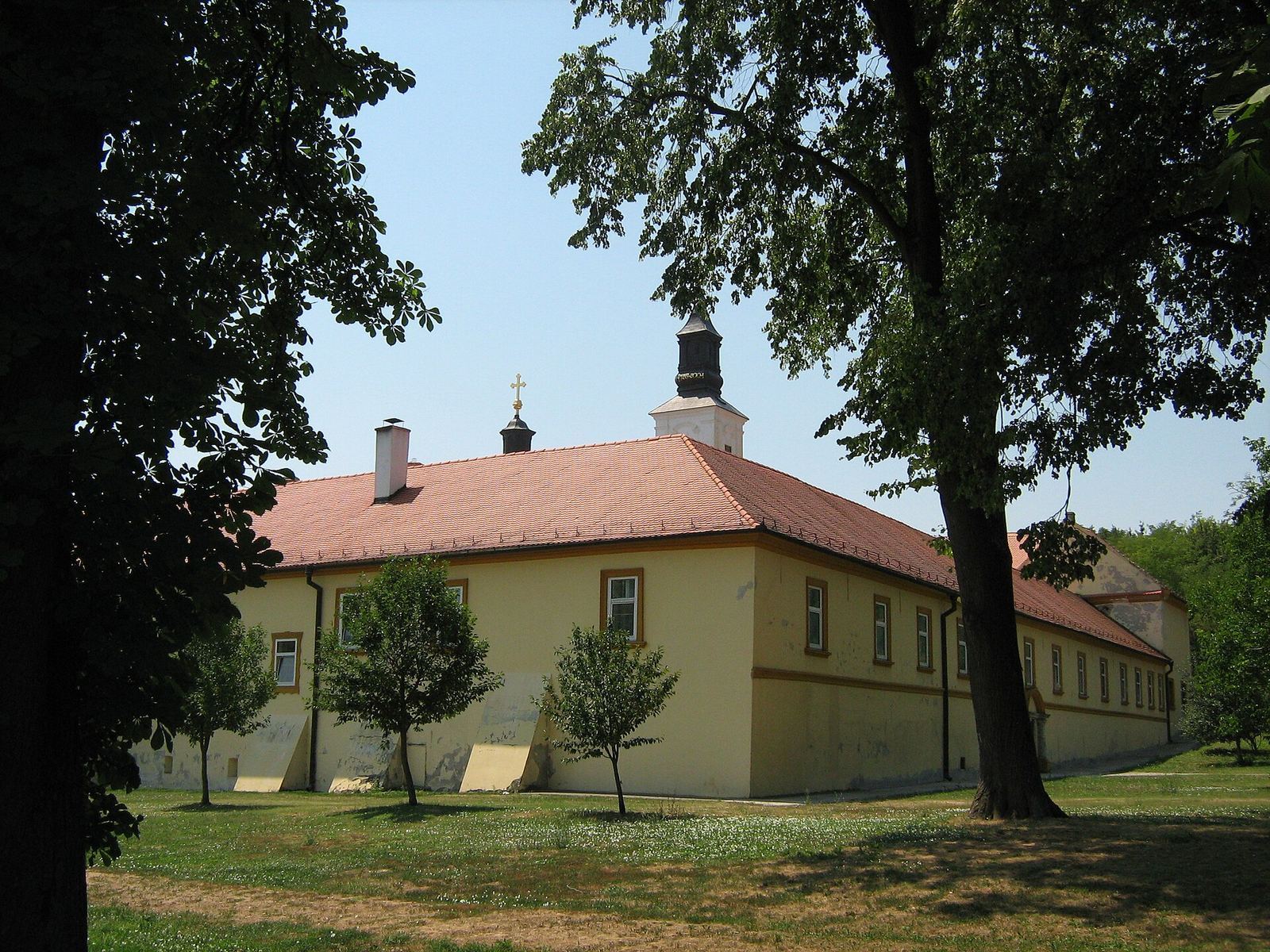
Nikanor oversaw the construction of the long eastern range, its chapel, his own cell, an inn, and crop stores. In 1726, benefactors from Novi Sad paid for a tall bell tower, its bells, and the church roof. The front range was extended in 1742, and the church was restored around 1750. The four-sided residential ranges were completed in 1753. Deputy abbot Pajsije built a structure with cells and a cellar in front of the church, while the spiritual father Sofronije restored cells.
Modern disruption and conservation
Repairs to the buildings and roofs took place in 1855-1856, with a contribution from Prince Mihailo Obrenović in 1856. The monastery was renovated in 1938 under Archimandrite Sava Petković and restored again after the Second World War. It was designated a monument of exceptional cultural importance in 1990 and received the first-grade Order of Saint Sava in 2009. Saint Sava, a medieval monk and archbishop, is regarded as a foundational figure of the Serbian Orthodox Church. Land later returned to the monastery included 28 hectares of forest and 160 hectares of arable land.
During the Second World War, the monastery was looted and damaged. Its library, archive, iconostasis, church valuables, furnishings, and treasury objects were taken to the Museum of Arts and Crafts in Zagreb; other movable property, food stores, and money were stolen. Among the displaced objects was a Gospel decorated with gold and jewels, given by monks of Hilandar to King Alexander Obrenović. The head of the Independent State of Croatia kept it for himself. Some objects were later returned, while many are now held by the Museum of the Serbian Orthodox Church.
Archimandrite Sava Petković fled to Belgrade in 1941, and Orthodox worship at the monastery was prohibited. Eighty-six Roman Catholic priests from Lower Styria were housed there; after they left, Ustaše troops took over the buildings. The Ustaše were a Croatian fascist movement that governed the wartime Independent State of Croatia. During this period, the remains of Patriarch Arsenije IV were burned. After the war, an opened and looted sarcophagus was found to contain dismembered human remains, including the severed head of Zora Mitrović, a woman from Maradik who had been murdered.
A conservation study in 2012 examined the church’s iconostasis and compared the artworks with historical records to investigate painting materials and techniques, artists, workshops, and artistic schools.
Remains
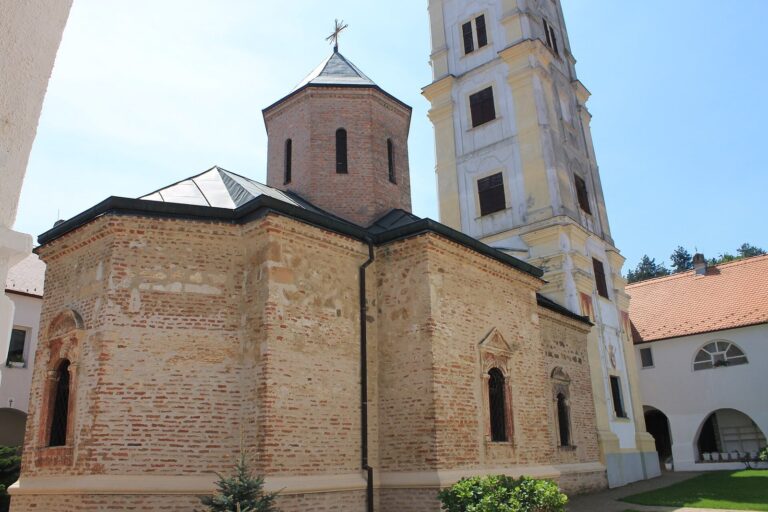
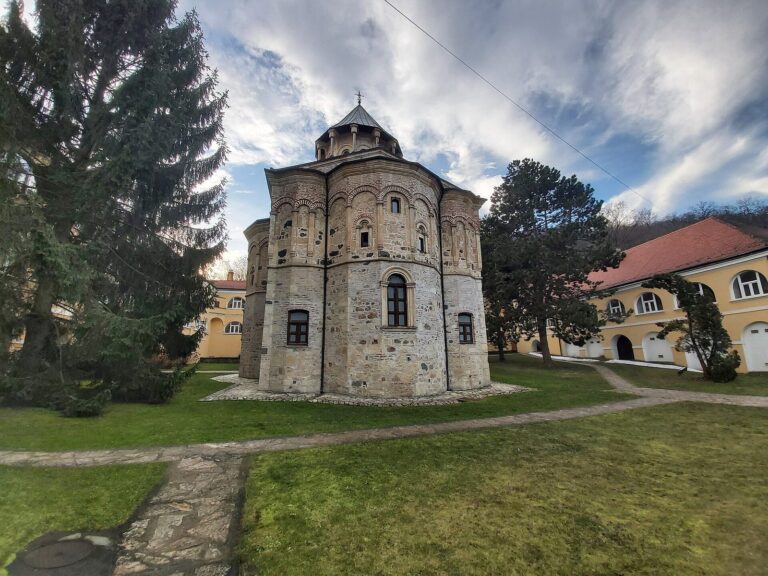
The complex comprises the male monastery and its Annunciation church, with a separate women’s monastery and church nearby. Four-sided residential ranges form part of the main monastic group. The buildings preserve both earlier church forms and alterations made during the Baroque rebuilding.
Annunciation Church
Plan and construction
The church has a three-conch plan, with three rounded sanctuary ends arranged around a central space, and is crowned by a dome. Its entrance area, or narthex, and nave have barrel vaults, continuous arch-shaped ceilings. The apses are semicircular inside and outside. Curved supports called pendentives carry the dome above the church’s different-shaped space; arches defining them descend onto pillars with eight-sided cross-sections. Baroque changes include the porch, doors, and windows. Seven windows were remodelled in that style after the eighteenth-century reconstruction. A sundial above an eastern window marks the hours from 6:00 to 17:00.
Wall paintings
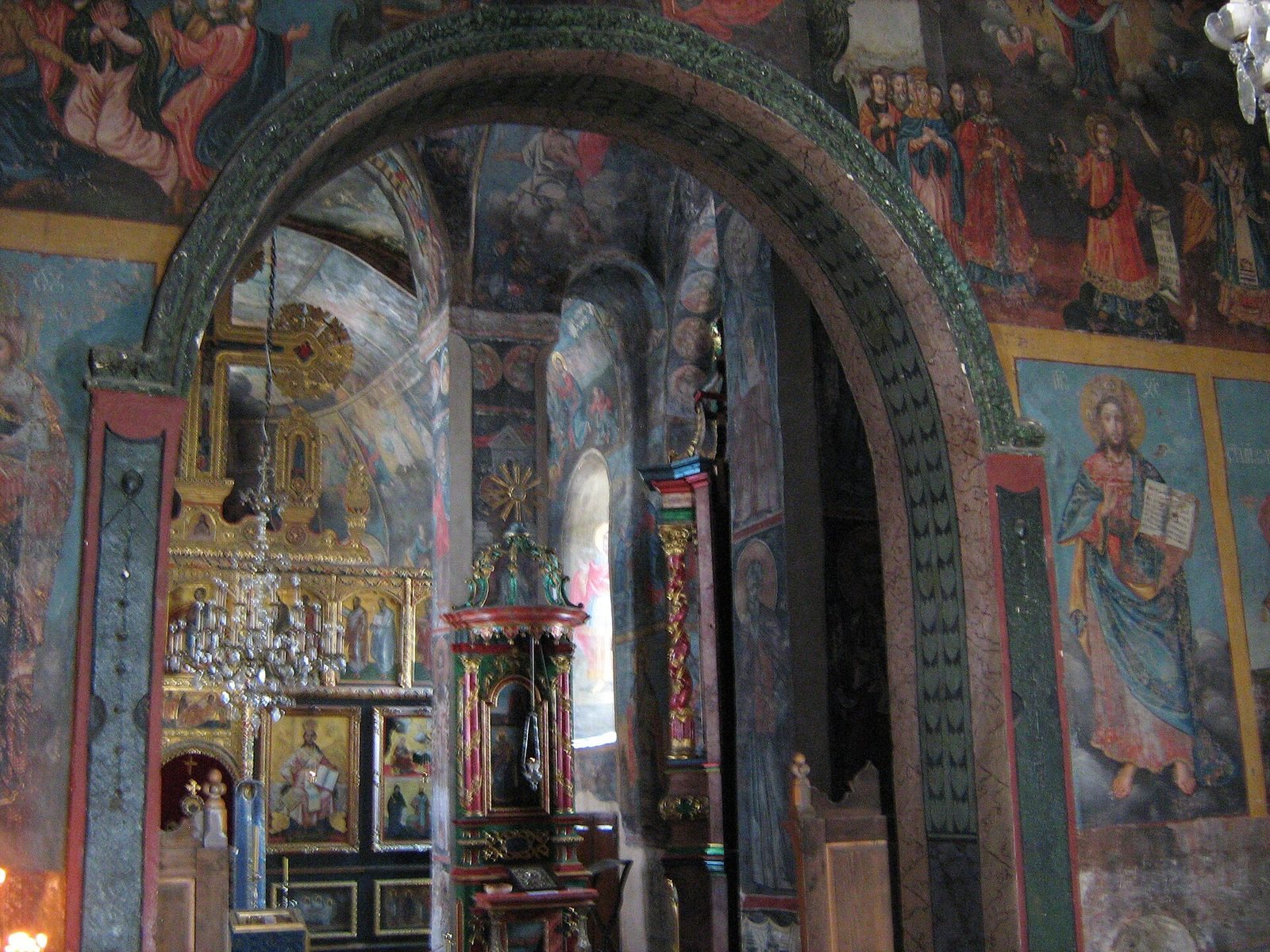
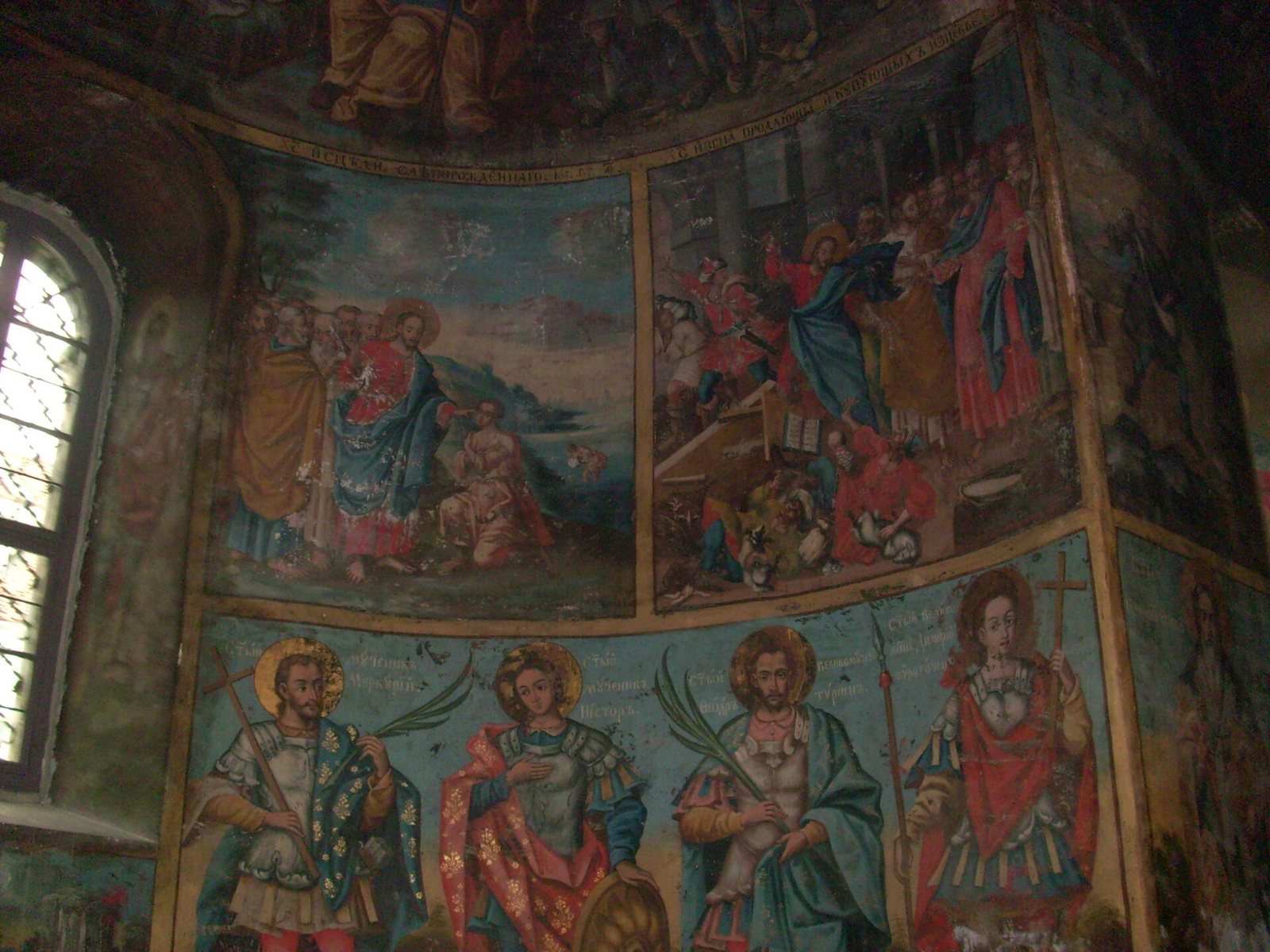
The church contains two layers of wall painting. The earlier works were painted in the narthex in 1543 and in other parts of the church in 1545-1546. Later paintings covered them in oil between 1745 and 1757, with work also dated specifically to 1750-1751 and 1756. These later paintings are attributed to Jov Vasiljević and Stefan Tenecki. They use linear and aerial perspective, natural landscapes, detailed anatomy, and realistically rendered clothing. Rulers of the medieval Nemanjić dynasty appear in the dress of eighteenth-century European monarchs. The later paintings are well preserved.
A Last Judgment painting appears on the church’s western façade. Another composition of the same subject, dated between 1650 and 1666, is on the eastern wall of the porch.
Iconostasis
The church’s carved wooden iconostasis, a screen of icons separating the sanctuary from the main body of an Orthodox church, brings together works from four periods spanning the sixteenth to nineteenth centuries. Its oldest icons, from around the middle of the sixteenth century, show the apostles with Christ, the Virgin Mary, and John the Baptist. A monumental Deesis, an image centered on Christ with figures who intercede with him, consists of nine icons and is regarded as a major work of sixteenth-century Serbian painting.
A large painted and carved cross, images of John the Evangelist and the Virgin Mary, and an over-door image known as the Eye That Never Sleeps were added in the mid-seventeenth century. Narrow icons of Saints Kondrat and Eustathius were added at the ends of the Deesis row in the second half of that century. During the eighteenth-century Baroque renovation, older royal doors, the central iconostasis doors leading to the sanctuary, and throne icons were replaced. The throne icons are attributed to Jov Vasiljević; the royal-door paintings are attributed to a painter closely associated with him.
Burials and relics
The narthex is a burial place for Branković family members and other prominent figures. Those buried there include Serbian Patriarchs Arsenije III Čarnojević and Arsenije IV Jovanović Šakabenta; Metropolitans Isaija Đaković and Vikentije Popović; Nikanor Melentijević; Count Đorđe Branković, who was unrelated to the Branković family; border-military colonel Atanasije Rašković; Voivode Stevan Šupljikac; Princess Ljubica Obrenović; and King Milan Obrenović. Caskets in front of the iconostasis hold relics of Đorđe Branković, Angelina, and the blind Stefan Branković. David Racković, a civic official from Novi Sad, supported their making and painting in 1759. A masonry tomb of Saint Maksim, dating to 1838, stood on the right side of the narthex.
Monastic residences and associated buildings
Residential ranges and grounds
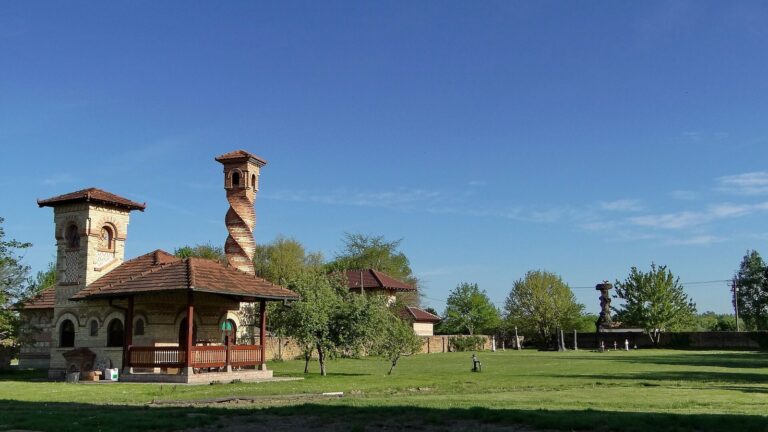
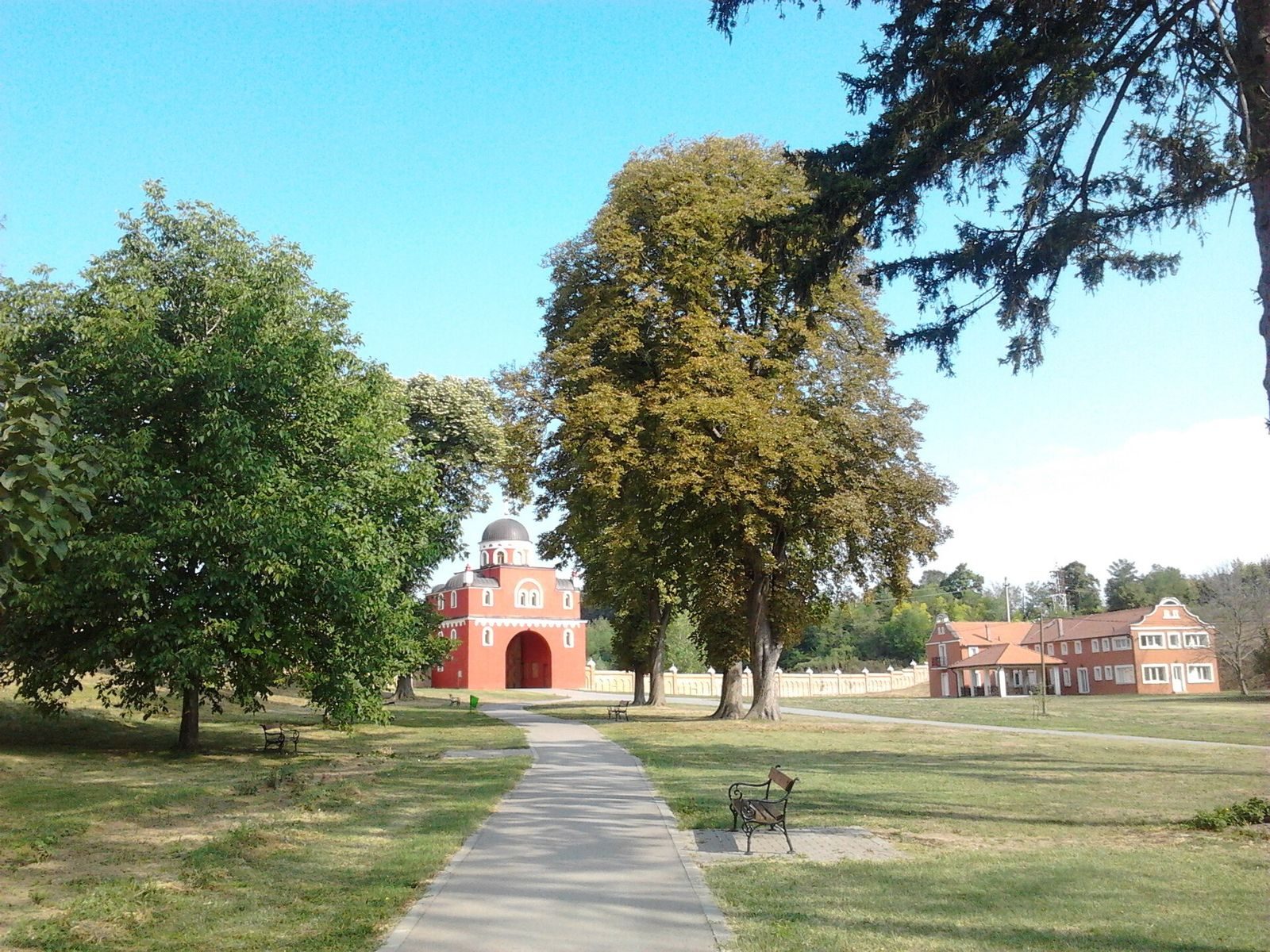
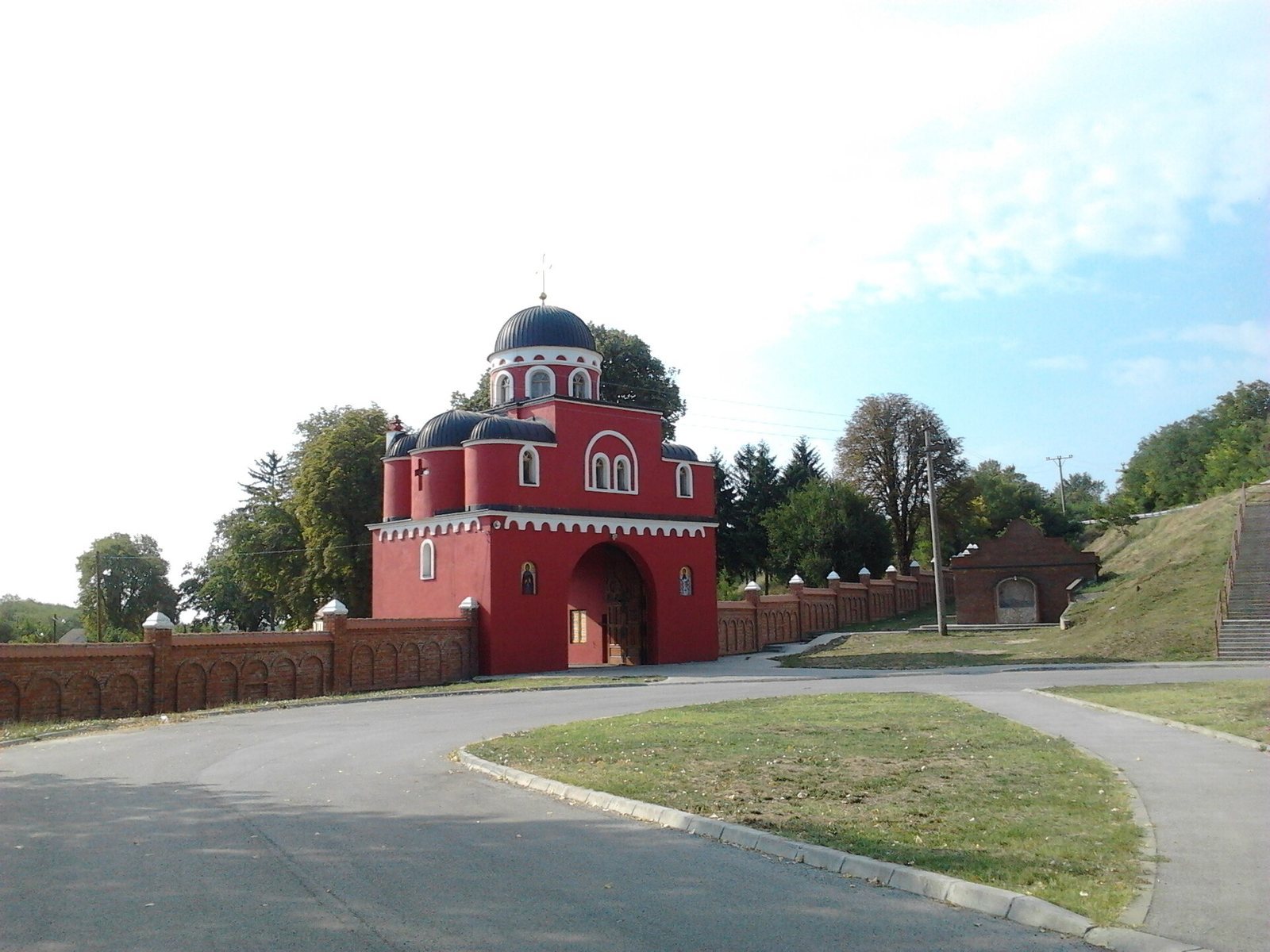
The residential buildings form four-sided ranges. The long eastern range includes a chapel, Nikanor’s cell, an inn, and stores for crops. The western range is associated with the tall bell tower. A flower garden and park are enclosed by a gate, and the entrance to the park is shaped like a church.
Women’s monastery
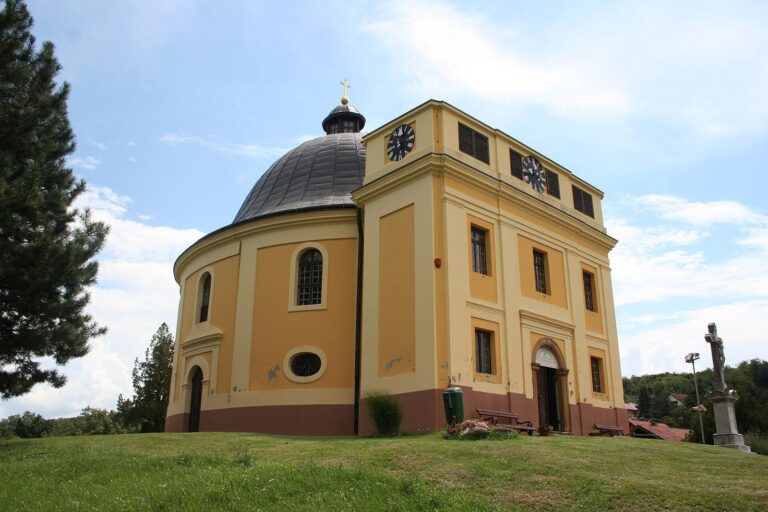
The separate women’s monastery stands near the main group. Its church, dedicated to the Presentation of the Lord, later became the parish church of Krušedol village. Remains of the women’s monastery cells still existed in the nineteenth century, when the Ćelijašević family occupied them.
Treasury and library
The monastery treasury held several charters in the mid-nineteenth century: one from a Moldavian ruler dated 1642, one from Russian tsars Ivan and Peter Alexeyevich dated 1685, and one from a Wallachian ruler dated 1707. It also held a handwritten Gospel written by the hieromonk Pankratije, an Orthodox monk who was also a priest, in 1514. The library was substantial. Abbot Amfilohije brought old church books from Russia in 1651, and a Service and Akathist to the Saints, an Orthodox devotional hymn, and chronicles were written at Krušedol in 1662.