St Enodoc’s Church, Trebetherick: A Church of England Chapel
Site at a Glance
- Rating
- 4.8
- Popularity
- Medium
- Country
- United Kingdom
- Primary era
- Medieval
- Eras represented
- Medieval
- Civilizations
- English
- Site type
- Religious
- Remains
- Church
On this page12 sections
History
Foundation and early phases
St Enodoc’s Church, Trebetherick, is a Church of England chapel in the United Kingdom, founded in 1150 at St Minver Lowlands. It belongs to the parish of St Minver and the Diocese of Truro, a territorial district of the Church of England. The church is associated with Enodoc, a Christian saint linked with Cornwall, and with the Old Cornish names Gwenedek and St Guenedoc. Local tradition places Enodoc’s hermitage in a cave beneath the church.
The church’s oldest fabric dates to around the twelfth century, with additions made in the thirteenth and fifteenth centuries. Its later history was shaped by the movement of sand across the surrounding dunes.
Buried by the dunes
From the sixteenth century until the mid-nineteenth century, dunes nearly covered the church. By the eighteenth century it was partly submerged in sand, and local names for it included “Sinkininny Church” and “Sinking Neddy.” A tradition held that the vicar and parishioners descended through a hole in the roof to hold a service at least once a year, preserving the church’s entitlement to tithes, payments made to support the church. Whether such services actually took place is uncertain.
Restoration and later associations
During the nineteenth century, sand was cleared away and the church was cleaned and restored under the direction of the vicar of St Minver, the Reverend W. Hart Smith. J. P. St Aubyn carried out architectural restoration in 1863–64. By 1864 the building had been unearthed and the dunes stabilized. The church received Grade I listing in 1969, England’s highest category of listed-building protection.
The church inspired Sir John Betjeman’s poem “Sunday Afternoon Service at St. Enodoc.” It also features prominently in Justin Cartwright’s 2004 novel The Promise of Happiness, which is partly set in Trebetherick.
Remains
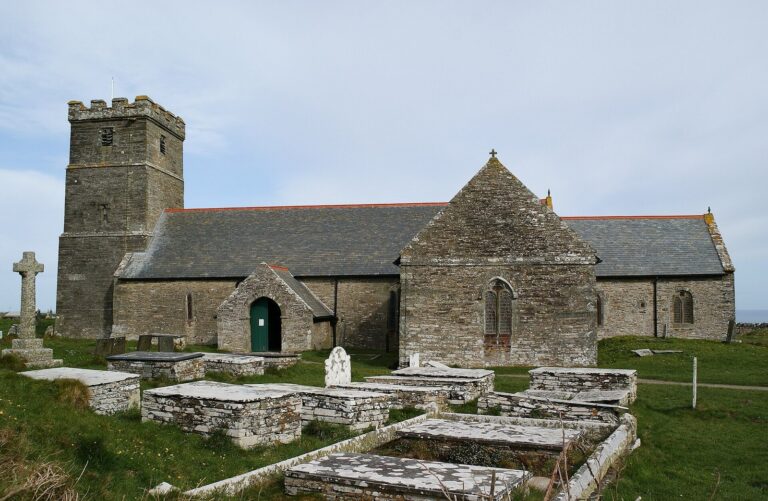
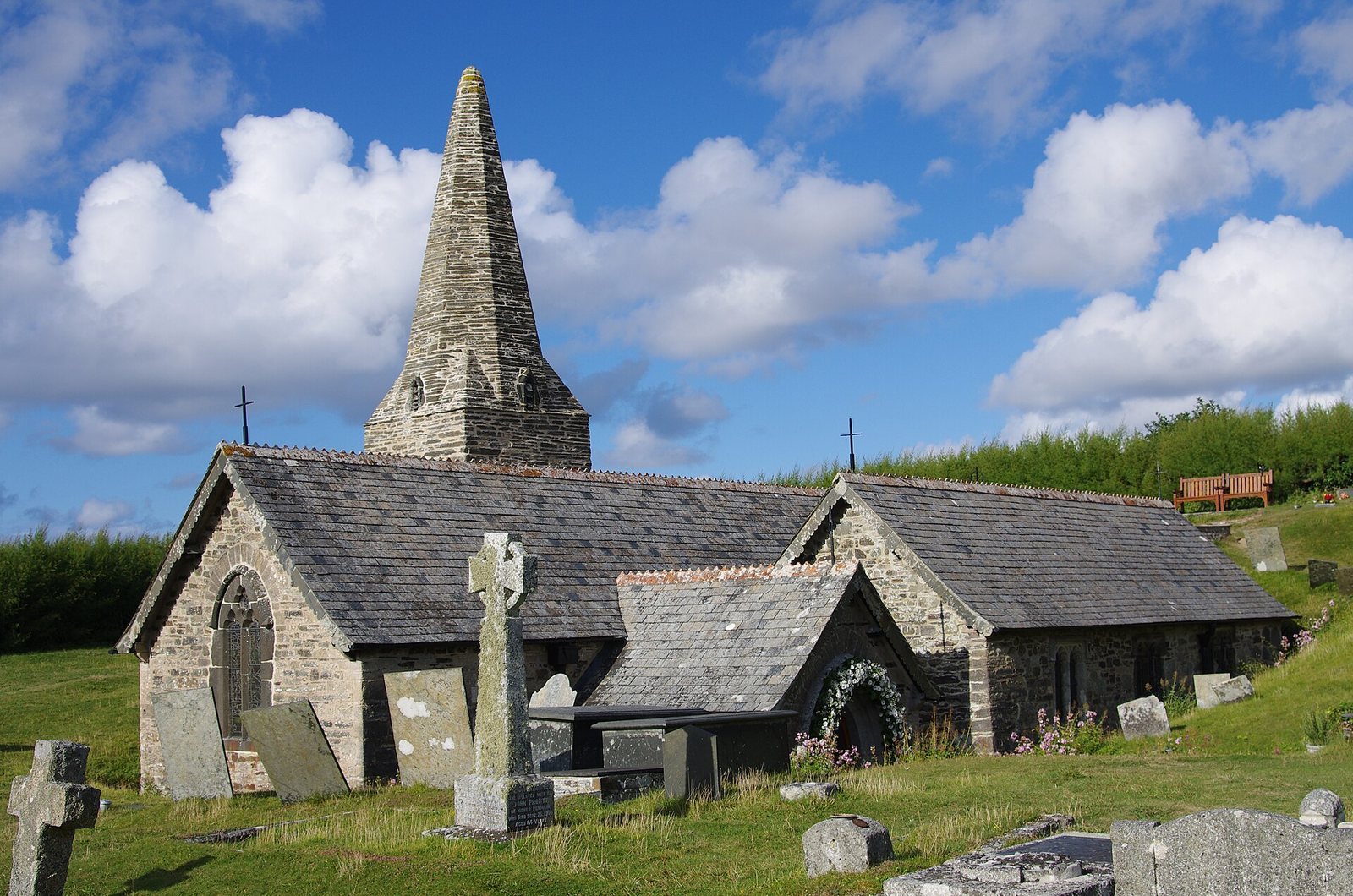
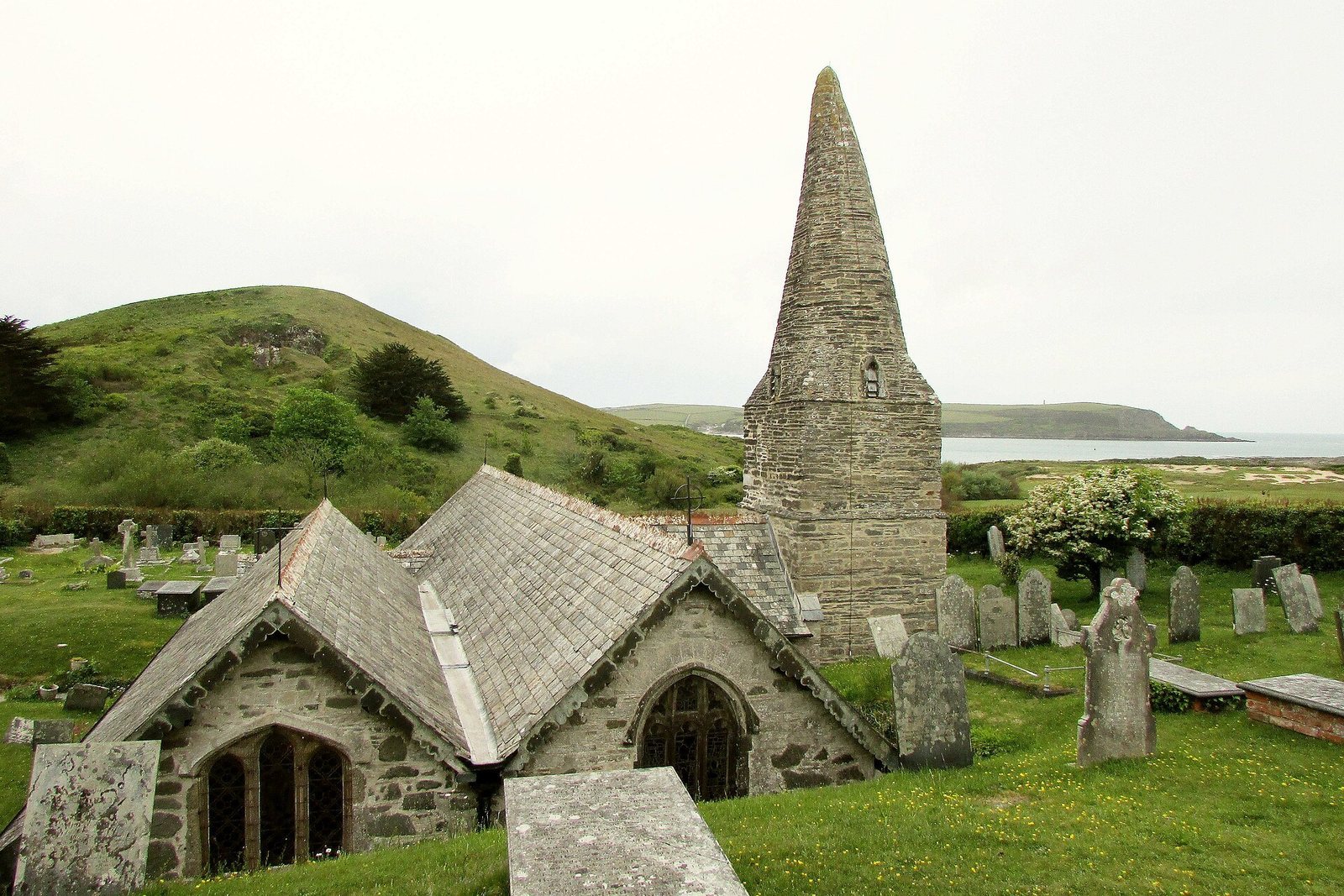
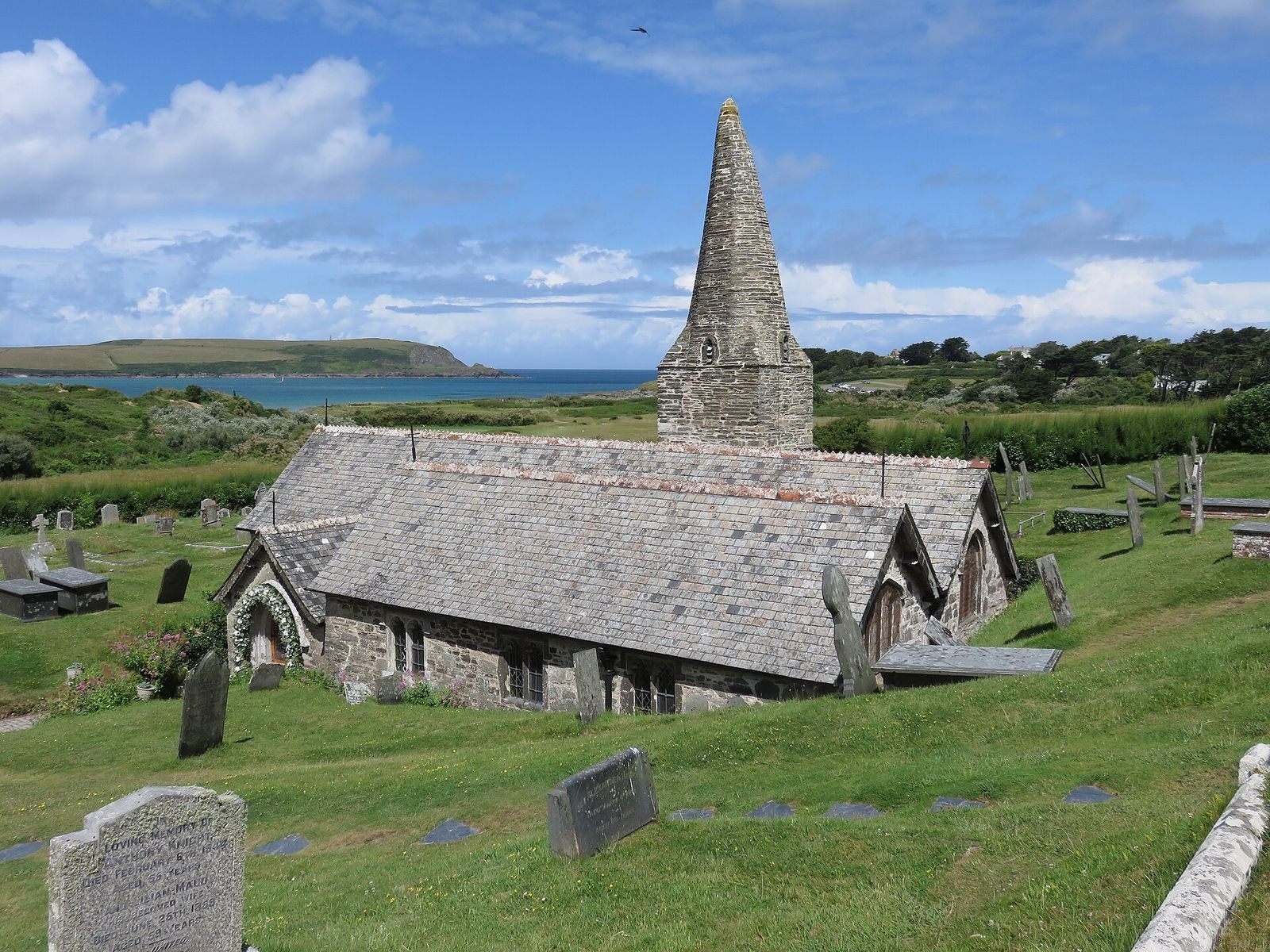
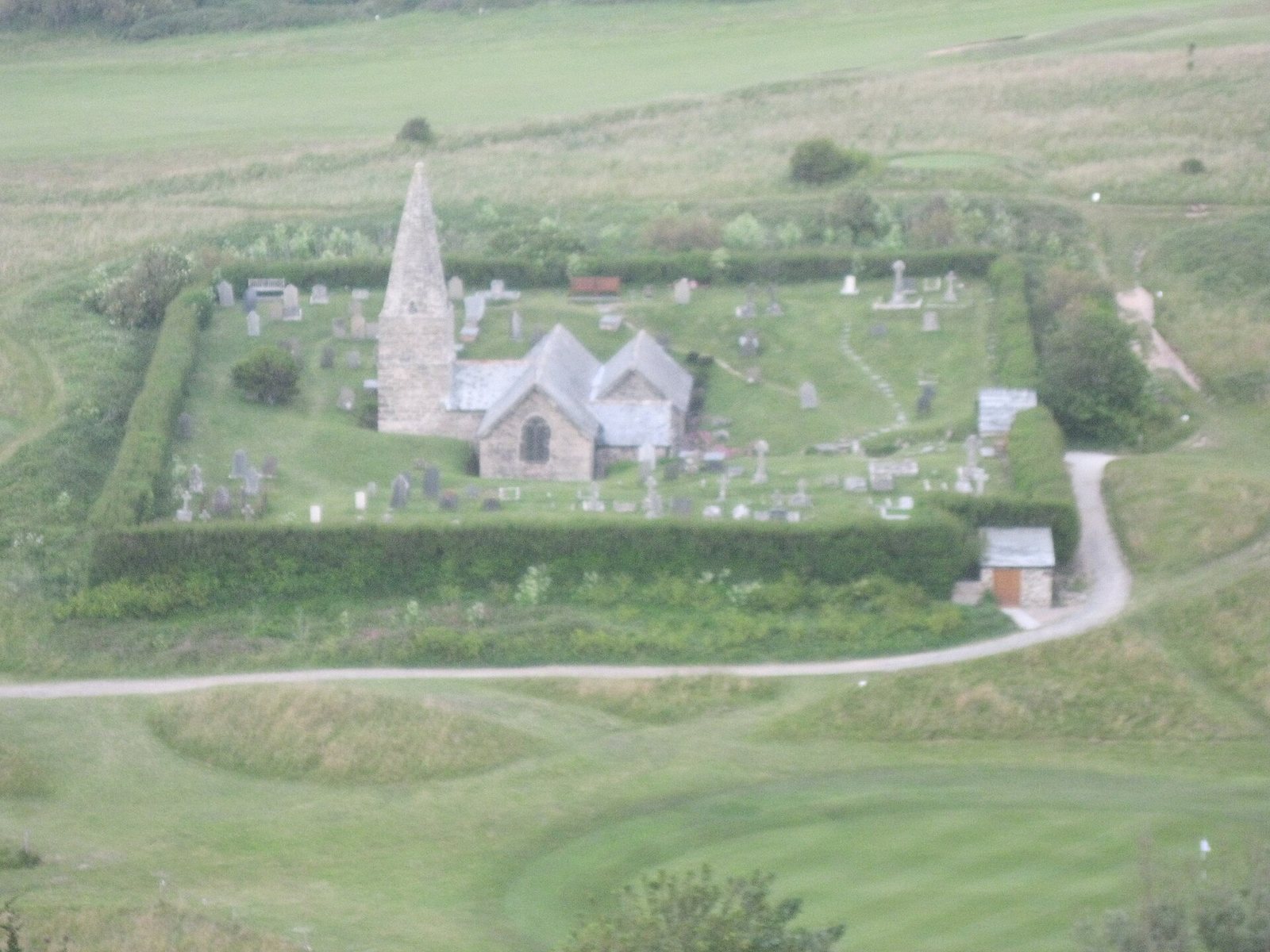
The church stands among sand dunes south of Trebetherick, east of Daymer Bay and Brea Hill, on the River Camel estuary. Windblown banks rise almost to roof height on two sides, and the Church course of St Enodoc Golf Club surrounds the building. Built of stone rubble with slate roofs, the church has an Early English Gothic design.
Church structure and interior
Plan and tower
The church’s plan comprises a nave, the main congregational space, and a chancel, the area around the altar. A three-section aisle runs south of the chancel; a north transept, the crosswise part of the building, leads to a tower on the north side. A porch stands on the south. The two-stage tower has a low spire that changes from a square base to an eight-sided form. Small openings with three-lobed heads pierce all four faces of its belfry.
Fittings and memorials
Most of the furnishings were replaced in 1863–64, while the base of a rood screen, a partition between nave and chancel, survives from around the fifteenth century. The twelfth-century granite baptismal font has a round, lead-lined bowl on a shaft decorated with cable moulding, a twisted-rope pattern, and a round base.
A stone in the south porch commemorates John Mably, who died in 1687. The south wall carries a memorial to Ernest Edward Betjeman (1872–1934), Sir John Betjeman’s father. Inside, another memorial commemorates the three crew members lost when the two-masted sailing vessel Maria Asumpta was wrecked at The Rumps in 1995.
Churchyard and nearby sacred features
Graves and headstones
The churchyard contains two headstones, three tomb chests and the grave of Sir John Betjeman (1906–1984), who served as Poet Laureate. The ashes of Fleur Lombard (1974–1996), the first female firefighter to die on duty in peacetime Britain, are also interred there.
Cornish cross
A Cornish cross in the churchyard is formed from a head and the upper part of its shaft. Both pieces were found built into the churchyard wall in 1863.
Jesus Well
Jesus Well, a holy well or spring regarded as sacred, lies about 0.6 miles south of the church. Its stone-rubble wellhouse was probably rebuilt in the nineteenth century and was restored in the twentieth.