Basilica of Our Lady of Help, Aspe: A Valencian Baroque Parish Church
Site at a Glance
- Rating
- 4.7
- Popularity
- Medium
- Country
- Spain
- Primary era
- Early Modern
- Eras represented
- Early Modern
- Civilizations
- Crown of Aragon, Habsburg, Habsburg Spain, Kingdom of Valencia, Spanish
- Site type
- Religious
- Remains
- Church
On this page13 sections
History
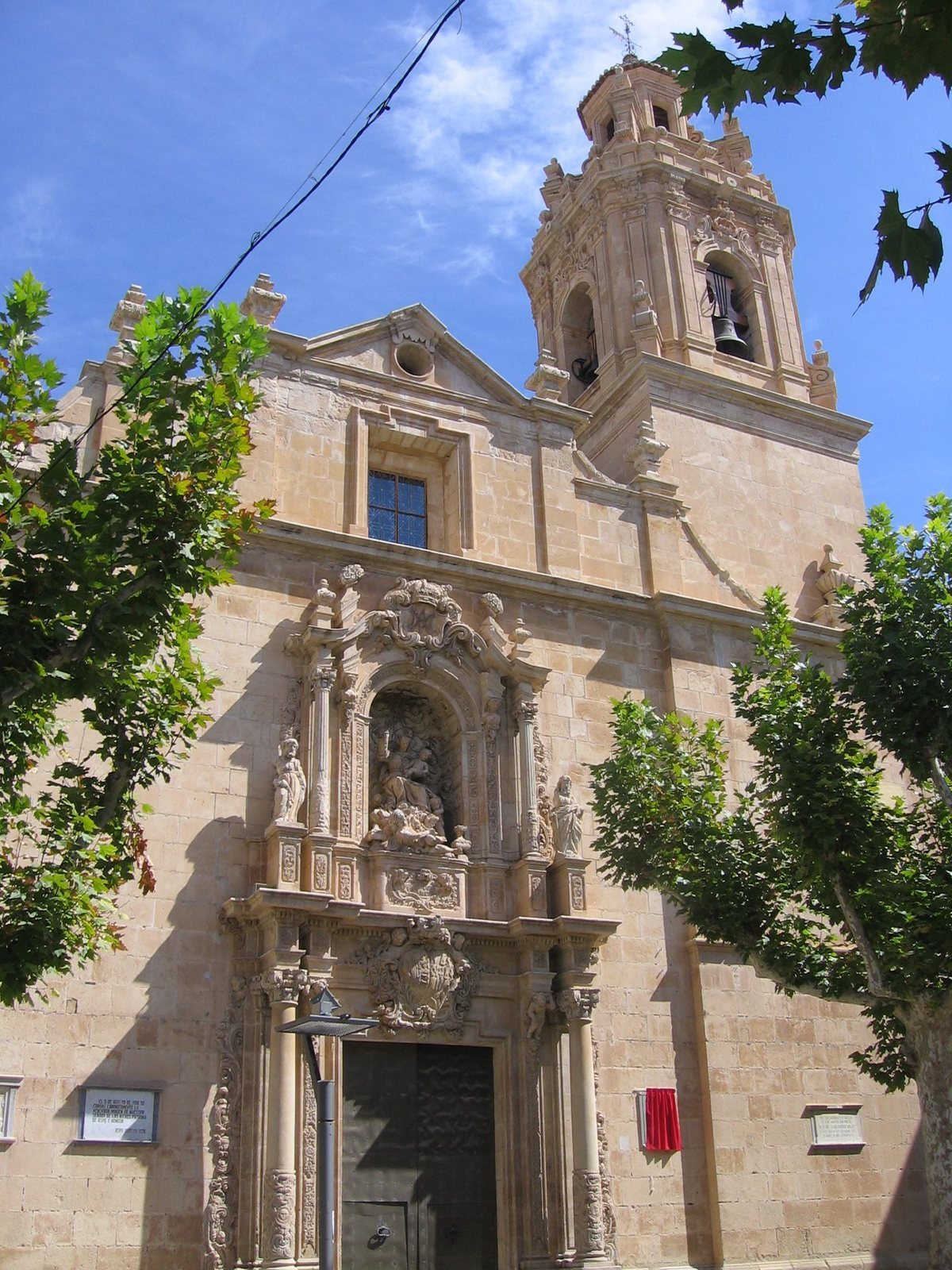
The Basilica of Our Lady of Help, Aspe, is a Catholic parish church in Spain, built in stages from 1722 to 1737 in the Valencian Baroque style. It belongs to the Diocese of Orihuela-Alicante and received the papal title of Minor Basilica in recognition of its role in religious celebrations, especially those honoring Our Lady of the Snows, a title of Mary.
Parish beginnings and earlier churches
The parish was established in 1602 under the dedication of Saint Mary. By 1611 it was known as Our Lady of Help, a title of Mary, the mother of Jesus. The first parish church stood on the site of a former mosque. An intermediate church began to take shape around 1650 under the direction of Genoese architect Francesc Verde. From 1663, work was led by Pere Quintana, an architect from Zaragoza, and this phase was completed in 1674.
Construction of the present church
Building resumed in 1722 after the War of the Spanish Succession, a conflict over the Spanish throne, had interrupted construction in the diocese. Between 1722 and 1728, the Communion Chapel was made smaller and remodeled so it could serve as the parish church during construction. In 1727, Bishop Castelblanco ordered the intermediate church demolished because its earthen construction was poor; its burials were left undisturbed.
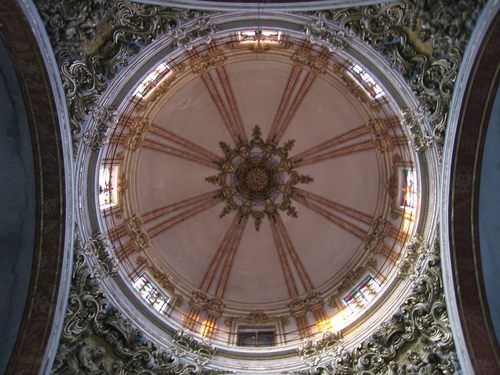
The present church was built in stages between 1722 and 1737 and blessed on September 1 that year. Its dome and bell tower were raised from 1728 to 1737 under architect Lorenzo Chapuli. The parish church was consecrated on August 3, 1951.
Damage and the basilica title
An assault on the church in August 1936, during the Spanish Civil War, damaged or destroyed several altarpieces, decorated structures behind altars. Some sculptural images in the church date from the middle of the twentieth century, following these losses.
On July 15, 2006, Pope Benedict XVI granted the church the title of Minor Basilica, an honorific papal distinction separate from the title of major basilica. The recognition reflected its place in religious celebrations, particularly the patronal festivities for Our Lady of the Snows.
Remains
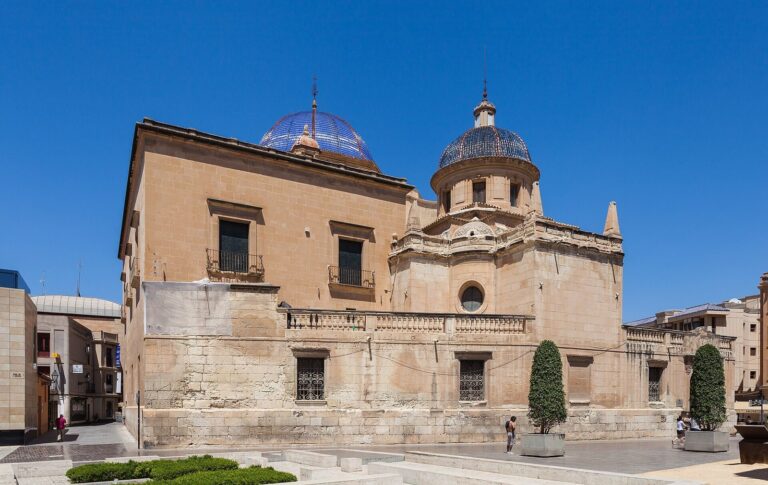
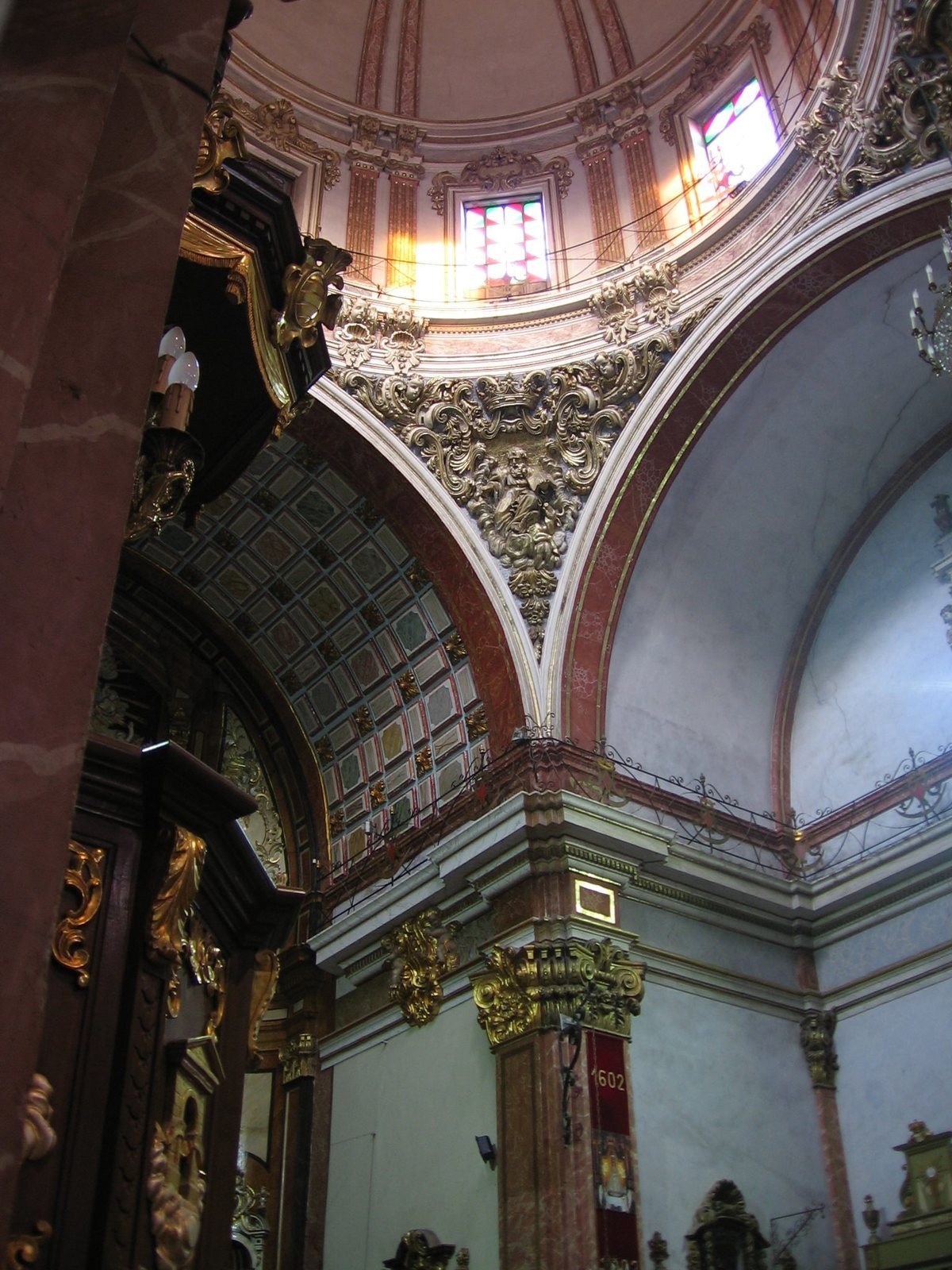
The church has three naves, or lengthwise interior sections, arranged on a Latin-cross plan: a long central axis crossed by a transept, or crosswise arm. The Communion Chapel occupies the space that would otherwise form a passage around the sanctuary. The building is 45 m long; the main nave measures 11.5 m across and 20 m high. Exterior buttresses support the nave, while side chapels are flanked by interior buttresses measuring 8 m high and 4 m wide. Above the crossing, the dome rests on a cylindrical drum and curved supports called pendentives, which carry it above the square space. A smaller dome caps the bell tower. The church’s two bells are named Christ and Teresa.
Portals
Main portal
The main entrance is presided over by an image of Our Lady of Help. Woodcarver Vicente Castell and sculptor Juan Antonio Salvatierra completed the portal’s second tier, apart from its coat of arms, between 1733 and 1737. The first tier is stylistically attributed to Juan Bautista Borja and Jacinto Perales, although Perales’s work at Aspe is possible rather than certain. The image of Mary was once attributed to Nicolás de Bussi, but is now considered more likely to be by Borja.
Epistle-side entrances
Two doorways open on the Epistle side, one side of the nave. The entrance at the transept is dedicated to Saint John the Baptist, a prophet in Christian tradition, and its style is attributed to Borja and Perales. The other doorway leads to the Communion Chapel.
Gospel-side entrance
The doorway on the Gospel side, the opposite side of the nave, is dedicated to Saint Teresa, a Catholic saint. Attributed to Castell and Salvatierra, its design follows the form of the Saint John the Baptist portal.
Chapels and altarpieces
Communion Chapel
The Communion Chapel occupies the former mosque site and the location of the parish’s earliest church. It contains the seventeenth-century high-altar altarpiece, transferred here when the present main altarpiece took its place. Its cornices were cut back to fit the chapel. The work combines gilded wood carving with panel paintings in oil attributed to Juan Conchillos. It is the only surviving seventeenth-century high-altar altarpiece in the Diocese of Orihuela-Alicante.
Main altarpiece
Ignacio Castell García made the present main altarpiece in the eighteenth century. It measures about 10 m wide and 18.5 m high, with a central sculptural group dominated by a 4 m-high image of Our Lady of Help by Valencian sculptor Vicente Rodilla Zanón. Images of Saints Peter and Paul, apostles in Christian tradition, flank the main altar and also appear on the main façade.
Side-chapel altarpieces
The first chapel on the Gospel side formerly belonged to the Dukes of Maqueda, holders of a Spanish noble title. Its Saint Teresa altarpiece was made by Vicente Castell, apart from its design, and its upper section survives. The 1725 altarpiece of Our Lady of the Rosary was made by Jacinto Perales; its first section was lost in the 1936 assault. Only the upper section of the altarpiece in the chapel of Our Lady of Sorrows survives. Its maker is uncertain, with Jacinto Perales and his brother Antonio, or José Ganga Ripoll, proposed as possibilities.