Tolisa Franciscan Monastery: A Catholic Religious Complex in Bosnia and Herzegovina
Site at a Glance
- Rating
- 5
- Popularity
- Low
- Country
- Bosnia and Herzegovina
- Primary era
- Modern
- Eras represented
- Modern
- Civilizations
- Austria-Hungary, Habsburg, Ottoman
- Site type
- Religious
- Remains
- Monastery
On this page13 sections
History
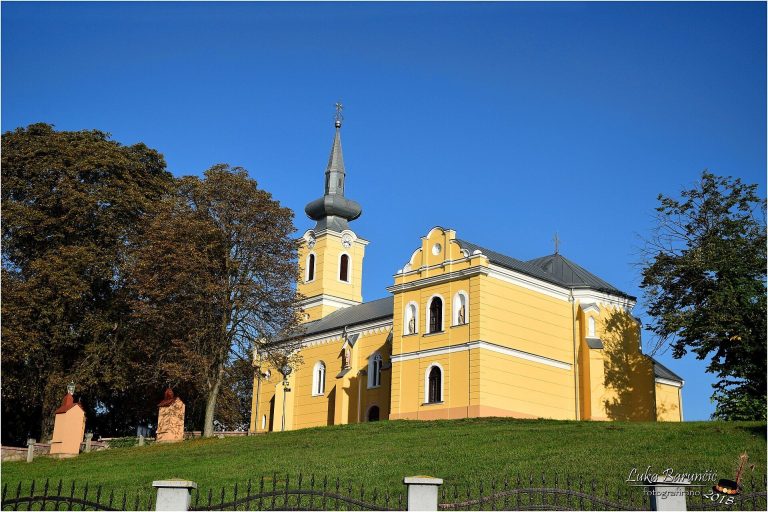
Tolisa Franciscan Monastery is a Catholic monastery in the municipality of Orašje, Bosnia and Herzegovina. Its church was begun in 1864 and completed in 1881 in a Romanesque style. The monastery belongs to the Archdiocese of Vrhbosna, a major Catholic church jurisdiction in Bosnia and Herzegovina.
Medieval records and Franciscan presence
Tolisa is first mentioned in a 1244 grant by Duke Coloman to the bishop of Bosnia and his diocese. Coloman’s brother, King Béla IV of Hungary, confirmed the grant. Franciscan friars, members of a Catholic religious order, were present in this part of Bosnia during the medieval period. They maintained monasteries at Modriča, Skakava, and St Mary in Polje, among other places. Most of those monasteries were destroyed in the 15th and 16th centuries.
Foundation and construction
In 1863, Ottoman Sultan Abdul Aziz authorized construction of a new church. Work on the monastery began the following year under Franciscan friar Martin Nedić, its founder, when the church’s cornerstone was laid. Tolisa became a Franciscan residence in 1869, meaning a local friary community not yet formally designated a monastery, and received monastery status in 1876.
The church was completed in 1881. Construction was carried out by Đuro Eichorn of Osijek. In 1911, architect Josip Vancaš directed a major renovation in which the church’s structural elements were demolished except for its exterior walls.
War damage and heritage status
The monastery and church were damaged during the 1992–1995 war in Bosnia and Herzegovina. The complex is designated a National Monument of Bosnia and Herzegovina.
Remains
Church and monastery buildings
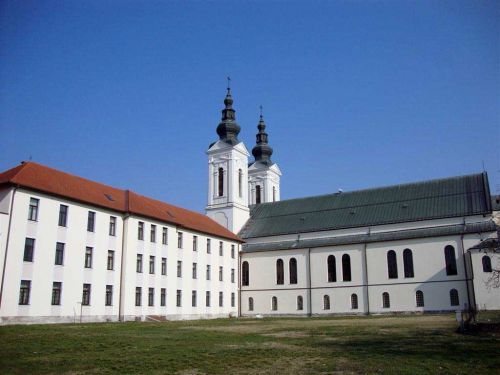
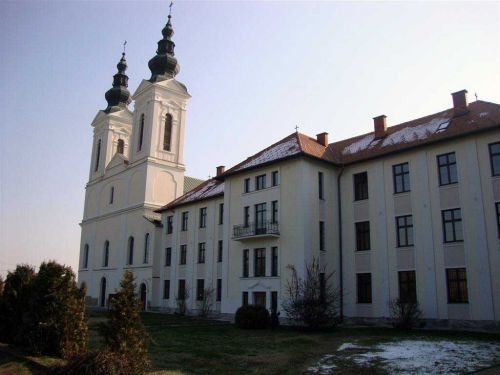
The complex comprises the Church of the Assumption of the Blessed Virgin Mary and old and new monastery buildings. The church is physically joined to one of the monastery buildings.
The church
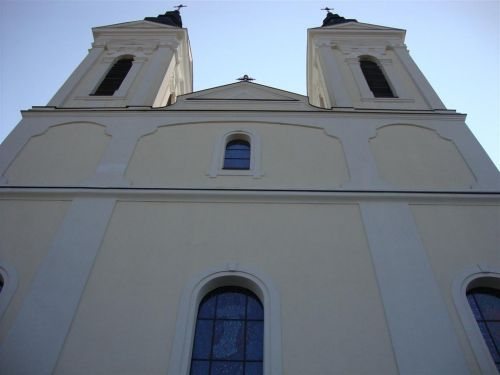
The brick church is Romanesque in style and was modeled on the former Jesuit church in Osijek. It is a three-aisled basilica, with a central aisle and two side aisles, measuring 56 by 25.60 metres. Its main axis runs from west to east, with a deviation of about 14 degrees to the north. Two brick bell towers rise above the church; together they reach 56 metres, and each tower has a base measuring 5.25 metres on each side.
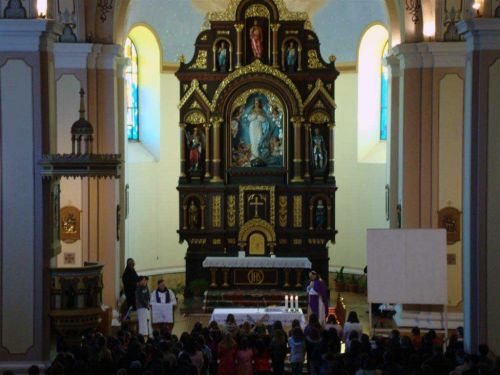
The renovated interior has barrel vaults, continuous tunnel-shaped ceilings, over the aisles, as well as five altars and a pulpit.
Monastery buildings
The old and new monastery buildings form part of the complex alongside the church. One monastery building is physically connected to the church.
Collections and library
Archaeological and coin collections
The archaeological collection contains finds from Bosnian Posavina spanning the Neolithic, Bronze Age, Iron Age, ancient, and medieval periods. The numismatic collection comprises 974 coins, including Greek, Roman, Hungarian, Serbian, Dubrovnik, Bosnian, Ottoman, and Venetian examples, as well as others.
Church textiles
The church-textile collection includes chasubles, garments worn by priests during Mass; dalmatics, vestments worn by deacons; and copes, long ceremonial cloaks. Its oldest examples date to the 17th century. Their designs differ across periods, and some chasubles carry the donor’s name and the year they were made.
Organ
The monastery’s movable heritage includes a 13-stop organ, acquired in 1896 from the Church of St Peter and St Paul in Osijek. An organ stop controls a set of pipes and helps determine the instrument’s sound.
Library
The library holds 11,270 books representing 10,850 titles, along with 735 volumes across 87 periodical titles. Its collections cover biblical, theological, liturgical, church-law, historical, devotional, and preaching subjects, as well as the lives of saints. They also include hymnals, dictionaries, grammars, and other publications. The library preserves the original Ottoman decree authorizing construction of the church, a document measuring 78 by 54 centimetres.