Holy Rood Church: A Roman Catholic Parish Church in Watford
Site at a Glance
- Rating
- 4.8
- Popularity
- Medium
- Country
- United Kingdom
- Primary era
- Modern
- Eras represented
- Modern
- Civilizations
- British
- Site type
- Religious
- Remains
- Church
On this page5 sections
History
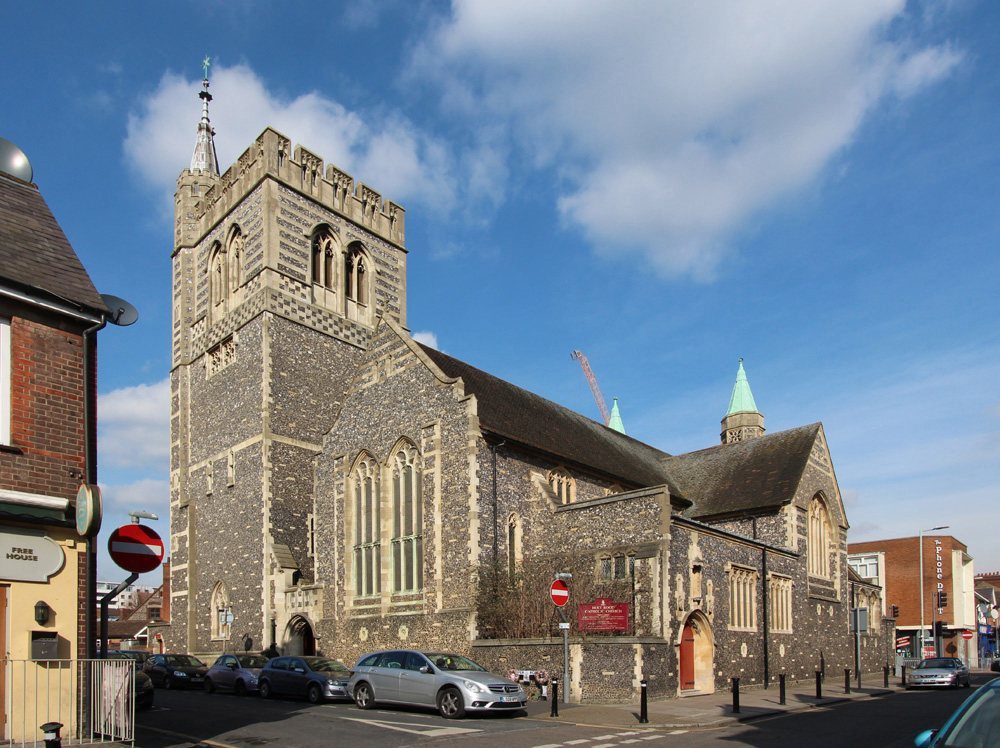
Holy Rood Church is a Roman Catholic parish church in Watford, Hertfordshire, United Kingdom, designed by John Francis Bentley in the Gothic Revival style, which draws on medieval Gothic forms. Its foundation stone was laid in 1889, as Watford’s Catholic community expanded.
Chapels before Holy Rood
In 1863, Catholic priest George Bampfield came to Watford to celebrate Mass in rented rooms at Carey Place. That year, he acquired land there and had a hut built to serve as a chapel.
As the congregation grew, Bampfield secured a larger site on Water Lane in 1882. A chapel opened there in 1883 and served the community until Holy Rood Church opened.
Construction, completion, and later status
Stephen Taprell Holland, owner of the building firm Holland & Sons, paid for much of Holy Rood’s construction and hired Bentley to design it. The church opened on 16 September 1890, with its sanctuary, nave, transepts, and south aisle complete; work continued afterward. Cardinal Herbert Vaughan laid the tower’s foundation stone on 7 May 1894, and Bishop Robert Brindle consecrated the completed church on 5 July 1900.
Holy Rood remains an active Roman Catholic parish church. It belongs to the Archdiocese and Province of Westminster, whose province groups dioceses under a metropolitan archbishop, and to the Watford Deanery, a grouping of local parishes. Its dedication is the Feast of the Cross, a Christian observance focused on the cross of Jesus; “Holy Rood” also means the Holy Cross. In 1980, the church was listed at Grade I, England’s highest listed-building category, reserved for buildings of exceptional architectural or historic interest.
Remains
Plan and fabric
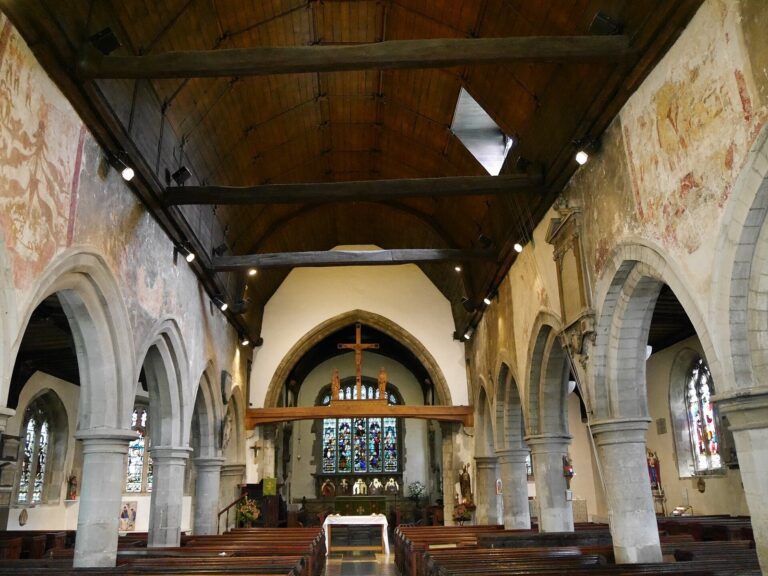
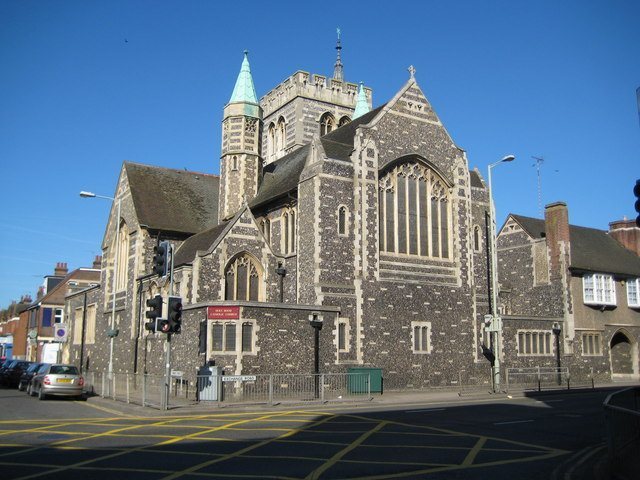
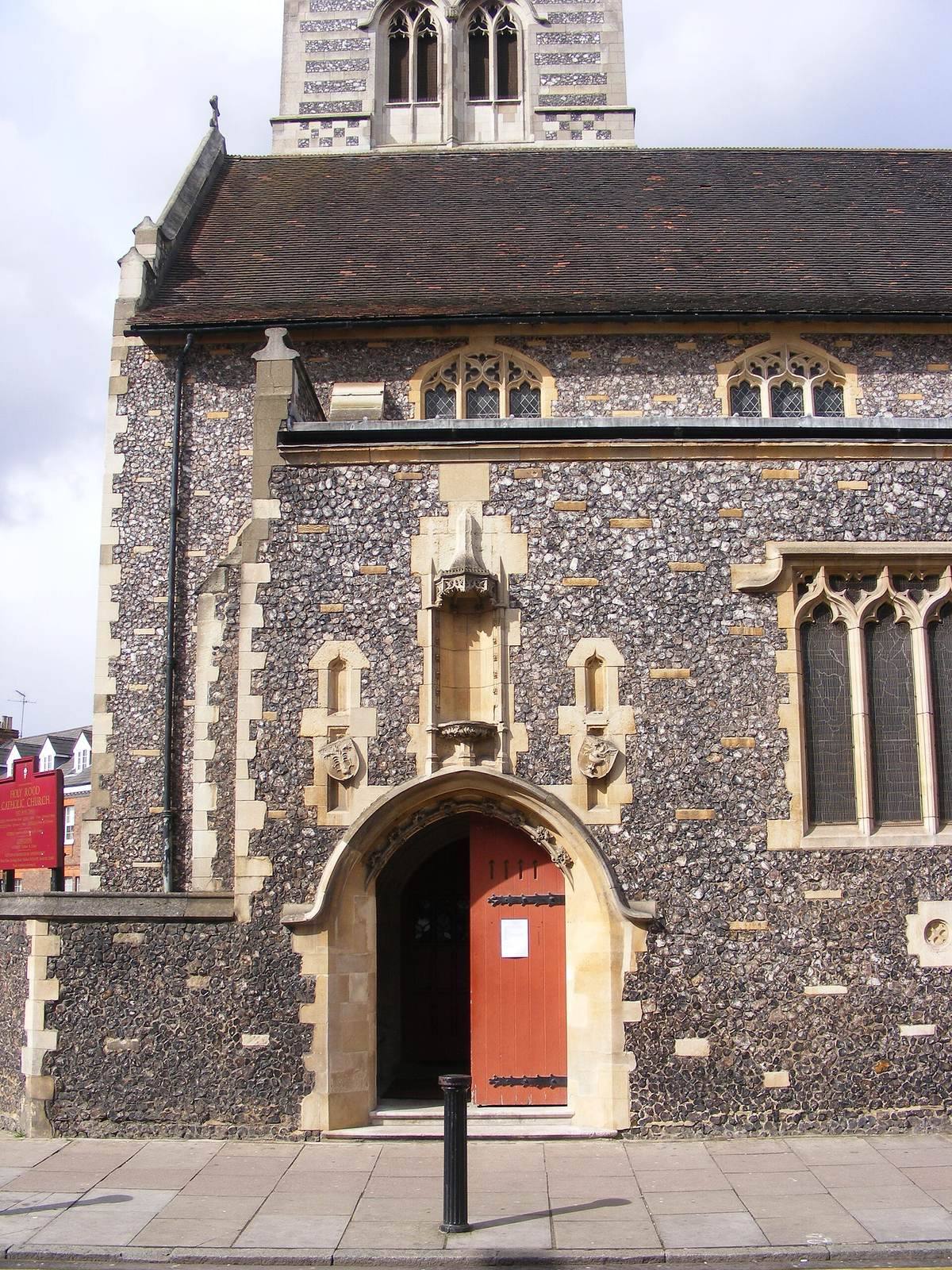
The church stands at the western corner of Market Street and Exchange Road. Its plan includes a sanctuary around the altar, a nave for the congregation, transepts crossing the main body, north and south aisles, a tower, and a baptistery used for baptism. A Chapel of the Holy Ghost, a traditional name for the Holy Spirit, was built beside the church. Flint and stonework, a roof, and interior paintings form part of its described fabric. Repairs in 1966 replaced some stone and included interior cleaning. In 1990, work repaired the flint and stonework and roof, while the paintings were cleaned.