Ellwangen Abbey: An Early Benedictine Monastery in Germany
Site at a Glance
- Rating
- 4.6
- Popularity
- Medium
- Country
- Germany
- Primary era
- Medieval
- Eras represented
- Medieval, Early Modern
- Civilizations
- Holy Roman Empire
- Site type
- Religious
- Remains
- Monastery
On this page11 sections
History
Ellwangen Abbey was a Benedictine monastery in Ellwangen, Germany, founded by the brothers Hariolf and Erlolf around 750. It was the first Benedictine community established in the Duchy of Swabia, and its surviving church belongs to the late-Romanesque architectural tradition. Benedictines followed the Rule of Saint Benedict. The Vita Hariolfi gives 764 as the foundation date.
Foundation and early growth
The monastery stood beside an Alamannic village, near the meeting of Swabian and Frankish lands. Its foundation also helped strengthen Frankish influence in the border region. Hariolf served the king, while Erlolf was probably a chorbishop at Langres, a bishop-like cleric associated with a rural district. Both brothers had connections with that office. Ellwangen belonged to the Diocese of Augsburg and was dedicated to Christ the Savior and the apostles Peter and Paul. Its first monks probably came from St. Benigne Abbey in Dijon. The community also honored Mary and Saints Sulpitius and Servilianus.
In 773, Pope Hadrian I gave relics of Sulpitius and Servilianus to Erlolf, then Bishop of Langres. Around 775–780, Ellwangen had become an imperial monastery. The community received substantial gifts, including land in the Virngrund, and its endowments grew in connection with its position at the crossing of important trade routes. In 814, Emperor Louis the Pious placed it under royal protection, confirmed its property, and granted its monks the right to choose their abbot. From 817, it ranked in the second class of imperial monasteries.
Imperial standing and monastic life
Ellwangen’s obligations to the empire included supplying Emperor Otto II with 30 armored riders for his Italian campaigns in 981. Between 981 and 987, the former abbot Sandrad brought an arm relic of Saint Vitus from Gladbach; Vitus later became the monastery’s patron. Ellwangen probably gained imperial immediacy in 1011 under Henry II. This status meant that the territory answered directly to the emperor rather than to an intervening lord. Charles IV confirmed the privilege in 1347.
The community grew to 120 priests and lay monks in 830 and 160 in 838. A confraternity book at St. Gall lists 177 religious people living within the expanded precinct. Abbot Ermanrich, who later became Bishop of Passau and died in 874, wrote a monastery chronicle, a life of Saint Solus, and, around 850, the Vita Hariolfi. Other writers included Lindolf and Erfinan, while Abbot Gebhard began an unfinished life of Saint Ulrich. Several members of the community later held senior church offices: Hatto became Archbishop of Mainz in 891, the monk Adalbero became Bishop of Augsburg in 894, and Gebhard became Bishop of Augsburg in 995. Liutbert also became Archbishop of Mainz. Around the middle of the tenth century, Abbot Milo was among those appointed to inspect St. Gall Abbey. Abbot Helmerich later introduced the Hirsau Reforms, a movement to renew monastic life associated with Hirsau Abbey.
Decline and transition
From the mid-fourteenth century, plague, poor harvests, rising prices, weak administration, and declining monastic discipline undermined Ellwangen’s finances and community life. The monks resisted reform efforts from Fulda and Ottobeuren. Only seven members remained in 1384, and after plague struck the town in 1430, the number fell to three.
The abbey’s imperial duties continued during this period. In February 1431, it paid to host Emperor Sigismund and his court on their return to Nuremberg. During the Hussite Wars, conflicts involving followers of the religious reformer Jan Hus, Ellwangen had to supply Frederick I, Elector of Brandenburg, with troops, horses, weapons, armor, and wagons. It also had to defend its territory against possible raids.
A major fire in the town badly damaged the abbey in 1443. The remaining monks moved into town houses and adopted a more secular way of life. In 1459, they asked Cardinal Peter of Schaumberg, Bishop of Augsburg, to turn the monastery into a collegiate foundation. With Pope Pius II’s consent, a community of secular canons took the monks’ place on 14 January 1460. These were clerics living together as a college rather than under a monastic rule.
Prince-provostry and dissolution
The head of the new community, the provost, held princely rank and governed a territory directly subject to the emperor. As a prince-provost, he also had a direct vote in the Imperial Diet, the assembly of the Holy Roman Empire’s estates. Ellwangen was one of only two prince-provostries, alongside Berchtesgaden. The foundation’s holdings included Ellwangen’s court manor and manors at Jagstzell, Neuler, Rötlen, Tannenberg, Wasseralfingen, Abtsgmünd, Kochenburg near Aalen, Heuchlingen on the River Lein, and Bühlertann.
In the late sixteenth and early seventeenth centuries, the territory was one of Germany’s main areas for witch-hunting. Ellwangen joined the Catholic League, an alliance of Catholic German states and rulers formed during the Reformation era, in 1609. Swedish troops occupied the territory in 1632 during the Thirty Years’ War, a major European conflict lasting from 1618 to 1648. They withdrew after the Battle of Nördlingen in 1634.
In 1802, during German Mediatisation, the process by which many small German territories were absorbed into larger states, Ellwangen passed to the Duchy of Württemberg. The abbey was dissolved and its property taken over. From 1803, Ellwangen served as the seat of Württemberg’s General Vicariate, an ecclesiastical office acting on a bishop’s behalf; this later became the Diocese of Rottenburg.
Remains
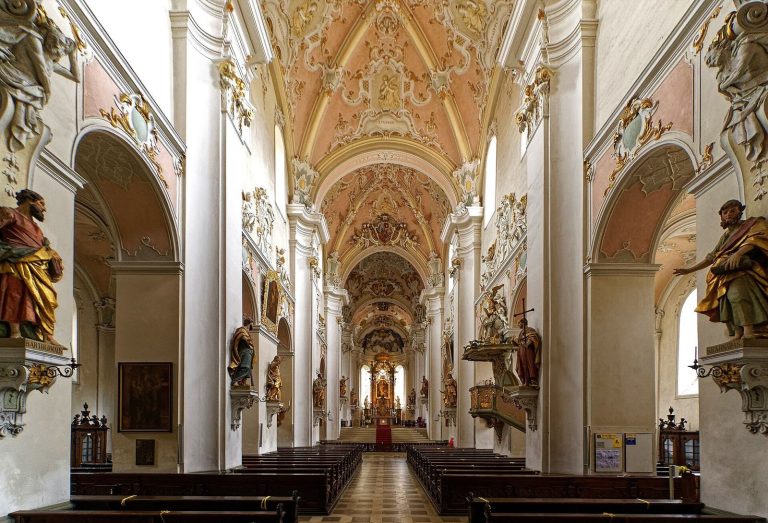
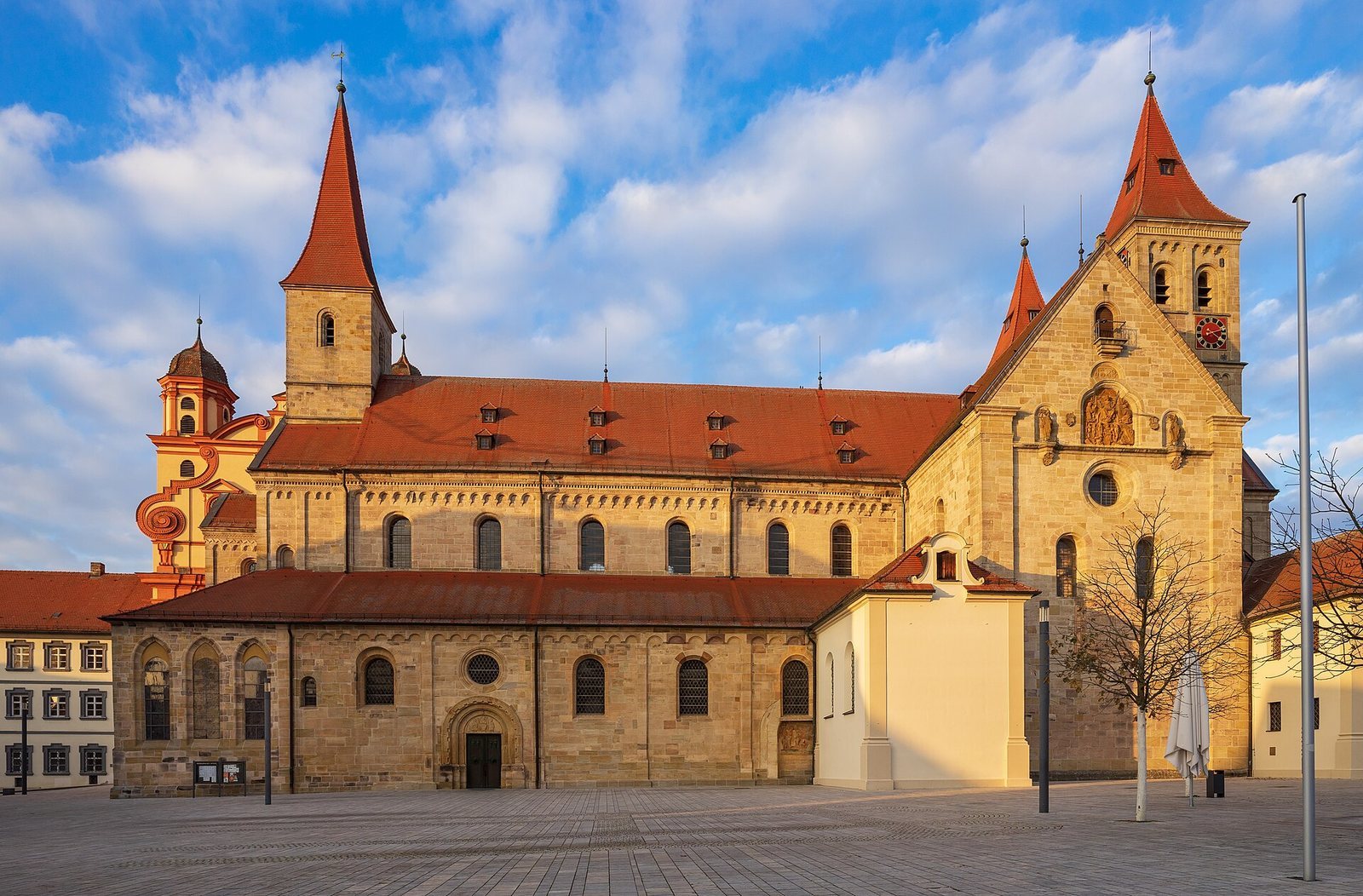
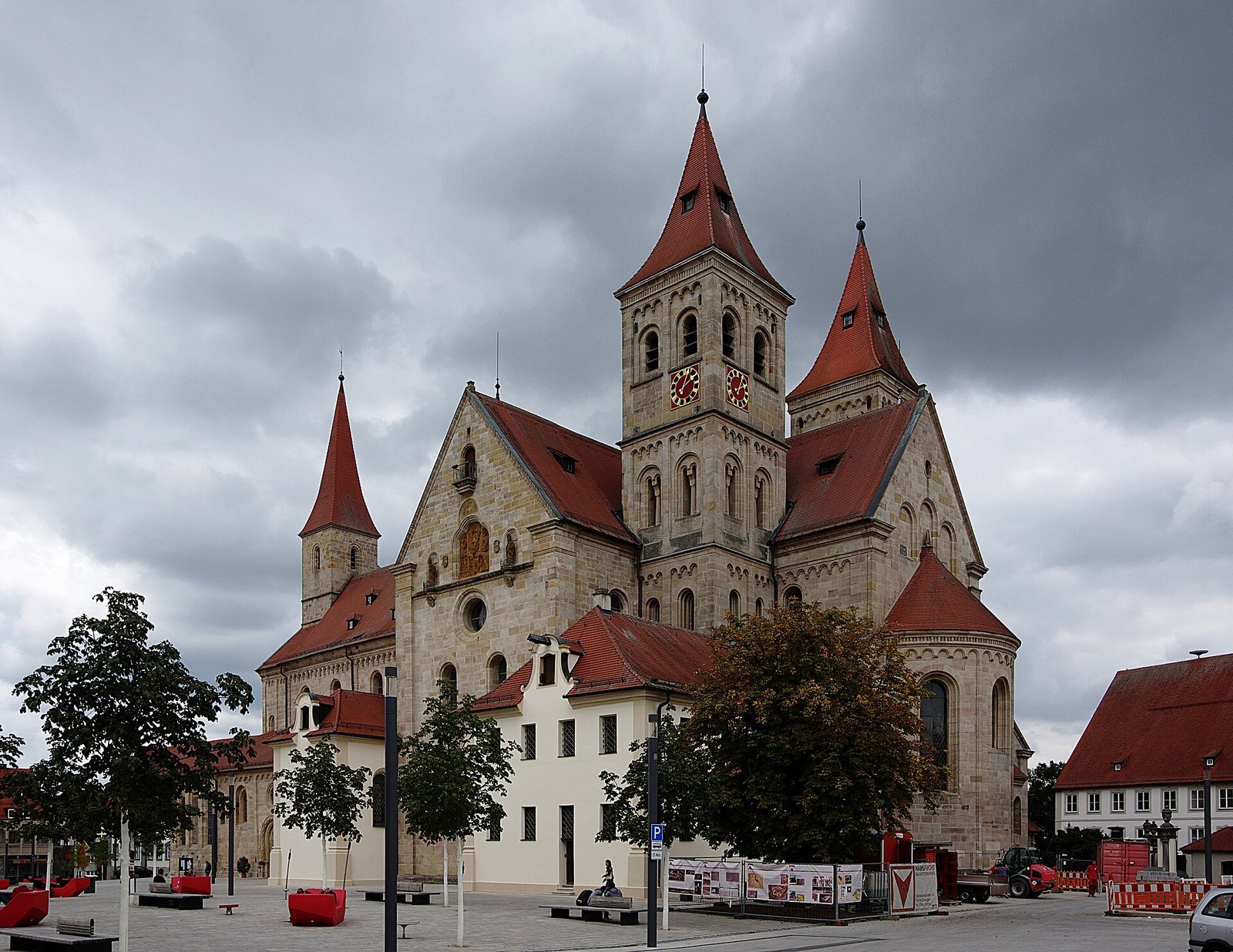
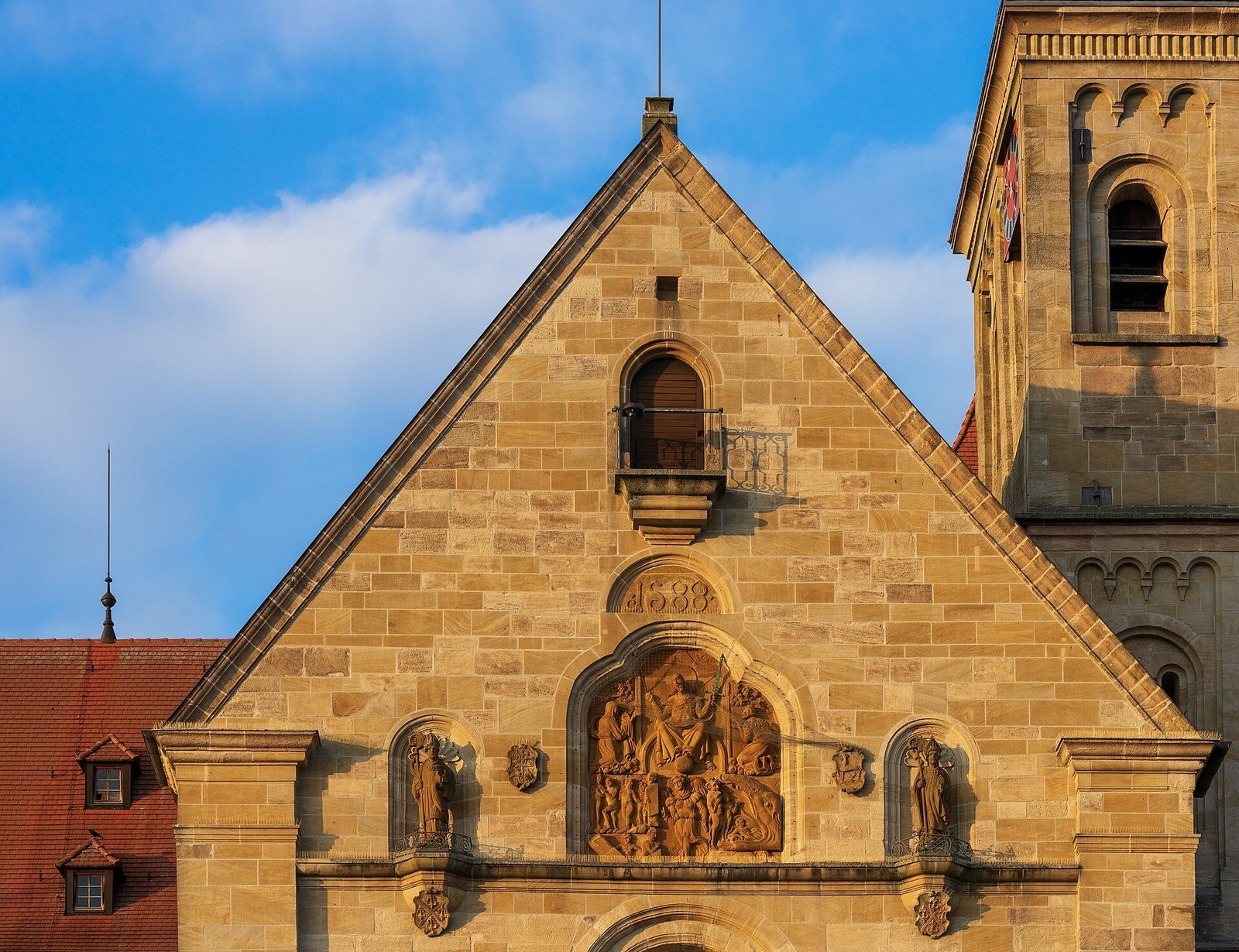
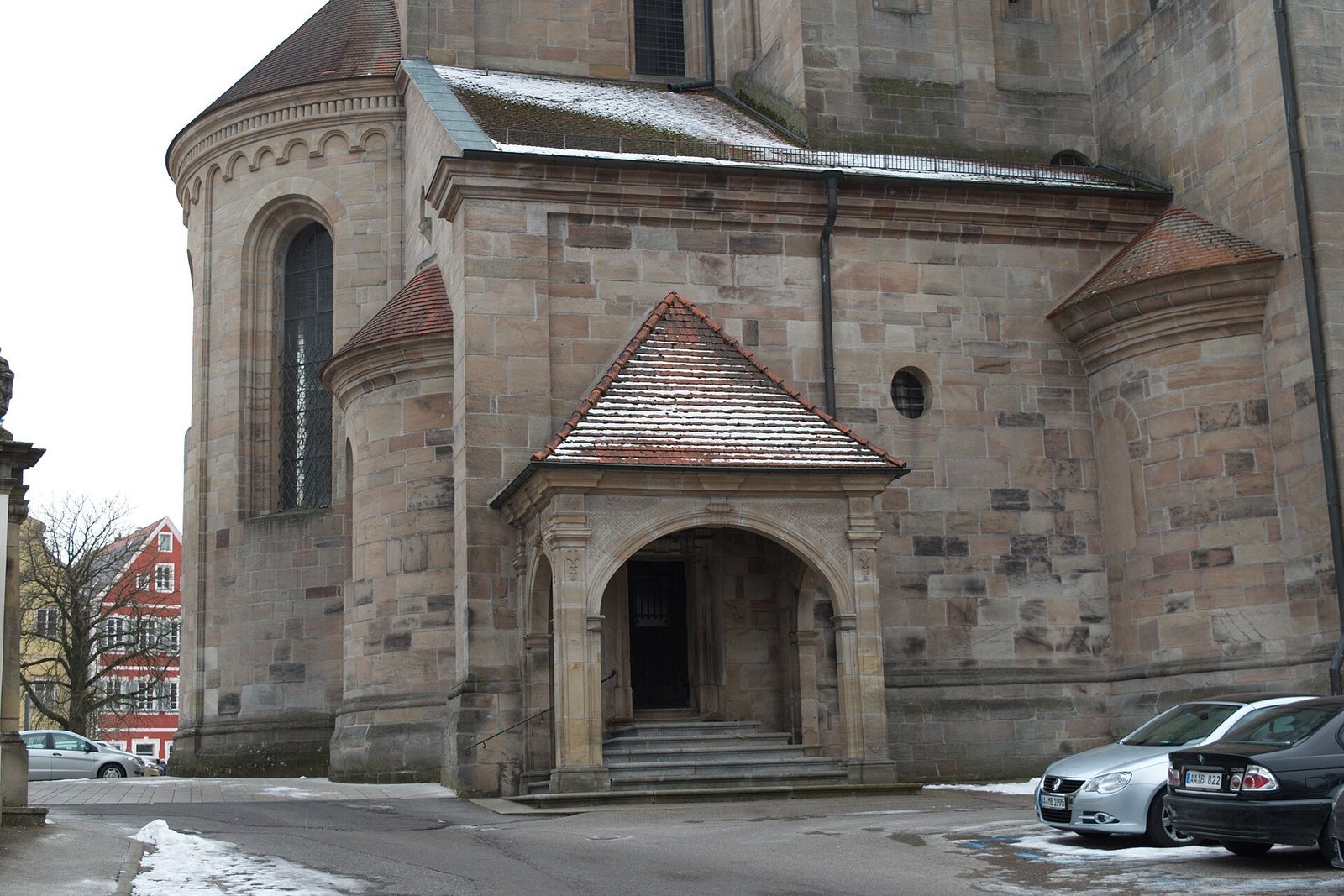
The former abbey’s church and most of its other ecclesiastical buildings survive and continue to shape Ellwangen’s townscape. The complex includes the former abbey church, now the Basilica of St. Vitus, monastic buildings, and a cloister added in the fifteenth century. The church’s fabric reflects successive Romanesque rebuilding, followed by Baroque and Rococo changes to its interior.
Church and monastic buildings
Romanesque rebuilding
Fires in 1100 and 1182 led to successive rebuilding campaigns, each producing larger buildings than before. A high-Romanesque rebuilding of the church and monastery took place between 1100 and 1124. The first church, probably set farther west than the present one, was consecrated in 1124 by Hermann of Vohburg, Bishop of Augsburg, and Ulrich I of Kyburg-Dillingen, Bishop of Constance. A later church was built under the master builder Wunnehard, whose work is noted in 1229. Engelhard, Bishop of Naumburg, consecrated it on 3 October 1233. The present Basilica of St. Vitus is late Romanesque, a style characterized by rounded arches and substantial masonry.
Interior and cloister
During the seventeenth century, the church interior was largely refitted in the Baroque style. Rococo decoration, generally more ornate and lighter in character, was added from 1737 onward, including work by the Italian painter and decorator Carlo Carlone. A cloister was added to the complex in 1467.
Relics and books
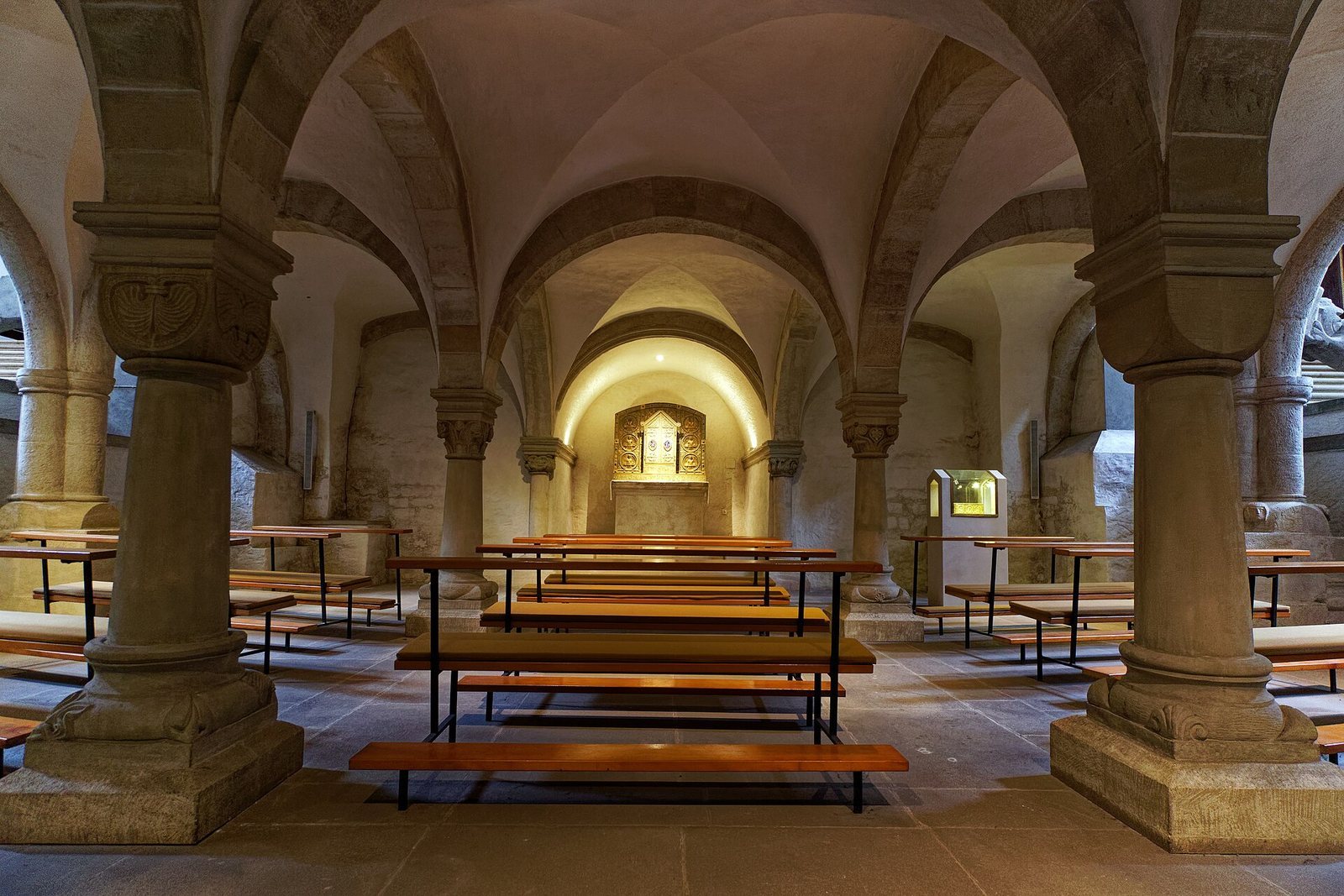
A reliquary in the former collegiate church holds relics of Saints Sulpitius and Servilianus. A Latin book of readings dating to about 1125–1133 is now held by the Württemberg State Library in Stuttgart. A necrology, a list of the dead used for commemoration, also dates from this period.
Ellwangen Castle
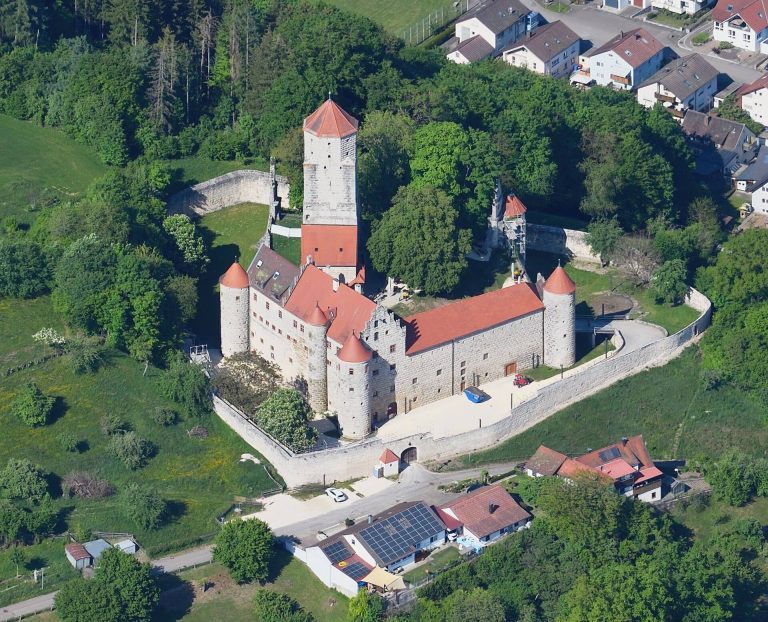
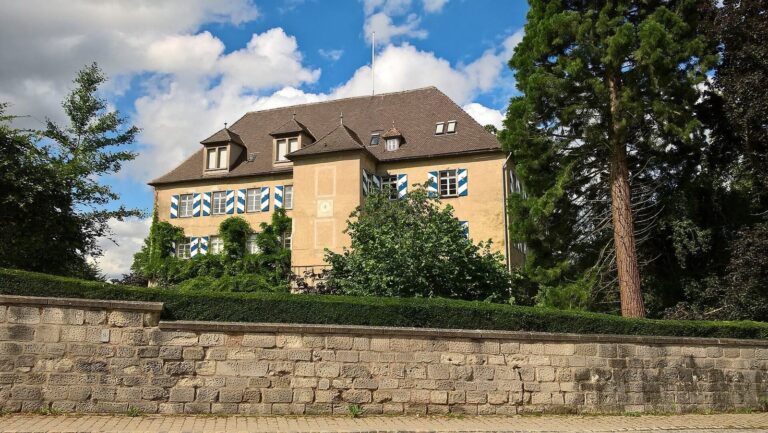
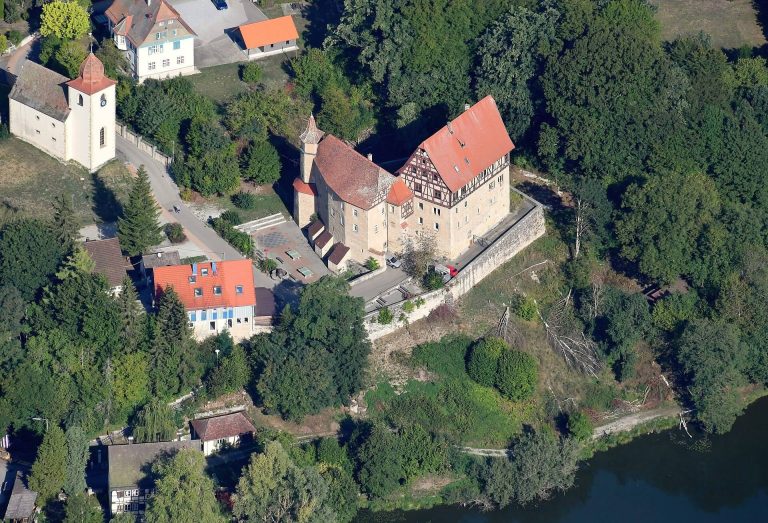
Ellwangen Castle was built as a fortified castle and rebuilt in the Baroque style around 1726.