St Mary’s Church, Angermünde: A Medieval Parish Church
Site at a Glance
- Rating
- 4.5
- Popularity
- Low
- Country
- Germany
- Primary era
- Medieval
- Eras represented
- Medieval, Early Modern, Modern
- Civilizations
- Brandenburg-Prussia, German, Holy Roman Empire, Margraviate of Brandenburg
- Site type
- Religious
- Remains
- Church
On this page15 sections
History
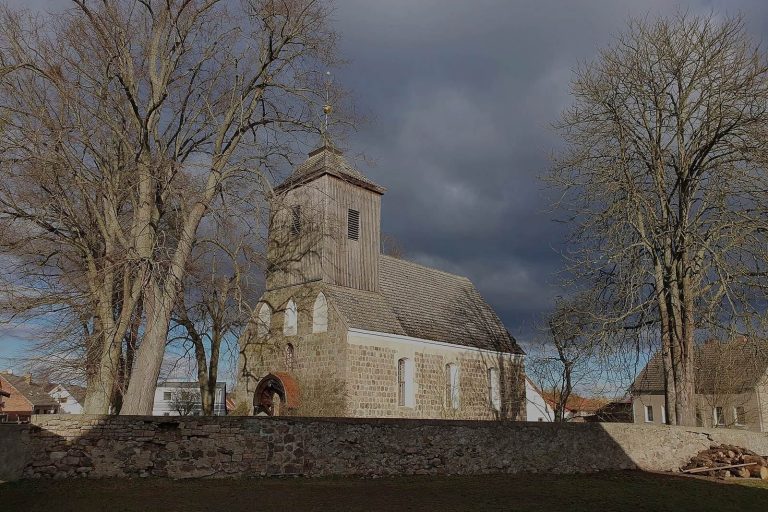
St Mary’s Church in Angermünde is a medieval parish church in Germany, dedicated to Mary and now the town’s principal Protestant church. Its first construction phase was completed around 1254, two decades after Angermünde was founded in 1233. The church belongs to the Uckermark Church District, part of the Evangelical Church of Berlin-Brandenburg-Silesian Upper Lusatia, a regional Protestant church body.
Medieval development and Protestant use
Extensions and alterations from the fifteenth into the sixteenth century established the church’s general form. The Reformation, a sixteenth-century religious movement that led to the emergence of Protestant churches, transformed the religious landscape in which the church served. Before the Reformation, the interior held as many as 17 side altars and a large cross bearing figures of nine saints.
Later furnishings and restoration
The church received important new furnishings in the early modern period, including a Renaissance altar and a Baroque organ. Alterations began in 1867, followed by the installation of a predominantly gray Neo-Gothic interior in 1868. Gothic-inspired decorative details were added in 1909. Bombing in 1945 broke a window on the south side of the choir. Restoration work in 1976 revealed late-medieval painted decoration and a color scheme dating to 1526; the roof was renewed and the interior restored in 1978.
By the late twentieth century, the roof structure, beams, and facades had suffered damage, probably because of inadequate roof drainage. Repairs carried out in stages from 2002 to 2005 included renewing the top of the walls and replacing almost all the beam ends.
Remains
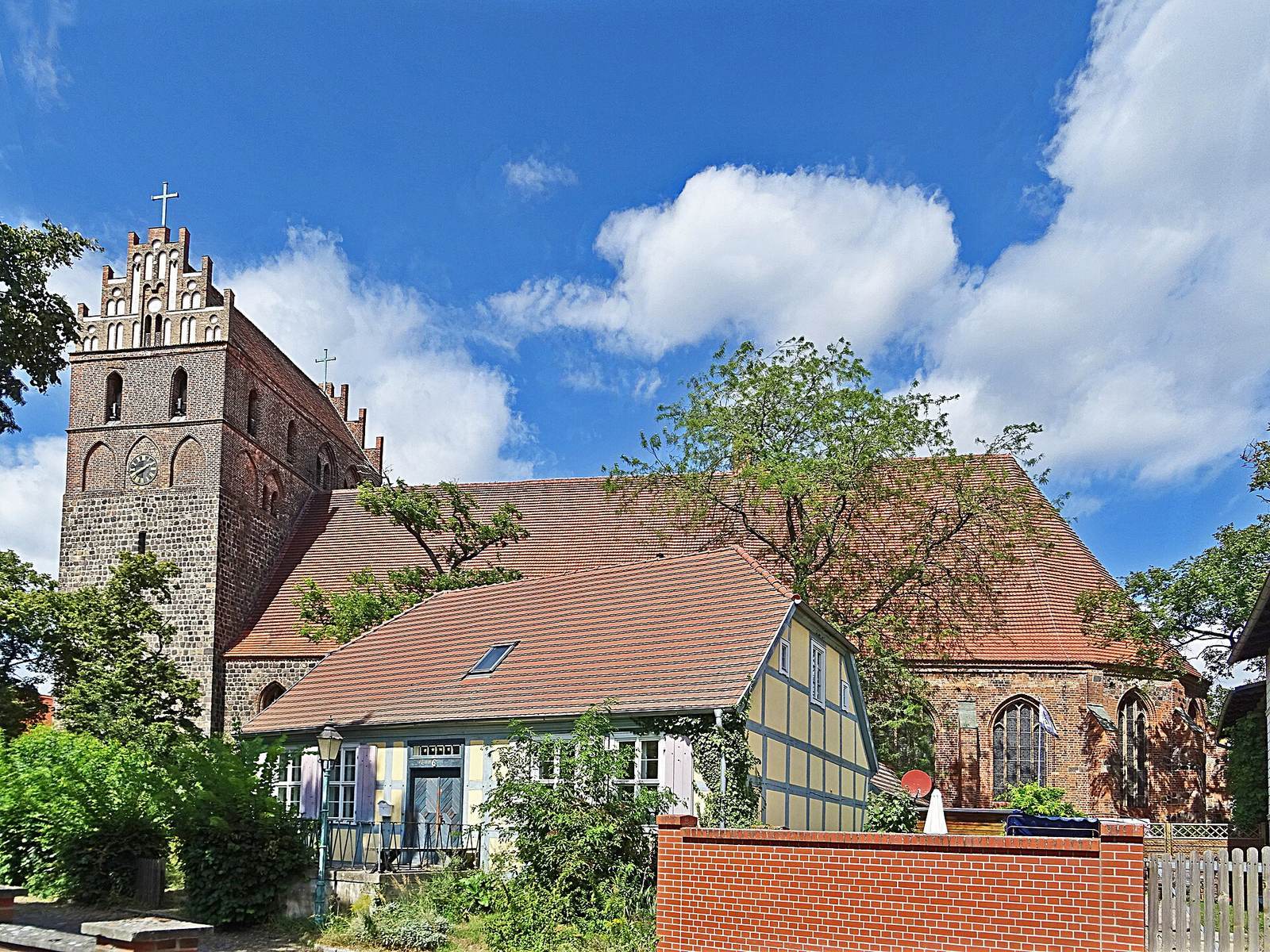
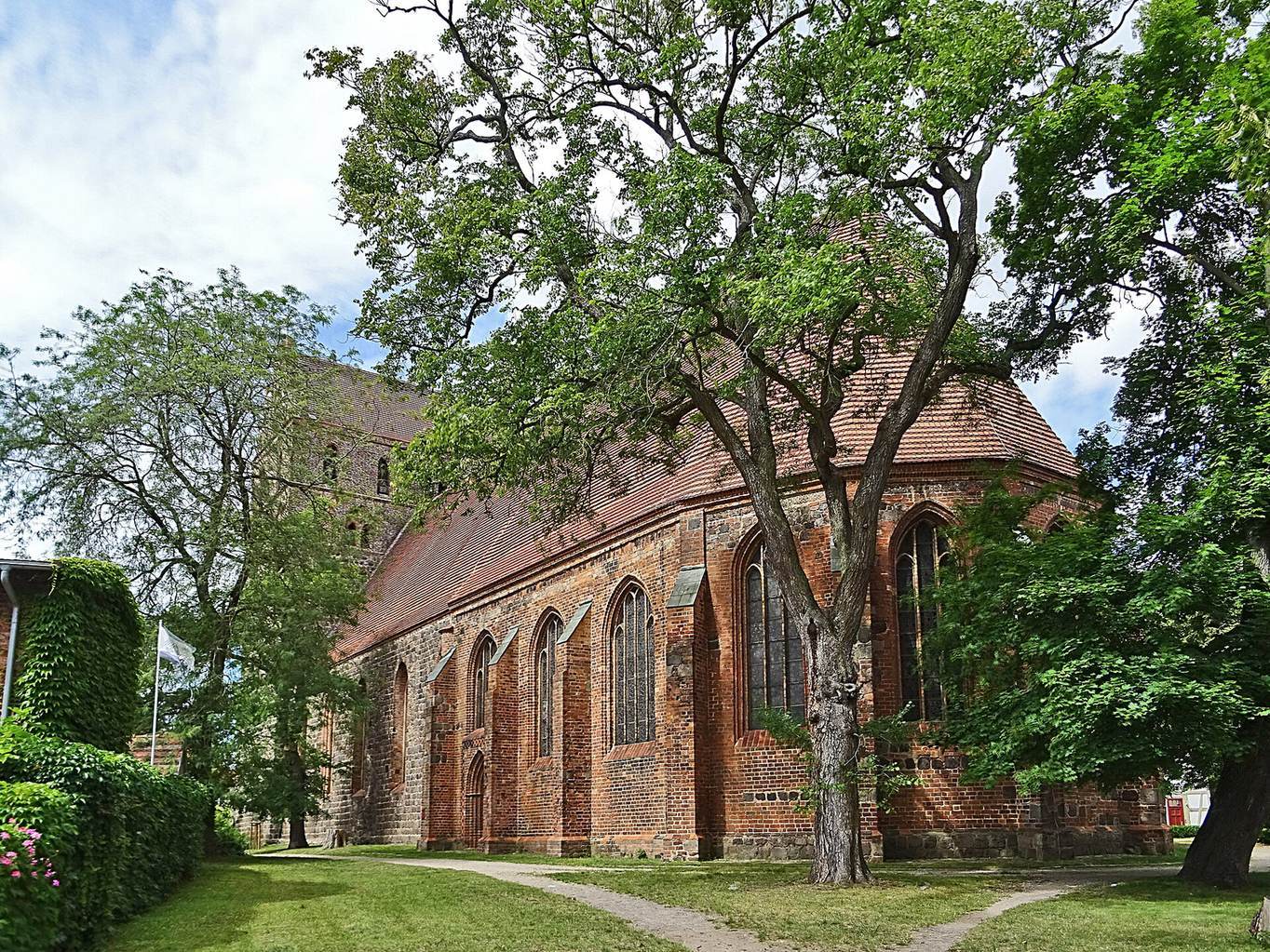
The church combines a fieldstone medieval core with later brick Gothic additions and a gray Neo-Gothic interior. Its main spaces extend from the western tower block and long nave to the broader, asymmetrical choir at the east end.
Plan and exterior
Nave and westwork
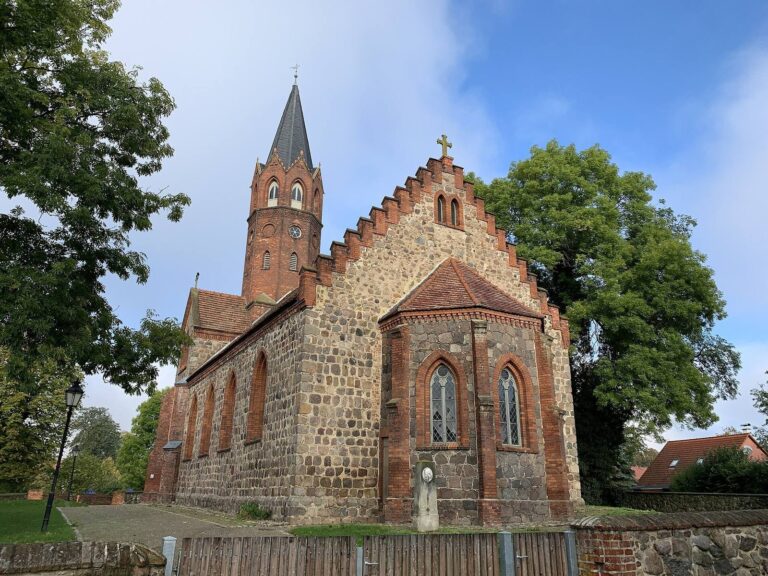
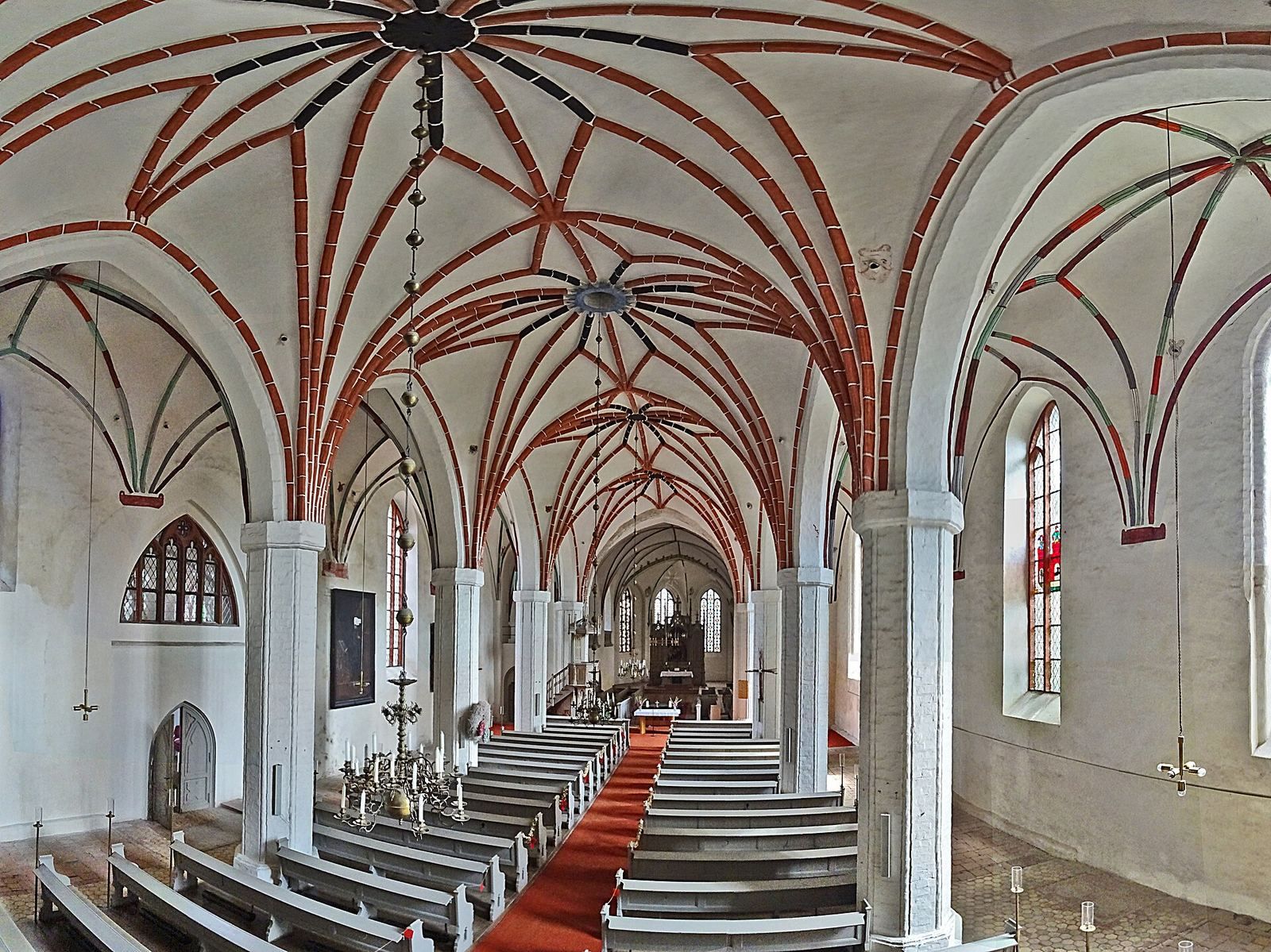
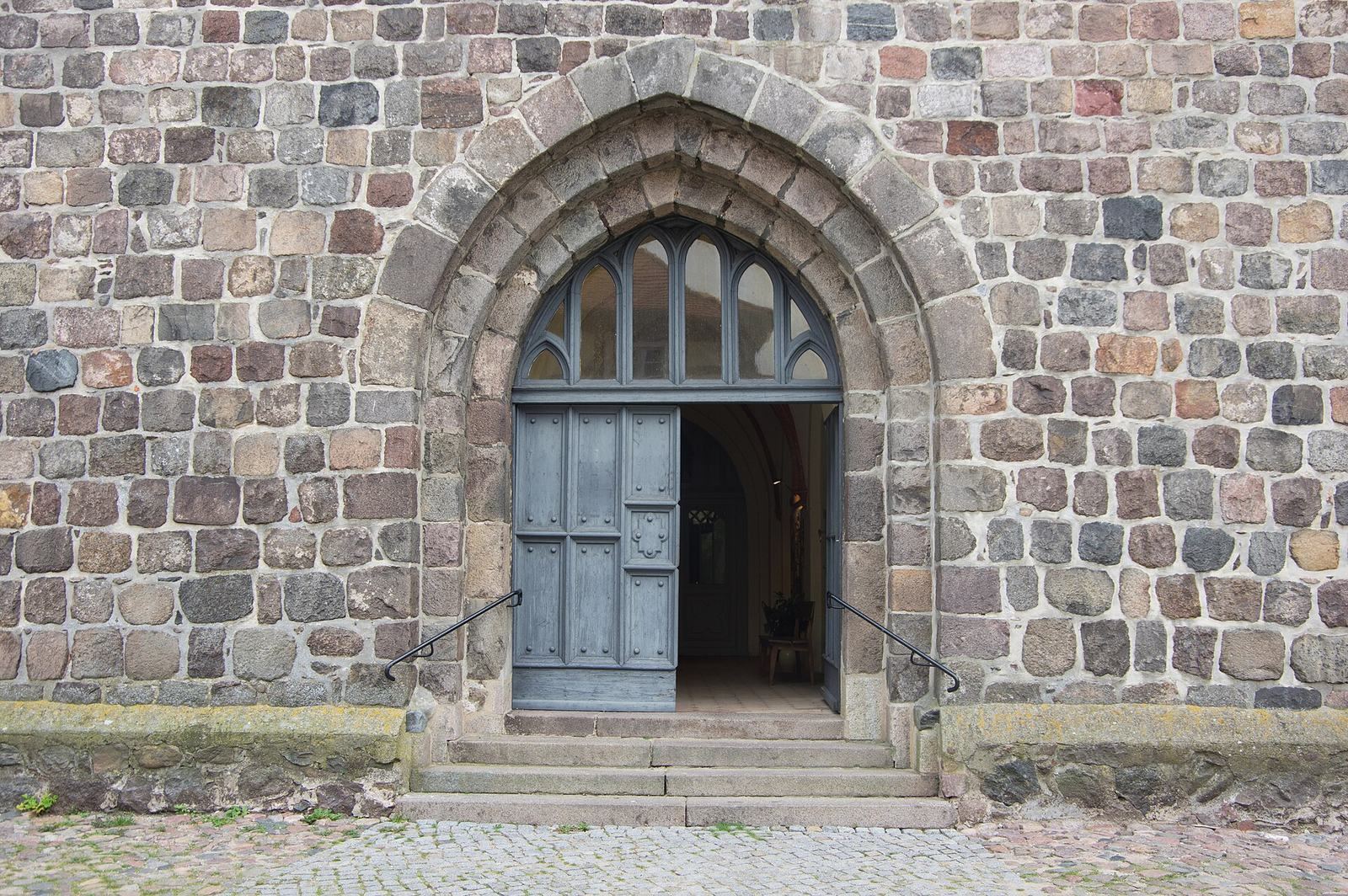
The earliest church comprised a westwork, the western entrance and tower block, and a five-bay nave with three aisles. The walls are built of dressed fieldstone, naturally occurring stone shaped for construction. The original building appears to have ended in a straight choir, with a sacristy already on the north side. The old nave was later given a vault. Two additional tower storeys raised the westwork, whose stepped gables bring it to 53 metres.
Mary Chapel
Begun on the north side in 1470, the brick Gothic Mary Chapel has a stepped gable. Its outward projection resembles a crosswise church arm, or transept, when seen from outside, though the church has no actual transept.
Choir and sacristy
Added between 1520 and 1526, the brick Gothic choir ends in five sides and has a star vault, whose ribs form a star pattern. It is asymmetrical and has two aisles; the sacristy occupies the northern aisle and includes a gallery. The eastern part of the church projects beyond the narrower nave on both sides. At the far eastern end, a polygonal vault partly conceals the choir’s uneven arrangement.
Choir frieze
A vine-scroll band runs along the east and south eaves of the choir. It probably dates from the nineteenth or early twentieth century and was secured and conserved during repairs in 2002–2005. The Franciscan churches at Angermünde and Chorin are thought to have provided models for its design.
Interior and furnishings
Painted decoration and interior furnishings
The interior is largely furnished in the gray Neo-Gothic style installed in 1868. Its high altar carries a large painting of the Raising of Lazarus, based on a composition by the Flemish Baroque painter Peter Paul Rubens. Pulpit, galleries, and pews form part of the same interior arrangement. Late-medieval wall paintings survive in places beneath later layers, alongside portions of the church’s 1526 color scheme.
Renaissance altar and earlier church furnishings
The Renaissance altar dates to 1601 and was donated by the wife of Mayor Krummkrüger. Parts remain in the Mary Chapel: two panelled sections depict the Ascension and the Last Supper, with a free-standing Crucifixion above them and a Good Shepherd relief over the entrance. Other carved figures are held by the Stadtmuseum Berlin. The church’s former triumphal cross, with nine figures of saints, is also in the museum; before the Reformation, the church had as many as 17 side altars.
Baptismal font
A Gothic bronze baptismal font from the fourteenth century stands in the choir, supported by three male figures. Beneath arcades it bears 16 saints, an Adoration of the Magi, and a Baptism of Christ. Its inscription praises God’s name and includes Johannes Justus, probably the bell founder who made the font.
Windows and memorials
The choir’s multi-panel stained-glass windows, filled with colored ornament, were donated in 1911. The south choir window was reassembled from fragments after the bombing. At the west end of the nave, another window displays the city arms and the date 26 April 1945, marking the end of the Second World War in Angermünde.
A sandstone plaque on the north choir wall presents the family tree of Mayor Krummkrüger and his wife. On the north wall of the nave, two full-length eighteenth-century oil portraits depict the provosts Sigmund Bärensprung and Joachim Stegemann. A long oak chest from the thirteenth century stands in the nave’s southwest corner. Local tradition connects it with a ransom payment for Margrave Otto IV, but the story has no historical basis.
Organ
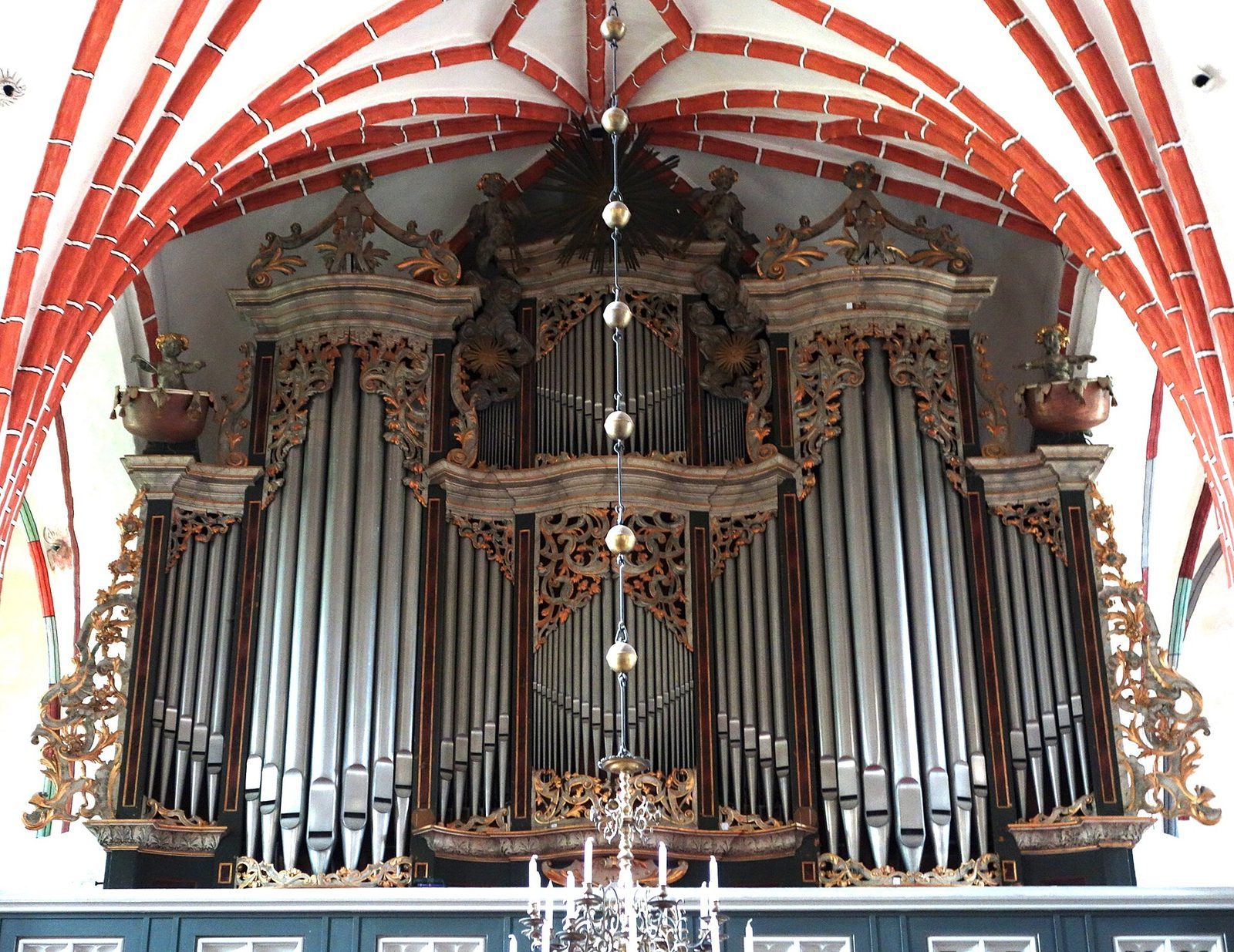
Joachim Wagner built the Baroque organ between 1742 and 1744; Carl August Buchholz altered its specification in 1845, and the Schuke firm of Potsdam restored it between 1964 and 1976. The instrument has 30 stops, which select pipe sounds, about 2,000 pipes, two hand keyboards, and a foot pedal. Its features include two cymbal stars that ring small bells, two trumpet-player figures, two tremulants that create a wavering sound, and two timpani. The specification also lists a Sun cymbal star, a manual coupler, and three stop valves. About 80 percent of the organ survives in its original state.