Pergamon Bridge: A Roman River Overbuilding beneath the Red Basilica
Site at a Glance
- Popularity
- Medium
- Country
- Turkey
- Primary era
- Classical
- Eras represented
- Classical
- Civilizations
- Roman
- Site type
- Infrastructure
- Remains
- Bridge
On this page5 sections
History
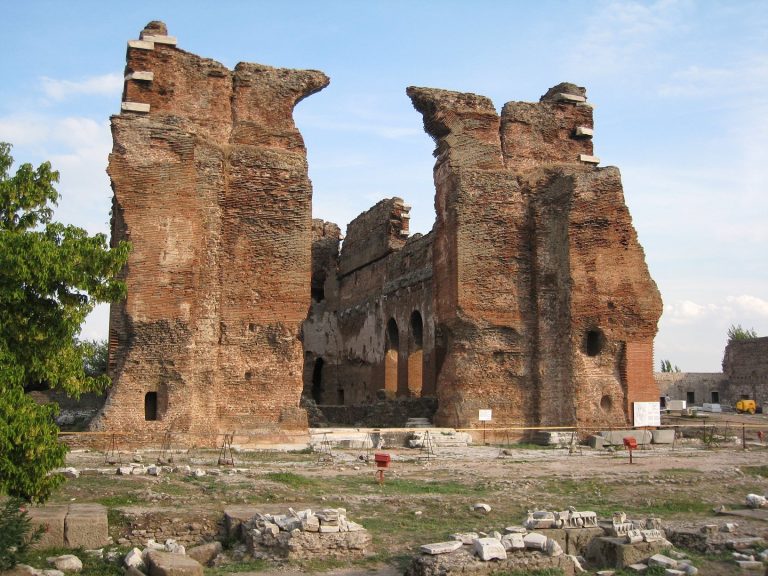
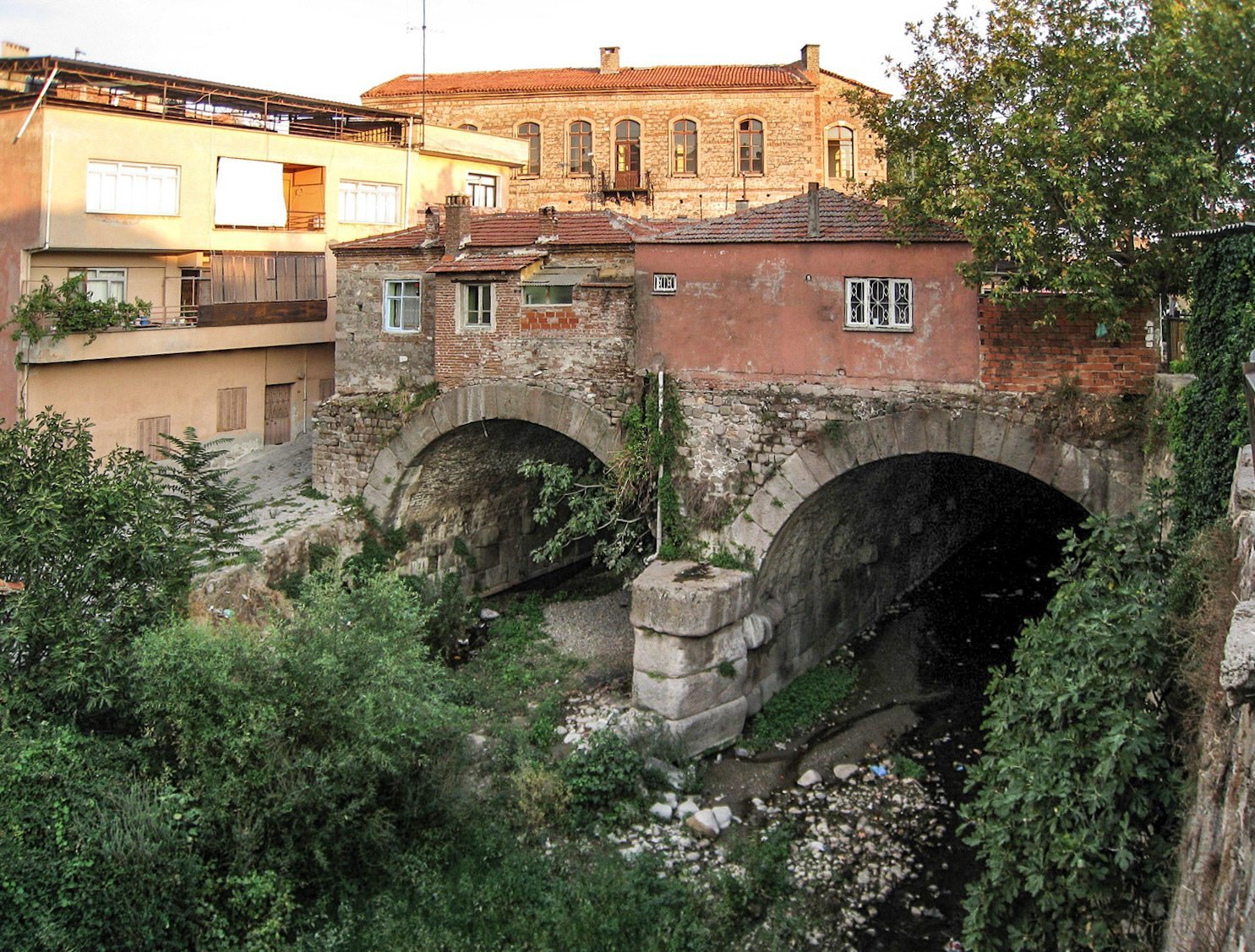
Pergamon Bridge is a Roman river overbuilding beneath the forecourt of the Red Basilica in ancient Pergamon, now Bergama, Turkey. Built during the reign of the Roman emperor Hadrian (AD 117–138), it spans a substantial section of the Selinus, now called Bergama Çayı.
Although often called a tunnel, the structure was built above ground using methods similar to bridge construction. It supported a large platform and forecourt before the Temple of the Egyptian Gods, also known as the Serapis Temple or Red Basilica. Serapis was a deity worshipped in the Greco-Egyptian religious tradition. The overbuilding provided usable space above the river for the temple precinct in a densely built-up city.
Remains
Twin river passages
The straight-running structure carries the Selinus beneath the Red Basilica forecourt and supports the square above it. A continuous wall divides two parallel passages, each covered by a barrel vault, a continuous arched roof. The western passage is 183 m long and the eastern one 196 m. Their uphill entrances are at the same level, while their exits down-valley are offset by 13 m.
The passages have nearly identical semicircular arches. Each spans 9 m, rises 4.5 m from the point where its curve begins, and provides 7.5 m of clearance. Rough stones set in firm mortar form the vaults, which rest on bases of squared blocks. A later-built threshold, 2 m high, has caused silt to accumulate in part of the western passage. Both passages otherwise remain intact and continue to serve their original purpose.
Flood capacity
Hydrological estimates put the capacity of each passage at up to 360 cubic metres of water per second. Above that flow, the Selinus could back up, press against the structure from within, and cause damage. The calculations used a river length of 13.4 km, an average gradient of 2.2%, and a catchment, or land area draining into the river, of 101 km². Four methods produced estimated recurrence intervals from 250 to 8,500 years. An overall estimate put floods exceeding the structure’s capacity at about once every 700 years. A recurrence interval is a statistical average, not a timetable.
Other crossings on the Selinus
Two other well-preserved ancient bridges cross the Selinus nearby, Tabak Köprüsü upstream and Üç Kemer Köprüsü, or Three-Arch Bridge, downstream.