Library of Pergamum: An Attalid Center of Scholarship
Site at a Glance
- Popularity
- Very High
- Country
- Turkey
- Primary era
- Classical
- Eras represented
- Classical
- Civilizations
- Kingdom of Pergamon
- Site type
- Civic
- Remains
- Library
On this page11 sections
History
The Library of Pergamum was an Attalid royal research institution in ancient Pergamum, at modern Bergama in Türkiye, established around 200 BCE during the Hellenistic period. The Attalids ruled a kingdom centered on Pergamum; the Hellenistic age followed Alexander the Great’s conquests and spread Greek culture across the eastern Mediterranean and western Asia. The library supported scholarly work and expressed the dynasty’s cultural ambitions.
Attalid foundation and scholarship
The library’s precise founder is uncertain. Attalus I may have begun gathering books, while Eumenes II is associated with building and organizing the institution. Under the Attalid court, it became a center for research and a place where rulers could display their cultural standing.
The collection may have held rare and very old works, including manuscripts thought to be more than three centuries old, papyrus scrolls, and writing on citrus wood, whose precise tree species is unclear. Books also came as gifts. When the physician and writer Galen moved to Rome, he left his medical and scholarly books in Pergamum. Flavia Melitene, a prominent citizen and the wife of a town councillor, helped supply the library and gave it a statue of the Roman emperor Hadrian.
Strabo relates that people holding books associated with Aristotle at Skepsis, an ancient city in northwestern Asia Minor, buried them because they feared the Attalids would seize the collection. These books were distinct from the Pergamene library, but the story reflects the dynasty’s reputation as an ambitious collector.
Pergamum competed with Alexandria, the Egyptian city whose royal library was a major Hellenistic center, for scrolls and scholars. The contest encouraged expensive collecting and a profitable book trade, but also led to hurried copies and forgeries. Pliny the Elder linked an Egyptian restriction on papyrus exports, probably imposed under Ptolemy V, with increased parchment production at Pergamum. Parchment, made from treated animal skin, was already in use; its manufacture there may have been expanded or improved. A tradition says that Attalus and the scholar Krates of Mallos sent finely made parchment to Rome in response to papyrus sent there by the Egyptian king Ptolemy and the textual scholar Aristarchus of Samothrace.
The library served scholars, diplomats, rulers, and invited visitors. Vitruvius says it was open to the public, although the high price of scrolls and limited literacy suggest that access may often have been restricted. The Stoic philosopher Athenodoros Kordylion, belonging to a school that stressed reason, self-control, and virtue, was its director. Krates of Mallos, a philosopher and scholar of language, was closely associated with it. Other users included the biographer Antigonos of Karystos, mathematician Apollonios of Perge, writer on siege engines Biton, and geographer Polemon of Ilion.
Pergamene scholars tended to preserve obscure or archaic passages in older works and explain them through allegory. Alexandrian scholars more often corrected or removed such passages. The library also kept a catalogue that included a work attributed to Kallikrates and a speech by Demosthenes. The Demosthenes speech appeared under the same title in the catalogues of Pergamum and Alexandria.
Roman rule and the library’s later fate
Pergamum became a Roman possession in 133 BCE, after Attalus III bequeathed the Attalid kingdom to Rome. Evidence for the library’s activity after this transfer is sparse. It may have declined in the later first century BCE, or continued into the Roman and early eastern Roman periods. Roman emperors may have supported it, and Augustus, Rome’s first emperor, may have returned some scrolls to Pergamum after Mark Antony’s death.
Plutarch claimed that Antony gave Cleopatra VII, ruler of Ptolemaic Egypt, about 200,000 scrolls from Pergamum in the 30s BCE to replace losses at Alexandria. The story is often treated as legend or as a political attack on Antony, so it does not establish the collection’s size. The library’s ultimate fate is unresolved. Valuable scrolls may have entered private Roman collections; another proposal is that a remaining collection went to Constantinople, the eastern Roman imperial capital, in the fourth century CE. A further possibility links its destruction to the sixth-century suppression of pagan institutions under Justinian I, an eastern Roman emperor. Pergamum suffered severe damage in an earthquake in 262 CE, but the effect on the library is uncertain.
Identification and modern investigation
Whether the excavated rooms belonged to the royal library remains disputed. Alexander Conze and Richard Bohn identified them as the library, while later interpretations have questioned that assignment and suggested other uses for the complex. Two inscriptions mentioning a library were found at Pergamum’s gymnasium, but these are generally understood to refer to a separate school library.
German engineer Carl Humann began excavating Pergamum’s ruins in 1869, and systematic work followed from 1878. The complex was uncovered in the early 1880s by a team led by Conze and Humann, with further excavation under Bohn; Conze and Bohn published their interpretation in 1885. Restoration took place between 1950 and 1985. Pergamum received UNESCO World Heritage status in 2014.
Remains
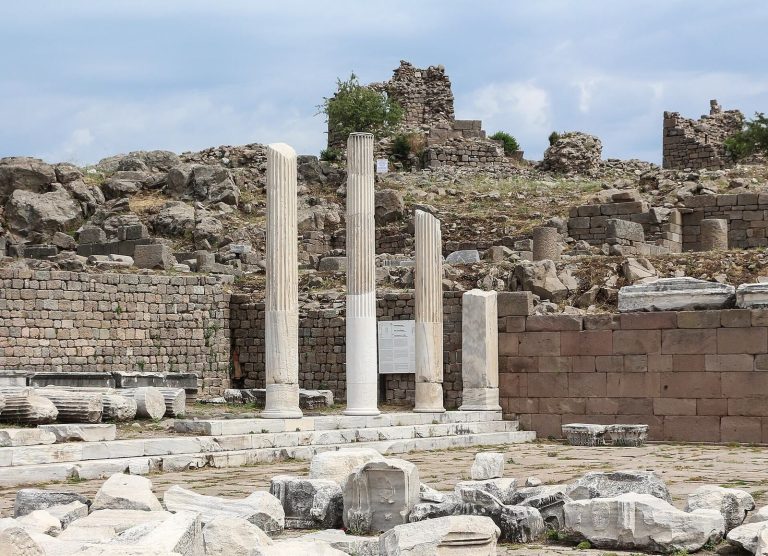
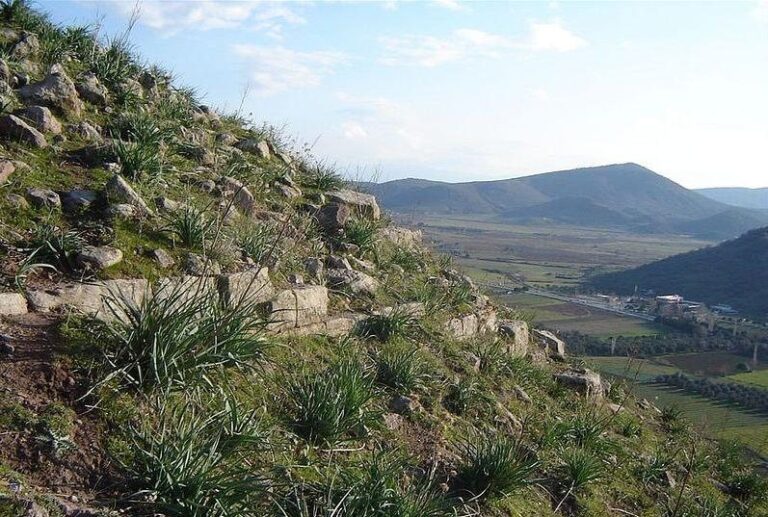
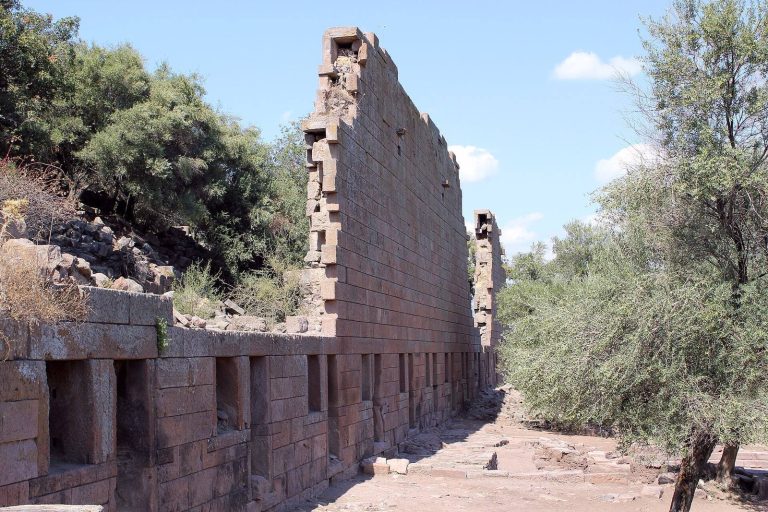
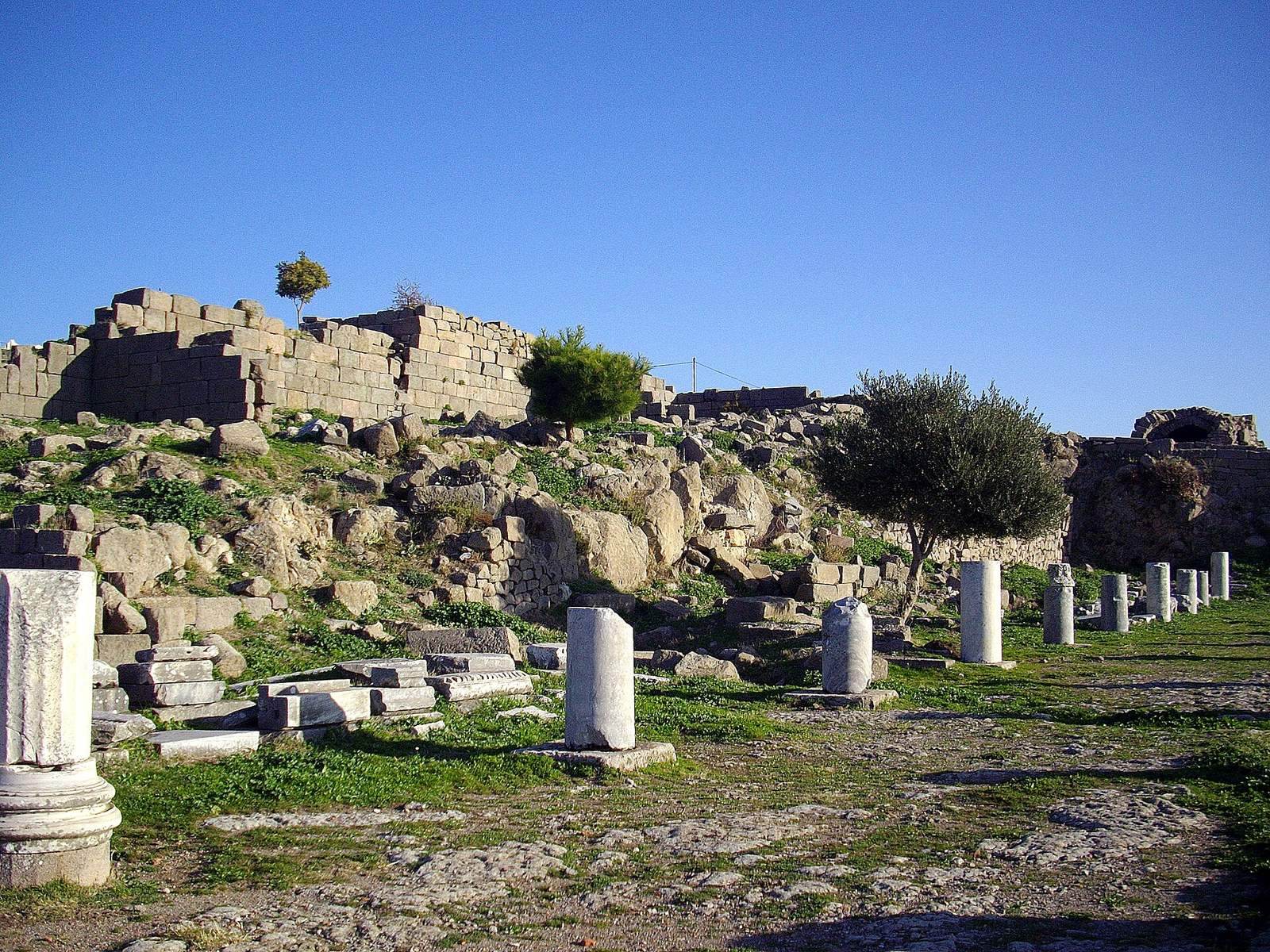
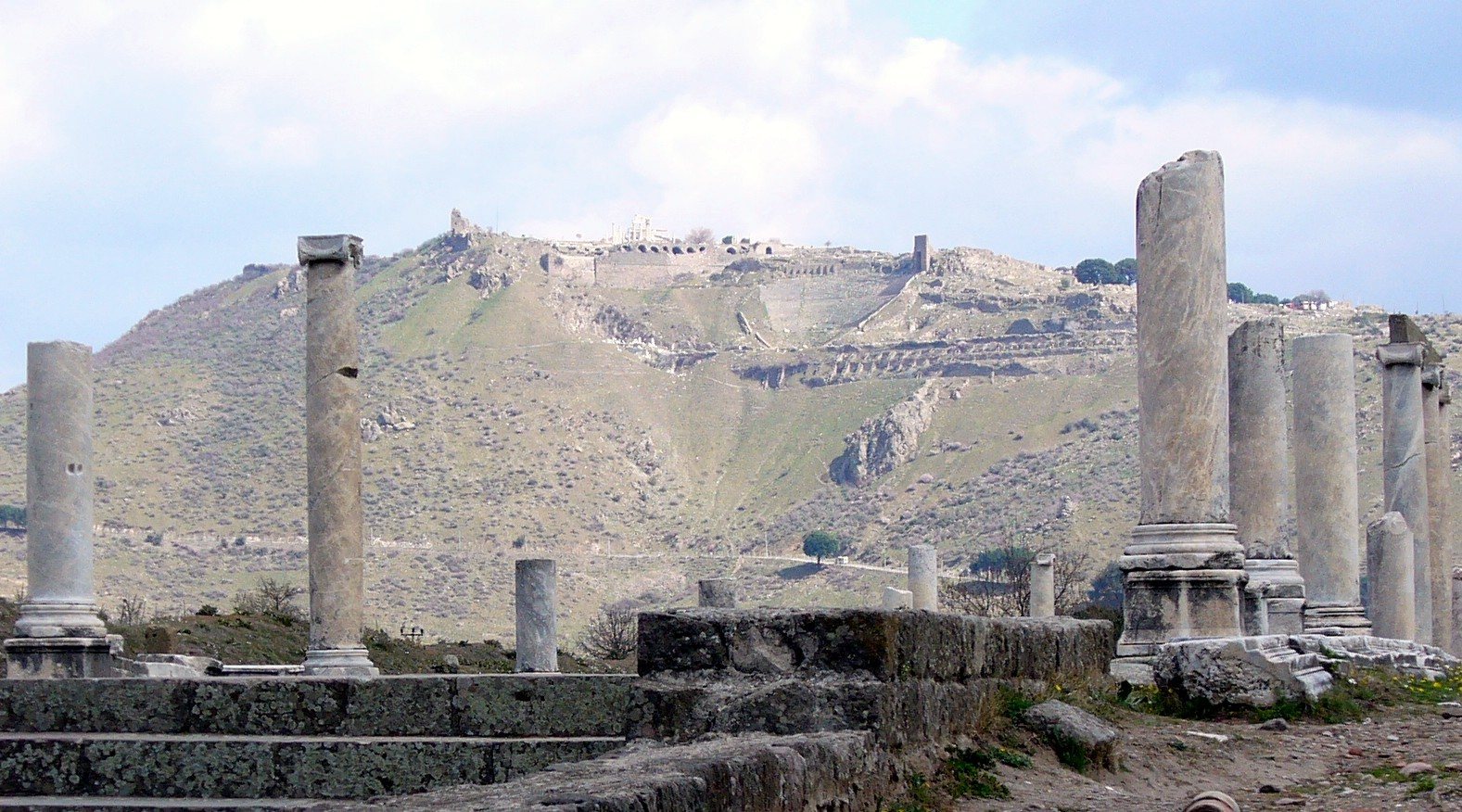
The remains occupy the summit plateau of Pergamum’s citadel hill, within the Sanctuary of Athena. The rooms adjoin the upper floor of the sanctuary’s northern hall, whose columns framed the entrance, and natural bedrock lies directly beneath them. The complex comprises one large hall and three smaller rooms, each about 90 square metres. Its position and plan form part of a tightly built sanctuary arranged around the city’s oldest temple, dedicated to Athena, the Greek goddess associated with wisdom.
Sanctuary setting and plan
Two-storey halls lined with columns bordered the temple on three sides. On the fourth, the ground fell steeply toward the theater, with retaining walls securing the slope. The sanctuary courtyard also held an altar and honorific statues. Portions of the large hall’s perimeter walls survive; they were built from local trachyte, a volcanic building stone. The hall measures about 16.95 by 13.53 metres.
The large hall and its fittings
Walls and shelving ledge
A stone ledge ran along the hall’s north, east, and west walls, set roughly half a metre away from them. It stood about a metre wide and half a metre high. The ledge may have supported wooden shelves for scrolls, with the space behind them helping protect the books from damp. Holes in the walls may have secured shelving, though other interpretations connect them with artwork, catalogue boards, or drainage fittings.
Statue and sculptural fragments
Near the middle of the north wall, the ledge broadens across a span of about 2.7 metres, possibly creating a base for a statue. A 3.10-metre marble statue of Athena Parthenos, the monumental image of Athena associated with the Parthenon, was found in the hall’s rubble about two metres above its original floor. It is a Hellenistic-period replica of the celebrated statue attributed to the sculptor Phidias, and may have stood on the widened section. Smaller statue and relief fragments were also found in the rubble, along with stone cover slabs that may have formed protective cases or niches for scrolls, small artworks, or statuettes. Owls among the sanctuary entrance gate’s ornamental designs have been interpreted as a possible reference to the nearby library.
Water features
A narrow channel cut into the rock floor survives in front of the eastern part of the ledge. Two widened points in the channel may have collected or drained water. A deep cistern cut into the rock occupies the hall’s southeast corner.
Function and preservation
The remains are partly restored, but the purpose of the large hall is unsettled. Interpretations include a scroll store, reception or reading room, meeting or lecture space, art gallery, and dining room. One proposal places the scrolls in the three smaller rooms and regards the large hall as a ceremonial or assembly space; another suggests that the wall openings were designed to carry away moisture rising from the ground.