Allianoi: A Roman Spa and Asklepieion in Türkiye



Site at a Glance
- Rating
- 4
- Popularity
- Very Low
- Country
- Turkey
- Primary era
- Classical
- Eras represented
- Classical, Medieval, Modern
- Civilizations
- Byzantine, Roman
- Site type
- Sanitation
- Remains
- Baths
On this page13 sections
History
Allianoi is an ancient spa and healing center in Türkiye, near Bergama in İzmir Province. Dedicated to Asklepios, the Greek god of healing, it developed into an urban spa and Asklepieion, a sanctuary and treatment center associated with his cult, during the Roman Imperial period, especially in the second century AD. Much of its substantial architecture belonged to this phase, when the hot springs, public buildings, streets, and water infrastructure gave the settlement an organized urban form.
Early settlement and Roman development
Activity in and around the settlement reaches back to prehistory. An Early Bronze Age II Yortan vessel, flint artefacts from the slopes of Çakmak Tepe, and two stone axes recovered from fill indicate earlier human activity in the area. Allianoi itself was first settled in the late Hellenistic period, when the hot springs probably supported a small thermal center. The Hellenistic phase has produced only a limited number of archaeological and coin finds, and no architectural remains from that period have been identified.
The settlement was transformed by a major public-works program under the Roman Empire, particularly during the second century AD. One attribution places this building activity during the reign of Emperor Hadrian, who ruled from AD 117 to 138 and sponsored extensive construction across the empire. Roman Allianoi included a large bathing complex, treatment spaces, streets, bridges, fountains, houses, shops, and planned urban blocks known as insulae. The site’s importance as a spa and healing center is also reflected in the account of Aelius Aristides, a second-century AD Greek rhetorician and medical writer. In Hieroi Logoi, or “Sacred Tales,” III.1, he described a treatment he received at Allianoi. This is the settlement’s only known mention in ancient literature.
Byzantine and Ottoman use
Allianoi remained densely occupied during the Byzantine period, although its social and economic condition had weakened. Inhabitants reused Roman architectural elements and continued to use the thermal baths and fountain buildings, making minor changes to them. Simpler dwellings were built over or beside Roman colonnades and streets, while a large basilica-like church, chapels, workshops, and burial areas formed part of the later settlement. Some buildings continued in use until approximately the eleventh or twelfth century.
Byzantine workshops produced metal, ceramics, and glass. Rare glass kilns and several hundred ceramic objects, including oil lamps and tableware, show the range of activity during this period. The spa was known as Paşa Ilıcası during the Ottoman period and appeared in the Aydın provincial yearbooks. Its use was not intensive, and only a few Ottoman coins have been recovered from this phase.
Reopening, excavation, and inundation
In the early twentieth century, the regional sub-governor Kemal Bey initiated a partial reopening of the spa, including its large pool. Silt was also partly cleared from the thermal complex, but later flooding left the facility largely out of use until the 1950s. The Roman bridge west of the settlement continued to carry the Bergama to İvrindi route from the Ottoman period until 1979. In 1992, part of the bridge was reconstructed or altered without the required conservation approval. The same year, unauthorized work at the spa included a modern building placed over ancient remains. Flooding in February 1998 made the facility unusable.
Emergency excavations began in 1994 at the place long called Paşa Ilıcası. Ahmet Yaraş directed the work from 1998, with assistance at different stages from the Turkish State Hydraulic Works, the German Archaeological Institute, Trakya University, Philip Morris Sabancı, the Bergama Yortanlı Rescue Society, and volunteers. Finds were transferred to the Bergama Archaeological Museum. Excavations in 1998 and 1999 established that Paşa Ilıcası was ancient Allianoi. On 29 March 2001, the İzmir Regional Council for the Conservation of Cultural and Natural Properties designated the settlement a first-degree archaeological site, and the excavations became a formal rescue project.
Between 2000 and 2004, excavation and conservation work removed many modern additions, exposed large areas of the ancient baths, simply restored one sector, and strengthened Roman and flood-protection walls. Work in 2003 revealed major thermal spaces beneath modern structures and offered partial protection from flooding by the Ilya River. Investigations across the proposed Yortanlı reservoir also identified a Hellenistic farm settlement about 2 km northeast of Allianoi, the continuation of an aqueduct associated with Pergamon, and a Byzantine burial area with a chapel in parcel 311.
The proposed Yortanlı Dam threatened to cover Allianoi because the settlement lay within the planned reservoir. The dam was intended to improve agricultural productivity through irrigation rather than generate hydroelectric power. In July 2005, Ahmet Yaraş and a coalition of 73 individuals and associations brought a legal action against the planned flooding. A conservation decision of 29 October 2005 temporarily prohibited filling the reservoir until protective measures had been completed, but that decision was reversed in a non-public ruling in late 2006, disclosed in January 2007.
A commission convened by the Ministry of Culture and Tourism inspected Allianoi on 5 and 6 July 2005 and reported on 18 July. It concluded that the registered archaeological site should be preserved because of its contribution to cultural history, while judging the proposed protective measures inadequate as a long-term solution. Alternatives included moving the dam, reconstructing Allianoi as an open-air museum, lowering the dam crest, building impermeable retaining walls, and diverting water through a tunnel. None was adopted.
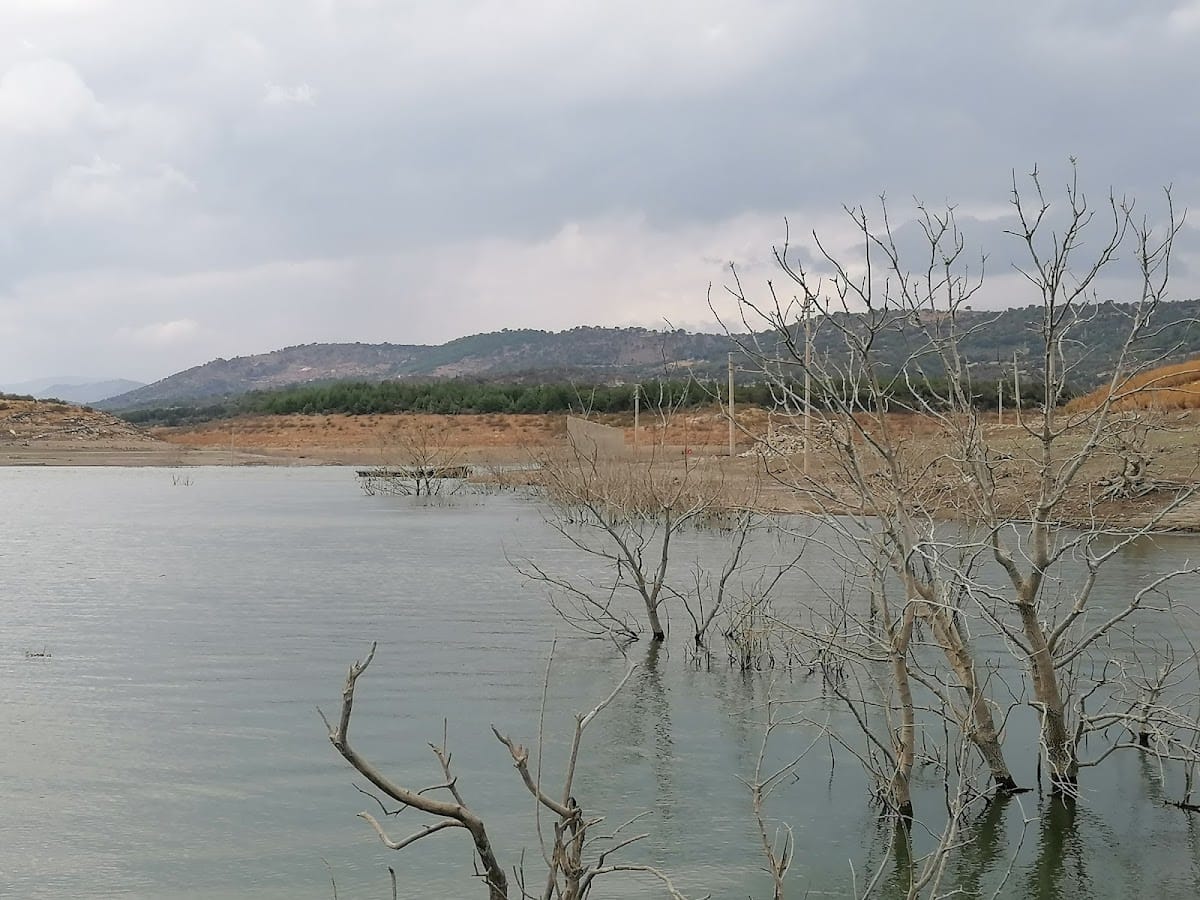
Yortanlı Dam began filling on 31 December 2010, and reservoir water reached the ruins in February 2011. The settlement was covered with sand and completely inundated. Water levels could reach approximately 17 metres, with an estimated 12 to 15 metres of alluvial material accumulating over the site. Sand covering was intended to offer limited protection to features such as mosaics, but the inundation destroyed Allianoi as an accessible archaeological ruin. The site is therefore described as submerged rather than simply ruined.
Remains
Valley setting and urban layout
Allianoi occupied the center of a valley between Bağ Tepe and Abdal Tepe to the south and Çamlık Tepe to the north. The Ilya River crossed the settlement, dividing it into northern and southern parts and periodically producing destructive floods. The urban area extended approximately 300 metres from east to west and about 200 metres across. By 2004, excavation had covered roughly 40,000 square metres, estimated to represent only 10 to 20 percent of the historical settlement.
The settlement was built over a hot spring whose water temperature is given as approximately 45 to 47 °C or 45 to 50 °C. Structures on both banks incorporated the hot-water source. Roman streets and lanes paved with marble connected the buildings, while houses and shops formed part of the urban fabric. The houses had access to a water-supply system, and several retained colorful geometric mosaics. Some gates were elaborately decorated.
Bridges
Two roughly symmetrical bridges crossed the Ilya River at the eastern and western ends of the settlement. The western Roman bridge remained in use until 1979. At the eastern crossing, only a ramp and one pier survived. The western bridge was altered during the 1992 intervention and was later partly reconstructed or deformed without the required conservation approval.
Thermal and medical buildings
Northern thermal complex
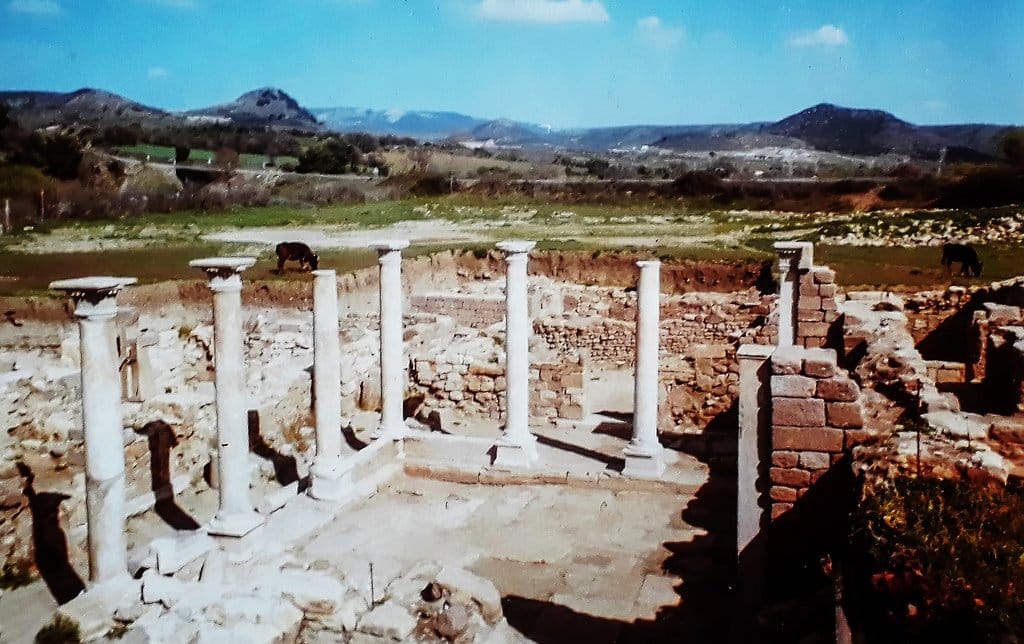
The principal building was the northern thermal complex, which covered approximately 9,000 to 9,700 square metres. Its rooms and pools survived in an unusually preserved state because much of the complex had been sealed beneath alluvial deposits. Multiple bathing rooms were connected by a long underground water tunnel. The baths remained in use during the Byzantine period after minor alterations. Modern structures placed over the complex in 1992 were largely removed during the 2003 excavation, exposing ancient thermal spaces.
Hospital building
A large building interpreted as a hospital contained an interior colonnaded courtyard surrounded by interconnected treatment rooms. Each room opened onto the colonnade and had its own mosaic floor. A fountain once stood at the center of the courtyard. Ancient medical instruments found within the building supported its interpretation as a place for treatment.
Water structures and civic buildings
Roman infrastructure also included a Connection Building, a propylon, or monumental entrance, public fountains, and one or more nymphaea, which were ornamental fountain buildings associated with springs or water supplies. Protective walls were later built along the southern thermal area and west of the northern complex. One strengthened and raised a surviving Roman wall, while the other protected rooms from flooding by the river.
Byzantine buildings and production areas
Byzantine construction included simpler houses placed over or beside Roman stoas and streets, a large basilica-like church in the eastern part of the settlement, chapels within and near the site, and necropolises. The thermal complex and nymphaea continued to function with small alterations. Metalworking, ceramic production, and glass production took place in workshops within the settlement. Rare glass kilns and several hundred ceramic objects, including lamps and tableware, were recovered.
Objects and medical evidence
Excavation produced sculptures, ceramics, metal, bone, glass objects, coins, and medical instruments. Approximately 10,000 objects were transferred to the Bergama Archaeological Museum. A nearly intact marble statue about 1.5 metres high represents a spring nymph and has been interpreted as Aphrodite. The nymph statue became one of the visual symbols associated with Allianoi.
Medical finds included bone needles of headed, plain, eyed, and awl-like forms. Headed needles, known as acus crinalis, could function as dress fasteners or hairpins. The forms and find locations of some Allianoi examples have also prompted the proposal that they were used for surgical suturing. A total of 443 headed needles were identified, with 273 classified into groups designated All. I Type Ia through All. I Type Ij. Type Ia contained 141 finds, including 90 in its principal category and the remainder divided among six subtypes. The principal examples had a globular head, a thickened body forming shoulders, and a shaft narrowing to a point. Most heads measured approximately 0.4 centimetres across.
During the excavation period, part of the site was arranged with a wooden viewing platform, paths, and vegetation. These modern elements, like the ancient buildings and archaeological deposits, were later submerged beneath the Yortanlı reservoir.