Pena Molexa: A Stone Complex of Uncertain Origin in Galicia
Site at a Glance
- Rating
- 4.5
- Popularity
- Medium
- Country
- Spain
- Primary era
- Unclassified
- Eras represented
- Unclassified
- Civilizations
- Unclassified
- Site type
- Civic
- Remains
- Megalithic Monument
On this page13 sections
History
Pena Molexa is a group of large stones in O Val parish, Narón, Galicia, Spain. Local people regarded it as one of Galicia’s sacred rocks before it was interpreted as a human-made monument. Whether people shaped or assembled it, and when or why they did so, remain unresolved.
Sacred rock and proposed meanings
Archaeologist André Pena Graña promoted the interpretation that the stones had been shaped or assembled by people. The name Pena Molexa is translated as Millstone Rock, a reference to its resemblance to stones used in traditional mills. The monument’s age and original function have not been established by excavation or laboratory dating; study has relied on visual observation and ethnological work.
One speculative chronology proposes that the base may have been revered as a sacred place or a seat of rulership around 8,000 years ago, with the disk placed later, perhaps 3,000 to 4,000 years ago. These dates have not been confirmed archaeologically. Other interpretations suggest that the site may have been used to observe natural cycles, for sacred ceremonies or prophecy, and possibly as a place of pilgrimage. Further proposed uses include supporting rulers’ authority and, eventually, burial rites for kings or princes. These are suggested possibilities, not established stages in the monument’s history.
A separate interpretation describes Pena Molexa as a lunar boat connected with a lost European ritual. A solar boat is an imagined vessel carrying the sun; this reading applies a similar idea to the moon. Some versions associate the monument with a female deity and ceremonies for deceased rulers, whose souls were thought to travel to the afterlife with the moon. The identification of the stones as a lunar boat, like the proposed ritual and original purpose, remains uncertain.
The arrangement has also been linked tentatively to recurring moonrises, the solstice, and the Metonic cycle, a period of about 19 years after which lunar phases recur on nearly the same dates in the solar year. This proposed alignment has not been verified. Another hypothesis connects the site with travel by sea and a land route between inland mines and the coast. Neither that connection nor a role in maritime navigation is established.
Modern inquiry and local traditions
In 2016, Narón’s council commissioned an inquiry from Arkho Arquitectura Servicios Integrados de Arquitectura y Urbanismo to consider whether the stones were natural or had been shaped by people. The investigation did not establish a date or a definitive origin. One further proposal is that a naturally balanced rock was partly dismantled to create the present arrangement.
Local stories give the rock a place in a wider landscape of enchanted beings and hidden treasure. In one tale, a beautiful moura, a supernatural female figure associated with enchanted places and treasure, appears near gold on St John’s morning. A suitor must choose between her and the treasure; if he chooses the gold, it becomes scales or charcoal, and she remains trapped in the rock for another year. Another tradition says an old woman made the stone or holds it in place with her little finger. The world, the story warns, will end if she withdraws it.
Other tales tell of a king and his warriors, sometimes joined by women, who stand as stones beside the monument. On St John’s night they become human, patrol the hills, and protect homes and older people, turning to stone again at dawn. Three golden mules are said to leave for the sea if their spell is not broken; a golden hen and chicks appear on St John’s morning and vanish if taken. A flying serpent is also associated with the site, with one version describing it as covered in shells.
A local solstice custom uses three bowls filled with fertile soil, clean air, and pure water gathered that night. Left outside homes for the year, the bowls serve as a pledge to care for the land. Local people have also performed the monument’s legends on St John’s night, a practice continued by a summer theatrical festival.
Remains
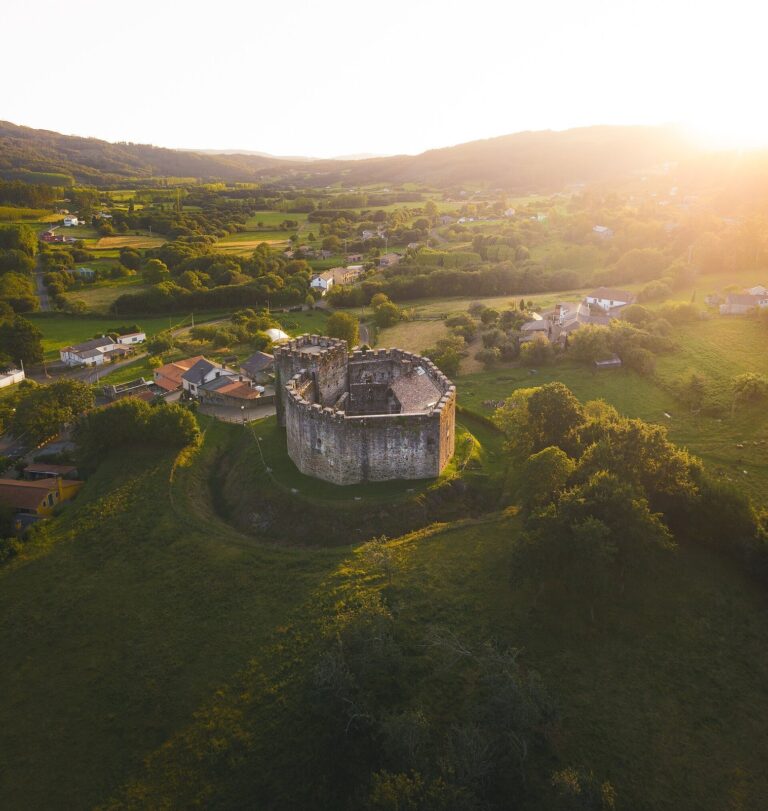
The complex occupies elevated ground overlooking a valley and extends about 9 metres along a northwest–southeast axis and 10 metres across, northeast to southwest. Its principal assembly consists of six large stones. The site lies about 170 metres above sea level, while the valley floor is around 40 metres and nearby high points reach roughly 200 to 300 metres. Pena Molexa faces inland toward the valley; the hill crest conceals it from offshore. A burial mound is nearby, and a funerary chamber has been confirmed elsewhere on the hilltop, close to the Vilasuso fortified settlement.
The principal stone assembly
Base, disk, and supports
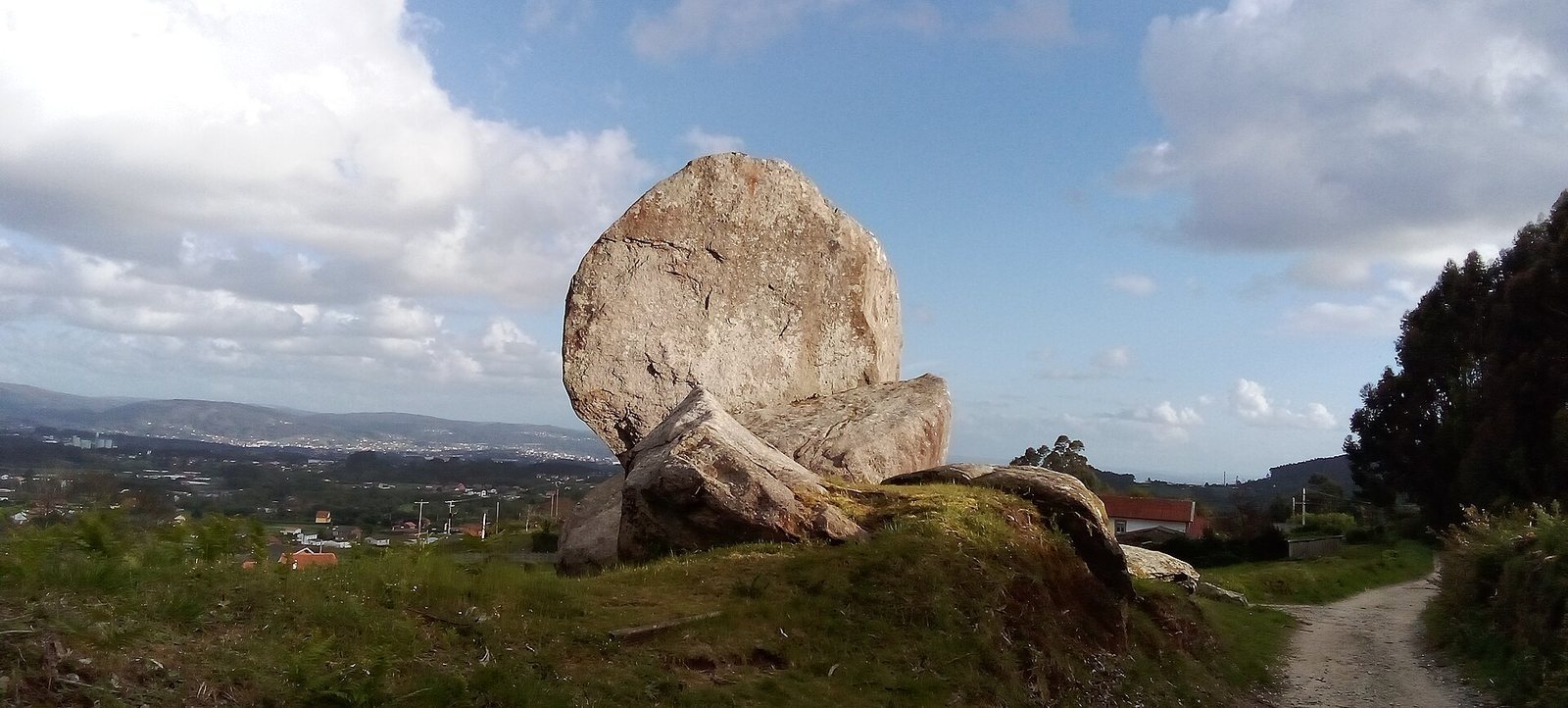
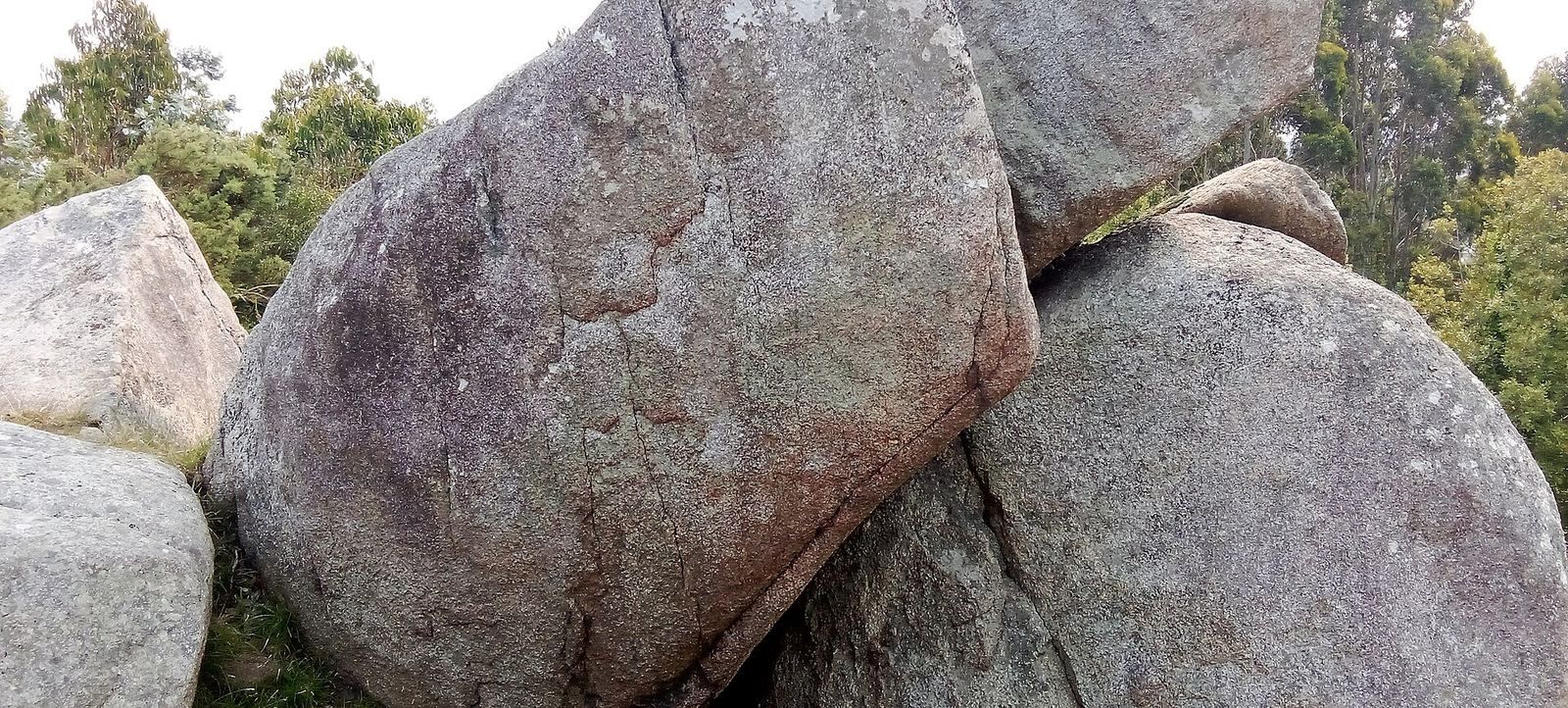
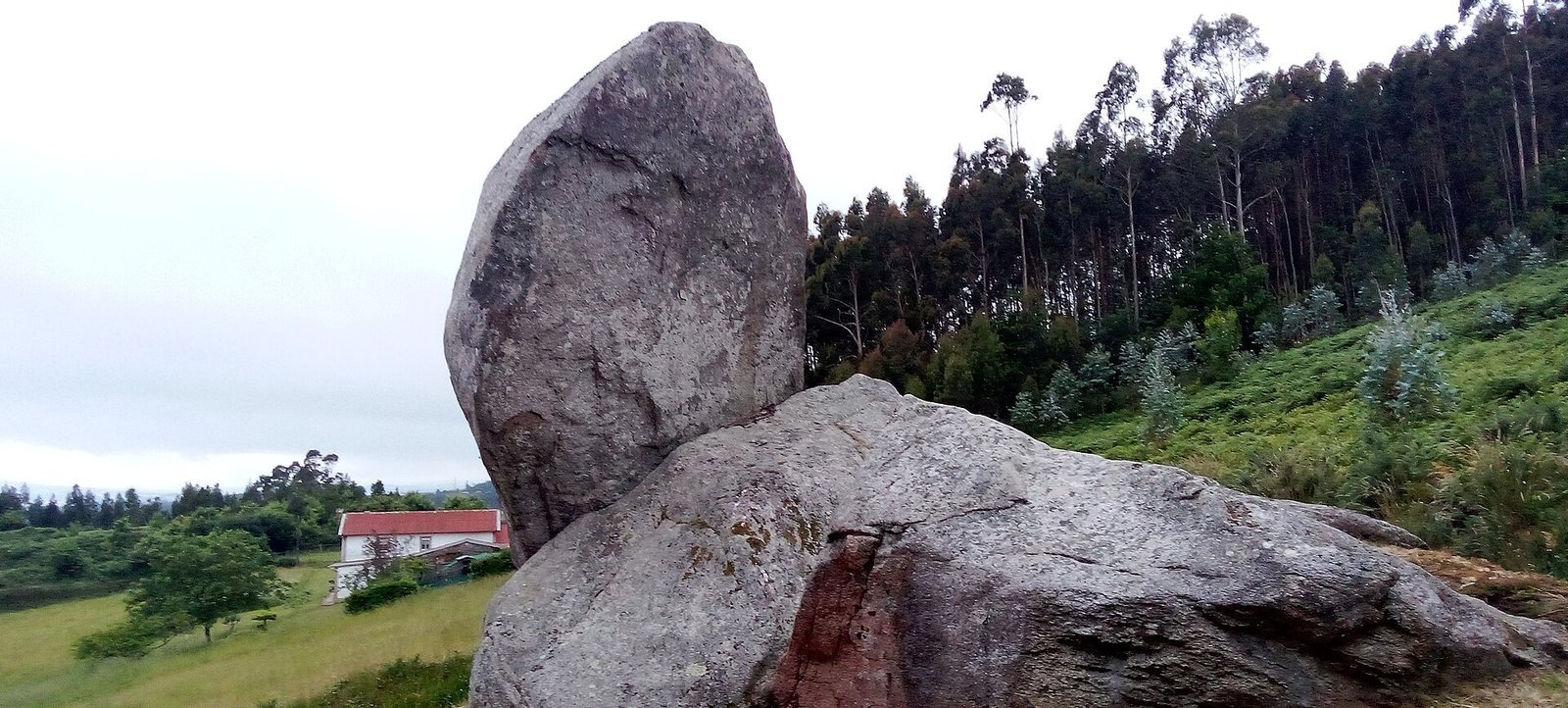
Stone 1 is a convexly shaped base block with a vertical fracture that may have resulted from the disk’s weight. Stone 2, a near-circular slab about 5 metres in diameter and estimated to weigh around 40 tonnes, rests vertically against it. Rather than being sunk into the ground, the disk leans at about 22 degrees. Its concave edge fits the base and a hollow in support stone 3. That support lies crosswise over the base, and wedges or shims placed in the gap help hold the disk at its angle. The shaped contact surfaces and arrangement of stones create a fitted support using wedge-and-lever principles.
Other stones in the six-stone group
Stone 4 is a long rock set in the opposite direction from stone 3. It may be naturally formed and weathered, and has a marked reddish colour. Together, stones 3 and 4 have been interpreted as resembling the sides of a boat. Stone 5 sits opposite stone 4 on a large earth mound, in a position that could have allowed it to serve as a table; parallel grooves mark its exposed surface. Smaller stone 6 stands slightly raised on another earth mound and may also have served as a table. Its straight profiles suggest alteration with stoneworking tools, although its original position is uncertain.
Surrounding stones and possible buried features
Outer stones and earth mounds
About five additional rocks, numbered 7 to 11, surround the main assembly, but their connection with its construction and their original positions are uncertain. Stone 11 is small and appears linked to stone 6 and the main group by an earth-and-stone mound resembling a buried wall. Near stone 8, an exposed accumulation of stones, numbered 13, may represent a buried gallery or another structure.
Stone 12 and the earth bank
Stone 12 lies beneath a soil layer only a few centimetres thick. The ground above it is slightly concave, and a foot tap is said to produce reverberation and vibration. These effects have prompted a proposal that a resonant chamber lies below, perhaps as part of a larger structure buried beneath the earth bank visible at the front of the complex. A burial chamber has been suggested but is unconfirmed. Other large stones are partly buried in the same bank.
Surface features and construction proposals
Stone shapes and lodged pebbles
The disk’s near-circular shape is clearest from behind and less apparent from the front. Its diagonal position against the supports has been interpreted as intentional rather than an accidental lean. Rounded stones are lodged in gaps in the assembly, including one where the disk meets its support and several between the base and support. The upper stones in the latter gap appear ordinary, while deeper ones resemble grey rounded pebbles. An eroded area on the left side of the base has been compared to waves formed by a boat’s keel.
Possible marks of working or damage
An apparent impact mark, possible abrasion from ropes along the disk’s edge, and possible fractures have been proposed as traces of construction or damage. A deep groove interrupts the disk’s otherwise nearly circular outline. These marks may reflect strain or an accident during construction, but that explanation is unconfirmed. In 2010, archaeologist Andrew Young proposed that shaped stone balls could have helped move large stones. This prompted speculation that rounded beach stones of amphibolite, a dark metamorphic rock, or dark granite were used to shift the disk into place; the method has not been demonstrated at Pena Molexa.