Castle of Moeche: A Medieval Fortress in Galicia

Site at a Glance
- Rating
- 4.6
- Popularity
- Low
- Country
- Spain
- Primary era
- Medieval
- External website
- Open
- Eras represented
- Medieval
- Civilizations
- Crown of Castile
- Site type
- Military
- Remains
- Castle
On this page9 sections
History
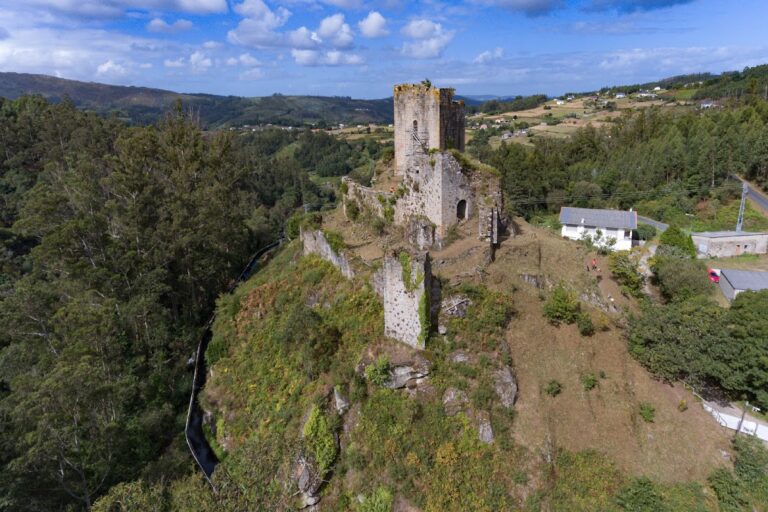
Castle of Moeche is a medieval fortress in Spain, associated with the parish of San Xurxo de Moeche in Galicia. A castle stood here by the fourteenth century, while the surviving structure belongs largely to the rebuilding that followed the Second Irmandiño Revolt. The fortress was connected with the noble Andrade family and combined military functions with the residential and administrative needs of a lordly estate.
Lordship and early defenses
Archaeological work has revealed an earlier defensive structure beneath the present castle. It may have been the fortress attacked by the Irmandiños around 1467, although its construction has been attributed either to García Rodríguez de Valcárcel, lord of Puentes, or to Fernán Pérez de Andrade, lord of Puentedeume. Earlier defensive remains also survive beneath the layer linked to the fire caused during the revolt.
In September 1371, Enrique II of Castile granted García Rodríguez de Valcárcel lordship over Puentes de García Rodríguez and the parishes of Moeche and Santa Cruz. In 1427, his daughter Constanza Rodríguez de Valcárcel acquired the territorial jurisdiction of Moeche for her husband, Pedro Álvarez Osorio, lord of Cabrera and Ribera. This jurisdiction was a coto, a territorial district governed under a lord’s authority.
The lordship subsequently passed through the inheritances of the Valcárcel and Enríquez de Castro families. Fadrique Enríquez de Castilla, duke of Arjona and head of the Enríquez de Castro family, supported the future Enrique II during his struggle with his half-brother Pedro I of Castile. After Juan II sanctioned Fadrique and removed his ducal dignity, much of his property passed to his sister Beatriz Enríquez de Castro. Her marriage to Pedro Álvarez Osorio returned Moeche to the Osorio lineage.
The Irmandiño revolts
The castle became involved in the Irmandiño revolts, popular uprisings by members of the fifteenth-century Galician brotherhoods, or Irmandades, against abuses by the feudal nobility. During the first revolt, the Irmandade Fusquenlla, led by Roi Xordo, attacked Moeche in response to abuses attributed to its lord, Nuno Freire de Andrade, who had already fled. After burning his lands, the rebels pursued him to Santiago de Compostela, where the archbishop protected him. Episcopal forces defeated the Irmandiños at the Battle of the Eume, where Roi Xordo is reported to have died.
During the Second Irmandiño Revolt, which reached its height between 1467 and 1469, Moeche was probably among the first castles destroyed, in spring 1467. After the nobles defeated the rebels between 1467 and 1469, Pedro Álvarez Osorio recovered his possessions and rebuilt the fortress. The reconstruction substantially enlarged and strengthened Moeche, using captured Irmandiños as laborers.
Later memory and preservation
Moeche is also described as the setting of a final battle after the Battle of Montiel, where Enrique of Trastámara, supported by the French commander Bertrand du Guesclin and Fernán Pérez de Andrade, confronted Pedro I of Castile. Pedro I died on 23 March 1369. The castle’s precise relationship to this event is not otherwise specified.
Since 1980, the Festival Irmandiño has been held annually, traditionally during the third week of August. Its central event is a nighttime symbolic recreation of the Irmandiño assault, with torches, music, dancing, communal food, and other elements of a local popular festival. The castle has been recognized as a Property of Cultural Interest, a formal Spanish designation for protected cultural heritage, since 1994. Restoration has been carried out, and the complex now includes historical interpretation facilities.
Remains
The present fortress occupies the site of the earlier defensive structure and has an irregular octagonal plan. Its defensive and seigneurial functions are combined within an octagonal wall that encloses service quarters, an armory, a dining room, and stables. A shallow moat surrounds the complex externally. The stables now house the Castle of Moeche Interpretation Centre.
Fortress layout and defensive structures
Keep and entrance
A square keep, or principal fortified tower, rises 18 metres and forms the main entrance beyond the forecourt. It is joined to the surrounding wall and contains three wooden floors. Its walls are approximately 4 metres thick. Narrow loopholes pierce the exterior, widening toward the interior to allow defensive fire from within.
The first floor is believed to have been used as a storeroom, the second as a prison, and the third as a refuge for the castle’s lords. The upper level opened onto the principal courtyard. From the forecourt, the keep leads into this central space, which provides access to the fortress’s different rooms.
Outer wall and northern turret
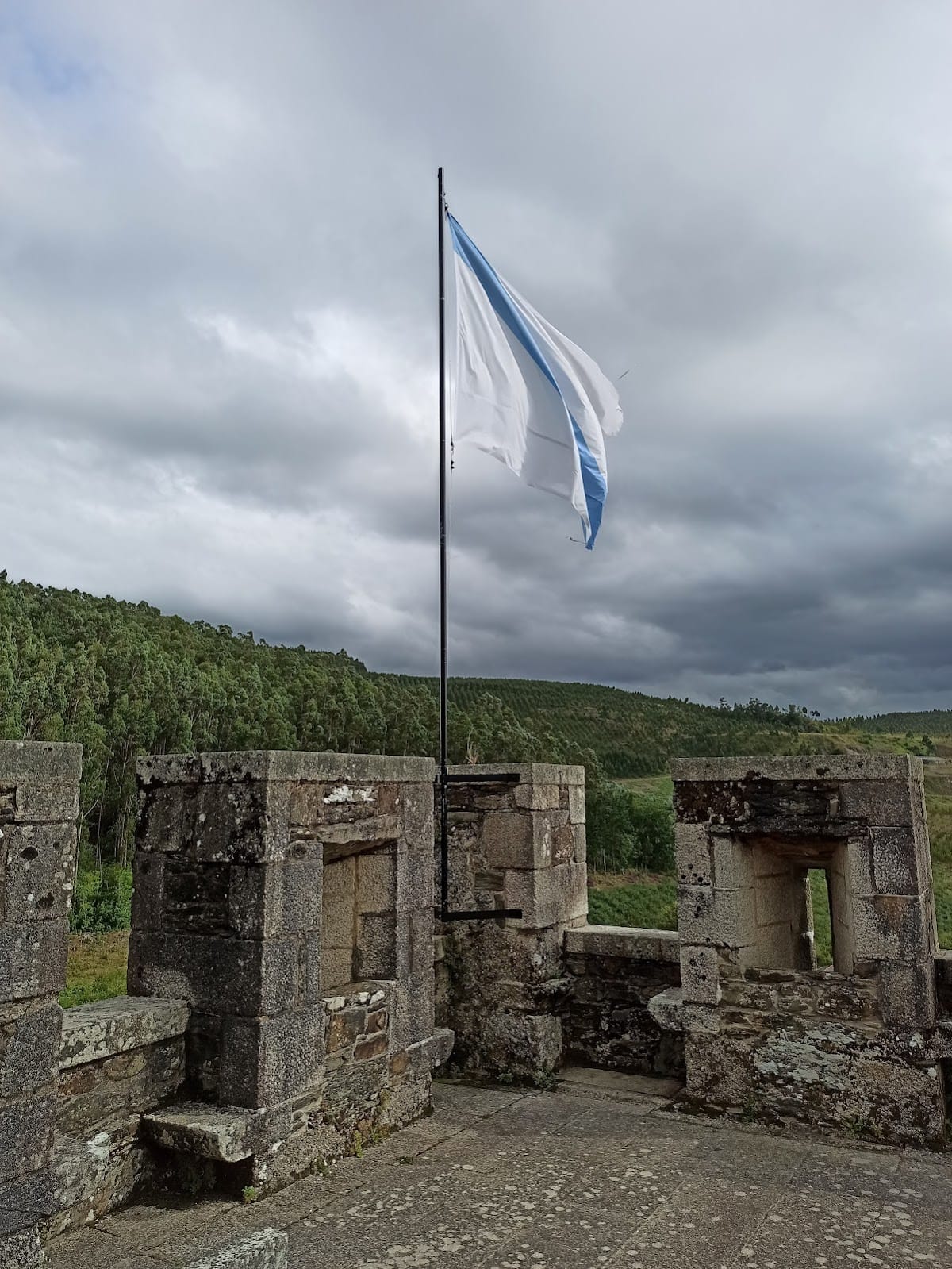
A circular turret at the northern corner contains a spiral staircase and helped distribute movement along the wall-walk, the passage running along the top of a defensive wall. It is reached from the forecourt. Together with the enclosing wall, moat, and keep, the turret forms part of the castle’s surviving defensive arrangement.
Materials and heraldic facade
The fortress is built mainly from schist rubble masonry. Dressed stone strengthens the corners and frames the arches and merlons. Three heraldic motifs remain on the keep’s principal facade. They are associated with the duke of Arjona, Pedro Álvarez Osorio, and Beatriz de Castro, and combine heraldic elements connected with the Osorio, Enríquez, Valcárcel, and Castro lineages.