San Felipe Castle: A Fortress Guarding the Ferrol Estuary


Site at a Glance
- Rating
- 4.3
- Popularity
- Medium
- Country
- Spain
- Primary era
- Early Modern
- External website
- Open
- Eras represented
- Early Modern, Modern
- Civilizations
- Spanish
- Site type
- Military
- Remains
- Castle
On this page13 sections
History
San Felipe Castle is a historic military fortress in Ferrol, Spain, built as part of the Spanish defense of the Ferrol estuary during the sixteenth century. Developed under Philip II, king of Spain from 1556 to 1598, it protected the port and its role as a provisioning point for the Royal Spanish Armada against English and French maritime threats.
Creation of the Estuary Defenses
The fortress formed one element of a defensive system that also included La Palma Castle and San Martín Castle. The Captain-General of the Kingdom of Galicia, the senior royal military and administrative authority in the territory, commissioned the wider system. Its design was assigned to the military engineers Fratín, Spanochi, and Muñiz. Construction at San Felipe began in the sixteenth century, although its precise starting year is uncertain.
The estuary became closely connected with Spanish naval preparations. In 1588, part of Philip II’s Spanish Armada, the large fleet assembled for operations against England, took shelter there during a storm. An English attempt to seize Ferrol was repelled in 1594. In 1639, a French assault under Admiral Henri D’Escobleau was also defeated. These actions demonstrated the defensive value of the three-fort system.
Deficiencies and Eighteenth-Century Modernization
By 1656, the fortress required major improvement. A military inspection described its gate as having fallen and judged the position undefended because troops on the surrounding mountain could attack it with stones. Between 1731 and 1755, the military engineer Francisco Montaigú carried out an extensive modernization. The work added a hornwork, an external defensive position placed before the main fortress to strengthen the landward approach, together with a moat and a new principal gate.
The modernization followed principles associated with Vauban, the French military engineer whose methods influenced early-modern fortifications through layered defenses, moats, hornworks, and artillery-focused plans. At San Felipe, these ideas were adapted to the estuary and the surrounding terrain.
Battle of Brión and Later Military Use
On 25 August 1800, San Felipe took part in the Battle of Brión, also known as the Battle of Doniños. A British fleet of more than 100 ships and approximately 15,000 men, commanded by Rear Admiral John Borlase Warren, attempted to capture Ferrol and destroy its shipyards. Three British assaults were repelled by the combined fire of San Felipe, La Palma, and gunboats in the estuary. The British force then re-embarked after suffering more than 1,000 casualties. The battle demonstrated the importance of the mutually supporting fortifications, and Napoleon reportedly commemorated the victory with the words “for the brave people of Ferrol.”
French forces occupied San Felipe for one month in 1809 during the Peninsular War, the 1808–1814 conflict in which Spain and its allies fought French forces occupying the Iberian Peninsula. During the Spanish Civil War, the 1936–1939 conflict between the Republican government and Nationalist forces led by Francisco Franco, the castle became a military prison. Political prisoners were concentrated there, tried by court-martial, and executed in the moats. Those recorded as executed in January 1938 included Amada García Rodríguez, Juan José Teijeiro Leira, José María Montero Martínez, Ángel Roldos Gelpi, Antonio Eytor Canizo of Mugardos, Ramón Rodríguez López and Jaime González Pérez of Ares, and Germán López García of Cabanas.
The fortress later held soldiers as prisoners, while La Palma Castle was used for officers. By the late 1970s, its military function had virtually ended, with only a command post and two soldiers remaining for essential maintenance and supervision. The Defence Ministry announced the castle for auction in 1996, but the auction did not succeed. Ferrol City Council acquired the property in 2000.
San Felipe Castle received formal protection under the general protection of Spanish castles established by the Decree of 22 April 1949 and under Law 16/1985 on Spanish Historical Heritage. It was declared a Site of Cultural Interest as a monument in 1994. This Spanish heritage designation places a monument under legal protection.
Remains
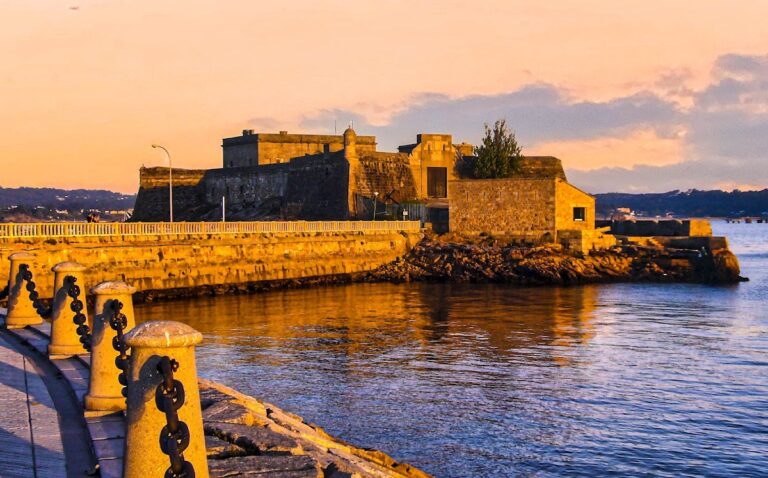
San Felipe Castle occupies a coastal position beside the Ferrol estuary, directly opposite La Palma Castle. Its plan responds to both the maritime entrance channel and the surrounding topography. Stone, brick, and earth form the principal materials, while later works used finely dressed stone masonry. The overall layout has been described as an open fan, with several enclosures arranged successively toward the large central hornwork on the landward side.
Landward Defenses
Central Hornwork
The central hornwork is oriented toward the mountain behind the fortress. As an external defensive work, it concentrated the principal landward defenses toward the rear heights and formed part of the eighteenth-century modernization. Its position reflects the need to reinforce the approach from the surrounding land while the seaward front faced the estuary.
Moat and Principal Gate
The modernization also introduced a moat and a new main gate. The portals were austere and built under the direction of the engineer La Ferrière, using finely dressed stone masonry. Together, the gate and moat formed part of the layered approach to the fortress.
Seaward Batteries and Water Defenses
Estuary-Facing Front
The seaward side has a pointed, arrow-shaped plan with two superimposed lines of fire. Its batteries facing the estuary could accommodate more than 70 artillery pieces. Across the fortress, approximately 100 gun positions or pieces of different calibres supported the defense of the maritime entrance.
Water-Level Battery
A battery was built at water level on the seaward front during the mid-nineteenth century. It strengthened the lower maritime defenses and formed part of the arrangement directed toward vessels entering the estuary.
Chain Across the Estuary
A thick chain could be stretched across the water between San Felipe and San Martín Castle. The barrier was intended to prevent hostile vessels from entering the Ferrol estuary, adding a water obstacle to the artillery defenses.
Associated Fortifications
San Felipe’s physical and defensive setting included La Palma Castle opposite it and San Martín Castle as another element of the estuary system. San Martín survives in ruins, while the coordinated positions of the three fortifications created mutually supporting fire across the maritime approach. The surrounding heights dominated San Felipe, leaving the fortress partly vulnerable to a land attack despite its strong position against vessels entering from the sea.