Cathedral of St Louis: A Roman Catholic Co-Cathedral in Plovdiv
Site at a Glance
- Rating
- 4.6
- Popularity
- Medium
- Country
- Bulgaria
- Primary era
- Modern
- Eras represented
- Modern
- Civilizations
- Ottoman
- Site type
- Religious
- Remains
- Cathedral
On this page10 sections
History
The Cathedral of St Louis is a Roman Catholic co-cathedral in Plovdiv, Bulgaria, built between 1858 and 1861 under Ottoman rule. A co-cathedral shares a diocese’s cathedral role with another church; here, that church is the Cathedral of St Joseph in Sofia. Dedicated to Saint Louis IX, a French king who reigned from 1226 to 1270 and was later canonized, it remains an active church. Its original design brought together Renaissance-era Roman church forms and Bulgarian Revival traditions, a period of cultural and national renewal in the eighteenth and nineteenth centuries. When completed, it was among the largest Roman Catholic churches in the Ottoman Empire, and it remained Bulgaria’s largest Roman Catholic church until 2006.
Early Catholic worship
Local Paulicians, members of a distinct Christian movement with communities in the medieval Balkans, are believed to have worshipped at this site for roughly four centuries before the present cathedral was built. They first gathered in a small house. A church here is dated to 1623, when Father Anton Bator, a priest from Nikopol and chaplain to Dubrovnik merchants in Plovdiv, was also assigned to visit nearby Paulician villages and convert their inhabitants.
Plovdiv’s Catholic parish dates to 1768. Missionaries sometimes held Mass in private homes, occasionally in secret. A city plan made in 1827 marks a Catholic monastery and church on the site of the present cathedral.
Building the present cathedral
In 1836, Father Ivan Ptacek, an apostolic vicar, secured a sultan’s decree and funding for a small Catholic church. An apostolic vicar administers a Catholic territory that has not been made a diocese. Local Catholics objected to the decree’s provision for Austrian protection and obtained a replacement recognizing them as the sultan’s subjects. Work began in the presence of an Ottoman official, and the church was completed in 1839. It burned down in 1856.
Rome recalled the Redemptorist missionaries from the Plovdiv region in 1840 and sent Capuchins, a Catholic order in the Franciscan tradition, in their place. Andrea Canova became apostolic vicar in 1843 and, with support from European consuls in Plovdiv, helped establish churches in Catholic parishes across the region. He initiated the present cathedral’s construction. Italian architect Alfonso designed it, and Ivan Boyanin, a master builder from Bratsigovo, carried out the work. The Lyon Charitable Society for the Support of Christianity contributed funding. Canova consecrated the cathedral on 25 March 1861.
Parish life and royal memorial
The cathedral’s first organ was installed in 1861, and a larger instrument replaced it in 1891. A separate bell tower was built in 1898, with five bells cast in Bochum, Germany, given by Pope Leo XIII.
Princess Marie Louise of Bourbon-Parma, the first wife of Ferdinand I of Bulgaria and mother of Boris III, died on 30 January 1899 after falling ill with a cold, shortly after the birth of her fourth child. She was a devout Catholic, had close ties to the Roman Catholic Church, and often visited Plovdiv on charitable missions. Pope Pius IX was her godfather. Her sarcophagus was placed in the cathedral temporarily while a royal mausoleum was planned. Political changes and Ferdinand’s death in 1948 meant that the mausoleum was never built.
In 1918, Plovdiv’s Catholic community numbered about 4,000. The parish priest, Father Nikola Selimov, served with eight assistants. Parish organizations included the Women’s Charitable Association of Our Lady, active from 1886 to 1950; the Marian Maidens girls’ association, active from 1899 to 1946; and the Bulgarian Catholic Peter Parchevich Society, active from 1921 to 1946. Peter Parchevich was a seventeenth-century Bulgarian Catholic archbishop and diplomat. A parish choir continued until 1945.
Damage, rebuilding, and later events
An earthquake badly damaged the cathedral in 1928, and a fire caused by an electrical short circuit damaged it further in 1931. Architect Kamen Petkov led its reconstruction. On 8 May 1932, Archbishop Angelo Giuseppe Roncalli, later Pope John XXIII, consecrated the rebuilt church.
During the anti-Catholic trials of 1952, the cathedral’s parish priest, Nikola Ivanov Barbov, received a 15-year prison sentence on false charges. Four bishops were consecrated in the cathedral: Simeon Kokov on 20 April 1958 and Bogdan Dobranov on 8 November 1959, both by Exarch Kiril Kurtev; Vasko Seyrekov on 26 October 1975 by Archbishop Mario Brini, assisted by Dobranov; and Georgi Yovchev on 31 July 1988 by Archbishop Francesco Colasuonno, assisted by Bishop Samuil Dzhundrin and Exarch Metodiy Stratiev.
A comprehensive renovation of the cathedral and its episcopal complex was completed in 2001. The cathedral was declared a monument of architectural and artistic culture in 1995 and holds national cultural-monument status. Pope John Paul II visited on 26 May 2002, preached, and met with young Catholics. In 2007, Bishop Georgi Yovchev consecrated a chapel inside the church to Blessed Pavel Djidjov, an Assumptionist and martyr regarded as a patron of youth in the diocese.
Remains
Building and façade
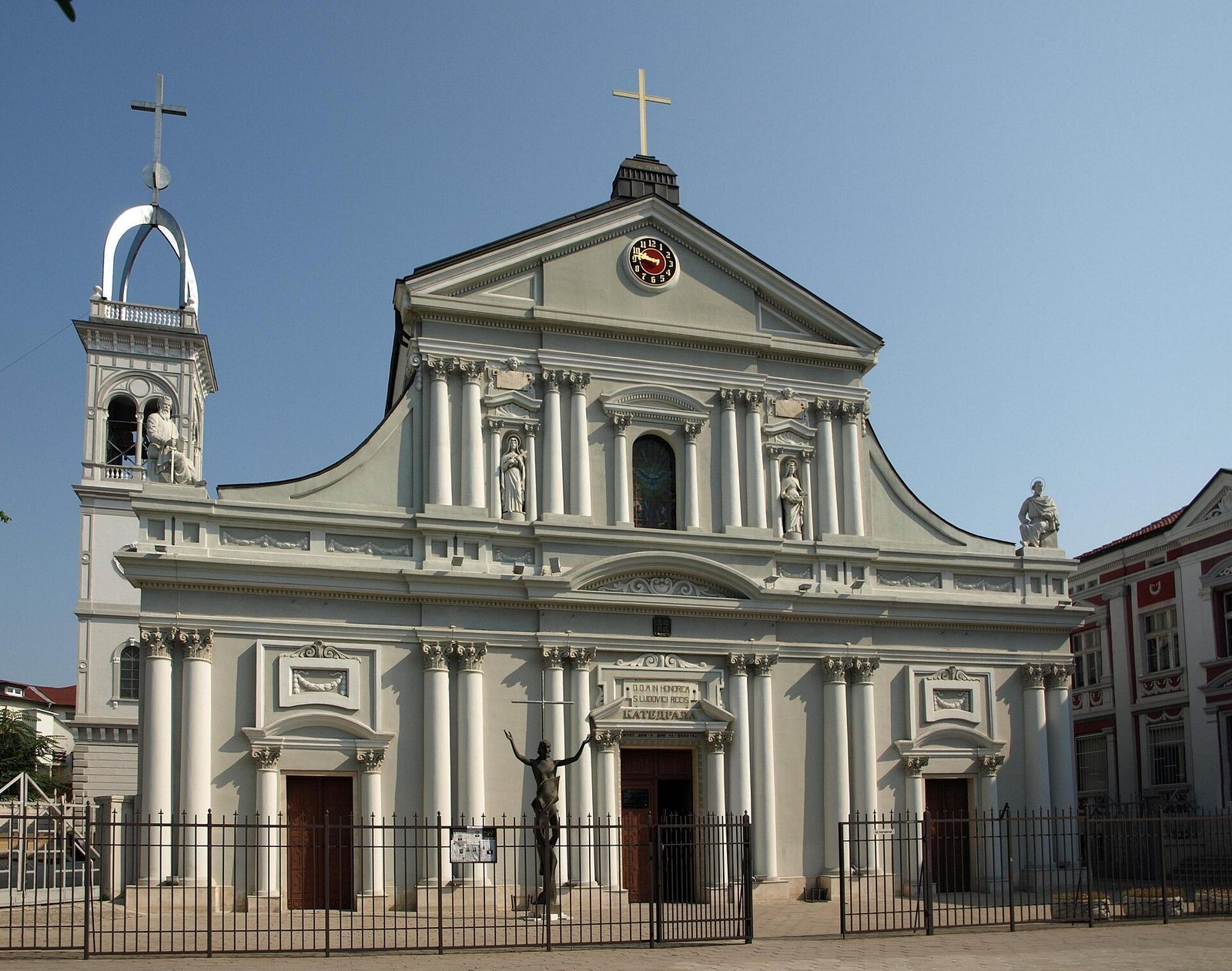
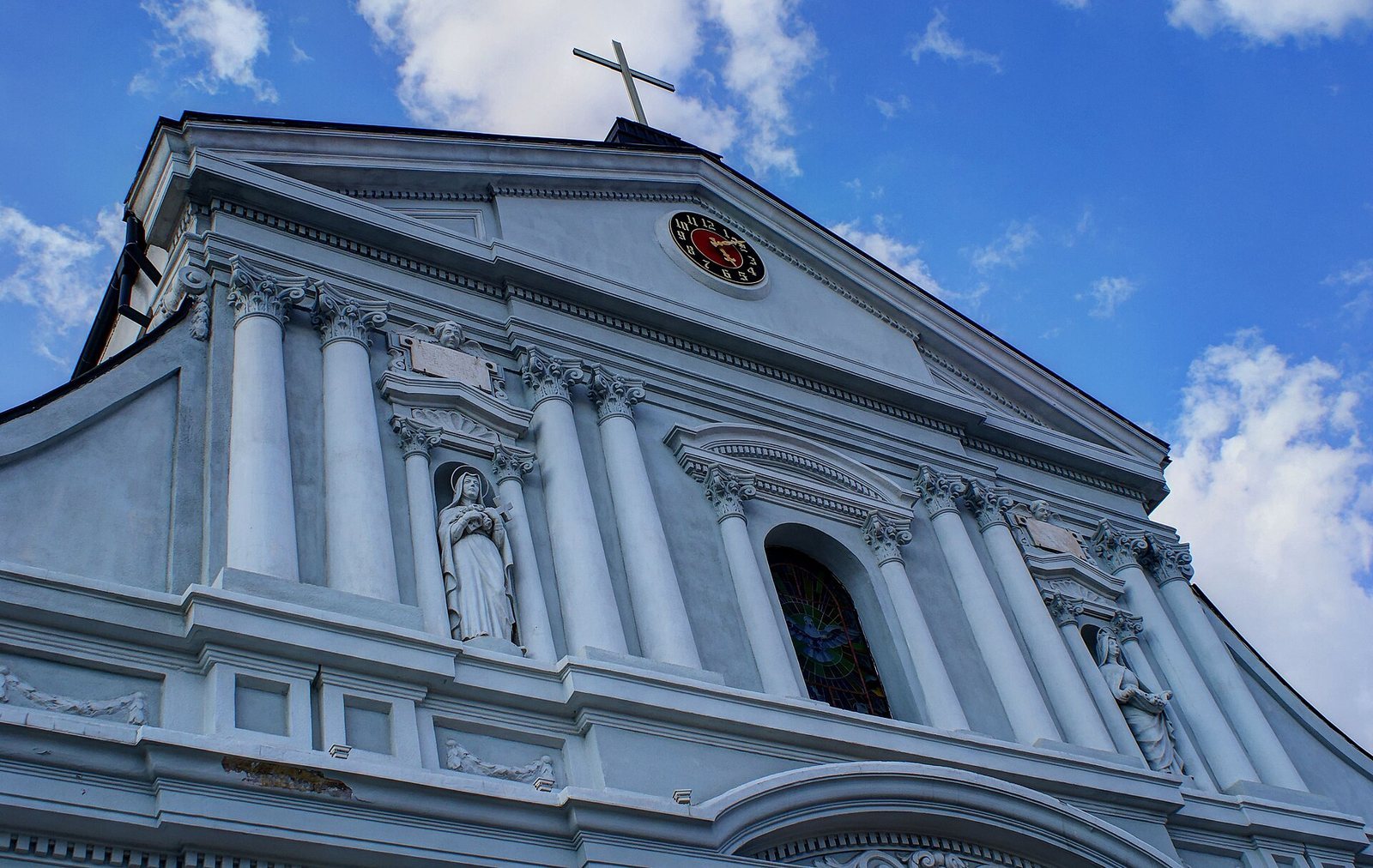
Built of brick, the cathedral is 48 metres long, 21 metres wide, and 15 metres high, with room for about 600 people. Its three-nave basilican plan has a central nave flanked by two aisles and ends in a single apse, a recessed space at the end of the church. The reconstructed building incorporates Neoclassical and Neo-Baroque elements. Its prominent façade combines classical and Baroque details, including half-columns, ornament, and numerous statues. A broad triangular pediment crowns the front; statues of Saint Teresa and Saint Elizabeth stand in its upper part, with a clock face set within it.
Interior
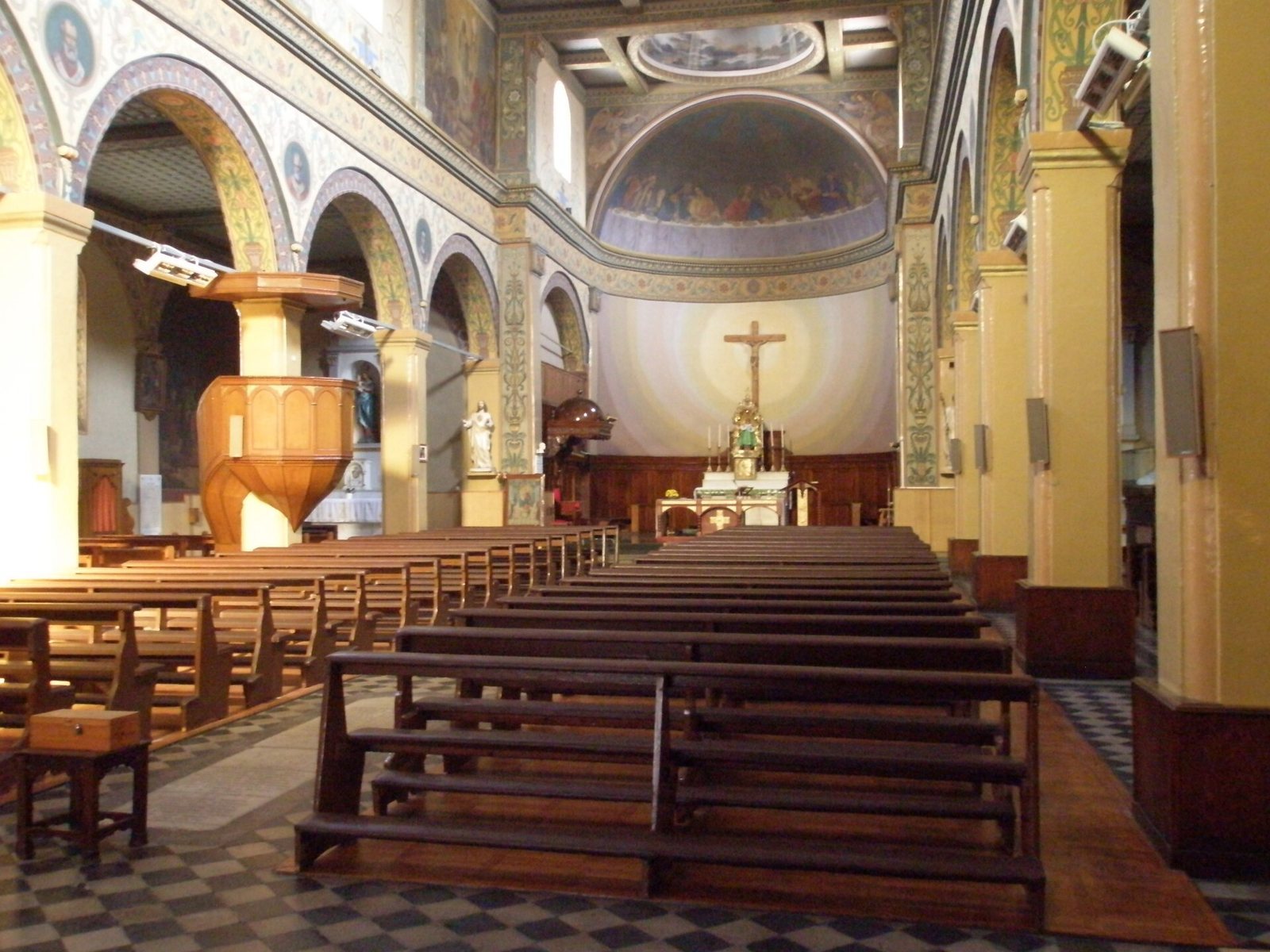
The original interior had a carved wooden ceiling, an altar decorated with ten statues, and an organ with 2,000 silver pipes made by Italian craftsmen. The 1931 fire destroyed these features. The present interior has frescoes by Krastyo Stamatov in a Neo-Byzantine style on the semicircular vault and on columns separating the central nave from the side aisles. Icons and paintings by Dosiu Mandov depict scenes from the Passion. The altar stands on a raised platform before the apse. A pipe organ made by Germany’s Walcker & Co. has 12 stops and two hand-played keyboards; it is on a balcony to the right of the narthex, the entrance vestibule. A chapel inside the church is dedicated to Blessed Pavel Djidjov.
Bell tower and sculpture
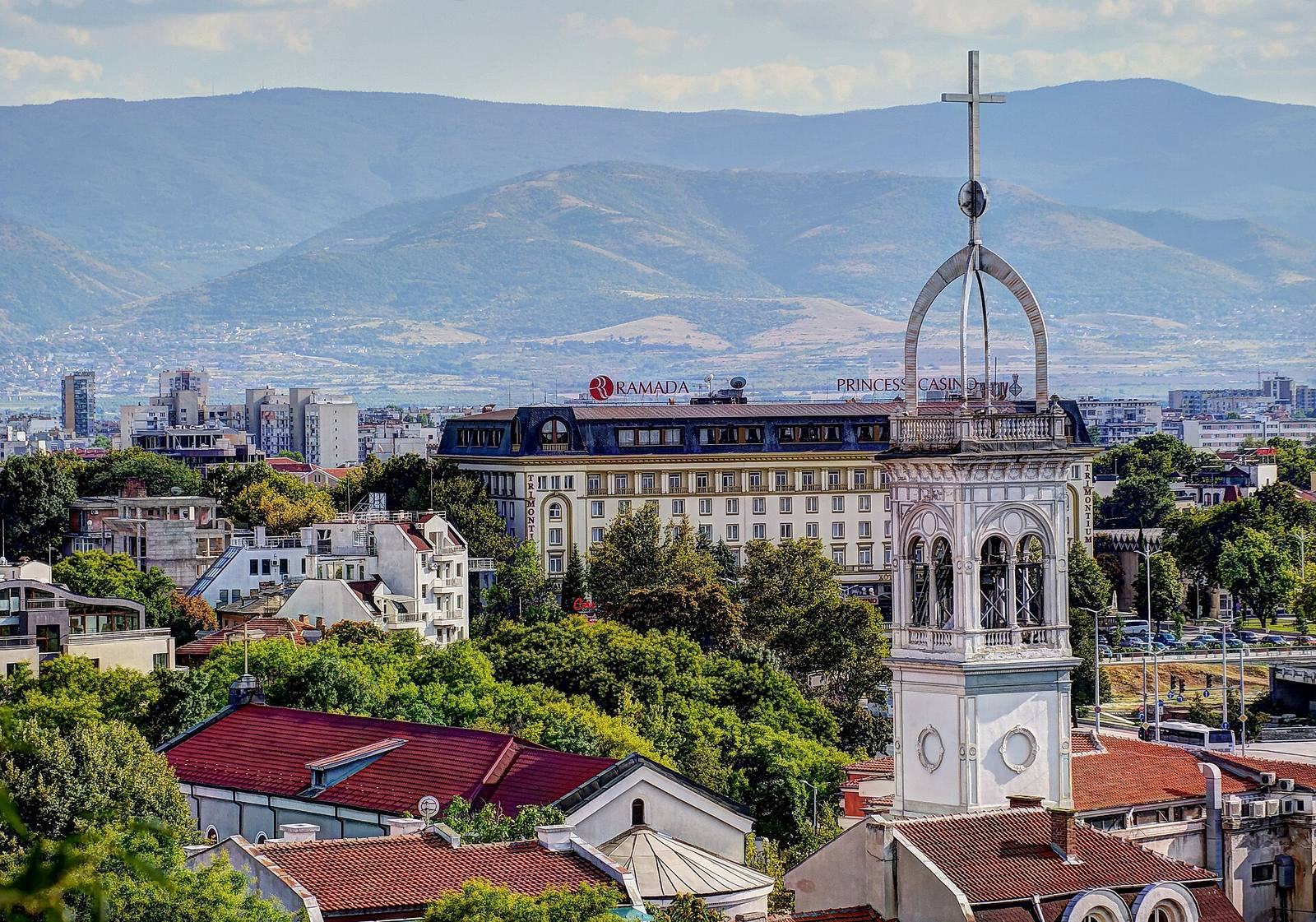
The bell tower stands apart from the cathedral and was designed by Italian architect Mariano Pernigoni in the Florentine style, associated with architectural traditions of Florence. Its five bells were cast in Bochum. A sculptural composition of a dome and cross by Kiril Naydenov stands above the tower. In front of the cathedral is Naydenov’s bronze statue of Jesus, titled Ascension, installed in 1993. It was the first sculpture of Jesus in Bulgaria.
Burials and memorials
The central nave floor covers the graves of bishops Andrea Canova and Francesco Renaudi and Archbishop Roberto Menini. Beneath the left aisle, viewed toward the main altar, are the graves of Bishop Vikenti Peev and Archbishop Giuseppe Mazzoli, marked by tombstones. Marie Louise’s marble sarcophagus stands at the far end on the right-hand side of the church, to the right of the altar. A sculpture shows the princess in royal dress and a crown. Inscriptions in Bulgarian and Latin appear on its sides, with her last words to Ferdinand carved beneath it.